
TL;DR:
This blog is aimed for Adults, parents, caregivers, and patients who have been advised to undergo PTA, tympanometry, or OAE testing and want to understand why an audiologist may recommend multiple hearing tests during the same evaluation.
- Each hearing test evaluates a different part of the hearing system: PTA measures hearing thresholds across different frequencies, tympanometry checks middle-ear and eardrum function, while OAE assesses how well the cochlea or inner ear responds to sound.
- Combining PTA and tympanometry provides a more complete diagnosis: PTA can identify whether hearing ability has reduced, while tympanometry helps determine whether middle-ear issues such as fluid, pressure imbalance, or eardrum problems may be contributing to the hearing difficulty.
- OAE may be added when more information about inner-ear function is needed: It can be particularly useful for young children or when PTA and tympanometry results require further clarification, helping audiologists distinguish between different types and possible causes of hearing loss.
- Accurate testing helps guide the right treatment or management plan: The blog explains common symptoms, when to see an audiologist, how the tests are performed together, and how results may lead to monitoring, ENT referral, hearing aids, or other personalised hearing-care recommendations.
The hearing check might require only one test, but you may be asked to have a PTA, tympanometry, and maybe an OAE as well. Anyone can ask themselves why so many tests are required and why it is that they are all needed.
This is because there isn’t a single hearing test that can give your audiologist all of the information they need. One test evaluates the sensitivity to sounds, another tests the motion and pressure of the middle ear, and another tests the response of the inner ear to sound.
Combining these findings, your audiologist can also better determine the source of your hearing difficulty and what steps to take next.
Here is a primer on PTA, tympanometry, OAE, what each test does, why your audiologist might need to order more than one type of hearing test, and what your test results can tell you about your hearing health.
What Is PTA and Tympanometry?
The most common test that people imagine when they think about a hearing check is PTA (Pure Tone Audiometry). You are seated in a quiet room or booth with headphones and listen as soft beeps are played at various frequencies and intensities. It determines the softest sound you can hear at every frequency, providing your audiologist with a precise picture of how well you hear at low, mid, and high frequencies.
In contrast to the above, tympanometry is not a direct test of hearing. It, on the other hand, tests the response of your eardrum to air pressure changes. A small, soft probe is inserted into the ear canal for a few seconds, and the results indicate whether fluid is behind the eardrum, if perforation is possible, or if there is pressure imbalance in the middle ear. Combined, PTA and tympanometry provide a more comprehensive evaluation of hearing and why hearing problems may be arising.
Know More About Hearing Tests
- PTA Test for Hearing: Procedure, Results and Normal Range
- PTA Test for the Ear: What It Measures and When It Is Needed
- Tympanometry Test: Procedure, Cost & Result Meaning
Why Might Your Audiologist Recommend More Than One Test?
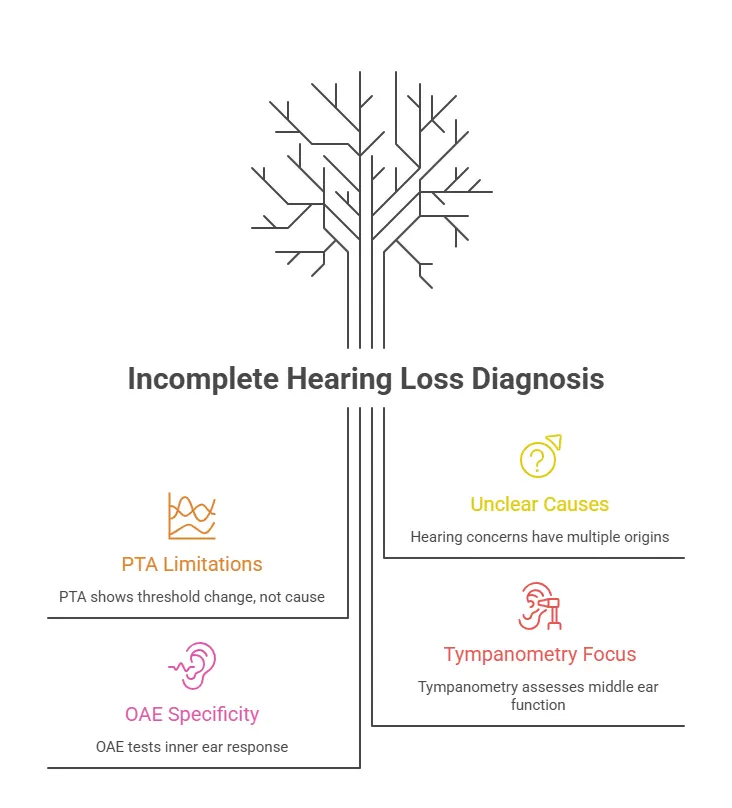
The causes of hearing concerns are not always clear, which is why PTA and tympanometry are frequently all done at the same appointment. With PTA, your audiologist will know that your hearing threshold has changed, but not necessarily why. Tympanometry is a test that helps to determine if the middle ear is working correctly. In a few instances, especially for children younger than 18 months or for patients who require an in-depth inner ear response, OAE (Otoacoustic Emissions) testing is included as well, which measures how well the cochlea is reacting to sound.
PTA and tympanometry can be used together – sometimes in combination with OAE – to help your audiologist determine if there is a middle ear problem and the type of hearing loss (conductive hearing loss versus sensorineural hearing loss caused by inner ear or auditory nerve problems). If one were to use just one of the above techniques, a diagnosis might be incomplete or incorrect.
What Causes the Hearing Issues These Tests Help Identify?
Hearing problems can happen for many different reasons, and the cause is not always obvious from symptoms alone. This is why audiologists may use PTA, tympanometry and OAE together to understand which part of the hearing system may be affected.
Some common causes include:
- Earwax blockage, which can reduce the amount of sound reaching the eardrum
- Fluid behind the eardrum, often after a cold, allergy or infection
- Middle ear infections, which can temporarily affect hearing
- A perforated eardrum, which may change the way sound is conducted through the ear
- Age-related changes in hearing, which usually develop gradually
- Long-term exposure to loud sounds, which can affect the inner ear
- Inner ear or auditory nerve problems, which may need more detailed assessment
Some hearing problems are temporary and may improve once the underlying cause is treated. Others may require ongoing monitoring or hearing support.
This is why identifying where the problem is coming from is important before deciding on treatment. PTA, tympanometry and OAE give your audiologist different pieces of information that can be put together to form a clearer picture of your hearing.
What Are the Early Signs You May Need Hearing Tests?
You do not have to wait until hearing loss becomes severe before having your hearing checked. In fact, many hearing changes begin gradually and can be easy to overlook at first.
You may want to consider a hearing test if you notice that:
- You often ask people to repeat themselves
- The television or phone volume needs to be higher than before
- Conversations are difficult to follow in restaurants, markets or family gatherings
- Speech sounds unclear or as though people are mumbling
- One ear seems to hear better than the other
- You experience a feeling of fullness or blockage in the ear
- You notice ringing, buzzing or other sounds in the ear
- Family members have started pointing out changes in your hearing
Children may show hearing difficulties differently. They may not always respond when their name is called, seem distracted during conversations, turn the volume up unusually high or have difficulties with speech and language development.
These signs do not necessarily mean that there is permanent hearing loss, but they are good reasons to have your hearing assessed. You can also read more about common ear symptoms and conditions.
When Should You See an Audiologist?
If you feel that your hearing has changed, or someone close to you has noticed that you are struggling to hear, it is worth arranging an assessment rather than waiting for the problem to become more noticeable.
For routine concerns, your audiologist may begin with tests such as PTA and tympanometry. Depending on the results, an OAE or another hearing test may be added to understand your hearing more clearly.
You should seek professional assessment promptly if you experience:
- Sudden hearing loss, particularly in one ear
- Severe or persistent ear pain
- Fluid, pus or blood coming from the ear
- Significant dizziness or vertigo
- Persistent or sudden tinnitus
- A sudden change in hearing along with other new symptoms
For less urgent concerns, a hearing evaluation can help establish a baseline and identify whether any treatment or monitoring is needed.
If you would prefer to discuss your symptoms before visiting a clinic, a video consultation can help you understand which hearing tests may be appropriate as a next step.
How Is Hearing Loss Diagnosed Using PTA and Tympanometry?
When you come in for a hearing assessment, your audiologist may use more than one test because each test answers a different question about how your ears are working.
A typical assessment may include:
- Tympanometry: This is usually a quick test that checks how well your eardrum and middle ear are functioning. It can help identify problems such as fluid, pressure changes or reduced eardrum movement.
- PTA or Pure Tone Audiometry: This measures the softest sounds you can hear at different pitches in each ear. It helps your audiologist understand the degree and pattern of any hearing loss.
- OAE testing, if needed: An OAE may be added when more information about inner ear function is required, particularly in children or when earlier test results need further clarification.
When the results of PTA and tympanometry are looked at together, your audiologist can understand more than simply whether hearing loss is present. The tests can also provide clues about what type of hearing loss it may be and which part of the hearing system may be affected.
Using multiple tests in this way helps build a more complete picture of your hearing before any treatment or management plan is suggested. This approach forms part of Resonnocare’s clinical excellence standards for hearing assessment.
What Treatment or Management Options Are Available After Hearing Tests?
There is no single treatment that follows every hearing test. The next step depends on what the tests show and what is causing the hearing difficulty.
Your audiologist may recommend:
- Monitoring: If the hearing change appears temporary or mild, you may simply need another hearing check after some time.
- ENT evaluation or medical treatment: If tympanometry suggests fluid, an infection, pressure problems or another middle-ear concern, you may be referred to an ENT specialist.
- Repeat testing: Sometimes a test needs to be repeated once a temporary ear problem has settled.
- Hearing aids: If permanent hearing loss is identified and hearing aids are likely to help, your audiologist can recommend devices based on your individual hearing profile.
- Ongoing hearing care: Regular checks may be advised to monitor whether your hearing changes over time.
If hearing aids are recommended, a free hearing aid trial can help you understand how amplification feels in everyday listening situations before making a longer-term decision. Ongoing aftercare can then help with fitting, adjustments and follow-up as your hearing needs change.
The goal of testing is not simply to give you a hearing test result. It is to understand why you are having difficulty hearing and what the most appropriate next step is for you.

Why Choose Resonnocare for Hearing and Audiology Care?
Resonnocare’s Hearing Evaluation is based on clinically driven, evidence-based testing and not on guesswork. Our qualified audiologists and clinicians employ PTA and tympanometry, and when applicable, OAE testing, to make sure that each diagnosis is as accurate as possible and that each care plan is truly personalised to the results. From hearing testing to hearing aids, home visits, video consultations and long-term support, our team can support you every step of the way. Discover all of the services we provide for children and adults on our hearing care for all ages page.
Find a Resonnocare Clinic Near You
Select your city to find the nearest Resonnocare clinic and book an appointment with our hearing care team.
Bangalore
Ear 360, Jayanagar
Ground Floor, Site No. 499, Municipal No. 499/97, East End Main Road, 9th Block, Jayanagar, Bangalore, Karnataka 560041
Timings: 10:00 AM to 7:00 PM
[Call] [Book an Appointment]
Ear 360, Spandana Sarjapura Hospital
239/205/34A, near Trinity Complex, Sompura Gate, Sarjapura Main Road, Bangalore, Karnataka 562125
Timings: 10:00 AM to 7:00 PM
[Call] [Book an Appointment]
Resonnocare, HSR Layout
150/5/72, 7th Cross, 24th Main, HSR Layout, Bangalore, Karnataka 560102
Timings: 10:00 AM to 7:00 PM
[Call] [Book an Appointment]
Resonnocare, Banashankari
272, 7th Cross Road, BSK 1st Stage, 2nd Block, Srinivasan Agra, 80 Feet Road, Bangalore, Karnataka 560050
Timings: 10:00 AM to 7:00 PM
[Call] [Book an Appointment]
Resonnocare, Indiranagar
34, Wind Tunnel Road, Murugeshpalya, Muniyappa Layout, Bangalore, Karnataka 560017
Timings: 10:00 AM to 7:00 PM
[Call] [Book an Appointment]
Resonnocare, JC’s ENT Center Nagarbhavi
57, 3rd Main Road, 2nd Block, Govindaraja Nagar Ward, Kalyan Nagar, Nagarbhavi, Bengaluru, Karnataka 560072
Timings: 10:00 AM to 7:00 PM
[Call] [Book an Appointment]
Resonnocare, Dr Bhattacharyya ENT Clinic
No. 14, 17th Cross Road, Sector 7, HSR Layout, Bangalore, Karnataka 560102
Timings: 10:00 AM to 7:00 PM
[Call] [Book an Appointment]
Delhi
Ear 360, Dr Hans Anand Lok
46, Anand Lok Road, Anand Lok, Sadiq Nagar, New Delhi, Delhi 110049
Timings: 10:00 AM to 7:00 PM
[Call] [Book an Appointment]
Resonnocare, Dr Hans Vasant Vihar
28, Basement, Paschimi Marg, Vasant Vihar, New Delhi, Delhi 110057
Timings: 10:00 AM to 7:00 PM
[Call] [Book an Appointment]
Resonnocare, Clarity ENT Clinic
Clarity, 2-10, Hauz Khas, New Delhi, Delhi 110016
Timings: 10:00 AM to 7:00 PM
[Call] [Book an Appointment]
Resonnocare, Dr Hans Center for ENT Punjabi Bagh
2/5, West Avenue Road, West Punjabi Bagh, Punjabi Bagh, New Delhi, Delhi 110026
Timings: 10:00 AM to 7:00 PM
[Call] [Book an Appointment]
Gurgaon
Resonnocare Head Office, M3M Urbana
Office 403, Office Block, 4th Floor, above Retail Blocks R1 and R5, M3M Urbana, Sector 67, Gurgaon, Haryana 122101
Timings: 10:00 AM to 7:00 PM
[Call] [Book an Appointment]
Resonnocare, Dr Hans Sector 28 DLF Ph-1
Metro Station, Plot No. 1SP, adjoining DLF Phase 1, Sector 28, Gurgaon, Haryana 122002
Timings: 10:00 AM to 7:00 PM
[Call] [Book an Appointment]
Ludhiana
Ear 360, BRS Nagar
963, Block B, BRS Nagar, Ludhiana, Punjab 141012
Timings: 10:00 AM to 7:00 PM
[Call] [Book an Appointment]
Resonnocare, Fawwara Chowk
565-A and 565-B, Upper Ground Floor, Cemetery Road, near Fawwara Chowk, West City, Ludhiana, Punjab 141001
Timings: 10:00 AM to 7:00 PM
[Call] [Book an Appointment]
Pune
Ear 360, Vighnaharta Healthcare Center
D-106-107, Choice Arcade, opposite Ruby Hall Hospital, Dhole Patil Road, Pune, Maharashtra 411001
Timings: 10:00 AM to 7:00 PM
[Call] [Book an Appointment]
Ear 360, Khan Parab ENT Hospital
Plot No. 102, Anand Nagar, Talegaon Dabhade, Taluka Maval, Pune, Maharashtra 410507
Timings: 10:00 AM to 7:00 PM
[Call] [Book an Appointment]
Tumkur
Resonnocare, Ashok Nagar
PID No. 3563, 8th Main, 8th Cross, Ashok Nagar, Tumkur, Karnataka 572103
Timings: 10:00 AM to 7:00 PM
[Call] [Book an Appointment]
Resonnocare, Ganadhal ENT and Dental Hospital
3rd Cross, Somashekara Puram, Coffee Board Colony, Tumkur, Karnataka 572102
Timings: 10:00 AM to 7:00 PM
[Call] [Book an Appointment]
Mangalore
Ear 360, Bunts Hostel Circle
Shop No. 6 and 7, Basement Floor, Javed Plaza, Bunts Hostel Circle, Mangalore, Karnataka 575003
Timings: 10:00 AM to 7:00 PM
[Call] [Book an Appointment]
Resonnocare, Dr G K Hebbar ENT Clinic
M-2-153/6, K.S.R.M. Building, Lighthouse Hill Road, Mangaluru, Karnataka 575001
Timings: 10:00 AM to 7:00 PM
[Call] [Book an Appointment]
Resonnocare, Dr Navisha ENT Centre
3rd Floor, Falnir Health Center, Falnir Road, Falnir, Mangaluru, Karnataka 575002
Timings: 10:00 AM to 7:00 PM
[Call] [Book an Appointment]
Mysore
Ear 360, Ramaswamy Circle
371/A, Ramaswamy Circle, Mysore, Karnataka 570024
Timings: 10:00 AM to 7:00 PM
[Call] [Book an Appointment]
Hubli
Ear 360, Vidya Nagar
Srishti Elite, Shirur Park Road, Shirur Park, Vidya Nagar, Hubballi, Karnataka 580031
Timings: 10:00 AM to 7:00 PM
[Call] [Book an Appointment]
Davangere
Ear 360, P J Extension
Shop First Floor, 2nd Main, P J Extension, Davangere, Karnataka 577002
Timings: 10:00 AM to 7:00 PM
[Call] [Book an Appointment]
Indore
Resonnocare, Dr Navnit Jain ENT Hospital
Dr Navnit Jain ENT Hospital, C/o Unique Hospital, 335, Jawahar Marg, Opp. Nafees Bakery, Indore, Madhya Pradesh 452007
Timings: 10:00 AM to 7:00 PM
[Call] [Book an Appointment]
Resonnocare, Hearing Solutions Dr Agarwal
7, Gulmarg Complex, First Floor, near Sapna Sangeeta Lumiere, Indore, Madhya Pradesh 452001
Timings: 10:00 AM to 7:00 PM
[Call] [Book an Appointment]
Conclusion
Knowing the rationale for having your PTA and tympanometry results evaluated together will remove some of the guesswork when it comes to your hearing test. A combination of these tests (and sometimes along with OAE) provides a comprehensive, accurate assessment of your hearing health, not just a limited assessment. If you have noticed any changes in your hearing or just want a baseline hearing test, contact Resonnocare for a thorough hearing assessment and conversation with a qualified audiologist on what it means to you.
FAQ’s
What is a normal tympanometry result?
The norm is typically designated as a Type A tympanogram, which means the eardrum is able to move normally and the middle ear pressure is within a normal range. This indicates normal middle ear function, which is not impaired by excessive fluid, obstruction, or eardrum stiffness.
What is the PTA test of the ear?
Pure Tone Audiometry (PTA) is a hearing test designed to assess hearing ability at various frequencies and intensities. The test is conducted with headphones on, and you answer questions when you hear a tone. One of the most common hearing assessments, PTA is used to determine the extent and nature of hearing loss.
Is a PTA test painful?
No, there is no pain or any harm at all in having a PTA test. It just requires listening to a bunch of sounds from a headset and signaling when you hear the sounds. There is no discomfort, and the test is safe for adults and children.
How long does a PTA test take?
A PTA test usually takes 15 to 30 minutes, depending on the individual’s hearing condition and the number of tests being performed. The process is simple and easy, and it can be done during a normal hearing evaluation session.
What is the normal PTA for hearing?
Typically, if a child’s hearing threshold is 0 dB to 25 dB (dB HL) at some of the speech frequencies, they are considered to have normal hearing on a PTA test. Scores in this range mean that someone has no major difficulty hearing most everyday sounds. Increased thresholds could indicate mild, moderate, severe, or profound hearing loss.