

TL: DR;
- A tympanometry test is a quick, painless test used to check eardrum movement and middle ear function.
- It is often recommended for children with recurring ear infections, suspected glue ear, or hearing concerns.
- Adults may need it if they experience ear pressure, blocked-ear sensation, hearing changes, or discomfort.
- The test uses gentle air pressure changes inside the ear canal and usually takes only a few minutes.
- Results such as Type A, Type B, and Type C help indicate normal middle ear function, fluid buildup, or pressure-related issues.
- Tympanometry can help detect middle ear fluid, Eustachian tube dysfunction, ear infections, a perforated eardrum, and other middle ear problems.
- Resonnocare provides accurate hearing assessments, expert audiology care, personalized treatment plans, home visits, video consultations, and ongoing aftercare.
Ear pressure, blocked-ear sensations, or hearing concerns can be worrying, especially when they affect a child. When a doctor recommends a tympanometry test, it is natural to wonder what the test involves, whether it will hurt, and what the results might mean.
A tympanometry test is a quick, painless way to understand how well the eardrum and middle ear are working. It does not directly measure hearing, but it can help identify issues such as middle ear fluid, pressure imbalance, ear infections, or Eustachian tube dysfunction.
At Resonnocare, we make hearing care simple, clear, and patient-focused. This guide explains what a tympanometry test measures, how it is performed, what different results mean, and when you or your child may need one.
What Is a Tympanometry Test?
Tympanometry is a diagnostic test that measures the functioning of the eardrum (tympanic membrane) and the middle ear system. It is not a test of how well a person can hear sounds; it specifically focuses on the eardrum’s movement in response to changes in air pressure.
Behind the eardrum is a small space where sound vibrations are transferred to the inner ear by means of three small bones. If this system functions properly, the eardrum moves freely and efficiently. If there is a problem like fluid in the middle ear, an obstructed Eustachian tube, or a perforated eardrum, the movement of the eardrum is different from normal, and the tympanometry test will detect it.
This is an extremely useful tool for diagnosing middle ear conditions that may not be seen during a routine ear examination.
Why Is a Tympanometry Test Ordered?
A tympanometry test is usually ordered when the clinician needs more information about the eardrum or middle ear rather than simply how softly you can hear.
It may help when there is:
- A blocked-ear or plugged-ear sensation
- Ear pressure or repeated popping
- Suspected middle-ear fluid
- Repeated ear infections
- A hearing-screening result that may be affected by middle-ear dysfunction
- Possible Eustachian tube dysfunction
- A history of eardrum perforation
- Previous middle-ear surgery
- Concern about reduced eardrum or middle-ear mobility
- A need to interpret another hearing test in the context of middle-ear function
For example, if a child does not pass a hearing screening, tympanometry can help determine whether middle-ear fluid or pressure may be contributing to the result before permanent hearing loss is assumed.
Does Tympanometry Test Your Hearing?
No. Tympanometry measures middle-ear function; it does not directly measure the quietest sounds you can hear or how clearly you understand speech.
Different tests answer different questions:
Test | Main question answered |
Tympanometry | Is the eardrum and middle-ear system moving and responding to pressure as expected? |
Pure-tone audiometry | What are the softest tones you can hear at different frequencies? |
Speech audiometry | How well can you detect and understand speech? |
OAE | Can measurable cochlear outer-hair-cell responses be recorded? |
This is why a normal tympanogram does not automatically mean hearing is normal, and an abnormal tympanogram does not by itself establish the degree of hearing loss.
How Is a Tympanometry Test Done? The Procedure Explained
A tympanometry test is simple, quick, and painless. Many patients worry that it may hurt, but the test only involves placing a soft probe into the ear canal and gently changing the air pressure inside the ear.
Here’s what happens during the test:
- A soft probe is placed in the ear: A small, soft tip is gently positioned at the entrance of the ear canal to create a light seal. It does not go deep into the ear.
- Gentle air pressure is used: The device slightly changes the air pressure in the ear canal. You may feel mild pressure, similar to the feeling you get in a lift or during a flight, but it should not be painful.
- The eardrum’s movement is measured: As the pressure changes, the machine checks how well your eardrum moves and how your middle ear responds.
- Results appear as a tympanogram: a graph created by the test. Your audiologist uses this graph to determine whether your middle ear is functioning normally or if there is fluid, a pressure imbalance, or another issue.
The test is done one ear at a time and usually takes only a few minutes. It is safe for adults, children, and no special preparation is usually needed.
Is Tympanometry Painful?
Tympanometry is generally not painful. You may briefly notice pressure in the ear while the machine changes the air pressure, similar to the sensation experienced during altitude changes.
Tell the clinician before testing if there is:
- Severe ear pain
- Active ear discharge
- Recent ear surgery
- Bleeding from the ear
- A known or suspected injury
- A very sensitive ear canal
The clinician can then decide whether tympanometry should proceed immediately or whether ear examination or medical review should come first.
What Do Tympanometry Test Results Mean?
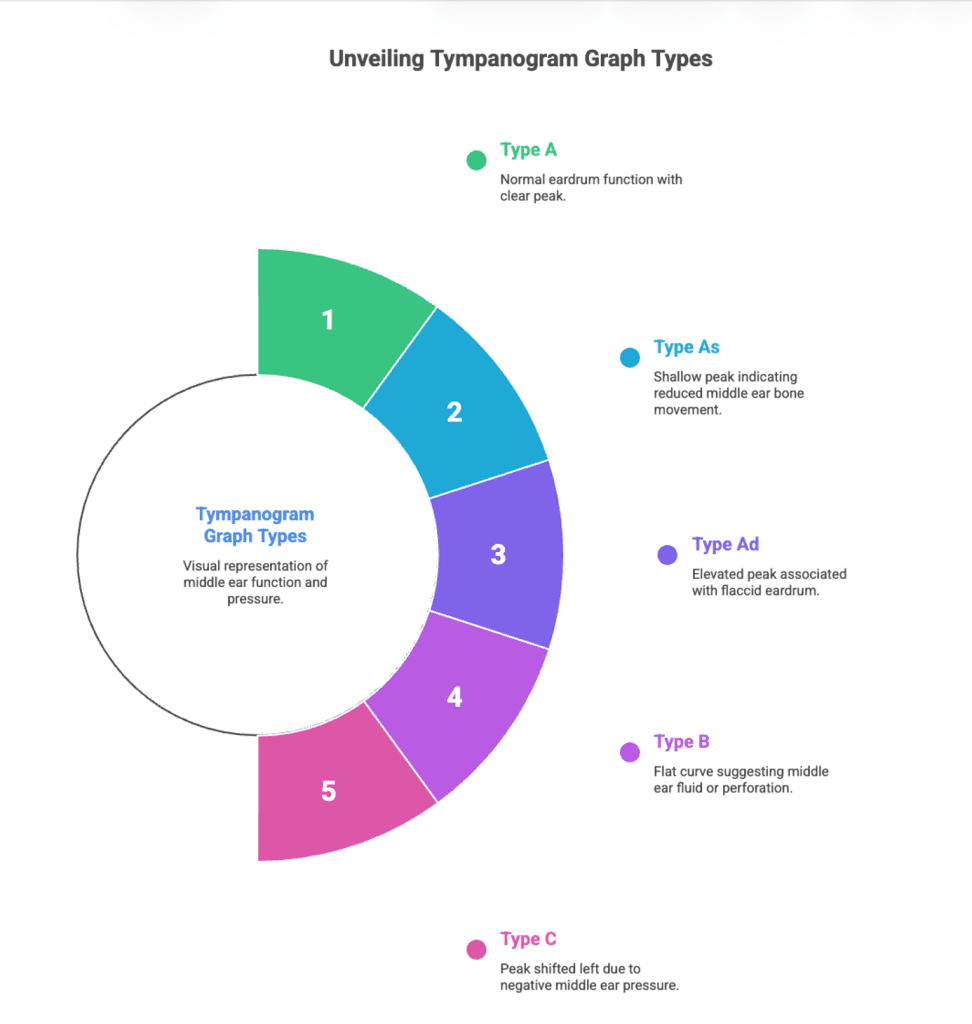
A tympanogram graph from a tympanometry test can be categorized into the following types, most commonly known as Type A, Type B, and Type C.
- A: Normal: This is a well-defined graph with a clear peak, which means that the eardrum is functioning normally and the middle ear pressure is at a normal level. That’s what you want to end up with.
- Type As: Stiff eardrum: The peak is there but shallower than normal. This can indicate reduced movement of the middle ear bones, as seen in conditions such as otosclerosis.
- Type Ad: Abnormally moving eardrum: The peak is unusually elevated and may be associated with a flaccid or floppy eardrum that sometimes occurs after some middle ear infections or after a perforation has healed.
- Type B: Flat curve: No peaks are evident. This is the most common finding and is often associated with middle ear fluid (also known as glue ear/pwe), a perforated eardrum, or the presence of grommets. A Type B result is one of the most frequent indications to look into further investigation of a child.
- Type C: Negative pressure: The peak is shifted towards the left, reflecting a negative pressure in the middle ear. This is frequently an indication of Eustachian tube dysfunction, a condition in which the tube connecting the middle ear to the back of the throat fails to open and close properly. This can be due to congestion, allergies, or an upper respiratory infection.
It should be noted that tympanometry test results should be compared to a complete clinical evaluation. Each hearing test is an independent test and does not give a full picture of your hearing health.
If you are already experiencing ear symptoms and want to understand what they might indicate, our ear symptoms and conditions page is a helpful place to start.
Type A, As, Ad, B and C Tympanometry Results Compared
Result type | Basic pattern | What it may suggest | Possible next discussion |
Type A | Clear peak around an expected pressure region | Middle-ear movement and pressure appear broadly within the expected pattern | Interpret alongside hearing symptoms and other hearing tests |
Type As | Shallow peak | A stiffer-than-expected middle-ear system | Review ear findings, hearing result and possible causes of reduced mobility |
Type Ad | Very high/deep peak | Greater-than-expected movement of the eardrum/middle-ear system | Interpret with history of perforation, infection, trauma or other findings |
Type B | Flat pattern with no clear peak | Can occur with middle-ear fluid, perforation, grommets or other test conditions | Ear-canal volume and ear examination become particularly important |
Type C | Peak shifted toward negative pressure | Negative middle-ear pressure, often associated with Eustachian tube dysfunction | Review congestion, infection, allergies, symptoms and whether follow-up is required |
The tympanogram category is a pattern not a diagnosis by itself. The result should be interpreted together with ear-canal volume, otoscopy, symptoms, hearing-test results and medical history.
What Does a Flat Type B Tympanogram Mean?
A flat Type B tympanogram means the test did not record a clear pressure peak. Middle-ear fluid is one possible explanation, but Type B does not automatically mean “glue ear.”
A flat result may also occur when:
- There is an eardrum perforation
- A ventilation tube or grommet is present
- The probe does not have an appropriate seal
- The probe is obstructed
- Another ear-canal or middle-ear condition affects the measurement
This is why clinicians look at the ear-canal volume and examine the ear rather than interpreting the flat curve alone.
Why Ear-Canal Volume Matters in a Type B Result
Ear-canal volume is an additional measurement that can help interpret a flat Type B tympanogram. The same flat graph can have different meanings depending on the measured volume and what is seen during ear examination.
For example, the clinician may consider whether the pattern is more consistent with:
- Middle-ear fluid
- A perforated eardrum
- A patent grommet or ventilation tube
- Probe blockage or measurement difficulty
The exact interpretation depends on age, equipment settings, examination findings and the rest of the hearing assessment. Patients should therefore avoid diagnosing fluid or perforation from “Type B” alone.
Can Earwax Affect a Tympanometry Result?
Yes. Significant earwax can interfere with probe placement, block the ear canal or affect the reliability of the measurement.
Before tympanometry, the clinician may therefore examine the ear canal to check for:
- Earwax
- Discharge
- Foreign material
- Canal swelling
- An obvious eardrum problem
If the ear canal is obstructed, the clinician may recommend addressing that problem before relying on the tympanometry result.
Can a Cold or Congestion Affect Tympanometry?
Yes. A cold, upper-respiratory infection, nasal congestion or related Eustachian tube dysfunction can affect middle-ear pressure and may contribute to a Type C pattern or other temporary middle-ear changes.
If the test is performed while you or your child is congested, tell the audiologist about:
- Recent cold or flu symptoms
- Nasal congestion
- Allergies
- Recent ear infection
- Ear pressure or popping
- Recent air travel
- Changes in hearing
The result can then be interpreted in the context of the current symptoms rather than as an isolated graph.
Tympanometry, Ear Fluid and Eardrum Problems: How Are They Connected?
Possible condition | What tympanometry may contribute |
Middle-ear fluid / glue ear | A flat or otherwise abnormal pattern may support suspicion of restricted eardrum movement when interpreted with ear examination |
Eustachian tube dysfunction | Negative middle-ear pressure may produce a Type C pattern |
Perforated eardrum | A flat result combined with ear-canal-volume information and examination may support further interpretation |
Grommet / ventilation tube | A Type B pattern may occur when the tube is open |
Stiff middle-ear system | A shallow Type As pattern may be recorded |
Hypermobile eardrum | A Type Ad pattern may be seen |
Tympanometry helps characterize middle-ear mechanics. It does not by itself establish every underlying diagnosis, so otoscopy and other hearing or medical assessments may still be necessary.
What Is the Cost of a Tympanometry Test in India?
The price of Tympanometry in India may vary from one city to another, depending on the type of clinic and whether it’s included as part of a full hearing assessment. For a standalone test, the range is generally between ₹500 and ₹1800. If it is used as part of a complete hearing assessment (including pure-tone audiometry or other assessments), costs may differ.
We make sure your hearing test is not buried in a bundle of other tests, and that it is thorough at Resonnocare. We don’t believe that cost should be a reason not to understand your hearing health. It is best to call us to get the most accurate and up-to-date pricing for your location and needs.
What Can Change the Cost of a Tympanometry Test?
The final amount may depend on whether tympanometry is performed alone or as part of a wider hearing assessment. Before booking, ask what the quoted amount includes.
Cost factors can include:
- City and clinic location
- Standalone tympanometry vs combined hearing evaluation
- Whether pure-tone audiometry is also required
- Whether speech testing is included
- Whether an audiologist consultation and result explanation are included
- Whether both ears are being assessed
- Whether additional testing such as OAE is recommended
- Whether a written report is included
- Whether follow-up review is charged separately
Compare the complete recommended assessment rather than only the starting price of one test.
Who Should Have a Tympanometry Test?
A tympanometry test may be recommended if there are signs that the eardrum or middle ear is not working as it should. It is commonly used for both children and adults, especially when ear pressure, fluid, infections, or hearing changes are suspected.
You or your child may need a tympanometry test if:
- There are frequent ear infections: This is especially common in children, where fluid can build up behind the eardrum.
- If a child does not pass a school hearing screening, tympanometry can help determine whether middle ear fluid or pressure is affecting the screening result.
- Hearing has become unclear or reduced: A new or worsening change in hearing may need further assessment.
- Hearing difficulty lasting more than one or two weeks: Ongoing hearing blockage should be evaluated to rule out middle ear problems.
- There is a feeling of fullness, popping, or pressure in the ear: These symptoms may be linked to Eustachian tube dysfunction or pressure imbalance.
- A GP or ENT specialist suspects an Eustachian tube problem: Tympanometry helps assess how the middle ear responds to pressure changes.
- There is a history of ear surgery or eardrum perforation: The test can help monitor middle ear function over time.
- Tinnitus is present with suspected middle ear involvement: If ringing or buzzing in the ear occurs along with pressure, blocked hearing, or infection symptoms, tympanometry may be useful.
Children are especially vulnerable to middle ear issues, and tympanometry is one of the more reliable tests for assessing middle ear health, even if a child is too young to clearly describe the symptoms of their middle ear problem. A hearing screening that includes a tympanometry test should be arranged for your child if they are not concentrating on the task, often turn up the TV volume, or are having difficulty with schoolwork.
For families looking for comprehensive, age-appropriate hearing evaluations, our hearing care for all ages service is designed to meet the needs of patients from newborns to older adults.
How to Prepare a Child for Tympanometry
Tympanometry is brief and does not require the child to identify or respond to tones, but a good probe seal and a few moments of relative stillness help obtain a reliable measurement.
Parents can prepare by:
- Explaining that a small soft tip will touch the ear
- Reassuring the child that the test should not hurt
- Telling the audiologist about recent colds, allergies or ear infections
- Bringing previous hearing or ENT reports
- Mentioning any history of grommets or ear surgery
- Reporting current ear pain, discharge or pressure
- Keeping the child calm during the brief measurement
If a child is upset or moving significantly, the measurement may need to be repeated rather than forcing an unreliable result.
What Happens After an Abnormal Tympanometry Result?
The next step depends on the tympanogram pattern, ear examination, symptoms, hearing difficulty and age of the patient. An abnormal graph does not automatically lead to the same treatment for everyone.
Finding or situation | Possible next step to discuss |
Type B with suspected middle-ear fluid | Ear examination, monitoring, ENT review and/or hearing testing depending on symptoms and duration |
Type C with congestion or pressure symptoms | Clinical review of Eustachian tube function and whether reassessment is needed |
Type As or Ad | Interpret together with hearing thresholds, ear examination and medical history |
Abnormal tympanometry plus hearing difficulty | Pure-tone audiometry and/or other age-appropriate hearing assessment may be required |
Child with repeated infections or persistent fluid | Audiology and ENT follow-up may be appropriate, particularly if hearing, speech or school performance is affected |
Pain, discharge or bleeding | Medical/ENT assessment may take priority |
Sudden hearing loss | Urgent medical assessment is required; tympanometry alone is not enough |
The result should move you toward the correct next assessment rather than being treated as a final diagnosis.
When Are Pure-Tone Audiometry, OAE or Other Hearing Tests Needed After Tympanometry?
Tympanometry and hearing tests answer different questions and are often used together.
Pure-tone audiometry may be useful when:
- Hearing difficulty is reported
- The patient did not pass a hearing screening
- The clinician needs to determine the degree and type of hearing loss
- An abnormal middle-ear result needs to be related to actual hearing thresholds
OAE may be useful in selected children or other patients when objective information about cochlear function is needed.
Additional testing or ENT assessment may be considered when:
- Results from different tests do not agree
- Middle-ear problems are persistent
- There is significant asymmetry between ears
- There is recurrent discharge or pain
- A child’s speech or language development is affected
- Sudden or rapidly worsening hearing is present
Tympanometry Result Next-Step Selector
Your situation | What to do next |
Type A result but you still struggle to hear | Discuss pure-tone and speech testing because tympanometry does not directly measure hearing ability. |
Type B result in a child | Ask what the ear-canal volume and ear examination show and whether fluid, perforation or grommets could explain the result. |
Type C result during a cold | Tell the clinician about congestion and ask whether monitoring or repeat testing is appropriate. |
Blocked ear with significant wax | Have the canal assessed before assuming the tympanogram reflects a middle-ear condition. |
Repeated ear infections plus school/hearing concerns | Discuss a broader hearing assessment and whether ENT review is appropriate. |
Persistent ear pressure or reduced hearing | Review tympanometry together with audiometry and clinical examination. |
Sudden hearing loss | Seek urgent medical/ENT evaluation rather than relying on tympanometry alone. |
Abnormal result after previous ear surgery | Have it interpreted in the context of the surgery and current ear findings. |
The key question after tympanometry should be: “What does this pattern mean when combined with my symptoms, ear examination and hearing result?”
When Should You See an Audiologist Without Delay?
A lot of middle ear conditions can be controlled if they are caught early, but if you have the following symptoms, it is important to get evaluated by a professional as soon as possible:
- Rapid hearing loss in one or both ears. This is a medical emergency.
- Severe ear pain that worsens with fever or pus draining from the ear.
- When blood or fluid oozes from the ear.
- An unusually persistent sense of “fullness” or “clogged ear” that doesn’t get better in a few days
- Hearing changes, dizziness, or balance problems
- Hearing loss in a child that is affecting speech development or school performance
Do not wait for these symptoms to go away. The sooner a diagnosis is made and the more accurate it is, the better the outcomes will be.
Why Choose Resonnocare for Hearing and Audiology Care
At Resonnocare, we combine clinical expertise with practical patient care and understand the challenges that concerns about hearing loss, especially when they involve children, can cause for the entire family.
- Clinically guided care: All tympanometry tests and hearing evaluations at Resonnocare are based on evidence-based clinical protocols and performed by qualified audiologists.
- Professionals with extensive clinical and research expertise: Our team comprises professionals with years of experience across disciplines that support audiology and rehabilitative hearing health services, including pediatric and adult audiology, hearing-related assessments, and ENT services.
- Correct and complete hearing evaluations: We do not rely on a single test alone. Your tympanometry test will be evaluated based on your complete clinical history and, if applicable, other tests.
- Clear explanations and personalized care plans: Our team provides a clear explanation of your evaluation results and collaborates with you to develop a course of action that best meets your needs, whether that involves monitoring, medical referral, or hearing rehabilitation.
- Hearing aids when needed: For patients with confirmed hearing loss, we offer access to a range of clinically appropriate hearing aids suited to different degrees of hearing loss and lifestyles.
- Home visits and video consultations: We understand that not everyone can travel easily to a clinic. Our home visit and video consultation options bring professional hearing care to you, wherever you are.
- Ongoing aftercare: Our support continues well beyond your initial appointment. We provide structured aftercare to ensure your hearing health is followed up and managed over the long term.
Conclusion
Tympanometry can be short and simple, but the information it provides about middle ear health is extremely valuable. This test is a fundamental part of a comprehensive hearing assessment and is used to diagnose glue ear in children and Eustachian tube dysfunction in adults.
If you have been recommended to have a hearing test recommended by your doctor or healthcare provider, or if you have concerns about your ear health and hearing, don’t delay. Early diagnosis of a middle ear problem means that appropriate treatment can start early.
A tympanometry test may be quick and painless, but it can provide important information about your middle ear health. It helps identify issues such as fluid behind the eardrum, pressure imbalance, glue ear, Eustachian tube dysfunction, and other conditions that may affect hearing or comfort.
If your doctor, ENT specialist, or audiologist has recommended this test, it is worth getting it done without delay. Early diagnosis can help you understand the cause of your symptoms and begin the right treatment at the right time.
At Resonnocare, we provide clear, patient-focused hearing assessments to help you make informed decisions about your ear and hearing health.
FAQ’s
What are good tympanometry results?
Normal eardrum movement and normal middle ear pressure will yield good results on a Tympanometry Test. A “Type A” tympanogram is considered “normal” and shows that the eardrum is functioning normally, with no blockage of fluid or pressure.
What is normal hearing for a 70-year-old?
People tend to develop some degree of hearing loss around age 70, particularly with high-pitched sounds. A mild hearing loss is a normal effect of aging, and the person should be able to hear normal speech easily in quiet environments. Difficulty understanding speech, particularly in noisy environments, can be a sign of clinically significant hearing loss.
What is the purpose of the tympanometry test?
Tympanometry is a test to check the function of the middle ear and eardrum. It can identify the presence of fluid behind the eardrum, ear infections, problems with Eustachian tube function, a perforated eardrum, and problems with middle ear mobility or pressure.
When is tympanometry not recommended?
Tympanometry may not be recommended promptly after ear surgery, when there is severe ear pain, active ear drainage, or a significant injury to the ear canal. In these instances, the decision to delay or change the type of test is made by an ENT specialist.
What does tympanometry check?
Tympanometry checks how well the eardrum and middle ear are working. It measures how the eardrum moves when air pressure in the ear canal is changed and can help identify problems such as middle-ear fluid, pressure changes, or reduced eardrum movement.
Is tympanometry a hearing test?
Not exactly. Tympanometry does not measure how well you hear sounds. Instead, it assesses the mechanical function of the middle ear. It is often used alongside hearing tests such as Pure Tone Audiometry to understand whether a middle-ear problem may be affecting hearing.
What does Type A tympanogram mean?
A Type A tympanogram generally indicates normal middle-ear pressure and normal movement of the eardrum. In many cases, it suggests that the middle ear is functioning as expected.
What does Type B mean?
A Type B tympanogram usually appears as a relatively flat tracing. It can be associated with conditions such as fluid behind the eardrum, although other factors, including a perforated eardrum or a blocked probe, may also produce this pattern. The result needs to be interpreted with the ear examination and other test findings.
What does Type C mean?
A Type C tympanogram usually indicates negative pressure in the middle ear. This may occur when the Eustachian tube is not ventilating the middle ear properly, such as during or after a cold, allergy, or upper respiratory infection.
Can tympanometry detect fluid behind the eardrum?
Yes. Tympanometry can provide evidence suggesting middle-ear fluid, particularly when a Type B pattern is found. However, the result is usually considered together with an ear examination and other hearing tests before a diagnosis is made.
Is tympanometry painful?
No. Tympanometry is generally quick and painless. A small probe is placed gently into the ear canal, and you may briefly feel pressure or a blocked-ear sensation while the measurement is taken.
Why might tympanometry be done with PTA?
PTA measures the softest sounds you can hear, while tympanometry checks how the middle ear is functioning. Using the two tests together can help your audiologist understand whether reduced hearing may be related to a middle-ear problem or another part of the hearing system.
What happens if my tympanometry result is abnormal?
An abnormal result does not always mean there is a serious problem. Your audiologist may review your symptoms, examine your ears, and recommend further hearing tests or an ENT evaluation. The next step depends on the pattern found and whether there are signs of fluid, pressure problems, eardrum changes, or another middle-ear condition.
What diseases can tympanometry be used to diagnose?
Tympanometry helps diagnose middle ear infection, fluid accumulation behind the eardrum, Eustachian tube dysfunction, otosclerosis, perforated eardrum, and some types of hearing loss caused by middle ear abnormalities.