

TL; DR:
This blog is for people experiencing tinnitus, especially those who have also noticed changes in hearing, difficulty understanding speech, or problems hearing in noisy environments.
- Tinnitus and hearing loss often occur together but are not the same condition: Tinnitus is the perception of sounds such as ringing, buzzing, or humming, while hearing loss refers to reduced ability to hear or understand sounds.
- Several factors can affect both tinnitus and hearing: Age-related hearing changes, loud-noise exposure, earwax, middle or inner ear conditions, and certain medicines may contribute to both symptoms.
- A hearing assessment can help identify what is happening: Hearing tests can determine whether measurable hearing loss is present, its type and severity, and whether further medical evaluation may be required.
- Management depends on the underlying cause and individual symptoms: Depending on the assessment, care may involve treating an ear problem, hearing aids, counselling, sound enrichment, sleep or stress support, and medical referral when appropriate.
If you are hearing a ringing, buzzing, humming, or whistling sound in your ears, it can be confusing, particularly if no one else can hear it. You might also find it harder to listen to what people are saying, and you may need to increase the volume of the TV.
These two problems are intertwined. It is possible for tinnitus and hearing loss to occur simultaneously, as many hearing-related conditions can also cause tinnitus.
Some individuals will be the first to know that they have tinnitus. Others discover that they have experienced a change in their hearing as well, at a hearing evaluation.
If you have an understanding of this relationship, you will be able to determine when to consult a professional and what kind of assessments might need to be done.
What Are Tinnitus and Hearing Loss?
Tinnitus is hearing a sound such as ringing, buzzing, humming or whistling without an external sound source.
Tinnitus is a unique condition for each person. You may hear:
- Ringing
- Buzzing
- Hissing
- Whistling
- Humming
- Clicking
- A high-pitched tone
The sound can be heard in one ear, both ears, or from within the head. It may happen from time to time, or it may happen repeatedly.
Hearing loss means reduced ability to hear or understand sound. You may notice difficulty with soft voices, conversations in noise, telephone calls, television or particular pitches.
Tinnitus and hearing loss can coexist as they may share some common components of the auditory system, but they are different symptoms.
Why Do Tinnitus and Hearing Loss Often Occur Together?
Sound reaches your ears through the auditory system to your brain.
When hearing is reduced, the auditory system receives less sound information than before. In some people, changes in how the auditory system responds to this reduced input may contribute to tinnitus.
Not all people with hearing loss experience tinnitus. It also doesn’t imply that all tinnitus patients will have an actual hearing loss.
But a few circumstances may have an impact on both hearing and tinnitus.
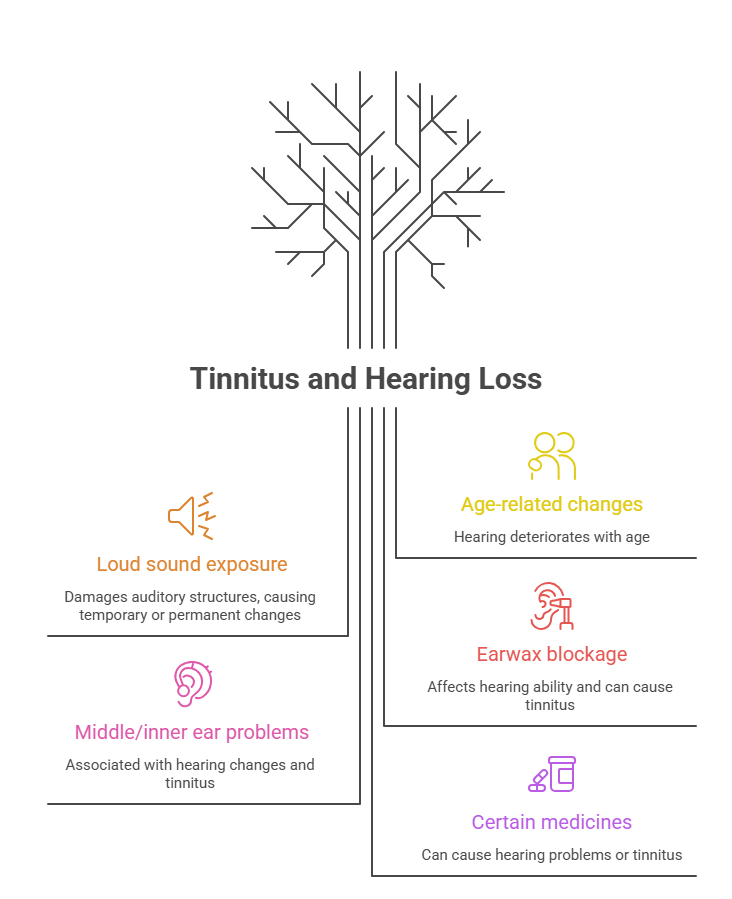
They include aging, exposure to loud noises, ear diseases, earwax, some medicines, and inner ear diseases.
As there are several possible causes, it is best to get your symptoms evaluated rather than just assuming that you are suffering from tinnitus and have to live with it.
What Causes Tinnitus and Hearing Loss?
There is no single cause that explains every case.
Age-related changes in hearing
As you age, your hearing may slowly deteriorate, especially for sounds that are higher in pitch.
Initially, you might think that speech is not as intelligible, but not that it is just quieter. A member of the family may talk in a mumble, or it might be hard to follow a conversation in a restaurant.
Some of these age-related changes in hearing can also be accompanied by tinnitus.
Exposure to loud sounds
Excessive exposure to loud music, machinery, traffic, industrial noise, construction noise, or loud recreational sound can compromise structures that are associated with auditory function.
But it can be temporary or permanent changes if the sound is loud enough.
A loud event may cause ringing in the ears. If the ringing does not quiet spontaneously, or there is also a loss of hearing, it is advisable to have an audiological assessment.
Earwax blockage
An excess accumulation of earwax may sometimes affect a person’s ability to hear well and can often be accompanied by tinnitus.
Don’t use a cotton bud, pin, or other object to remove earwax, as this can either push the wax further in or harm the ear. Earwax should only be professionally checked, never removed with cotton buds, pins, or other objects that may push the earwax further or damage the ear.
Middle or inner ear problems
Other ear disorders may be associated with hearing changes in conjunction with the tinnitus.
Ear pressure, dizziness, ear discharge, pain and sudden hearing changes are all good indicators of what is occurring.
You can read more about common ear symptoms and conditions and why the combination of symptoms matters during assessment.
Certain medicines
In some situations, certain medicines can cause hearing problems or be a cause of tinnitus.
Don’t discontinue any prescribed medication due to the development of tinnitus. Talk to the doctor who prescribed it to review your symptoms, dosage, medical history, and possible alternatives, all without compromising safety.
What Are the Early Signs You May Have Hearing Loss Along With Tinnitus?
People with tinnitus may become preoccupied with the tinnitus tone, and tune out when their hearing changes slightly.
If you’re starting to experience that:
- Voices seem softer or less clear than before.
- You frequently ask people to repeat themselves.
- The volume of the television has been slowly turned up.
- Telephone conversations have become harder to follow.
- You can’t hear what people are saying in noisy places like restaurants or when you’re in a family setting
- Some pitches or voices are less clear than others.
- You can hear one ear more clearly than the other
- Tinnitus seems to be louder in quiet surroundings
When you have tinnitus and hearing loss, you should get a hearing test to see if there is measurable hearing loss, and which frequencies.
Can Tinnitus Make It Seem Harder to Hear?
Sometimes it does feel like that.
Tinnitus can be distracting, especially in low noise environments. For some people, it is more difficult to concentrate on soft speech when they notice the tinnitus.
But one should not take it for granted that all hearing impairments are due to tinnitus.
It may be necessary to look for some underlying hearing change.
That is why an accurate hearing assessment is useful. Our approach to hearing care for different age groups starts by understanding the symptoms and testing hearing where appropriate rather than relying on symptoms alone.
How Are Tinnitus and Hearing Loss Diagnosed?
The assessment generally starts with your history.
An audiologist/clinician may ask:
- When did you first notice the tinnitus?
- Is it in one ear or in both ears?
- Is it regular or irregular?
- Do you have a change in hearing?
- Have you been exposed to loud noises recently?
- Dizziness, pressure, pain, or drainage?
- Are you taking any medicines?
- Does the tinnitus seem to pulse in time with your heartbeat?
A hearing assessment may then be suggested.
Pure Tone Audiometry can be used to check the lowest intensities at which you can hear different frequencies. Depending on your symptoms and clinical findings, other hearing tests may be recommended.
Testing is not a way to “confirm” tinnitus. It’s to determine if hearing loss exists, the nature of the hearing loss, and if you need a further medical evaluation.
When Should You See an Audiologist or Doctor for Tinnitus and Hearing Loss?
If the tinnitus is persistent, it should be professionally assessed, especially if there is a prominent hearing change.
If you have any of these symptoms, please see a doctor immediately:
- Acute (sudden) loss of hearing in one or both ears
- Abrupt decrease in hearing ability
- Severe ear pain
- Ear discharge
- Worsening or new vertigo.
- Post-traumatic tinnitus.Head injury-induced tinnitus.
- Pulsatile tinnitus is tinnitus that seems to pulse along with your heartbeat.
- New, single-ear tinnitus
- Neurological manifestation (weakness, a change in the face)
Sudden hearing loss is not a standard hearing loss and should not be treated as such or monitored at home.
An assessment will help you to understand what is going on when tinnitus has occurred over a period of time rather than assuming from the sound alone.
How Can Tinnitus and Hearing Loss Be Managed?
The treatment for the symptoms relies on the cause.
No one treatment fits all patients.
If earwax or some other ear issue is causing symptoms, then ear problem management might be the initial step.
Some may need hearing aids if they have hearing loss.
Hearing aids increase the volume of sounds and speech in the environment based on their level of hearing. For some people who also have hearing loss, hearing aids make speech and environmental sounds more audible. This may make tinnitus less noticeable or less intrusive for some users, but hearing aids are not a guaranteed treatment for tinnitus.
But hearing aids do not always provide a tinnitus cure, and appropriateness will be determined by evaluation.
You can explore how hearing aids are assessed, selected, and fitted based on your hearing test, communication needs, comfort, lifestyle, and listening environments.
Other tinnitus-management approaches may include education, counselling, sound enrichment, sleep support, stress management, or medical referral where appropriate.
The right approach depends on your symptoms and diagnosis.
Can Hearing Aids Help When You Have Tinnitus and Hearing Loss?
Once hearing loss has been identified, hearing aids can enhance your ability to hear sounds and conversations.
This may be helpful when you have trouble understanding speech, or you’re feeling socially withdrawn because listening is tiring.
Depending upon the model, some modern hearing aids can also have tinnitus-support or sound-therapy features.
But device features should not be the starting point.
The first question to ask is: if you have any hearing loss, what is the nature of the hearing loss and what types of problems you wish to solve in your daily life.
If hearing aids are recommended, ongoing hearing aid aftercare can help with fitting, programming, comfort, device care, and follow-up adjustments.
What Can You Do at Home While Waiting for an Assessment?
While waiting for an assessment, a few simple strategies may make tinnitus less intrusive.
Do not go completely silent as this can make tinnitus more noticeable. Quiet environments might be more comfortable with soft background noise like a fan, gentle music, or background sounds from regular household items.
Keep your ears safe from loud noises – particularly at concerts, industrial noise, or around machinery. Meanwhile, there’s typically no reason to have to wear earplugs all day for normal, safe everyday noises.
Pay attention to patterns.
Make note of when the tinnitus is loudest, if it is louder in one ear, if your hearing is affected, if you get dizzy, if you get pressure or pain in your ears, or if you get any other symptoms.
The information you gather during the appointment can be helpful.

Why Choose Resonnocare for Hearing and Audiology Care?
At Resonnocare, we do not just look at one symptom when evaluating an individual’s hearing loss; we want to understand why the hearing loss occurred.
Our approach includes:
- A symptom-directed approach to care according to your symptoms, hearing outcomes, and your personal requirements.
- Familiarity with hearing issues and steps to take next (experienced audiologists/clinicians who can take a comprehensive look at hearing issues and provide guidance on what to do next)
- Correctly diagnosing the type and severity of a hearing loss.
- A plan of care tailored to your individualized communication needs, lifestyle, and clinical information.
- Hearing tests, hearing aids, home visits, video consultation, and aftercare (as appropriate)
If visiting a clinic is difficult because of age, mobility, or travel concerns, selected services may also be available through our home visit and hearing care support.
When symptoms require medical or ENT evaluation rather than routine audiology care, our team can guide you toward an appropriate next step.
Find a Resonnocare Clinic Near You
Select your city to find the nearest Resonnocare clinic and book an appointment with our hearing care team.
Bangalore
Ear 360, Jayanagar
Ground Floor, Site No. 499, Municipal No. 499/97, East End Main Road, 9th Block, Jayanagar, Bangalore, Karnataka 560041
Timings: 10:00 AM to 7:00 PM
[Call] [Book an Appointment]
Ear 360, Spandana Sarjapura Hospital
239/205/34A, near Trinity Complex, Sompura Gate, Sarjapura Main Road, Bangalore, Karnataka 562125
Timings: 10:00 AM to 7:00 PM
[Call] [Book an Appointment]
Resonnocare, HSR Layout
150/5/72, 7th Cross, 24th Main, HSR Layout, Bangalore, Karnataka 560102
Timings: 10:00 AM to 7:00 PM
[Call] [Book an Appointment]
Resonnocare, Banashankari
272, 7th Cross Road, BSK 1st Stage, 2nd Block, Srinivasan Agra, 80 Feet Road, Bangalore, Karnataka 560050
Timings: 10:00 AM to 7:00 PM
[Call] [Book an Appointment]
Resonnocare, Indiranagar
34, Wind Tunnel Road, Murugeshpalya, Muniyappa Layout, Bangalore, Karnataka 560017
Timings: 10:00 AM to 7:00 PM
[Call] [Book an Appointment]
Delhi
Ear 360, Dr. Hans Anand Lok
46, Anand Lok Road, Anand Lok, Sadiq Nagar, New Delhi, Delhi 110049
Timings: 10:00 AM to 7:00 PM
[Call] [Book an Appointment]
Resonnocare, Dr. Hans Vasant Vihar
28, Basement, Paschimi Nagar, Vasant Vihar, New Delhi, Delhi 110057
Timings: 10:00 AM to 7:00 PM
[Call] [Book an Appointment]
Gurgaon
Resonnocare Head Office, M3M Urbana
Office 403, Office Block, 4th Floor, above Retail Blocks R1 and R5, M3M Urbana, Sector 67, Gurgaon, Haryana 122101
Timings: 10:00 AM to 7:00 PM
[Call] [Book an Appointment]
Resonnocare, Dr. Hans Sector 28
Plot No. 1SP, adjoining DLF Phase 1 Metro Station, Sector 28, Gurgaon, Haryana 122002
Timings: 10:00 AM to 7:00 PM
[Call] [Book an Appointment]
Ludhiana
Ear 360, BRS Nagar
963, Block B, BRS Nagar, Ludhiana, Punjab 141012
Timings: 10:00 AM to 7:00 PM
[Call] [Book an Appointment]
Resonnocare, Fawwara Chowk
565-A and 565-B, Upper Ground Floor, Cemetery Road, near Fawwara Chowk, West City, Ludhiana, Punjab 141001
Pune
Ear 360, Vighnaharta Healthcare Center
D-106-107, Choice Arcade, opposite Ruby Hall Hospital, Dhole Patil Road, Pune, Maharashtra 411001
Timings: 10:00 AM to 7:00 PM
[Call] [Book an Appointment]
Ear 360, Khan Parab ENT Hospital
Plot No. 102, Anand Nagar, Talegaon Dabhade, Taluka Maval, Pune, Maharashtra 410507
Timings: 10:00 AM to 7:00 PM
[Call] [Book an Appointment]
Tumkur
Resonnocare, Ashok Nagar
PID No. 3563, 8th Main, 8th Cross, Ashok Nagar, Tumkur, Karnataka 572103
Timings: 10:00 AM to 7:00 PM
[Call] [Book an Appointment]
When Should You Book a Hearing Assessment?
Don’t delay hearing testing until tinnitus becomes loud or it’s hard to carry on a conversation.
If the ringing, buzzing, or other unknown sounds have continued, or if you notice that your speech is not as clear as it used to be, the volume on your TV is different, you have trouble hearing on the phone, or you have trouble hearing in loud settings, an assessment can give you some answers.
Often tinnitus and hearing loss go hand in hand, but for some, it is not because of the same cause.
If you have hearing symptoms, a professional hearing checkup will help determine if you are experiencing hearing loss and what to do next.
If you have tinnitus, loss of hearing, or trouble understanding speech that persists, please make an appointment with the Resonnocare audiology team.
Do not delay seeking medical attention for any hearing changes or the occurrence of tinnitus with severe ear pain, discharge, vertigo, or other alarming symptoms. Attend a hearing appointment if one is scheduled or is necessary.
FAQ’s
Can hearing loss due to tinnitus be reversed?
Usually, tinnitus does not lead to hearing loss, and hearing loss from tinnitus is not always reversible. If the hearing loss is due to something that can be treated, like earwax or an ear infection, it may be possible to improve the hearing loss. Hearing aids, sound therapy, and tinnitus management techniques can help with hearing and tinnitus symptoms in the case of permanent hearing loss.
Can tinnitus cause more hearing loss?
Generally, tinnitus is not a cause of hearing loss, but a symptom of an underlying condition. Other problems associated with tinnitus, including noise-induced hearing loss, age-related hearing loss, and ear disorders, can cause hearing loss over time. A hearing evaluation can be used to determine the cause.
What are the causes of tinnitus?
Hearing loss, exposure to loud noise, earwax buildup, ear infection, Ménière’s disease, some medications, head injury, and circulatory disorders are all common causes of tinnitus. In most instances, tinnitus is linked with problems in the inner ear or the auditory system.
How to stop thinking about tinnitus?
Background sounds, activities, coping, and relaxation are methods for relief for many. Other treatments such as Cognitive Behavioral Therapy (CBT), tinnitus retraining therapy, and hearing aids can also help lessen the awareness of tinnitus and make it less bothersome over time.
What is the 7-second trick to stop tinnitus?
On the internet, the “7-second trick” has become a popular method that some individuals may find to be temporarily relieving their tinnitus, but this is not a medically proven therapy for the issue. Typically, management consists of determining the underlying cause, preventing exposure to further damage, sound therapy, and a professional evaluation if the symptoms continue or become more severe.