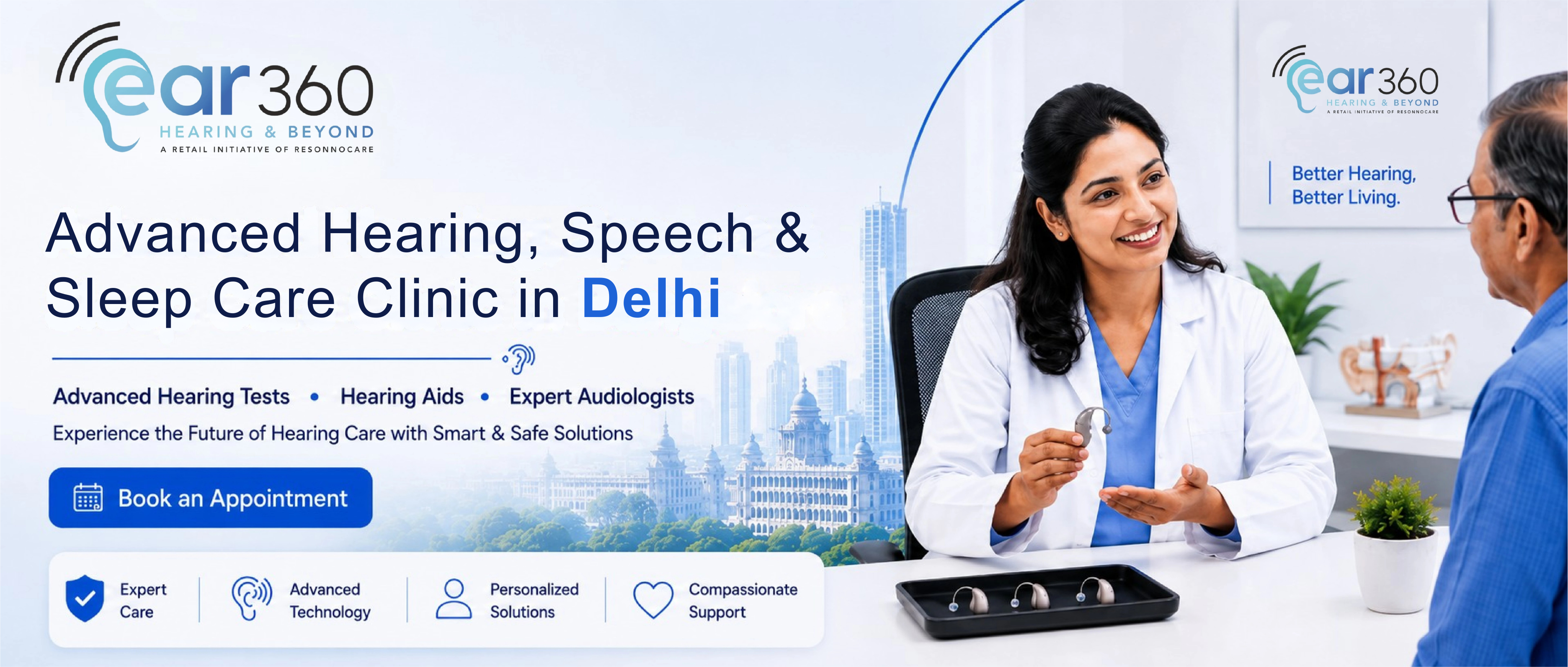
Leading Hearing Aid Centre & Diagnostic Audiology Clinics in Delhi NCR
EAR360 Delhi provides hearing tests, hearing aid trials, speech therapy, tinnitus assessment and sleep apnea care at four clinics: Anand Lok, Vasant Vihar, Hauz Khas and West Punjabi Bagh. Our audiologists work with patients of all ages, from newborns and school-going children to working professionals and senior citizens, using internationally accepted diagnostic protocols and advanced clinical technology.
Delhi’s dense traffic, constant construction noise and high pollution levels make residents more prone to ear infections, hearing strain and stress-related conditions like tinnitus over time. Whether you are finding it harder to follow conversations at home or work, managing a persistent ringing in your ears, or noticing delayed speech development in your child, EAR360 Delhi offers personalized clinical care built around your specific needs.
Find a Clinic Near You
Visit your nearest Resonnocare clinic for expert hearing care.
EAR360- Delhi Dr Hans Anandlok
New Delhi, Delhi
EAR360- Delhi Dr Hans Vasant Vihar
New Delhi, Delhi
EAR360- Delhi Clarity ENT Clinic
New Delhi, Delhi
EAR360- Delhi Dr Hans Center for ENT Punjabi Bagh
New Delhi, Delhi
Services Available at Our Delhi Clinics
Our Delhi clinics offer a range of hearing assessments, speech therapy, hearing aid support and specialised audiology services. Explore the services available across our Anand Lok, Vasant Vihar and Hauz Khas clinics.
| Service | Anand Lok | Vasant Vihar | Hauz Khas |
|---|---|---|---|
| Pure Tone Audiometry (PTA) | ✓ Available | ✓ Available | ✓ Available |
| PTA + Speech Audiometry | ✓ Available | ✓ Available | ✓ Available |
| PTA + Speech Audiometry + Tympanometry | ✓ Available | ✓ Available | ✓ Available |
| Paediatric Audiometry | ✓ Available | ✓ Available | ✓ Available |
| Tympanometry | ✓ Available | ✓ Available | ✓ Available |
| Tympanometry + Reflexometry | ✓ Available | ✓ Available | ✓ Available |
| Eustachian Tube Function Test | ✓ Available | ✓ Available | ✓ Available |
| OAE Screening | ✓ Available | ✓ Available | ✓ Available |
| Diagnostic ABR / BERA | ✓ Available | ✓ Available | ✓ Available |
| ASSR | ✓ Available | ✓ Available | ✓ Available |
| Speech Therapy Consultation | ✓ Available | ✓ Available | ✓ Available |
| Follow-up Speech Therapy | ✓ Available | ✓ Available | ✓ Available |
| Hearing Aid Adjustment | ✓ Available | ✓ Available | ✓ Available |
| Special Tests: Tone Decay, SISI & Stenger | ✓ Available | ✓ Available | ✓ Available |
| VEMP | ✓ Available | ✓ Available | ✓ Available |
| Electrocochleography (ECoG / ECOCHG) | ✓ Available | ✓ Available | ✓ Available |
| Tinnitus Matching | ✓ Available | ✓ Available | ✓ Available |
Need a specific hearing test or service? Contact our team before your visit to confirm appointment availability and help us guide you to a convenient Delhi clinic.
Check Service AvailabilityMeet Our Audiology Expert
Get to know the clinical professionals contributing to patient education, hearing care and audiology expertise at ResonnoCare.

Anant Arun
Audiologist & Speech-Language Pathologist | Assistant General Manager, ResonnoCare
Anant Arun is an Audiologist and Speech-Language Pathologist with experience across clinical audiology, hearing aid technology, patient counselling, audiology training and hearing healthcare operations. His work includes evidence-based hearing care, hearing aid fittings, clinical troubleshooting and patient-focused audiology support.
Areas of Expertise
Anant also contributes to research and educational content on hearing loss, hearing aid use, tinnitus, tele-audiology and modern audiology practices, helping patients and families better understand hearing-related concerns and treatment options.
What Our Patients and Families Say

Shalini Kapoor
I had been dealing with a constant ringing sound in my left ear for almost six months. Visited the EAR360 clinic in Vasant Vihar and the specialist did a thorough tinnitus assessment, explaining the likely cause in a way I could actually understand. No other clinic in South Delhi had taken this much time with me before. The staff was warm and the whole visit felt unhurried.

Vikram Malhotra
Had been postponing my hearing test for over a year due to a busy work schedule. Finally visited EAR360 at the Anand Lok clinic and the entire process was smooth from start to finish. The audiologist explained my Pure Tone Audiometry results clearly and recommended a hearing aid that fit my budget without any pressure to upgrade. Genuinely one of the better hearing clinics in Delhi.

Arnav Chatterjee
We took our son for a speech evaluation at EAR360 Delhi after his teacher flagged some concerns about his pronunciation. The team conducted a proper assessment and explained everything to us in detail, including a clear therapy plan going forward. If you are looking for a reliable hearing and speech clinic in Delhi for your child, this is a solid choice.
Our Services
We offer a comprehensive range of professional audiology and hearing care services. From advanced diagnostic tests to personalized treatment plans and therapy support, our specialists evaluate, diagnose, and manage all hearing and speech-related needs using state-of-the-art technology.
Hearing Test - Pure Tone Audiometry
Pure Tone Audiometry, commonly called PTA, is one of the most important hearing tests used to measure how well a person hears different frequencies. It helps identify the type and degree of hearing loss and is usually the first step before recommending hearing aids or further diagnostic tests.
At Resonnocare, Pure Tone Audiometry is performed in a sound-proof room so the audiologist can understand your hearing needs and explain the results clearly.
BERA / ABR Testing
BERA (Brainstem Auditory Evoked Response) or ABR Testing is a specialized hearing test used to assess how the auditory nerve and brainstem respond to sound. It is commonly recommended for newborns, infants, young children, or patients who cannot reliably respond during regular hearing tests.
At Resonnocare, BERA / ABR testing is used for accurate diagnosis in cases where behavioral hearing testing is difficult or incomplete.
Hearing Aids
If you have hearing loss and find hearing aids may help, our expert team provides support including consultation and fitting support. We offer recommendations based on your hearing test results, lifestyle, communication needs, and budget.
Patients can explore different types of hearing aids, including behind-the-ear options, invisible-in-the-canal devices, rechargeable models, and advanced digital hearing aids.
OAE Testing
OAE Testing measures the response of the inner ear, especially the outer hair cells of the cochlea. It is a quick, objective test commonly used for newborn hearing screening and to evaluate hearing in infants.
At Resonnocare, OAE testing helps identify whether the inner ear is functioning correctly and whether further testing may be required.
Speech Audiometry
Speech Audiometry helps determine how well a person can understand speech in different sounds. This test is especially useful when patients state, "I can hear people talking, but I cannot understand the words clearly."
At Resonnocare, speech audiometry helps the audiologist understand your hearing difficulties and recommend suitable treatment, hearing aid settings, or rehabilitation support.
Sleep Apnea Diagnostics & Management
Sleep Apnea is a sleep disorder where breathing repeatedly stops and starts during sleep. Common signs include loud snoring, choking during sleep, morning headache, daytime sleepiness, poor concentration, and fatigue even after a full night's sleep.
At Resonnocare, our team helps identify the underlying cause and supports appropriate management to restore healthy sleep.
Pediatric Hearing Assessment
Children may not always be able to describe hearing difficulties. Delayed speech development, poor response to sounds, and difficulty in following instructions can indicate the need for a pediatric hearing assessment.
We provide age-appropriate hearing assessment for children. The goal is to detect hearing concerns early and guide parents with the right next steps, whether that includes further testing, hearing devices, therapy, or other support.
Swallow Assessment & Therapy
Individualized evaluation support for swallowing difficulties, also known as dysphagia. This service helps patients who experience coughing while eating or drinking, feeling of food stuck in the throat, coughing during/after swallowing, frequent throat clearing, or chronic chest infections.
How Does a Hearing Test Help With Hearing Aid Selection?
A hearing test helps an audiologist select suitable hearing aids by identifying the degree and pattern of hearing loss in each ear. The audiogram provides information about hearing thresholds at different frequencies, while speech testing and information about everyday listening difficulties help guide device selection and fitting.
Hearing aid selection is not based on the audiogram alone. Comfort, ear anatomy, lifestyle, communication needs, handling ability and budget also influence the recommendation.
From Hearing Assessment to Hearing Aid Aftercare
Step 1: Hearing Assessment
The audiologist reviews your hearing history, symptoms and audiometry results to understand your hearing needs.
Step 2: Hearing Aid Suitability
Suitable device styles and technology options are considered according to the hearing findings and individual preferences.
Step 3: Hearing Aid Trial or Demonstration
Selected hearing aids may be demonstrated or offered for trial where the programme and device availability permit.
Step 4: Fitting and Programming
The chosen hearing aid is fitted and its settings are personalised to the individual’s hearing profile.
Step 5: Verification and Adjustment
The audiologist checks comfort and sound quality and may use appropriate verification procedures to assess amplification.
Step 6: Follow-Up and Aftercare
Ongoing appointments may include fine-tuning, maintenance guidance, reassessment and hearing aid support.
How Does an Audiogram Guide Hearing Aid Selection?
An audiogram displays the softest sounds a person can hear at different sound frequencies. These results help identify whether hearing loss is present and whether particular frequencies need more amplification.
For example, someone with greater hearing loss at higher frequencies may struggle with certain speech sounds even when voices seem loud enough. The audiologist uses the findings to plan suitable amplification and hearing rehabilitation.
Which Hearing Aid Features Should Be Considered?
Hearing aid feature | How it may support listening | What affects suitability |
Directional microphones | May help focus on speech in selected listening environments | Daily communication needs and device technology |
Noise management | May reduce distracting background sounds | Listening conditions and individual hearing difficulties |
Rechargeable batteries | Reduce the need to replace small disposable batteries regularly | Charging habits and handling preferences |
Bluetooth connectivity | May support streaming from compatible phones or other devices | Device compatibility and lifestyle |
Custom-fit styles | May offer a discreet design and personalised physical fit | Ear anatomy, hearing level and handling ability |
Automatic sound adjustment | May change selected settings as listening environments change | Technology level and individual preferences |
Can You Try Hearing Aids Before Purchasing?
Selected hearing aids may be available for trial or demonstration at participating EAR360 clinics. A trial can help patients evaluate speech clarity, comfort and everyday device handling before making a purchasing decision.
Ask the clinic which hearing aids are eligible, whether a hearing assessment is required, what the trial includes and which conditions apply.
Why Is Professional Hearing Aid Fitting Important?
A hearing aid should be programmed according to the individual’s hearing thresholds and comfort levels rather than amplifying every sound equally.
Appropriate verification, including real-ear measurement where available and indicated, can help assess whether the device is providing suitable amplification.
Follow-up appointments allow adjustments when speech sounds unclear, certain sounds feel too loud, the device is uncomfortable or the patient struggles in noisy environments.
Does Everyone With Hearing Loss Need Hearing Aids?
No. Some hearing difficulties require medical treatment, monitoring or other hearing-care options. Hearing aids are usually considered when amplification is appropriate for the person’s type of hearing loss and communication needs.
An audiologist should explain the expected benefits and limitations before recommending a device.
Which Delhi Clinic Is Right for You?
Choose a clinic based on your location and hearing care needs. If you are unsure, our team can help you find the most suitable EAR360 clinic in Delhi.
Anand Lok
A convenient option for patients from Anand Lok, Sadiq Nagar, South Extension, Defence Colony, Greater Kailash, Siri Fort and nearby South Delhi areas.
Vasant Vihar
A convenient option for patients from Vasant Vihar, Vasant Kunj, Munirka, R.K. Puram and surrounding South-West Delhi areas.
Hauz Khas
A convenient option for patients around Hauz Khas, Green Park, Safdarjung Development Area and nearby South Delhi neighbourhoods.
Not sure which clinic is closest? Share your area with our team and we will help you choose a convenient location.
Find My Nearest Clinic →Concerns and Conditions We Support
Hearing and communication concerns can affect people of all ages, from newborns and children to working professionals and seniors. At EAR360, our audiologists and hearing care specialists evaluate, diagnose and manage a wide range of hearing, speech and balance-related conditions using advanced diagnostic technology and evidence-based treatment approaches.
Hearing Loss
Difficulty hearing conversations, frequently asking others to repeat themselves, increasing TV volume, or struggling in noisy environments can all be signs of hearing loss. We assess and manage age-related, noise-induced, sudden, and conductive hearing loss through comprehensive testing and personalized treatment plans.
Tinnitus (Ringing in the Ears)
Tinnitus is often experienced as ringing, buzzing, humming, or whistling sounds in the ears without an external source. Our team evaluates the underlying causes and recommends appropriate management strategies to reduce its impact on daily life.
Pediatric Hearing & Speech Concerns
Hearing plays a critical role in a child's speech and language development. We assess hearing difficulties, speech delays, auditory processing concerns, and communication challenges to help children achieve better developmental outcomes.
Age-Related Hearing Loss
Gradual hearing loss is common as we age and can affect communication, confidence, and overall quality of life. Our specialists provide hearing evaluations and hearing aid solutions designed specifically for older adults.
Noise-Induced Hearing Loss
Prolonged exposure to loud workplaces, traffic, music, or recreational noise can damage hearing over time. Early diagnosis helps prevent further deterioration and supports better long-term hearing health.
Auditory Processing Difficulties
Some individuals hear sounds normally but struggle to understand speech, especially in noisy environments. We conduct specialized assessments to identify auditory processing challenges and recommend suitable interventions.
Balance & Vestibular Disorders
Inner ear problems can affect balance and lead to dizziness, unsteadiness, or vertigo-like symptoms. Our specialists evaluate vestibular function and guide patients toward appropriate treatment pathways when balance disorders are suspected.
Sleep-Related Breathing Disorders
Conditions such as snoring and sleep apnea can impact sleep quality, concentration, and overall health. Our sleep assessment services help identify underlying issues and support appropriate management.
Which Hearing Test or Specialist May Be Recommended for Your Symptoms?
The hearing test or specialist recommended for you depends on your symptoms, age, medical history and the type of hearing or communication problem. Audiologists evaluate hearing and related auditory function, ENT specialists assess medical conditions affecting the ears, and speech-language professionals assess communication and swallowing difficulties within their scope of practice.
Some conditions require more than one professional. Symptoms can guide the assessment, but a diagnosis requires an appropriate clinical evaluation.
Symptoms, Specialists and Possible Assessments
Symptom or concern | Specialist to consult | Possible assessment | Possible next step |
Gradual difficulty hearing conversations | Audiologist | Pure Tone Audiometry and Speech Audiometry | Review hearing results and suitable care options |
Difficulty understanding speech in background noise | Audiologist | Hearing thresholds and speech understanding assessment | Communication strategies, further testing or hearing aid evaluation |
Persistent tinnitus | Audiologist or ENT specialist depending on symptoms | Hearing assessment and appropriate medical evaluation | Tinnitus counseling, management or specialist referral |
Sudden hearing loss | Urgent ENT or emergency medical service | Prompt medical examination and audiometry | Time-sensitive investigation and treatment where indicated |
Blocked ears, pain or discharge | ENT specialist or another appropriate medical professional | Ear examination, tympanometry and hearing testing when indicated | Medical treatment or further evaluation |
Newborn who does not pass hearing screening | Pediatric audiologist or suitably equipped diagnostic service | Diagnostic ABR / BERA and other age-appropriate tests | Prompt diagnostic follow-up |
Child with speech delay | Audiologist and speech-language professional | Pediatric hearing and speech-language assessments | Coordinated support or developmental referral |
Older adult with gradual hearing difficulty | Audiologist | Pure Tone Audiometry and appropriate additional tests | Hearing rehabilitation, monitoring or amplification evaluation |
Dizziness or vertigo | ENT or relevant medical specialist | Medical evaluation and vestibular tests where indicated | Appropriate investigation and treatment |
Persistent voice changes | ENT specialist and speech-language professional where indicated | Medical voice examination and voice assessment | Treatment or voice rehabilitation |
Difficulty swallowing | Appropriate medical specialist and swallowing professional | Clinical swallowing assessment and further investigations when needed | Individualised swallowing management |
Snoring with daytime sleepiness | Sleep medicine or an appropriate medical specialist | Sleep assessment or sleep study | Medical management according to the findings |
When Should You Consult an Audiologist in Delhi?
An audiologist can help when you experience gradual hearing difficulties, trouble understanding speech, changes in hearing aid performance or concerns about hearing development in a child.
Tests such as Pure Tone Audiometry, Speech Audiometry, Tympanometry, OAE or BERA may be recommended according to the clinical need.
When Is an ENT Specialist More Appropriate?
Sudden hearing loss, severe ear pain, bleeding, persistent ear discharge and other concerning medical symptoms require prompt medical evaluation.
Sudden hearing loss, particularly in one ear, is urgent. Do not wait for a routine audiology appointment before seeking medical care.
Can You Need Both an ENT and Audiologist?
Yes. For example, an ENT specialist may assess a suspected middle-ear condition while an audiologist measures hearing function. Combining the findings can help determine the appropriate next step.
The aim is to identify the right professional and test for the concern rather than booking multiple unrelated assessments.
When Should a Child Have Both Hearing and Speech-Language Assessments?
A child may need both a hearing assessment and a speech-language assessment when there are concerns about delayed speech, unclear pronunciation, difficulty understanding instructions or inconsistent responses to sound. Hearing difficulties can affect speech and language development, while speech-language difficulties may also occur in children whose hearing thresholds are within the expected range.
Assessing hearing and communication together can help identify whether a child needs audiological care, speech-language therapy, further developmental evaluation or a combination of services.
Signs That May Require Hearing and Speech-Language Evaluation
- Delayed development of words or sentences
- Difficulty understanding age-appropriate instructions
- Inconsistent response when called by name
- Frequent requests for repetition
- Speech that is difficult for familiar or unfamiliar listeners to understand
- Repeated middle-ear infections or suspected hearing problems
- Difficulty following classroom conversations
- Concerns raised by parents, teachers or pediatricians
- Loss of previously acquired words or communication skills
How Do Hearing and Speech-Language Assessments Work Together?
Assessment | What it evaluates | Why it matters |
Pediatric hearing assessment | Age-appropriate hearing sensitivity and auditory function | Identifies hearing difficulties that may affect access to speech sounds |
OAE screening | Cochlear outer hair-cell responses | Provides objective hearing-related information in selected children |
BERA / ABR | Electrical responses of the auditory nerve and brainstem | Useful when objective hearing assessment is required |
Tympanometry | Middle-ear function | May help investigate recurrent infections or suspected fluid |
Speech-language assessment | Speech production, language understanding, expression and communication | Identifies speech-language needs and appropriate therapy goals |
ENT assessment | Medical or structural ear problems | May help address conditions affecting hearing |
Developmental assessment | Broader developmental or behavioural concerns | Supports coordinated care when indicated |
Should Parents Wait for Hearing Test Results Before Starting Speech Therapy?
Parents should discuss both hearing and speech-language concerns with qualified professionals. In many situations, these assessments can proceed alongside each other so that appropriate support is not unnecessarily delayed.
A normal OAE result alone does not rule out every hearing disorder. Further audiological assessment may be recommended when concerns continue.
Why Is Early Identification Important?
Hearing, speech and language skills develop through listening, communication and interaction. Identifying difficulties early helps families understand their child’s needs and obtain suitable professional support.
A child who has lost previously acquired language or other developmental skills should receive prompt pediatric or developmental evaluation.
What Happens After Both Assessments?
The audiologist and speech-language professional explain their findings and may recommend further hearing tests, ENT consultation, speech-language therapy, developmental assessment or ongoing monitoring.
Families should receive clear guidance about the recommended next steps rather than assuming that speech delay always has a single cause.
What Is Included in an Audiologist Consultation in Delhi?
An audiologist consultation in Delhi generally involves reviewing your hearing concerns, relevant medical history, previous test reports and communication difficulties. The audiologist then recommends suitable assessments, explains the findings and discusses any required treatment, rehabilitation, referral or monitoring.
The exact tests and services included in the consultation fee depend on the clinic, the patient’s age and the reason for the appointment.
What Happens During an Audiologist Appointment?
Consultation component | What it may involve | What to confirm before booking |
Hearing and medical history | Discussion of symptoms, onset, noise exposure, medicines and previous hearing problems | Whether the consultation includes a case-history review |
Ear examination | Visual assessment of the ear canal and eardrum where appropriate | Whether additional ENT evaluation may be required |
Pure Tone Audiometry | Measurement of hearing thresholds at different frequencies | Whether PTA is included in the fee |
Speech Audiometry | Assessment of aspects of speech detection and understanding | Whether speech testing is included or billed separately |
Tympanometry | Assessment of middle-ear function | Whether it is recommended and available |
Objective diagnostic testing | OAE, BERA/ABR or another test when clinically indicated | Whether specialised testing requires a separate appointment |
Audiogram and written report | Documentation of hearing-test findings | Whether a report is included in the quotation |
Result explanation | Discussion of hearing findings and their relevance to daily communication | Whether audiologist-led interpretation is included |
Hearing aid evaluation | Discussion of amplification options when appropriate | Whether this is included or booked separately |
Referral and follow-up | Guidance about medical referral, rehabilitation or monitoring | Whether follow-up appointments involve additional charges |
Do All Patients Need the Same Hearing Tests?
No. An adult with gradual hearing loss may require routine audiometry, while a newborn or young child may need different assessment methods. Patients with middle-ear problems or suspected auditory-pathway concerns may require additional testing.
The audiologist should recommend tests according to the clinical question rather than assuming every patient needs a fixed package.
What Should You Bring to Your Consultation?
Bring previous hearing reports or audiograms, relevant medical prescriptions, existing hearing aids and details of situations where you struggle to hear.
For children, bring newborn hearing-screening reports, relevant developmental assessments and any recommendations from a pediatrician or speech-language professional, if available.
What Should You Ask Before Leaving the Clinic?
- What did my hearing test show?
- Do I have hearing loss in one or both ears?
- Which frequencies are affected?
- Are further hearing tests required?
- Should I consult an ENT specialist?
- Are hearing aids or communication strategies appropriate?
- When should I return for a follow-up?
- Can I receive a written copy of my report?
A useful consultation should provide an explanation of the findings and a clear plan for the next step.
Can You Consult an Audiologist Online or Do You Need a Clinic Visit?
An online audiologist consultation may be suitable for reviewing previous hearing reports, discussing hearing concerns, explaining hearing aid features or arranging selected follow-up support. However, diagnostic hearing tests such as Pure Tone Audiometry, Tympanometry, OAE and BERA usually require appropriate equipment, testing conditions and professional supervision that cannot be provided through an ordinary video call.
Whether an online consultation is appropriate depends on your needs and whether physical examination or diagnostic testing is required.
Online Audiologist Consultation vs Clinic Visit
Service or situation | Online consultation | Clinic visit |
Discussion of hearing concerns | May be appropriate for an initial discussion | Suitable for clinical examination and further assessment |
Review of previous audiograms | Can be useful when reports are available | Can be combined with repeat testing when required |
Explanation of hearing-test results | May be possible through a video consultation | Can be provided alongside testing |
Pure Tone Audiometry | An ordinary video call is not a substitute for calibrated audiometry | Requires suitable equipment and testing conditions |
Tympanometry | Cannot ordinarily be performed through video alone | Requires middle-ear testing equipment |
OAE or BERA testing | Cannot ordinarily be performed through video alone | Requires appropriate diagnostic equipment and clinical conditions |
Hearing aid counseling | May help patients compare features and understand options | Can include physical assessment, demonstration and fitting |
Hearing aid reprogramming | Remote fine-tuning may be possible with compatible devices and professional arrangements | Suitable for hands-on fitting and device checks |
Physical ear discomfort or discharge | May support initial triage but cannot replace examination | Medical examination may be required |
Pediatric diagnostic hearing testing | Report discussion may be possible remotely | Age-appropriate testing requires suitable facilities |
When Is an Online Audiologist Consultation Useful?
An online consultation may help when you already have a hearing report and want to understand the findings, need guidance on hearing aid care or want to discuss whether an in-person appointment is appropriate.
It may also be convenient for selected follow-up discussions when the audiologist does not need to examine the ear or repeat hearing tests.
When Should You Visit a Clinic Instead?
A clinic or appropriate medical facility is generally required when a diagnostic hearing test, physical ear examination, device fitting or specialised assessment must be performed.
Newborns and children requiring objective hearing tests should be directed to a suitable diagnostic service rather than relying on an ordinary online consultation.
Can Hearing Aids Be Adjusted Remotely?
Some hearing aids support remote programming or fine-tuning through compatible technology and authorised professional services. Availability depends on the device model, connectivity and the provider’s arrangements.
Remote adjustment cannot address every problem. A damaged device, poor physical fit or ear-related discomfort may require an in-person visit.
When Is Online Consultation Not Appropriate as the Only Next Step?
Sudden hearing loss, severe ear pain, bleeding, facial weakness or concerning neurological symptoms require prompt medical assessment. A routine online audiology appointment should not delay urgent care.
For a non-urgent hearing concern, the EAR360 team can help determine whether a video consultation or clinic appointment is more suitable.
Patient Journey

Comprehensive Assessment
Advanced diagnostics are used to evaluate hearing, speech and other relevant health parameters, using validated equipment to understand the exact nature of the concern.

Structured Clinical Plan
Based on findings, a clear and personalised plan is created. This may include medical devices, therapy, rehabilitation or referral coordination where required.

Targeted Intervention
Treatment is delivered using appropriate technology, devices and therapeutic support to improve functional outcomes and everyday quality of life.

Long-Term Monitoring
Regular follow-ups, fine-tuning and progress reviews ensure sustained results across hearing, speech and other specialised healthcare services.
What Happens After Your First Audiologist Consultation?
After your first audiologist consultation, the audiologist explains your hearing assessment results and recommends appropriate next steps based on the findings. These may include monitoring, further diagnostic testing, ENT consultation, hearing aid evaluation, rehabilitation or speech-language support.
The recommendation should reflect the patient’s hearing status, communication needs, age, medical history and individual goals.
Possible Next Steps After Your Hearing Assessment
Assessment finding | Possible recommendation | What happens next |
Hearing thresholds within the expected range | Monitoring or further evaluation if concerns continue | Follow advice according to symptoms and risk factors |
Conductive hearing loss | Medical or ENT review | Assessment for outer-ear or middle-ear causes |
Sensorineural hearing loss | Hearing rehabilitation discussion | Consider communication support and amplification when appropriate |
Mixed hearing loss | Medical assessment and hearing rehabilitation planning | Address the different components of hearing loss |
Asymmetric hearing loss | Further medical or audiological assessment | Investigate differences between the ears according to clinical findings |
Hearing difficulties in a child | Pediatric audiology follow-up | Age-appropriate testing and early support where indicated |
Speech-language concerns | Speech-language assessment | Further evaluation or therapy planning |
Persistent tinnitus | Assessment of hearing and other relevant symptoms | Counseling, medical referral or other appropriate management |
Inconclusive test results | Repeat or additional testing | Clarify the findings before making treatment decisions |
Existing hearing aid difficulties | Hearing aid fitting or programming review | Adjustment, maintenance or troubleshooting |
Will You Need a Follow-Up Appointment?
Not every patient requires immediate follow-up. Some people may benefit from routine monitoring, while others need further tests, specialist assessment or hearing rehabilitation.
The audiologist should explain whether another appointment is necessary and when it should take place.
When May Hearing Aids Be Recommended?
Hearing aids may be considered when a person’s hearing loss affects communication and amplification is clinically appropriate. The audiologist should review the audiogram, speech understanding, listening needs and preferences before recommending suitable devices.
A hearing test does not automatically mean the patient needs hearing aids. Some conditions may require medical evaluation or alternative care.
When Should You Seek Urgent Medical Attention?
Sudden hearing loss, especially in one ear, should be treated as urgent. Severe ear pain, bleeding, facial weakness or new neurological symptoms may also require prompt medical assessment.
Do not delay urgent evaluation while waiting for routine testing or a follow-up appointment.
The goal of the first consultation is to help you understand the findings and the most suitable next step in hearing care.
Areas We Serve in Delhi
EAR360 currently operates four clinics in Delhi, located at Anand Lok, Vasant Vihar, Hauz Khas and West Punjabi Bagh, making expert hearing care accessible to patients from across the city.
Our EAR360 clinic on Anand Lok Road serves residents of Anand Lok and Sadiq Nagar for hearing tests, hearing aid fitting and tinnitus evaluation.
Our Vasant Vihar clinic at 28, Paschimi Nagar (basement) is well-placed for patients from Vasant Vihar and the surrounding diplomatic enclave area.
Patients from the Siri Fort area visit our Anand Lok clinic for pure tone audiometry, speech audiometry and paediatric hearing assessments.
Residents of Greater Kailash I and II seeking a trusted audiology clinic in Delhi can access our clinic without long travel.
Families from South Extension visit EAR360 for comprehensive ear care, including BERA testing, OAE screening and hearing aid consultations.
Patients from Vasant Kunj and nearby sectors visit our Vasant Vihar clinic for hearing evaluations, sleep apnea diagnostics and speech therapy support.
Residents of Munirka and the surrounding JNU campus area can reach our Vasant Vihar clinic easily for hearing health consultations.
Patients from Hauz Khas and the nearby Deer Park area can visit our clinic at EAR360 Clarity ENT Clinic, Z-19, Hauz Khas, for hearing tests and hearing aid support.
If your area is not listed here, contact us to check directions to your nearest EAR360 clinic or ask about our home hearing test and audiologist visit option, available for patients who prefer care at home.
Frequently Asked Questions
1. What services are available at EAR360 Delhi?
EAR360 Delhi provides hearing tests, Pure Tone Audiometry, hearing aids, speech audiometry, pediatric hearing assessment, BERA/ABR testing, OAE testing, tinnitus management and sleep apnea diagnostics with CPAP/APAP device support.
2. Who should visit EAR360 Delhi?
You should visit EAR360 if you have difficulty hearing, trouble understanding speech, ringing sounds in the ear, delayed speech in a child, snoring, disturbed sleep or daytime sleepiness.
3. How long does a hearing test take?
A basic hearing test such as Pure Tone Audiometry usually takes around 30 to 45 minutes. Some specialised tests may take longer depending on the patient’s age, condition and cooperation.
4. Do I need an appointment before visiting?
Yes, booking an appointment is recommended so the clinic team can schedule the right specialist and test slot for your concern.
5. Can I try hearing aids before buying?
Yes, selected hearing aids may be available for trial. A hearing aid trial helps you understand comfort, clarity and real-life listening benefit before making a final decision.
6. What is the price of hearing aids in Delhi?
Hearing aid prices vary depending on the technology level, brand, style, features and degree of hearing loss. After your hearing test, the audiologist will suggest suitable options based on your report, lifestyle and budget.
7. What is Pure Tone Audiometry?
Pure Tone Audiometry is a hearing test that checks how well you hear different sound frequencies. It helps identify the type and level of hearing loss.
8. What is Speech Audiometry?
Speech Audiometry measures how clearly you understand speech. It is useful for patients who can hear sounds but struggle to understand words clearly.
9. What is BERA or ABR testing?
BERA/ABR is an objective hearing test that checks the response of the hearing nerve and brainstem to sound. It is often used for newborns, infants, children or patients who cannot respond reliably during regular hearing tests.
10. What is OAE testing?
OAE testing checks inner ear function and is commonly used for newborn hearing screening and pediatric hearing evaluation.
11. What is tinnitus?
Tinnitus is the perception of ringing, buzzing, humming or whistling sounds in the ear when there is no external sound. It can be linked to hearing loss, noise exposure, stress, ear conditions or other medical factors.
12. What is OSA?
OSA stands for Obstructive Sleep Apnea. It is a sleep disorder where breathing repeatedly stops or reduces during sleep due to airway blockage. Common symptoms include loud snoring, choking during sleep, morning headache and daytime sleepiness.
13. Where is the sleep test conducted?
Sleep testing may be conducted at home or at a sleep diagnostic setup, depending on the type of test recommended and the patient’s condition. The EAR360 team can guide you on the suitable option during consultation.
14. What are CPAP and APAP devices?
CPAP and APAP devices are used in sleep apnea management. They help keep the airway open during sleep by delivering controlled air pressure through a mask.
15. Does EAR360 provide aftercare?
Yes. EAR360’s care approach includes follow-up support, device guidance, adjustments, therapy planning and long-term care where required.
16. Where can I get a hearing test in Delhi?
EAR360 has four clinics in Delhi: Anand Lok, Vasant Vihar, Hauz Khas and West Punjabi Bagh. You can book by calling 9911666828 or through the Resonnocare website. Please confirm which tests (for example BERA or OAE) are available at your chosen clinic when you book.
17. Is there a hearing aid trial available in Delhi?
Yes. EAR360 Delhi offers a hearing aid trial before any purchase decision is made. After your hearing evaluation, the audiologist recommends a suitable hearing aid based on your hearing loss type, lifestyle and budget, and you can try the device in real-world conditions before committing.
18. Does EAR360 Delhi offer speech therapy?
Yes. EAR360 provides speech and language assessment and therapy support through its Delhi clinic network. Services may include support for children with speech delays and adults with communication difficulties, voice concerns or speech-language rehabilitation needs. Specialist availability varies by clinic, so call 9911666828 to confirm the appropriate location and appointment availability before visiting.
19. Can I book a home visit in Delhi?
Yes. EAR360 offers a home hearing test and audiologist home visit option in Delhi for patients unable to visit the clinic due to age, mobility concerns or other health conditions. To book a home visit, call 9911666828 or submit a request through the contact form on resonnocare.com.
How do I choose a hearing clinic in Delhi NCR?
Choose a hearing clinic based on the qualifications of its audiologists, the hearing tests available, the range of hearing aids offered, and the follow-up support provided. Check the clinic’s location, patient reviews, and appointment availability. Contact the clinic to confirm that it can address your specific hearing concerns.
Can I enquire about hearing tests and hearing aids?
Yes, you can ask the clinic about hearing assessments, audiology consultations, hearing aid selection, fitting, and adjustment services. The team can explain which tests may be appropriate and whether you need an assessment before choosing a hearing aid.
How can I book an appointment?
You can book an appointment by calling the clinic’s verified contact number or using its official online booking facility, if available. Confirm the branch address, appointment time, and services required. If you are visiting for a hearing concern, mention your symptoms when booking so the clinic can guide you appropriately.
Not Sure Which Delhi Clinic to Visit?
Tell us your area and hearing concern. Our team can help you choose a convenient clinic and check whether the service or hearing test you need is available there.
Help Me Choose a ClinicOther Facilities:
Hearing Care for All Ages | Hearing Aids | Free Hearing Aid Trial | Speech Audiometry and Therapy | Home Visit & Video Consultation | Aftercare