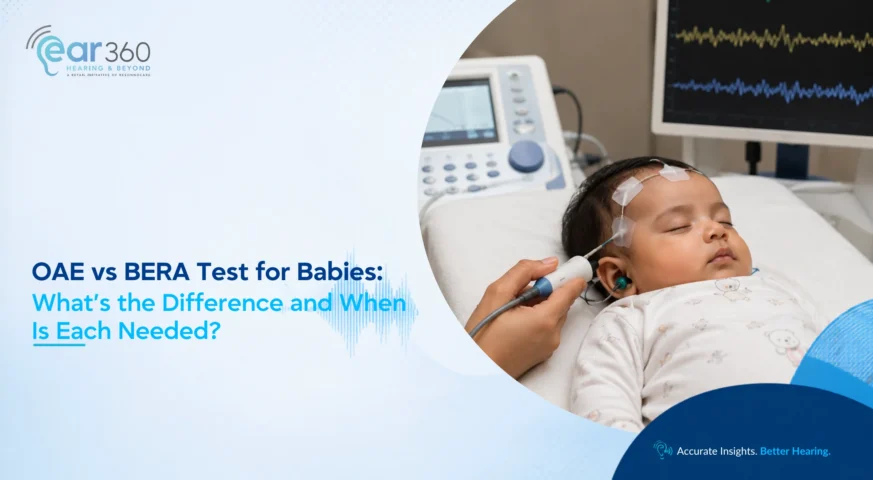
OAE vs BERA Test for Babies: What’s the Difference and When Is Each Needed?
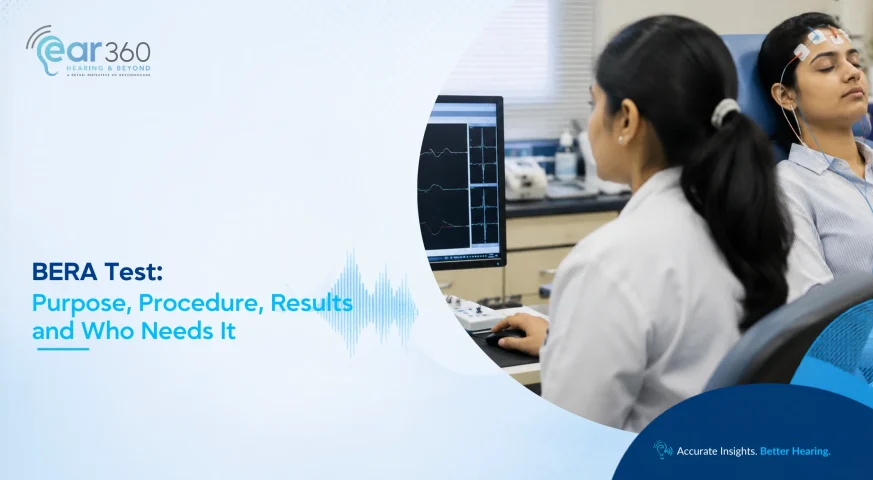
TL;DR: This blog is aimed for Parents of newborns and infants, especially those whose baby has had an inconclusive newborn hearing screening, received a “refer” result, has hearing-loss risk factors, or has been advised to undergo OAE or BERA testing. OAE is usually the first-level hearing screening: OAE is a quick, painless, and non-invasive test that checks how well the cochlea or inner ear responds to sound and is commonly used for newborn hearing screening. BERA provides a more detailed assessment: BERA evaluates how sound signals travel from the ear through the auditory nerve to the brainstem, making it useful when OAE results require further confirmation or detailed diagnosis. OAE and BERA complement each other: The blog explains that it is not simply a choice of OAE vs BERA OAE is generally used for initial screening, while BERA may be recommended as the next diagnostic step when needed. Early testing supports timely hearing and speech development: The blog guides parents on warning signs, when to consult an audiologist, possible next steps after testing, and how Resonnocare supports families through assessment, follow-up, and hearing care. Your baby could be seen as being just fine, hearing your voice, and still need to have another hearing test following newborn screening. Of course, that raises questions in the minds of many parents: What was the problem with the first test? Is my baby experiencing a hearing loss? So what are OAE and BERA tests? The good news is that a referral for further testing does not necessarily indicate your baby has a hearing loss. In some cases, the first screening might simply be confused due to ear fluid, movement during the screening, background noise, or temporary conditions. This is where the OAE and BERA tests can assist doctors and audiologists in understanding your baby’s hearing. Both are non-invasive hearing screenings and are performed in children, but they test different components of the hearing pathway and could be ordered at different times. Here we break down what OAE is and what BERA is in simple terms, what each test checks, when OAE might be sufficient and when BERA might be suggested, and what parents should expect next. What Is the OAE Test for Babies? What Does an OAE Result Actually Tell You? An OAE mainly reflects the function of the cochlea’s outer hair cells. A “pass” result is reassuring, but it should not be interpreted as proof that every part of the auditory system is normal or that the baby has completely normal hearing at every frequency. A baby may receive a “refer” result even when permanent hearing loss is not present. Common factors include vernix or debris in the ear canal, middle-ear fluid, a poor probe fit, crying or movement, and environmental noise. For this reason, a refer result should be followed according to the recommended newborn hearing-screening pathway rather than being treated as a diagnosis by itself. OAE Screening: What It Can and Cannot Do OAE can help identify: Whether cochlear outer hair-cell responses are detectable. Babies who may need repeat screening or diagnostic evaluation. Some cochlear hearing problems that affect the measurable OAE response. OAE cannot, by itself, establish: The exact degree of hearing loss. Whether the auditory nerve and brainstem pathway are functioning normally. The complete type and configuration of hearing loss. Whether a baby with a “pass” will necessarily develop normal hearing and speech-language skills later. This distinction is important when explaining the result to parents: OAE is a screening window into cochlear function, not a complete hearing assessment. Your baby will likely first get an OAE (Otoacoustic Emissions) hearing test–this is often the first test they will receive, often already in the first few days after birth. A soft probe is inserted into your baby’s ear canal and then plays a soft sound in the ear. If the ear is functioning normally, the ear will echo a sound at a low volume, which the machine will detect and record. It is painless, requires only a few minutes, and is performed while your baby is sleeping or resting quietly. It is not uncomfortable and does not need sedation. OAE is employed in hospitals and clinics as a first-level newborn hearing screening due to its quickness, non-invasiveness, and reliability. In simple terms: OAE asks, *“Is the inner ear responding to sound?”* It is a useful first step, but it does not answer every question about the baby’s entire hearing pathway. Know More About BERA Test: Procedure, Uses, Results & When It Is Needed BERA Test Price in India: Cost, Procedure & Where to Get Tested BERA Test: Purpose, Procedure, Results and Who Needs It What Is the BERA Test for Babies? BERA, ABR and AABR: Are They the Same? Parents may encounter several terms that sound different but are closely related. BERA (Brainstem Evoked Response Audiometry) is commonly used to describe an auditory evoked-potential assessment of the pathway from the ear to the brainstem. In current clinical practice, the term ABR (Auditory Brainstem Response) is also widely used. AABR (Automated ABR) is generally designed for automated screening and produces a pass/refer type screening outcome. A diagnostic ABR/BERA is more detailed and can be used by an audiologist to estimate hearing sensitivity and assess neural synchrony using appropriate stimuli and protocols. Therefore, parents should not assume that every test called “BERA” has exactly the same purpose. The clinician should explain whether the appointment is for screening, diagnostic hearing estimation, or assessment of the auditory pathway. Why Sleep Matters During BERA/ABR The test records very small electrical responses generated by the auditory system. Movement, muscle activity, crying and electrical interference can obscure these responses. A naturally sleeping baby is therefore ideal for many infant ABR assessments. Some babies may not sleep sufficiently for a reliable diagnostic recording. Depending on the child’s age, medical history and the protocol being used, the audiologist and physician may discuss whether another appointment, a different preparation strategy, or medically supervised sedation is appropriate. Sedation is not automatically
Read More