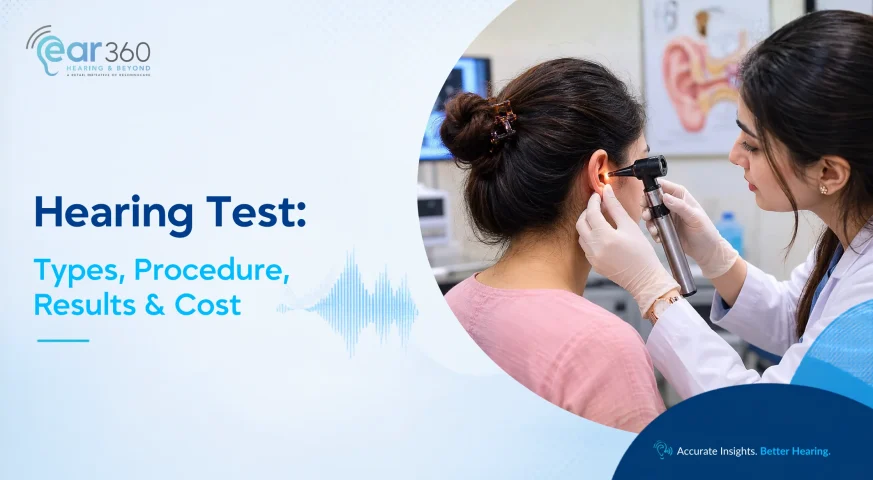
Hearing Test: Types, Procedure, Results, and Cost
TL: DR; Hearing tests: They check how well you hear different sounds, pitches, and volumes. Different tests check different needs: PTA, speech audiometry, tympanometry, OAE, and ABR assess different parts of hearing. The procedure is simple: Most hearing tests are painless, non-invasive, and guided by an audiologist. Results are clearly shown: Audiograms help classify hearing loss as normal, mild, moderate, severe, or profound. Costs vary by test type: Hearing test cost in India depends on the assessment needed and the clinic location. Get checked at Ear360 clinics: Visit Ear360 clinics for guided testing, clear results, and personalized hearing care. In most cases, people only call in for a hearing test when hearing issues have become a problem. But most often, hearing loss is a gradual process. It may become difficult to hear people when they are talking; you may find yourself repeating what you hear, turning the TV up to a higher volume, or becoming more fatigued after longer listening sessions. These signs may occur gradually, and some individuals adapt without noticing any changes in their hearing. A hearing test can eliminate the uncertainty. It is a non-invasive, easy-to-use method to determine the degree of hearing loss and its type, if any, and determine if any further intervention is required. We at ResonnoCare offer correct and clinically relevant hearing testing for all ages. Whether it’s a routine checkup or your child’s hearing problem, age-related or new symptoms, this guide will help you prepare for your initial appointment. Do You Need a Hearing Test? You should consider a professional hearing test if you are finding speech unclear, asking people to repeat themselves, increasing the television or phone volume, struggling in background noise, experiencing tinnitus, noticing a difference between your ears, or having concerns about a child’s response to sound or speech development. A hearing test does more than tell you whether hearing is reduced. Depending on the assessments performed, it can help show which ear is affected, the degree and pattern of hearing difficulty, whether the problem may involve the outer, middle, or inner ear, and what the appropriate next step may be. This page is particularly useful if you are: Not sure whether your symptoms justify a hearing test Trying to understand which type of hearing test may be needed Booking a first audiology appointment Comparing PTA, speech testing, tympanometry, OAE, or ABR Concerned about whether the procedure is uncomfortable Trying to understand your audiogram Comparing hearing-test costs Deciding what to do after receiving a hearing-test result What Is a Hearing Test? A hearing test measures the ability to hear various sounds, including loudness and pitch. It is performed by a trained audiologist and typically lasts about 30 to 60 minutes, depending on the tests required. This is not simply to determine if there is a hearing loss. An appropriate hearing test can also indicate if you have a hearing loss, the nature of the hearing loss, the affected ear(s), and what may be causing it. Your audiologist uses this information as a guide to the next steps. This can be hearing monitoring, additional medical testing, hearing aids, or other hearing support, depending on your results. Hearing tests are appropriate for everyone, from newborns to older adults. Our hearing care for all ages service at Resonnocare is built around exactly this understanding. Which Hearing Test Might You Need? You usually do not need to choose the test yourself. The audiologist selects the appropriate assessment according to your age, symptoms, ability to respond, ear condition, and the clinical question that needs to be answered. Your situation Test that may form part of the assessment What it helps assess Adult noticing gradual hearing difficulty Pure Tone Audiometry, with other tests where required Hearing thresholds across different pitches and the pattern of hearing loss “I can hear people but cannot understand the words” Speech Audiometry along with the hearing assessment Speech detection and understanding Blocked ear, pressure, suspected middle-ear fluid, or eardrum concern Tympanometry Middle-ear and eardrum function Newborn or patient unable to give reliable behavioural responses OAE and/or objective testing depending on the clinical need Objective information about auditory function Additional auditory nerve or brainstem assessment required ABR Response of the auditory nerve and brainstem to sound Previous test results do not explain the symptoms A combination of tests may be required Helps build a more complete hearing profile One test does not necessarily replace another. For example, a pure-tone test measures hearing thresholds, while tympanometry answers a different question about middle-ear function. What Are the Different Types of Hearing Tests? There is no one test that fits all. An effective audiological assessment is a sequence of assessments, each addressing a different aspect. The most common hearing test performed in clinics is known as Pure Tone Audiometry (PTA). Sounds can be heard at different pitch and volume levels through headphones, and the event of the sound can be perceived. These will be reported on an audiogram, which will show your speech range and hearing thresholds. Speech Audiometry: This test assesses not only tones but also speech. Words or phrases repeated are uttered at varying volumes. This is particularly beneficial for appreciating the effects of hearing loss on communication in everyday life. Tympanometry: This test determines the health and mobility of your eardrum and middle ear. The air pressure is slowly changed as a small probe is inserted into the ear canal. It is not a hearing test but a method of detecting underlying conditions such as fluid behind the eardrum, a perforated eardrum, or Eustachian tube problems. Otoacoustic Emissions (OAE): OAE tests measure the sounds produced by the inner ear (cochlea) when a sound is played in the ear. It lends itself especially well to newborn hearing screening and can be applied to persons who are unable to communicate verbally. Auditory Brainstem Response (ABR): A test used to evaluate the response of the auditory nerve and brainstem to sound. Electrodes are put on the scalp, and reactions are measured. May be
Read More