
TL; DR:
This blog is intended for individuals experiencing hearing difficulties, tinnitus, or age-related hearing changes; parents concerned about a child’s hearing; and anyone who has been advised to undergo a Pure Tone Audiometry (PTA) test to assess their hearing health.
- Explains What a PTA Test Measures: The article describes Pure Tone Audiometry as the gold-standard hearing test that evaluates the softest sounds a person can hear across different frequencies and volumes, helping diagnose hearing loss accurately.
- Highlights Common Causes and Early Signs of Hearing Loss: We will discuss hearing loss caused by aging, noise exposure, infections, earwax buildup, medications, genetics, and ear injuries, along with warning signs such as tinnitus, difficulty understanding speech, and needing higher volumes.
- Covers the Complete PTA Test Procedure and Results: The blog explains how the test is performed, including headphone-based sound testing, response recording, bone conduction assessment, and audiogram interpretation, while also outlining normal hearing ranges and hearing loss classifications.
- Provides Guidance on Treatment and Hearing Care: Possible management options after a PTA test, including medical treatment, earwax removal, hearing aids, assistive listening devices, and ongoing monitoring, while highlighting Resonnocare’s comprehensive hearing care and follow-up support.
One of the easiest tests that can be conducted to gain an understanding of your hearing abilities is a PTA test. In the test, you will hear a sequence of soft sounds with various pitches and mark when you hear them. This makes it easier for the audiologist to determine what the quietest sounds are that each ear can hear.
The Pure Tone Audiometry (also called PTA) test is painless and is a common test performed to determine if a child has any hearing loss and how serious it is. Resonnocare outlines the process of a PTA test, the documentation of the results, and what they could imply for your hearing.
Know More About
- Sensorineural Hearing Loss: Causes, Symptoms & Treatment Options
- Hearing Aid Price in India: Complete Cost Guide by Type and Features
- Mild Hearing Loss: Symptoms, Test Results & Do You Need Hearing Aids?
What Is a PTA Test?
A PTA (Pure Tone Audiometry) test is a hearing test conducted to measure how loud it takes to hear each frequency/pitch and intensity/loudness of sound. It is considered to be the “gold standard” for measuring hearing sensitivity. It is the foundation of the majority of hearing assessment programs, such as routine hearing screening, workplace hearing screening, and the diagnosis of hearing loss.
A PTA test cannot measure brain wave activity and is a test that you have to take. The audiologist sounds out different tones through the headphones, and you respond to them to help them draw a picture of your hearing profile.
Point of Difference | PTA Test | BERA Test |
Full form | Pure Tone Audiometry | Brainstem Evoked Response Audiometry |
What it checks | Measures the softest sounds a person can hear at different pitches | Measures how the hearing nerve and brainstem respond to sound |
Type of test | Subjective hearing test | Objective hearing test |
Patient participation | The patient must respond by pressing a button, raising a hand, or indicating when a sound is heard | No active response is required from the patient |
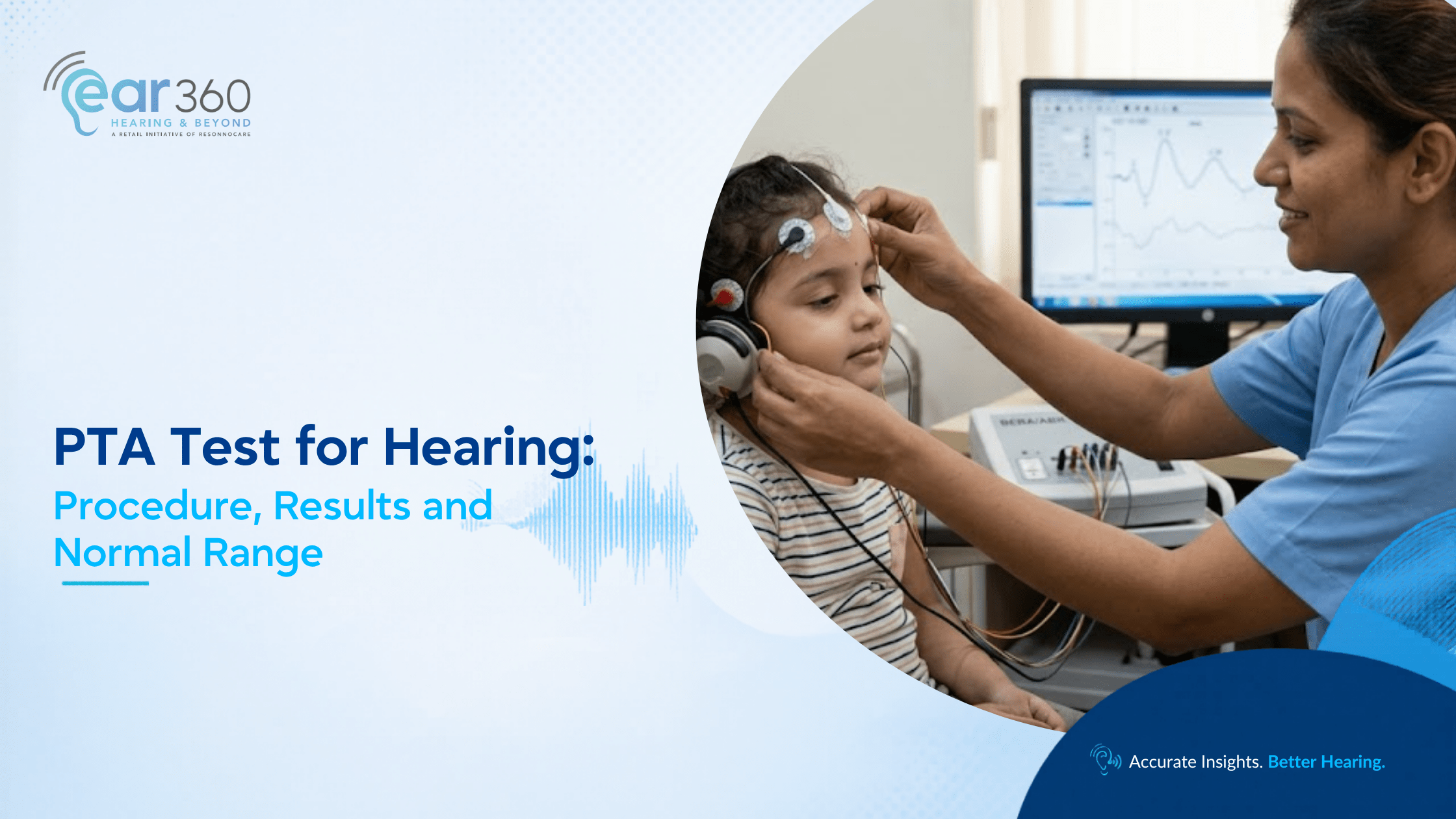
How it is performed | Sounds are played through headphones in a quiet room | Small electrodes are placed on the forehead and behind the ears while sounds are played through earphones |
Best suited for | Adults and older children who can understand and follow instructions | Newborns, infants, young children, and people who cannot reliably respond during a regular hearing test |
What the patient needs to do | Stay alert and respond whenever a sound is heard | Remain relaxed, still, or asleep during the test |
Main purpose | Identifies the degree and pattern of hearing loss across different frequencies | Assesses the functioning of the auditory nerve and brainstem hearing pathways |
Results provided | An audiogram showing hearing levels in each ear | Waveforms showing how sound signals travel from the ear to the brainstem |
Can it identify the type of hearing loss? | Air and bone conduction testing can help differentiate conductive, sensorineural, and mixed hearing loss | Helps detect hearing loss and possible problems affecting the auditory nerve or brainstem |
Test duration | Usually around 20–30 minutes, depending on the patient and tests required | Usually takes longer and may last around 30–90 minutes |
Is it painful? | No. It is painless and non-invasive | No. The electrodes only record electrical activity and do not give electric shocks |
Need for sleep or sedation | Not required | Babies and young children may need to sleep naturally. Sedation may occasionally be considered under medical supervision when they cannot remain still |
Common recommendation | Usually the first hearing test for cooperative adults and older children | Recommended when reliable behavioural hearing responses cannot be obtained or when the auditory nerve pathway needs evaluation |
What Exactly Does a PTA Test Measure?
A PTA test measures hearing sensitivity across a range of frequencies. The audiologist identifies the softest sound level that you can respond to reliably at each tested frequency in each ear. These points are then plotted on an audiogram.
PTA can help answer:
- How much hearing sensitivity is reduced
- Which frequencies are affected
- Whether the right and left ears are similar
- Whether the loss appears mild, moderate, severe, or profound
- Whether air- and bone-conduction findings suggest conductive, sensorineural, or mixed hearing loss
- Whether another hearing or medical assessment may be appropriate
PTA primarily measures detection of tones. It does not by itself show how well you understand everyday speech, especially in complex listening environments.
What Causes Hearing Loss That a PTA Test Can Detect?
A PTA test can help identify hearing loss associated with any of the following:
- Presbycusis (age-related hearing loss)
- Excessive noise, such as traffic, machinery, or listening to music at high volume for a long period of time.
- When earwax builds up or becomes blocked.
- Otitis media (ear infection) or otitis media with effusion (fluid in the middle ear)
- Hearing loss present at birth or inherited from parents.
- Some drugs that can cause hearing loss
- Traumatic injuries to the ear or trauma.
Since hearing loss can stem from issues in the outer, middle, or inner ear, a PTA test is often paired with other assessments to pinpoint the exact cause. If you are also noticing pain, discharge, or other unusual sensations, it may help to review common ear symptoms and conditions before your appointment.
What Are the Early Signs You May Need a PTA Test?
Many people experience a gradual onset of hearing loss, so a PTA test is often recommended even before symptoms get too bothersome. Signs of an early stage include the following:
- Frequently asking people to repeat themselves
- Loud noise from the TV or cell phone when others don’t need it
- Difficulty hearing or understanding speech in environments where there are background noises such as restaurants or family gatherings
- Difficulty understanding words that are not clearly articulated.
- Unusual noises in the ears (tinnitus)
- Trouble understanding high-pitched noises (like birds and doorbells)
If any of these symptoms ring a bell, a PTA test will provide clarity instead of uncertainty.
Who Is PTA Suitable For? Adults vs Children
PTA depends on the patient providing a reliable response each time a tone is heard. It is therefore most useful when the person understands the instructions and can participate consistently.
Patient | PTA suitability | What may be considered |
Cooperative adult | Usually suitable | Standard pure-tone air- and bone-conduction testing as required |
Older child who follows instructions reliably | Usually suitable | Testing adapted to age and attention level |
Very young child | Standard adult-style PTA may not be appropriate | Age-appropriate behavioural or objective hearing assessments may be considered |
Patient unable to provide reliable responses | PTA results may be unreliable | Objective tests such as BERA/ABR or OAE may be considered depending on the clinical question |
Existing hearing-aid user | Useful when hearing levels need reassessment | PTA may be combined with speech testing and device review |
The test should match the patient’s developmental level and ability to respond rather than using the same testing method for every age.
How Is a PTA Test Performed?
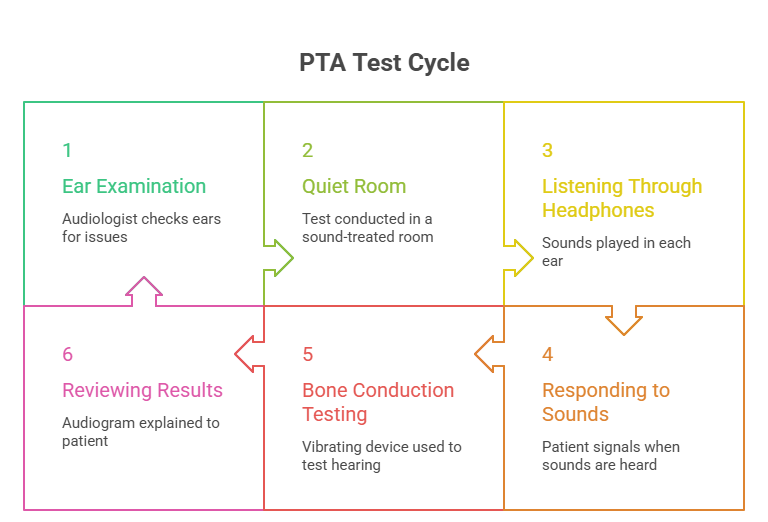
PTA test is a quick and painless hearing screening test that generally takes about 20 to 30 minutes. The following are some of the expectations for the appointment:
1. Ear Examination
The audiologist will examine the inside of your ears with a very small instrument called an otoscope before the hearing test. This can help detect earwax, infection, or any visible issue that could impact your hearing.
2. Sitting in a Quiet Room
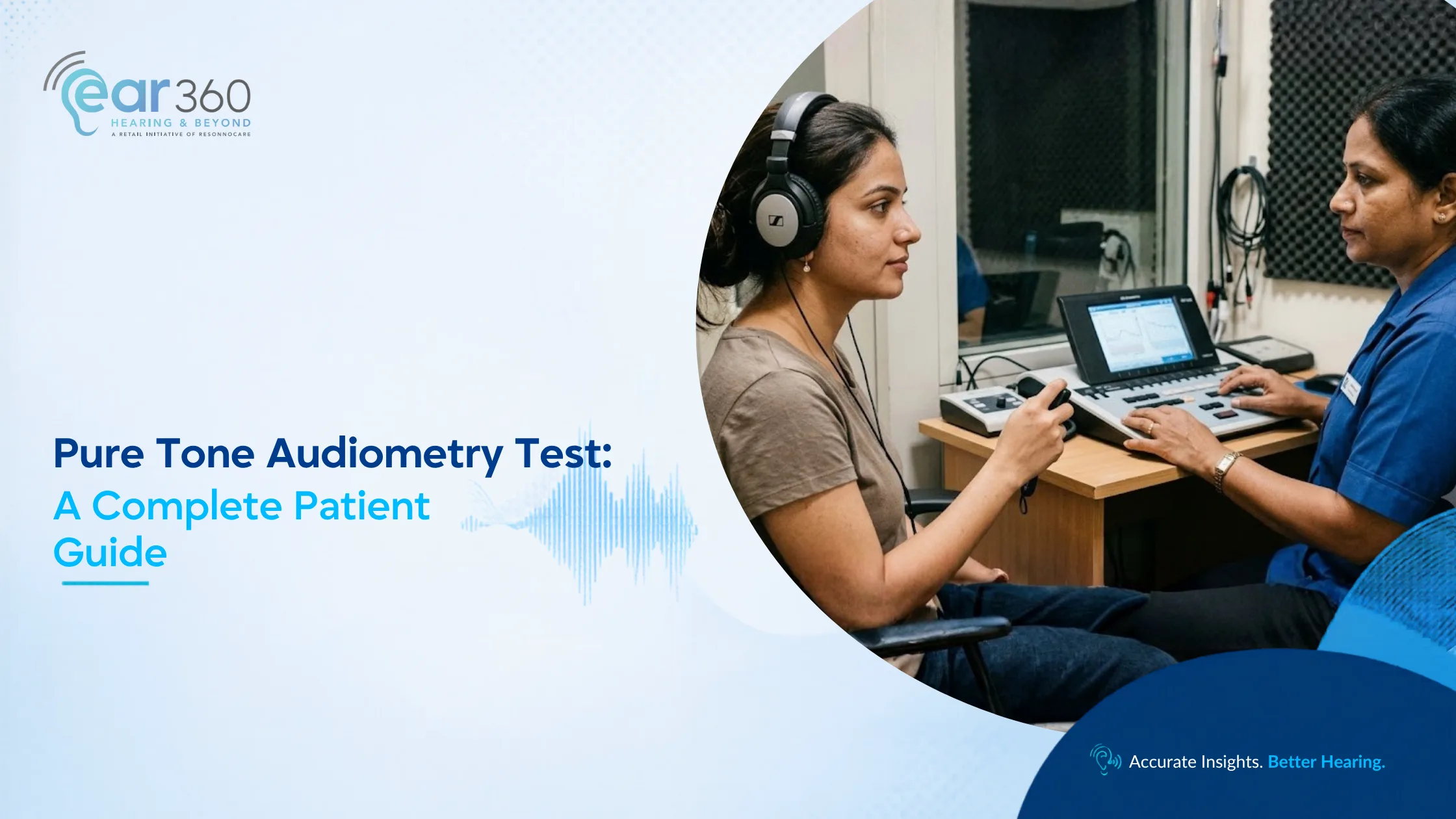
The test is typically performed in a quiet or sound-treated room in order to ensure that background noise does not impact the results of the test.
3. Listening Through Headphones
Be prepared to use headphones or earphones, and a sequence of sounds will be presented one at a time to each ear. The sounds will be of different pitch and volume.
4. Responding to Sounds
When you hear a sound, be it quieter or noisier, you will be asked to raise your hand, press a button, or provide some other simple response.
There are no right or wrong answers. Only answer when you hear the tone.
5. Bone Conduction Testing, If Needed
The audiologist sometimes may attach a tiny vibrating gadget behind your ear. This is known as bone conduction testing. It is useful to determine if the hearing loss is due to the outer or middle ear or the inner ear.
6. Reviewing Your Results
Your answers are plotted on a graph, which is called an audiogram. Following the test, the audiologist will discuss the results of the test and determine if the hearing loss is present or if the ear can hear the sounds.
Because hearing needs vary significantly across age groups, from young children to older adults, Resonnocare’s hearing care for all ages approach ensures the PTA test is conducted in a way that suits each patient’s comfort and level of comprehension.
Air Conduction vs Bone Conduction in a PTA Test
Air- and bone-conduction testing help the audiologist understand whether reduced hearing may involve the outer or middle ear, the inner ear, or a combination of these areas.
Air Conduction
Air-conduction testing presents tones through headphones or insert earphones. Sound travels through the usual pathway: outer ear → middle ear → inner ear.
Bone Conduction
Bone-conduction testing uses a vibrator placed behind the ear to stimulate the inner ear while bypassing much of the outer and middle ear.
General pattern | What it may suggest |
Air conduction poorer than bone conduction | A conductive component may be present |
Air and bone conduction reduced to a similar degree | A sensorineural pattern may be present |
Both reduced, but air conduction additionally poorer | A mixed hearing-loss pattern may be present |
These patterns need professional interpretation alongside the complete audiogram, ear examination and other hearing tests.
What Is an Air-Bone Gap in PTA?
An air-bone gap refers to a difference between the air-conduction and bone-conduction thresholds at the same or similar frequencies.
In simple terms, it may mean that the inner ear responds better when sound bypasses the outer and middle ear than when sound travels through the complete normal pathway.
An air-bone gap can prompt the audiologist to consider whether there may be:
- Earwax or another ear-canal blockage
- Middle-ear fluid
- Eardrum-related problems
- Eustachian tube or pressure-related middle-ear problems
- Reduced movement of middle-ear structures
- Another conductive component
An air-bone gap is a test finding, not a diagnosis on its own. The audiologist may use tympanometry, otoscopy and other clinical information to interpret it.
What Is Masking in a PTA Test?
Sometimes sound presented to one ear can be detected by the other ear, particularly when there is a large difference between the hearing levels of the two ears. Masking is a clinical technique used to obtain more ear-specific results in these situations.
During masking:
- A controlled noise may be presented to the non-test ear
- The tone continues to be tested in the target ear
- The audiologist uses the response to establish a more reliable threshold for the ear being assessed
Masking does not mean your hearing has become worse or that an extra disease has been found. It is a testing technique used when the audiologist needs to separate the response of one ear from the other more accurately.
What Do PTA Test Results and Normal Range Look Like?
The results of the PTA are plotted on an audiogram, which shows the softest sound level (in decibels, dB) you can hear at each frequency (in Hertz, Hz).
In general, thresholds of hearing are divided into:
- Normal hearing: 0 to 25 dB
- Mild Hearing loss :26 to 40 dB
- Moderate hearing loss: 41 to 55 dB
- Moderately severe hearing loss: 56 to 70 dB
- Severe hearing loss: 71 to 90 dB
- Profound hearing loss: more than 90 dB
The pattern of hearing loss, whether it affects one ear, both ears, or specific frequencies, is important in determining the cause and the most appropriate management pln., and a qualified audiologist should always evaluate it.
PTA Normal Range and Hearing-Loss Levels at a Glance
PTA result range | Classification used in this guide | Possible everyday implication |
0 to 25 dB | Normal hearing | Softer sounds are generally detected within the stated range |
26 to 40 dB | Mild hearing loss | Soft speech or some speech detail may become difficult, especially in noise |
41 to 55 dB | Moderate hearing loss | Normal conversation may become more difficult without support |
56 to 70 dB | Moderately severe hearing loss | Speech usually needs to be substantially louder to be detected clearly |
71 to 90 dB | Severe hearing loss | Conversational speech may be difficult to hear without amplification |
More than 90 dB | Profound hearing loss | Even very loud speech and sounds may be difficult to detect |
The degree is only one part of the result. Which frequencies are affected, whether one or both ears are involved and how clearly speech is understood can materially change the real-life impact.
Degree of Hearing Loss vs Type of Hearing Loss
“Degree” and “type” describe different parts of a PTA result.
- Degree tells you how much hearing sensitivity is reduced for example, mild, moderate, severe or profound.
- Type helps explain which part of the hearing pathway may be contributing for example, conductive, sensorineural or mixed hearing loss.
Type | Typical PTA relationship |
Conductive hearing loss | Air-conduction thresholds may be poorer than bone-conduction thresholds |
Sensorineural hearing loss | Air- and bone-conduction thresholds may both be reduced without a significant air-bone gap |
Mixed hearing loss | Both air and bone conduction may be reduced, with air conduction additionally poorer |
A person can therefore have mild conductive loss, moderate sensorineural loss or another combination of type and degree.
Can PTA Detect Every Hearing Problem?
No. PTA is an important measure of hearing sensitivity, but it does not assess every part of hearing or every communication problem.
PTA does not directly tell you:
- How clearly you understand words
- How well you hear speech in background noise
- Whether the auditory nerve and brainstem are functioning normally
- Whether a newborn or very young child hears normally when reliable behavioural responses cannot be obtained
- Whether middle-ear function is normal
- The exact medical cause of every hearing-loss pattern
- Whether someone has an auditory-processing difficulty
This is why PTA may be combined with speech audiometry, tympanometry, OAE, BERA/ABR or other assessments according to the patient’s age, symptoms and test findings.
What Is the Role of Speech Testing After PTA?
PTA tells the audiologist how softly tones can be heard. Speech audiometry adds information about how speech is detected and understood.
Speech testing can be useful when:
- You can hear people talking but words remain unclear
- The pure-tone result appears better than your everyday communication experience
- The audiologist needs additional information before planning hearing rehabilitation
- There is a significant difference between the ears
- Hearing aids are being considered
- The clinician wants to discuss realistic communication expectations
A hearing-aid decision should not necessarily be based on the PTA threshold alone when speech understanding and real-life communication difficulties provide important additional information.
Why Can Speech Still Be Difficult With a Relatively Good PTA Result?
PTA is performed with simple tones in a controlled environment. Real-world speech is much more complex. Background noise, distance, several people speaking, telephone quality and missing visual cues can all make communication harder.
You may therefore have relatively mild hearing thresholds but still report:
- Difficulty in restaurants
- Listening fatigue after meetings
- Problems understanding telephone calls
- Missing softer consonants
- Difficulty following group conversations
- Dependence on lip-reading or visual cues
These concerns should be discussed with the audiologist even if the PTA result appears only mildly reduced.
When Should You See an Audiologist or Doctor?
Some hearing symptoms should not be ignored and require immediate professional evaluation; a PTA test is usually included in a routine hearing check.
- Acute hearing loss, in one or both ears, sudden
- Ongoing ringing or buzzing of the ears
- Earache, discharge, or sensation of ear fullness
- Dizziness and/or balance problems with hearing loss
- Persistent hearing loss that persists for more than a few weeks.
The symptoms mentioned above should not be left unchecked or self-diagnosed, as early evaluation typically leads to better outcomes.
Is PTA Enough Before Buying Hearing Aids?
PTA is an important part of a hearing-aid evaluation, but a hearing-aid decision should usually consider more than a pure-tone graph alone.
Before selecting a hearing aid, the clinician may also consider:
- Speech-understanding ability
- Ear health
- Whether one or both ears are affected
- Type and pattern of hearing loss
- Real-life communication difficulty
- Work and social listening environments
- Tinnitus
- Manual dexterity and vision
- Previous hearing-aid experience
- Whether medical or ENT referral is required
- Expected benefit from amplification
PTA provides the hearing thresholds that help guide programming, but the device recommendation should be based on the complete hearing and communication profile.
What Treatment or Management Options Are Available After a PTA Test?
After a PTA test, management will rely solely on the nature of the loss and the severity of the hearing loss. Your Audiologist might suggest:
- Medical treatment for infections or fluid-related ear conditions.
- Removing earwax caused by blockage if it is causing hearing problems.
- If the hearing loss is sensorineural, hearing aids can be used. For sensorineural hearing loss, hearing aids can be used.
- Assistive listening devices for specific situations, such as the workplace or the classroom.
- Ongoing screening of mild or early hearing loss
If hearing aids are recommended, Resonnocare’s free hearing aid trial allows you to experience the difference in real-world settings before making a decision, which many patients find genuinely helpful.
PTA Result to Next Step: Decision Table
PTA finding or situation | Possible next step to discuss |
Hearing thresholds within the expected range and no significant symptoms | Routine monitoring according to the audiologist’s advice |
Normal or near-normal PTA but speech remains difficult | Speech audiometry or additional assessment may be considered |
Mild hearing loss with limited daily impact | Monitoring, communication strategies, hearing protection and follow-up may be discussed |
Hearing loss affecting work, family or social communication | Hearing-aid evaluation or trial may be appropriate |
Air-bone gap / conductive pattern | Ear examination, tympanometry and/or medical evaluation may be required |
Sensorineural pattern | Discuss cause, speech understanding, amplification suitability and monitoring |
Mixed hearing loss | Management may involve both medical care and hearing rehabilitation |
One ear is significantly poorer than the other | Ask whether additional audiological or ENT assessment is appropriate |
Sudden hearing loss | Seek urgent medical/ENT evaluation rather than treating PTA as a routine hearing-aid pathway |
Existing hearing aids provide less benefit than before | Review PTA thresholds, speech understanding, device performance and programming |
Questions to Ask When Reviewing Your PTA Report
After the test, ask your audiologist:
- Is hearing loss present in one ear or both?
- What degree of hearing loss is present?
- Which frequencies are affected most?
- What do my air- and bone-conduction results show?
- Is there an air-bone gap?
- Does the result suggest conductive, sensorineural or mixed hearing loss?
- Was masking required, and why?
- Do I need speech audiometry?
- Do I need tympanometry or another hearing test?
- Does anything in the result require ENT review?
- Should I monitor the hearing or consider treatment?
- Would a hearing-aid trial be useful?
- When should the PTA be repeated?
The aim is to leave with a clear next decision, not simply a printed audiogram.
Where to Read the Detailed Audiogram Symbols
This page should remain focused on the PTA procedure, normal ranges, hearing-loss pattern and next step. If you want to understand the individual X/O symbols, frequency and decibel axes, right-versus-left-ear markings or more detailed audiogram interpretation, use the dedicated Pure Tone Audiometry Test: What Your Audiogram Means guide.
Keeping detailed symbol interpretation on that page helps separate two questions clearly:
- This PTA guide: “How is PTA done, what is the normal range and what happens next?”
- Audiogram interpretation guide: “What exactly do the symbols and patterns on my report mean?”
PTA vs Broader Audiometry: Where This Test Fits
PTA is one important type of audiometry, but “audiometry” can refer to a broader hearing-assessment pathway containing several tests.
Use the broader audiometry hub when your question is:
- Which hearing test do I need?
- What are the different types of audiometry?
- Is speech audiometry included?
- How does audiometry differ from tympanometry or OAE?
- What factors affect the cost of a complete hearing evaluation?
Use this PTA page when your question specifically concerns pure-tone thresholds, PTA procedure, air/bone conduction, normal range and what the result means for your next decision.
PTA Content Consolidation Note
This URL should remain the primary PTA procedure/result/normal-range guide. If another Resonnocare page substantially duplicates the same PTA intent, retain genuinely unique information, consolidate it into this canonical guide where useful, and evaluate the overlapping URL for redirection rather than maintaining multiple pages competing for the same query.
The broader audiometry hub should remain responsible for test selection and comparison, while the audiogram page should remain responsible for detailed report-symbol interpretation.
How Can Resonnocare Help
We are committed to making the PTA testing experience simple and stress-free, whether it is a child’s first hearing assessment or a routine follow-up appointment. We provide clear explanations, without all the jargon, so you walk out of the appointment with a true understanding of your hearing health, not just a paper report.
For patients who find it difficult to visit a clinic, Resonnocare also offers home visits and video consultations, making evaluations and follow-ups more accessible.
Why Choose Resonnocare for Hearing and Audiology Care
Resonnocare is founded on guided, patient-centric hearing care based on clinical experience. We have a staff of audiologists and clinicians who go the extra mile to ensure your hearing is tested correctly, whether it is the PTA test or another method. Each result is explained in detail, and a personal care plan appropriate to your lifestyle, age, and hearing requirements is provided.
Beyond testing, we support you through the complete hearing care journey, including hearing aid fitting, home visits, video consultations for added convenience, and structured aftercare to ensure your hearing solution continues to serve you well over time.

Find a Resonnocare Clinic Near You
Select your city to find the nearest Resonnocare clinic and book an appointment with our hearing care team.
Bangalore
Ear 360, Jayanagar
Ground Floor, Site No. 499, Municipal No. 499/97, East End Main Road, 9th Block, Jayanagar, Bangalore, Karnataka 560041
Timings: 10:00 AM to 7:00 PM
[Call] [Book an Appointment]
Ear 360, Spandana Sarjapura Hospital
239/205/34A, near Trinity Complex, Sompura Gate, Sarjapura Main Road, Bangalore, Karnataka 562125
Timings: 10:00 AM to 7:00 PM
[Call] [Book an Appointment]
Resonnocare, HSR Layout
150/5/72, 7th Cross, 24th Main, HSR Layout, Bangalore, Karnataka 560102
Timings: 10:00 AM to 7:00 PM
[Call] [Book an Appointment]
Resonnocare, Banashankari
272, 7th Cross Road, BSK 1st Stage, 2nd Block, Srinivasan Agra, 80 Feet Road, Bangalore, Karnataka 560050
Timings: 10:00 AM to 7:00 PM
[Call] [Book an Appointment]
Resonnocare, Indiranagar
34, Wind Tunnel Road, Murugeshpalya, Muniyappa Layout, Bangalore, Karnataka 560017
Timings: 10:00 AM to 7:00 PM
[Call] [Book an Appointment]
Delhi
Ear 360, Dr. Hans Anand Lok
46, Anand Lok Road, Anand Lok, Sadiq Nagar, New Delhi, Delhi 110049
Timings: 10:00 AM to 7:00 PM
[Call] [Book an Appointment]
Resonnocare, Dr. Hans Vasant Vihar
28, Basement, Paschimi Nagar, Vasant Vihar, New Delhi, Delhi 110057
Timings: 10:00 AM to 7:00 PM
[Call] [Book an Appointment]
Gurgaon
Resonnocare Head Office, M3M Urbana
Office 403, Office Block, 4th Floor, above Retail Blocks R1 and R5, M3M Urbana, Sector 67, Gurgaon, Haryana 122101
Timings: 10:00 AM to 7:00 PM
[Call] [Book an Appointment]
Resonnocare, Dr. Hans Sector 28
Plot No. 1SP, adjoining DLF Phase 1 Metro Station, Sector 28, Gurgaon, Haryana 122002
Timings: 10:00 AM to 7:00 PM
[Call] [Book an Appointment]
Ludhiana
Ear 360, BRS Nagar
963, Block B, BRS Nagar, Ludhiana, Punjab 141012
Timings: 10:00 AM to 7:00 PM
[Call] [Book an Appointment]
Resonnocare, Fawwara Chowk
565-A and 565-B, Upper Ground Floor, Cemetery Road, near Fawwara Chowk, West City, Ludhiana, Punjab 141001
Pune
Ear 360, Vighnaharta Healthcare Center
D-106-107, Choice Arcade, opposite Ruby Hall Hospital, Dhole Patil Road, Pune, Maharashtra 411001
Timings: 10:00 AM to 7:00 PM
[Call] [Book an Appointment]
Ear 360, Khan Parab ENT Hospital
Plot No. 102, Anand Nagar, Talegaon Dabhade, Taluka Maval, Pune, Maharashtra 410507
Timings: 10:00 AM to 7:00 PM
[Call] [Book an Appointment]
Tumkur
Resonnocare, Ashok Nagar
PID No. 3563, 8th Main, 8th Cross, Ashok Nagar, Tumkur, Karnataka 572103
Timings: 10:00 AM to 7:00 PM
[Call] [Book an Appointment]
Conclusion
One of the best ways to know about your hearing health is to get a PTA test. This test provides a clear understanding of how well you hear sounds at different pitches and volumes. From noticing early indications of hearing loss to simply wanting a baseline assessment, knowing what to expect, the outcome, and the normal range of values from a PTA test can help you make informed decisions about your hearing care.
If you’ve noticed changes in your hearing or want to stay updated on your hearing health, Resonnocare’s clinical team is available to guide you. Schedule a PTA test or consultation with Resonnocare today and take the first step toward clearer, more confident hearing.
FAQ’s
What is the test of PTA?
Pure Tone Audiometry (PTA) is a test that measures how well a person can hear sounds at various frequencies and loudness levels. In the test, you listen to a tone through your headphones and then respond to it. PTA can assist in determining the type, level, and nature of hearing loss, enabling an audiologist and ENT doctor to recommend the most suitable treatment or hearing options.
Is a PTA test painful?
No, there is no pain involved in a PTA test. This technique involves listening to sounds through headphones and pointing to them as you hear them. No injections, instruments in the ear canal, or any uncomfortable procedure are required. The test is painless and safe for children and adults.
What is a PTA blood test?
The PTA hearing test is not the same as a PTA blood test. Audiology uses PTA, or Pure Tone Audiometry, to assess hearing ability. In medical labs, PTA may be used to test blood clotting or for other measurements. If your doctor refers you for a blood test called PTA, ask which test is being ordered.
What is the cost of a hearing PTA test?
The price of a PTA hearing test in India ranges from ₹300 to ₹2,000, depending on the clinic, location, and any other hearing assessment tests you might need. If the test is part of a comprehensive audiological assessment, some specialized hearing centers may have higher fees. Always ask the clinic for definite rates.
How long does a PTA test take?
A PTA test typically takes 15–30 minutes to complete. This may take longer if further hearing tests are needed, depending on the patient’s cooperation and age. The test is fast and easy, and it provides information on hearing sensitivity to enable specialists to diagnose hearing loss and plan suitable treatment.