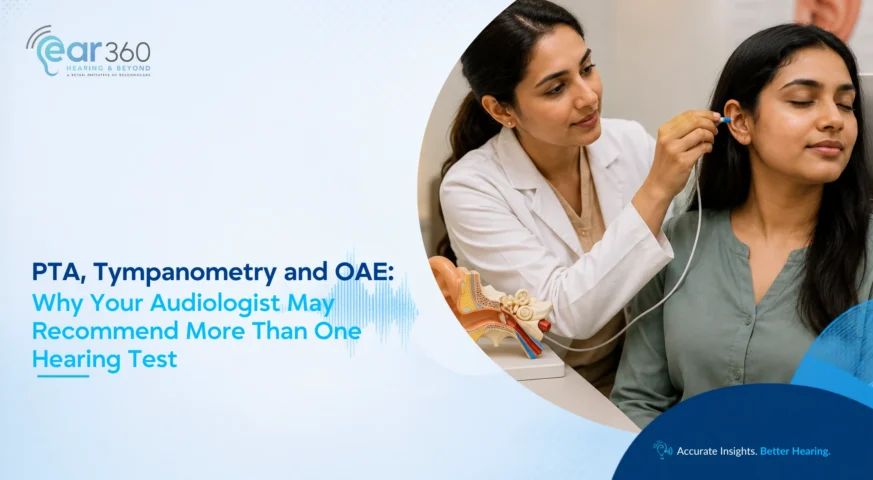
PTA, Tympanometry and OAE: Why Your Audiologist May Recommend More Than One Hearing Test
TL;DR: This blog is aimed for Adults, parents, caregivers, and patients who have been advised to undergo PTA, tympanometry, or OAE testing and want to understand why an audiologist may recommend multiple hearing tests during the same evaluation. Each hearing test evaluates a different part of the hearing system: PTA measures hearing thresholds across different frequencies, tympanometry checks middle-ear and eardrum function, while OAE assesses how well the cochlea or inner ear responds to sound. Combining PTA and tympanometry provides a more complete diagnosis: PTA can identify whether hearing ability has reduced, while tympanometry helps determine whether middle-ear issues such as fluid, pressure imbalance, or eardrum problems may be contributing to the hearing difficulty. OAE may be added when more information about inner-ear function is needed: It can be particularly useful for young children or when PTA and tympanometry results require further clarification, helping audiologists distinguish between different types and possible causes of hearing loss. Accurate testing helps guide the right treatment or management plan: The blog explains common symptoms, when to see an audiologist, how the tests are performed together, and how results may lead to monitoring, ENT referral, hearing aids, or other personalised hearing-care recommendations. The hearing check might require only one test, but you may be asked to have a PTA, tympanometry, and maybe an OAE as well. Anyone can ask themselves why so many tests are required and why it is that they are all needed. This is because there isn’t a single hearing test that can give your audiologist all of the information they need. One test evaluates the sensitivity to sounds, another tests the motion and pressure of the middle ear, and another tests the response of the inner ear to sound. Combining these findings, your audiologist can also better determine the source of your hearing difficulty and what steps to take next. Here is a primer on PTA, tympanometry, OAE, what each test does, why your audiologist might need to order more than one type of hearing test, and what your test results can tell you about your hearing health. What Is PTA and Tympanometry? The most common test that people imagine when they think about a hearing check is PTA (Pure Tone Audiometry). You are seated in a quiet room or booth with headphones and listen as soft beeps are played at various frequencies and intensities. It determines the softest sound you can hear at every frequency, providing your audiologist with a precise picture of how well you hear at low, mid, and high frequencies. In contrast to the above, tympanometry is not a direct test of hearing. It, on the other hand, tests the response of your eardrum to air pressure changes. A small, soft probe is inserted into the ear canal for a few seconds, and the results indicate whether fluid is behind the eardrum, if perforation is possible, or if there is pressure imbalance in the middle ear. Combined, PTA and tympanometry provide a more comprehensive evaluation of hearing and why hearing problems may be arising. Know More About Hearing Tests PTA Test for Hearing: Procedure, Results and Normal Range PTA Test for the Ear: What It Measures and When It Is Needed Tympanometry Test: Procedure, Cost & Result Meaning Why Might Your Audiologist Recommend More Than One Test? The causes of hearing concerns are not always clear, which is why PTA and tympanometry are frequently all done at the same appointment. With PTA, your audiologist will know that your hearing threshold has changed, but not necessarily why. Tympanometry is a test that helps to determine if the middle ear is working correctly. In a few instances, especially for children younger than 18 months or for patients who require an in-depth inner ear response, OAE (Otoacoustic Emissions) testing is included as well, which measures how well the cochlea is reacting to sound. PTA and tympanometry can be used together – sometimes in combination with OAE – to help your audiologist determine if there is a middle ear problem and the type of hearing loss (conductive hearing loss versus sensorineural hearing loss caused by inner ear or auditory nerve problems). If one were to use just one of the above techniques, a diagnosis might be incomplete or incorrect. What Causes the Hearing Issues These Tests Help Identify? Hearing problems can happen for many different reasons, and the cause is not always obvious from symptoms alone. This is why audiologists may use PTA, tympanometry and OAE together to understand which part of the hearing system may be affected. Some common causes include: Earwax blockage, which can reduce the amount of sound reaching the eardrum Fluid behind the eardrum, often after a cold, allergy or infection Middle ear infections, which can temporarily affect hearing A perforated eardrum, which may change the way sound is conducted through the ear Age-related changes in hearing, which usually develop gradually Long-term exposure to loud sounds, which can affect the inner ear Inner ear or auditory nerve problems, which may need more detailed assessment Some hearing problems are temporary and may improve once the underlying cause is treated. Others may require ongoing monitoring or hearing support. This is why identifying where the problem is coming from is important before deciding on treatment. PTA, tympanometry and OAE give your audiologist different pieces of information that can be put together to form a clearer picture of your hearing. What Are the Early Signs You May Need Hearing Tests? You do not have to wait until hearing loss becomes severe before having your hearing checked. In fact, many hearing changes begin gradually and can be easy to overlook at first. You may want to consider a hearing test if you notice that: You often ask people to repeat themselves The television or phone volume needs to be higher than before Conversations are difficult to follow in restaurants, markets or family gatherings Speech sounds unclear or as though people are mumbling One ear seems to hear better than the other
Read More