
TL;DR:
The blog is intended for adults experiencing hearing difficulty, parents or caregivers concerned about a family member’s hearing, people frequently exposed to loud noise, and patients advised to undergo a PTA hearing test.
- Purpose of a PTA Test: The blog explains that Pure Tone Audiometry measures the quietest sounds a person can hear across different frequencies. The results are recorded on an audiogram to provide a detailed picture of hearing sensitivity in each ear.
- What the Test Measures: It describes air conduction and bone conduction testing, which help an audiologist identify whether hearing loss is conductive, sensorineural, or mixed, along with its severity and frequency pattern.
- When the Test May Be Needed: The blog highlights common warning signs such as frequently asking people to repeat themselves, difficulty understanding speech in noisy places, increasing device volume, tinnitus, and avoiding conversations because of hearing difficulties.
- Testing, Results, and Resonnocare Support: It explains that the PTA test is painless, non-invasive, and usually completed within 20 to 30 minutes. Based on the results, Resonnocare may recommend medical referral, earwax management, monitoring, hearing aids, or further hearing evaluation.
If you or a family member has had a history of difficulty hearing conversations or hearing things that aren’t clearly heard, a PTA test to evaluate your ears is a first step towards understanding what is going on. PTA (also called Pure Tone Audiometry) is the most frequently used and widely accepted hearing test in audiology. This test is used at Resonnocare every day to aid hearing health patients of all ages with a clear and accurate picture.
This blog is intended to tell you what the tests are as well as what they measure and when to consider getting one done.
What Is a PTA Test for the Ear?
The PTA test for ear assessment is a typical hearing test that measures the lowest sound level someone can hear at various frequencies, or pitches. It takes place in a quiet room or sound-treated room with headphones attached to an audiometer that produces tones of different volumes and frequencies.
This is graphed on an audiogram, which will indicate the lowest volume that you can hear at each pitch for each ear. This also means the PTA test is one of the most objective and reliable means of understanding hearing sensitivity.
Unlike a fast screening, the ear test performed by a PTA provides a detailed, frequency-specific assessment of hearing ability, which can assist an audiologist in determining the type, degree, and pattern of hearing loss (if there is one).
What Does a PTA Test Measure?
The typical PTA test performed on ears will measure two items:
- Air conduction: This is to see how sound is conducted along the ear canal and the eardrum and middle ear bones to the inner ear. Measured using headphones.
- Bone conduction: This measures the conduction of sound directly through bone (skull) without the outer and middle ear. It is measured by a small vibrating device located at the back of the ear.
A comparison of these two results will help your audiologist determine if the hearing loss is conductive (ear canal or middle ear), sensorineural (inner ear or hearing nerve), or a combination of both.
What Causes Hearing Loss That May Require a PTA Test?
Over time, several factors can impact hearing, such as:
- Extended duration of exposure to loud noise, work, headphones, or living in a town with lots of traffic.
- Inner ear changes associated with aging.
- Middle-ear infection or fluid in the middle ear.
- Earwax blockage
- Some drugs that affect hearing (ototoxic drugs)
- Genetic or congenital disabilities
- Exposure to an injury to the head or exposure to sudden loud noises
In most instances, hearing loss is not sudden and occurs over a prolonged period of time; this is where a PTA test for ear evaluation comes in handy, even if it doesn’t feel like a problem or if it is only occasional.
What Are the Early Signs You May Need a PTA Test?
The changes in hearing are usually gradual at first. Early indicators are:
- Frequently asking others to repeat themselves
- Increasing the volume of the TV or phone more than normal
- Trouble hearing what is said in crowded areas such as restaurants or family get-togethers
- The sensation of being unable to hear others speak.
- Ringing or buzzing noises in the ear (tinnitus)
- Avoiding social activities because of problems listening
If you notice any of these patterns in yourself or a loved one, it may be worth reviewing common ear symptoms and conditions to understand what could be contributing to the change.
When Should You See an Audiologist or Doctor?
There is a certain amount of hearing loss that is normal and not a matter of concern; however, if there are some symptoms, it is important to seek immediate attention from a professional. If you have any of the following symptoms, it’s important to seek advice from an audiologist or an ENT specialist:
- Acute loss of hearing in one or both ears
- Severe ear pain
- Discharge or fluid coming from the ear
- Continued dizziness or vertigo
- When tinnitus persists and does not get better.
- Recurrent hearing loss (recurring for more than a couple of weeks)
These symptoms are signs of other underlying problems that need immediate medical attention, and a PTA test for ear assessment might be a part of ear assessment tests.
How Is a PTA Test for the Ear Conducted?
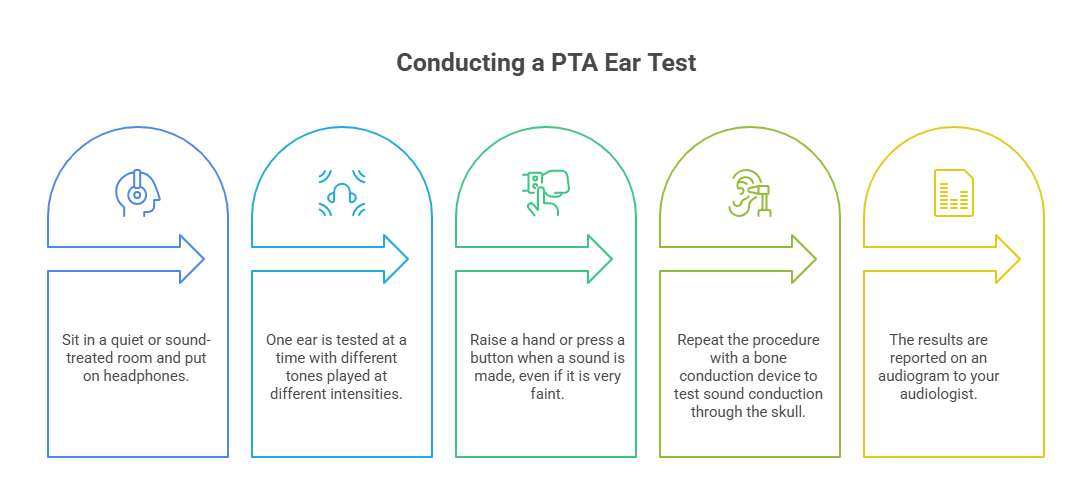
It’s easy and painless and typically requires about 20-30 minutes. Here are some things to look for:
- You are required to sit in a quiet room or sound-treated room and to have headphones on.
- One ear will be used at a time and different tones will be played with different intensities.
- When a sound is made, you will have to raise a hand or press a button, and you will respond even if the sound is very faint.
- The procedure is repeated again with a bone conduction device to see how the sound is conducted through the skull.
- These are reported on an audiogram to your audiologist.
This test is comfortable, requires no needles or invasive procedures, and is suitable for most age groups, including children old enough to follow simple instructions. For families managing hearing concerns across generations, exploring hearing care for all ages can help identify the right testing approach for each family member.
What Do PTA Test Results Show?
An audiogram created with a PTA test for ear evaluation will help your audiologist determine:
- Whether or not hearing loss is present and in which ear
- The severity of the hearing loss – mild, moderate, moderate to severe, severe or profound
- Whether the hearing loss is conductive, sensorineural, or mixed
- If the pattern applies to certain frequencies (high-pitched sounds)
These insights can help your audiologist decide what to do next, such as more testing, referral for medical help,p or evaluation of hearing aids.
What Treatment or Management Options Are Available?
Based on the results of the PTA test for the ear, management could involve:
- Treatment of infection or accumulation of fluid in the body
- Washing out ear wax if it is causing hearing loss.
- Hearing Aids programmed to fit your particular audiogram
- Regular check-ups for progressive hearing loss that may occur with age.
- Re-referral for structural or medical issues to an ENT specialist.
If hearing aids are recommended, Resonnocare’s free hearing aid trial allows you to experience the difference before making a decision, with guidance from a qualified audiologist at every step.

Why Choose Resonnocare for Hearing and Audiology Care?
At Resonnocare, hearing care is always clinically guided and built around your individual needs. Our team of experienced audiologists and clinicians uses standardized testing protocols to ensure every PTA test for ear evaluation is accurate and reliable.
Beyond testing, we focus on personalized care plans that consider your lifestyle, symptoms, and comfort. Whether you need a detailed hearing assessment, guidance on hearing aids, or ongoing support after fitting, our team is involved throughout the process. For those unable to visit a clinic easily, home visit consultations and video consultations make quality hearing care accessible without compromising on clinical accuracy. Our commitment to aftercare also means your hearing health is monitored well beyond the first appointment.
Find a Resonnocare Clinic Near You
Select your city to find the nearest Resonnocare clinic and book an appointment with our hearing care team.
Bangalore
Ear 360, Jayanagar
Ground Floor, Site No. 499, Municipal No. 499/97, East End Main Road, 9th Block, Jayanagar, Bangalore, Karnataka 560041
Timings: 10:00 AM to 7:00 PM
[Call] [Book an Appointment]
Ear 360, Spandana Sarjapura Hospital
239/205/34A, near Trinity Complex, Sompura Gate, Sarjapura Main Road, Bangalore, Karnataka 562125
Timings: 10:00 AM to 7:00 PM
[Call] [Book an Appointment]
Resonnocare, HSR Layout
150/5/72, 7th Cross, 24th Main, HSR Layout, Bangalore, Karnataka 560102
Timings: 10:00 AM to 7:00 PM
[Call] [Book an Appointment]
Resonnocare, Banashankari
272, 7th Cross Road, BSK 1st Stage, 2nd Block, Srinivasan Agra, 80 Feet Road, Bangalore, Karnataka 560050
Timings: 10:00 AM to 7:00 PM
[Call] [Book an Appointment]
Resonnocare, Indiranagar
34, Wind Tunnel Road, Murugeshpalya, Muniyappa Layout, Bangalore, Karnataka 560017
Timings: 10:00 AM to 7:00 PM
[Call] [Book an Appointment]
Delhi
Ear 360, Dr. Hans Anand Lok
46, Anand Lok Road, Anand Lok, Sadiq Nagar, New Delhi, Delhi 110049
Timings: 10:00 AM to 7:00 PM
[Call] [Book an Appointment]
Resonnocare, Dr. Hans Vasant Vihar
28, Basement, Paschimi Nagar, Vasant Vihar, New Delhi, Delhi 110057
Timings: 10:00 AM to 7:00 PM
[Call] [Book an Appointment]
Gurgaon
Resonnocare Head Office, M3M Urbana
Office 403, Office Block, 4th Floor, above Retail Blocks R1 and R5, M3M Urbana, Sector 67, Gurgaon, Haryana 122101
Timings: 10:00 AM to 7:00 PM
[Call] [Book an Appointment]
Resonnocare, Dr. Hans Sector 28
Plot No. 1SP, adjoining DLF Phase 1 Metro Station, Sector 28, Gurgaon, Haryana 122002
Timings: 10:00 AM to 7:00 PM
[Call] [Book an Appointment]
Ludhiana
Ear 360, BRS Nagar
963, Block B, BRS Nagar, Ludhiana, Punjab 141012
Timings: 10:00 AM to 7:00 PM
[Call] [Book an Appointment]
Resonnocare, Fawwara Chowk
565-A and 565-B, Upper Ground Floor, Cemetery Road, near Fawwara Chowk, West City, Ludhiana, Punjab 141001
Pune
Ear 360, Vighnaharta Healthcare Center
D-106-107, Choice Arcade, opposite Ruby Hall Hospital, Dhole Patil Road, Pune, Maharashtra 411001
Timings: 10:00 AM to 7:00 PM
[Call] [Book an Appointment]
Ear 360, Khan Parab ENT Hospital
Plot No. 102, Anand Nagar, Talegaon Dabhade, Taluka Maval, Pune, Maharashtra 410507
Timings: 10:00 AM to 7:00 PM
[Call] [Book an Appointment]
Tumkur
Resonnocare, Ashok Nagar
PID No. 3563, 8th Main, 8th Cross, Ashok Nagar, Tumkur, Karnataka 572103
Timings: 10:00 AM to 7:00 PM
[Call] [Book an Appointment]
Conclusion
Whether you are aware of subtle changes in your hearing or have been recommended to have a PTA test due to other symptoms, it is still one of the most effective tests to learn about your hearing. Waiting is seldom the best approach, as early evaluation often makes management easier and more effective.
If someone in your family or you notices changes in your hearing, don’t wait for symptoms to get worse. Schedule a PTA test today to have an expert audiology team member evaluate your ears and take a step towards clearer, more confident hearing with Resonnocare.
FAQs
What is a PTA test for the ear?
A PTA test measures the lowest volume (or quietest sound) you can hear across different frequencies. It is an objective test conducted in a sound-treated room to map your hearing sensitivity.
Is a PTA test painful or invasive?
No. The PTA test for ear assessment is totally non-invasive, and there is no discomfort or needles involved. All you have to do is touch a button or raise your hand when a tone is sounded, typically when you hear it.
How long does a PTA test take?
Most PTA tests last anywhere from 20 to 30 minutes, depending on the number of frequencies being tested and whether air and bone conduction are to be evaluated.
Can a PTA test be done for children?
Yes, a PTA test to assess the ear is appropriate for children above the age of 5 years who can follow simple instructions. For younger children, alternative testing techniques might be more appropriate.
How often should you get a PTA test done?
There is no set time for all of them. A hearing test or ear check is advised if any hearing changes, hearing ringing, or risk factors such as frequent exposure to loud noise are noticed. If not, your audiologist can recommend an appropriate period of time based on your hearing history.