


TL; DR:
This blog is for people who are using hearing aids for the first time, especially those in their first month of use who want to understand what is normal, how to adjust, and when to contact their audiologist.
- The first 30 days are mainly about adjustment: New hearing aid users may notice everyday sounds, their own voice, or background noises more strongly at first. Gradual adaptation and consistent use are important during this period.
- Each week brings different listening goals: The blog guides users from getting comfortable with their hearing aids in Week 1 to testing real-life environments, identifying fine-tuning needs, and building a regular routine by Week 4.
- Daily care and specific feedback improve aftercare: Proper cleaning, charging, storage, and noting exactly where listening problems occur can help keep hearing aids working reliably and give audiologists better information during follow-up appointments.
- Some problems should not simply be waited out: Persistent discomfort, poor fit, unclear speech, repeated feedback, sudden hearing changes, severe ear pain, discharge, vertigo, or severe tinnitus should be discussed with an audiologist or medical professional rather than treated as normal adjustment.
During the first few weeks, your brain is becoming familiar with sounds that may not have been as noticeable for some time. Everyday noises such as fans, utensils, traffic, footsteps and even your own voice may initially seem different or more noticeable.
What Should You Expect During Your First 30 Days With Hearing Aids?
The first month is typically an adaptation period. Your hearing aids are set to your hearing assessment. A clinic fitting gives your audiologist a starting point. Everyday situations such as conversations, television, traffic, and meetings show how those settings work in real life.
Sometimes speech may sound clearer, while at other times it may not. Some noises may sound louder than usual, or you might notice that your voice doesn’t sound the same.
Try not to judge the hearing aids based on the first day alone. Use them on a schedule as recommended by your audiologist and be aware of the contexts in which listening is easy, challenging, too loud, or too unclear.
These observations are valuable as hearing aid fitting doesn’t always stop once you walk out the door. Later changes can be made with the help of your own experience in your home, work, travel, and conversations.
Week 1 of the First 30 Days With Hearing Aids: Getting Used to Sound Again
In the first week, concentrate on comfort and everyday wear.
Understand the proper insertion and removal of hearing aids. Know how to charge them or change batteries, how to clean parts that your audiologist has demonstrated to you, and how to store the devices safely.
Start in familiar listening environments such as home and gradually build confidence with everyday use. Have one-on-one conversations with family, watch TV at a comfortable level, and listen to daily household noises.
The ceiling fan, running water, rustling of paper, footsteps, or utensils might be more noticeable than usual all at once. These sounds may sound sharper at first since your auditory system is taking in information that might not have been as prominent in the past.
If pain, pressure, soreness, or irritation is persistent, however, this shouldn’t be taken for granted as a normal part of the adjustment process.
If your hearing aids whistle often, are loose, do not fit properly, or cause discomfort, contact your audiologist about a different fit and do not change the physical fit yourself.
Week 2 of the First 30 Days With Hearing Aids: Testing Real-Life Listening
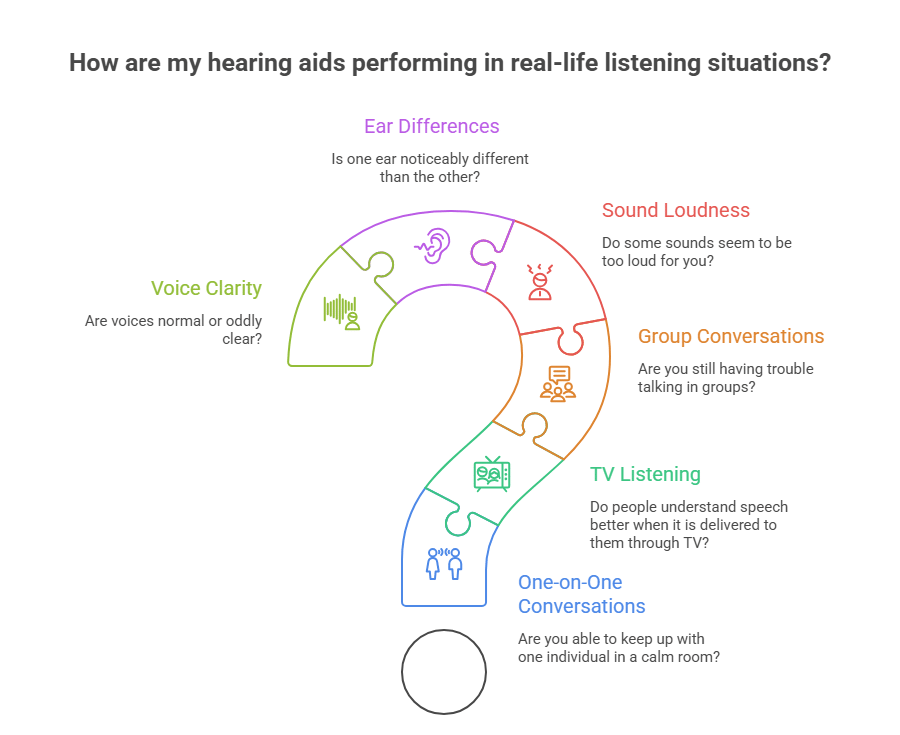
After two weeks, slowly try your hearing aids out in more environments.
This could be during family meals, small gatherings, out on walks, shops, places of worship, work meetings, etc.
Rather than label the hearing aid as “good” or “bad”, identify particular listening contexts:
- Are you able to keep up with one individual in a calm room?
- Is television speech easier to follow?
- Are group conversations still difficult to follow?
- Do some sounds seem to be too loud for you?
- Is one ear noticeably different than the other?
- Do voices sound natural, too sharp, hollow or muffled?
This information can assist your audiologist in determining if the problem is related to adaptation, fitting, device handling, or programming.
Week 3 of the First 30 Days With Hearing Aids: Knowing What May Need Fine-Tuning
By around the third week, many users have a clearer idea of what is working well and which situations remain difficult.
If the speech is often difficult to understand, ordinary sounds are too loud, soft speech is difficult to hear, or background noise becomes too loud in some places, programming may need to be reviewed.
If the hearing aid is unstable, causes pressure, or is uncomfortable after being worn for a couple of hours, the physical fitting may need attention.
Use the controls and programmes your audiologist has shown you, but avoid repeatedly changing settings simply to make every situation louder. Persistent problems with clarity or comfort are better discussed at a follow-up appointment.
At Resonnocare, hearing-aid aftercare may include fit checks, cleaning guidance, programming adjustments, troubleshooting and follow-up counselling where needed.
Week 4: What Should Feel Better by the End of the First Month?
After the fourth week, it’s possible that many start to form a more regular hearing aid routine.
The basic controls- turning devices on and off, charging and cleaning them- may become easier. You might also be able to distinguish between comfortable and challenging listening situations.
Hearing aids can improve access to speech and everyday sounds, but they cannot make every difficult listening environment effortless.
There are cases where further listening effort is required in a noisy environment, such as a restaurant, when several people are talking at once, when people talk from a distance, or in rooms that have poor acoustics.
The key question is whether the hearing aids are getting easier to use and more comfortable in your daily life.
If you still take them out regularly due to discomfort, they’re not particularly pleasant to listen to, or you still have trouble talking even in moderately quiet settings, it may be time for a follow-up appointment.
What Daily Care Is Important During the First 30 Days With Hearing Aids?
By following a simple everyday routine, you can increase the reliability of your hearing aids.
Clean and dry the devices as per instructions for your particular model. Gently wipe the outside surface with the recommended material.
Look for any earwax or debris around domes, earmoulds, filters or openings, but do not use pins, needles or sharp objects to clean inside the hearing aid.
For rechargeable hearing aids, charge the devices as directed by the manufacturer. If your hearing aids use disposable batteries, replace them when needed and store spare batteries safely.
Keep hearing aids in the case or as recommended in a storage system when they’re not in use. Keep them protected from water, hot temperatures, pets, and young children.
If sound suddenly gets weak and fuzzy, basic cleaning may be beneficial. If it persists, it’s best to seek professional help, not to turn up the TV.
What Problems Should You Tell Your Audiologist About?
There will be a transition or adjustment time, but it should not be a time you have to endure every problem and issue that arises in your initial 30 days of using hearing aids.
If you hear any of these sounds, talk to your audiologist:
- Whistling or feedback repeatedly
- Chronic pain or pressure
- An aid that is constantly falling out of place.
- Speech that is not clear.
- Everyday sounds remain uncomfortably loud.
- Sounds that are too quiet for correct use
- A problem with charging or battery issues
- You are having difficulty using the device controls, charger or mobile app.
- A sudden change in sound of one hearing aid
It can be used to hold short notes for a couple of days.
Record the location of the problem, an abnormal noise, the ear involved, and if the problem occurs every time or only in certain circumstances.
For instance, if you say, “Three or four people are talking at dinner, and I’m not hearing what they’re saying,” your audiologist can get much more useful information from this statement than if you say, “the hearing aid isn’t good.”
If travelling to a clinic is difficult, suitable support may also be available through home visit services or a video consultation, depending on the concern and whether an in-person examination is required.
When Should You See an Audiologist or Doctor Instead of Waiting?
Not all hearing difficulties are considered an everyday occurrence of hearing aid usage.
Schedule an appointment for a professional review if you think your hearing has changed, your devices are still uncomfortable or have not improved since you started using them, and it was recommended.
Other symptoms warrant more immediate medical care.
If you’ve had a sudden hearing loss, severe earache or discharge, new or severe vertigo, severe tinnitus, or persistent ear-related symptoms, seek immediate professional evaluation.
These concerns may not be addressed with a hearing aid adjustment, but need medical evaluation.
Adjustment of a hearing aid should never be used in place of an investigation of a new or unexplained ear symptom.
How Can You Make Your First Month With Hearing Aids Easier?
Slowly increasing confidence while getting used to your hearing aids can make the first 30 days easier.
Follow your audiologist’s recommendations for how to wear the devices, and start with situations that are easier to manage.
When having a conversation, face the person you are talking to. Minimize background noise (if possible). Encourage family members to speak in a normal tone and volume.
Gradually use the hearing aids in a wider variety of listening environments rather than starting with the most difficult situations immediately.
Follow-up appointments are also crucial to the hearing aid process. Fine-tuning doesn’t have to mean “not good enough. When feedback is received in real time, it’s easier for an audiologist to make more customized adjustments.
Most importantly, make it clear what you find hard to hear. Specific information is needed to determine the next step, which may include fitting, counselling, maintenance, further testing, and programming changes.

Why Choose Resonnocare for Hearing and Audiology Care?
Hearing care at Resonnocare is clinically directed by the results of the hearing assessment, how you currently listen, how you feel about it, and what you want to accomplish with your hearing.
We are expert audiologists and clinicians and are able to create accurate hearing tests and plans to suit the individual, not a transaction for a one-off purchase.
Depending on your individual needs, your care may include:
- Audiological assessments and tests by a professional.
- Choosing and fitting hearing aids.Choosing and fitting hearing aids.
- Programming and follow-up adjustments to the program.
- Advice on hearing aid maintenance.
- If appropriate, we visit homes to observe their surroundings.
- Video consultation on appropriate concerns
- Regular post-initial hearing aid care
It is our goal to help you understand what is happening, what can be changed, what you should be monitoring, and when you may need additional medical or audiological evaluation.
As your listening needs, hearing levels, lifestyle, or device usage changes, so can your hearing care. Ongoing monitoring ensures your care plan remains relevant to those needs.
Find a Resonnocare Clinic Near You
Select your city to find the nearest Resonnocare clinic and book an appointment with our hearing care team.
Bangalore
Ear 360, Jayanagar
Ground Floor, Site No. 499, Municipal No. 499/97, East End Main Road, 9th Block, Jayanagar, Bangalore, Karnataka 560041
Timings: 10:00 AM to 7:00 PM
[Call] [Book an Appointment]
Ear 360, Spandana Sarjapura Hospital
239/205/34A, near Trinity Complex, Sompura Gate, Sarjapura Main Road, Bangalore, Karnataka 562125
Timings: 10:00 AM to 7:00 PM
[Call] [Book an Appointment]
Resonnocare, HSR Layout
150/5/72, 7th Cross, 24th Main, HSR Layout, Bangalore, Karnataka 560102
Timings: 10:00 AM to 7:00 PM
[Call] [Book an Appointment]
Resonnocare, Banashankari
272, 7th Cross Road, BSK 1st Stage, 2nd Block, Srinivasan Agra, 80 Feet Road, Bangalore, Karnataka 560050
Timings: 10:00 AM to 7:00 PM
[Call] [Book an Appointment]
Resonnocare, Indiranagar
34, Wind Tunnel Road, Murugeshpalya, Muniyappa Layout, Bangalore, Karnataka 560017
Timings: 10:00 AM to 7:00 PM
[Call] [Book an Appointment]
Delhi
Ear 360, Dr. Hans Anand Lok
46, Anand Lok Road, Anand Lok, Sadiq Nagar, New Delhi, Delhi 110049
Timings: 10:00 AM to 7:00 PM
[Call] [Book an Appointment]
Resonnocare, Dr. Hans Vasant Vihar
28, Basement, Paschimi Nagar, Vasant Vihar, New Delhi, Delhi 110057
Timings: 10:00 AM to 7:00 PM
[Call] [Book an Appointment]
Gurgaon
Resonnocare Head Office, M3M Urbana
Office 403, Office Block, 4th Floor, above Retail Blocks R1 and R5, M3M Urbana, Sector 67, Gurgaon, Haryana 122101
Timings: 10:00 AM to 7:00 PM
[Call] [Book an Appointment]
Resonnocare, Dr. Hans Sector 28
Plot No. 1SP, adjoining DLF Phase 1 Metro Station, Sector 28, Gurgaon, Haryana 122002
Timings: 10:00 AM to 7:00 PM
[Call] [Book an Appointment]
Ludhiana
Ear 360, BRS Nagar
963, Block B, BRS Nagar, Ludhiana, Punjab 141012
Timings: 10:00 AM to 7:00 PM
[Call] [Book an Appointment]
Resonnocare, Fawwara Chowk
565-A and 565-B, Upper Ground Floor, Cemetery Road, near Fawwara Chowk, West City, Ludhiana, Punjab 141001
Pune
Ear 360, Vighnaharta Healthcare Center
D-106-107, Choice Arcade, opposite Ruby Hall Hospital, Dhole Patil Road, Pune, Maharashtra 411001
Timings: 10:00 AM to 7:00 PM
[Call] [Book an Appointment]
Ear 360, Khan Parab ENT Hospital
Plot No. 102, Anand Nagar, Talegaon Dabhade, Taluka Maval, Pune, Maharashtra 410507
Timings: 10:00 AM to 7:00 PM
[Call] [Book an Appointment]
Tumkur
Resonnocare, Ashok Nagar
PID No. 3563, 8th Main, 8th Cross, Ashok Nagar, Tumkur, Karnataka 572103
Timings: 10:00 AM to 7:00 PM
[Call] [Book an Appointment]
Conclusion: Making the Most of Your First 30 Days With Hearing Aids
The first 30 days with hearing aids is a learning curve for you and your hearing-care team.
There may be some unfamiliar sounds or listening difficulties that are a part of the adjustment process. If they do not fit properly, cause discomfort, prevent you from hearing clearly, or you experience new symptoms in your ears, these issues should receive professional attention.
Educate yourself on what you hear in real-life situations, establish a consistent routine, and provide specific feedback during follow-up visits.
With appropriate fitting, follow-up and daily use, expectations become more realistic and the devices can gradually become easier to integrate into everyday communication.
If you are having trouble wearing your new hearing aids, or you are not sure whether you are adjusting or having something else, please schedule a hearing assessment or aftercare appointment with the Resonnocare team to get a personalised evaluation.
FAQ’s
Does hearing loss continue to get worse?
Hearing loss may worsen over time, particularly if it is attributed to age, excessive noise, medical problems, and untreated ear disorders. But the progression is different for each person. Maintain regular check-ups with a hearing specialist, wear hearing protection, and use early intervention to slow down further hearing loss and enhance communication.
How many hours a day should I wear new hearing aids?
When you first start using hearing aids, it is best to wear them for several hours each day and gradually increase the duration as you become comfortable. Most hearing care professionals recommend working toward wearing your hearing aids throughout your waking hours. Consistent daily use helps your brain adapt to new sounds and improves speech understanding over time.
Why does my own voice sound strange with new hearing aids?
It is common for your own voice to sound different, louder, or echo-like when you first begin wearing hearing aids. This is known as the occlusion effect and occurs because amplified sounds and changes in ear canal acoustics feel unfamiliar. Most users adjust within a few weeks, and your audiologist can make programming changes if the sensation remains bothersome.
Is it normal for background noise to sound louder at first?
Yes, this is completely normal. When hearing aids restore sounds that you may not have heard clearly for a long time, everyday noises such as footsteps, air conditioners, traffic, or rustling paper can seem unusually loud. As your brain readjusts to hearing these sounds again, they usually become less distracting and more natural.
When should I have my first hearing-aid follow-up?
Most audiologists recommend a follow-up appointment within 1 to 4 weeks after your initial hearing aid fitting. This visit allows your hearing care professional to check comfort, review your listening experiences, make programming adjustments, and answer any questions. Regular follow-ups help ensure you receive the maximum benefit from your hearing aids.