

TL; DR:
Especially people who want to know how often their hearing aids should be professionally checked and when they may need an earlier review.
- For most users, a professional hearing aid check every 6 to 12 months is a useful starting point. However, the right frequency depends on hearing loss, age, device type, ear condition, and daily usage.
- A hearing aid check can include physical inspection, professional cleaning, function testing, programming review, and a hearing reassessment if the user’s hearing appears to have changed.
- Users should consider an earlier check if they notice weak or muffled sound, frequent feedback, intermittent sound, reduced battery life, connectivity problems, discomfort, or increased difficulty hearing.
- Home cleaning and maintenance are important between appointments. Still, they do not replace professional reviews, which can identify hidden device problems and determine whether reprogramming, repair, or another hearing test is needed.
After fitting, ongoing maintenance of hearing aids is essential. A hearing aid routine check ensures your hearing aids are functioning correctly, continue to meet your hearing needs, and remain comfortable in your daily life.
A hearing aid should not be treated as a fit-it-and-forget-it device. Over time, your hearing may change, earwax can affect the device, small components may wear out, and your everyday listening needs may change as well.
Regular reviews can help identify these changes early and keep your hearing aids working reliably and comfortably.
How Often Should You Have a Hearing Aid Check?
For many hearing-aid users, a professional device review every 6 to 12 months is a useful starting point.
The right schedule depends on your hearing loss, age, device type, ear health and how often you use your hearing aids.
More frequent follow-ups may be necessary if:
- You are new to using a hearing aid.
- You have a fluctuating hearing loss.
- Your ears make a considerable amount of wax.
- You wear your hearing aids for a lot of time on a daily basis.
- Feedback or blocked sound occurs often.
- Your hearing aids come in contact with dust, moisture, or sweat
- Have trouble handling or cleaning the devices.
- Your hearing needs are complicated.
Sometimes there are earlier follow-ups which are beneficial for new users, often within the first few weeks after fitting. The visits enable your audiologist to tweak settings for volume, comfort, sound quality, and programming as you acclimate to hearing with them.
Know More About
- Which Hearing Aid Style Is Best for Seniors?
- Hearing Aid Prices in India by Type, Features and Technology
- Hearing Aid Machine Price: What Determines the Cost?
Why Is a Regular Hearing Aid Check Important?
Cleaning a hearing aid is not a hearing aid check.
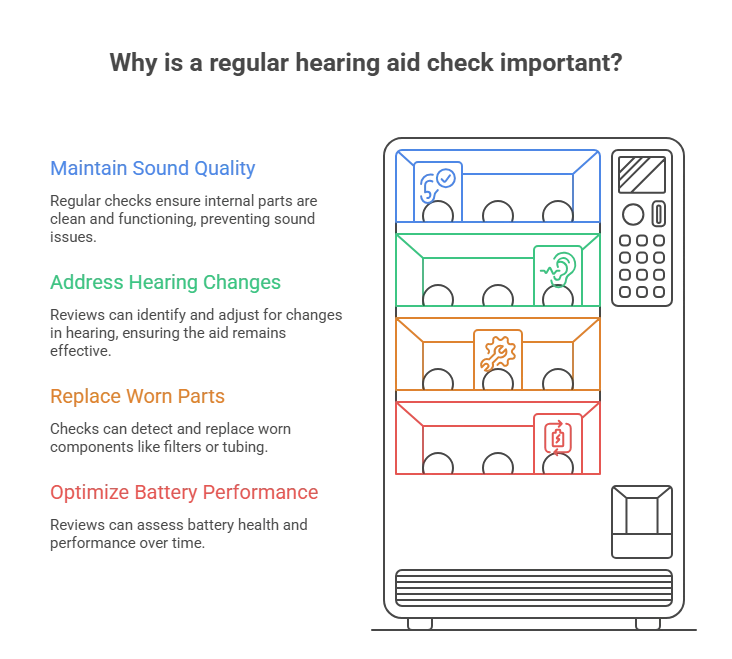
Hearing aids have a number of small parts located inside them, such as the microphone, speaker, filters, tubing, receiver, and electronic components. Although the device appears to be normal on the outside, there may be minor problems that cause the sound to be poor.
Normally, earwax or fluid can clog the sound outlet. Microphones can get dust. Domes, filters, or tubing may need to be replaced. The rechargeable battery could also exhibit different performance as the unit ages.
If your hearing has changed, settings based on an older hearing test may no longer provide the same clarity or comfort.
Through the hearing aid review, we can evaluate the hearing aid and the individual wearing it.
What Happens During a Hearing Aid Check?
In a professional hearing aid check, your audiologist typically examines multiple aspects.
1. Physical Inspection
The hearing aids are examined for any obvious damage, cracks, missing sections, or obstructed openings.
Other equipment such as domes, earmoulds, tubing, and wax filters may also be inspected.
2. Cleaning and Maintenance
Cleaning by professionals can easily clean areas that are difficult to clean safely at home and remove wax and debris.
Filters, domes, and tubing may be changed depending on the device.
3. Listening and Function Test
Your audiologist will determine if the hearing aid sounds clear and steady.
If you have poor sound quality, or the sound or distortion is sporadic, then a component needs to be addressed.
4. Programming Review
Currently set options can be reviewed depending on experience.
Questions about speech clarity, discomfort with background noise, and situations that continue to be challenging may be asked.
5. Hearing Reassessment When Needed
A re-test might be recommended if your hearing seems to have changed.
This enables settings of the device to be changed based on your most recent results.
For broader assessment and ongoing support, you can also explore our hearing care for all ages.
What Are the Signs You Need a Hearing Aid Check Earlier?
If something doesn’t feel right, you don’t need to wait for your regular appointment.
If you notice that you need to arrange a hearing aid check sooner, you might have:
- Sound suddenly becomes weak, soft or muffled.
- Speech that is difficult to hear or muffled
- Whistling or feedback often during the lesson
- One hearing aid is different than the other
- Intermittent sound
- Problems connecting the hearing aids to your phone or other devices.
- Reduced battery life
- You need to increase the volume more often than before.
- Persistent discomfort, pressure or irritation while wearing the device.
- The feeling of a hearing aid.The sensation of a hearing aid.
- Some increased difficulty hearing, as though it is harder to hear than normal
Sometimes the problem is simple, such as a blocked wax filter. In other instances, it might have to be reprogrammed, repaired, or tested further.
Your audiologist may want to reassess your hearing if the hearing aid appears to be functioning well, but your hearing has deteriorated.
Can You Check and Maintain Hearing Aids at Home?
Yes. Ongoing home care is a critical component of care between visits.
Clean your hearing aids with a clean and dry cloth and clean domes, earmoulds, or filters according to the manufacturer’s instructions.
Waterproof hearing aids should be the only type you would use near water; otherwise, do not use them.
If the hearing aids are rechargeable, ensure the contacts are kept clean, and the hearing aids are inserted properly into the charger.
Avoid using pins, needles, or sharp objects to clear blocked openings. These can cause damage to sensitive parts.
Home maintenance can help keep your hearing aids working, but does not replace hearing aid service by a professional. Audiologists are able to detect issues that are not apparent during normal use.
Do Your Hearing Aids Need Reprogramming Over Time?
Sometimes they do.
Your hearing level and preference for sound determine the setting of your hearing aid. The programming may need to be adjusted if either of these changes.
You can benefit from reprogramming if:
- Speech is now difficult to understand. People are more difficult to understand.
- Sounds are not loud enough or too loud.
- Background sounds are too loud.
- In new listening contexts, you are not coping well.
- The hearing test indicates an increase in hearing loss.
- Your lifestyle or workplace has changed.
For instance, a person who has just begun a career at a bustling office might have different listening needs from an individual who spends the majority of their day at home.
At a hearing aid check, your audiologist can discuss these changes and determine if fine-tuning the hearing aid can assist.
How Often Should Your Hearing Be Tested If You Wear Hearing Aids?
Most people who use a hearing aid will get a hearing test about once a year, but some may need more or less frequent testing.
If you notice a change in your hearing, your hearing audiologist may suggest that you come in for testing sooner.
A hearing test will determine if there are changes in hearing thresholds or if the current device is delivering adequate amplification.
It also helps differentiate between the hearing aid issue and a change in your hearing.
This distinction is important because just increasing volume isn’t always the right approach.
When Should You See an Audiologist or Doctor Urgently?
A routine check of the hearing aid is recommended for any concerns related to the hearing aid, while some symptoms require medical evaluation.
Seek prompt professional or medical assessment if you develop:
- Sudden or rapidly worsening hearing loss, especially in one ear
- Severe ear pain
- Ear discharge or bleeding
- New or severe dizziness or loss of balance
- Sudden or significantly worsening tinnitus
- New neurological symptoms along with a hearing change
In particular, sudden hearing loss should not be considered a hearing aid maintenance problem. Sudden hearing loss should be assessed promptly and should not be treated as a routine hearing-aid maintenance problem.
If you have any doubt whether it is a symptom of the hearing aid or ear, it is better to talk to an audiologist or ENT specialist.
Can Older Adults Need More Frequent Hearing Aid Reviews?
Yes, there are older adults who do need more frequent follow-ups.
Your hearing ability, memory, eyesight, dexterity, or earwax may change, making it more challenging to care for your hearing aids.
Sometimes family members will recognize issues before the hearing aid owner does, for example, when the TV volume is turned up, or when the individual is not hearing all the words in a conversation.
Regular review can assist with handling, cleaning, and charging devices as well as insertion and removal.

What Should a Professional Hearing-Aid Review Include?
A professional review should look at both the hearing aid and the person using it. This may include checking the physical condition of the device, cleaning blocked components, reviewing the fit, testing how the hearing aid is functioning and discussing any changes in speech clarity or comfort. If your hearing appears to have changed, your audiologist may also recommend a new hearing test before adjusting the settings.
Find a Resonnocare Clinic Near You
Select your city to find the nearest Resonnocare clinic and book an appointment with our hearing care team.
Bangalore
Ear 360, Jayanagar
Ground Floor, Site No. 499, Municipal No. 499/97, East End Main Road, 9th Block, Jayanagar, Bangalore, Karnataka 560041
Timings: 10:00 AM to 7:00 PM
[Call] [Book an Appointment]
Ear 360, Spandana Sarjapura Hospital
239/205/34A, near Trinity Complex, Sompura Gate, Sarjapura Main Road, Bangalore, Karnataka 562125
Timings: 10:00 AM to 7:00 PM
[Call] [Book an Appointment]
Resonnocare, HSR Layout
150/5/72, 7th Cross, 24th Main, HSR Layout, Bangalore, Karnataka 560102
Timings: 10:00 AM to 7:00 PM
[Call] [Book an Appointment]
Resonnocare, Banashankari
272, 7th Cross Road, BSK 1st Stage, 2nd Block, Srinivasan Agra, 80 Feet Road, Bangalore, Karnataka 560050
Timings: 10:00 AM to 7:00 PM
[Call] [Book an Appointment]
Resonnocare, Indiranagar
34, Wind Tunnel Road, Murugeshpalya, Muniyappa Layout, Bangalore, Karnataka 560017
Timings: 10:00 AM to 7:00 PM
[Call] [Book an Appointment]
Delhi
Ear 360, Dr. Hans Anand Lok
46, Anand Lok Road, Anand Lok, Sadiq Nagar, New Delhi, Delhi 110049
Timings: 10:00 AM to 7:00 PM
[Call] [Book an Appointment]
Resonnocare, Dr. Hans Vasant Vihar
28, Basement, Paschimi Nagar, Vasant Vihar, New Delhi, Delhi 110057
Timings: 10:00 AM to 7:00 PM
[Call] [Book an Appointment]
Gurgaon
Resonnocare Head Office, M3M Urbana
Office 403, Office Block, 4th Floor, above Retail Blocks R1 and R5, M3M Urbana, Sector 67, Gurgaon, Haryana 122101
Timings: 10:00 AM to 7:00 PM
[Call] [Book an Appointment]
Resonnocare, Dr. Hans, Sector 28
Plot No. 1SP, adjoining DLF Phase 1 Metro Station, Sector 28, Gurgaon, Haryana 122002
Timings: 10:00 AM to 7:00 PM
[Call] [Book an Appointment]
Ludhiana
Ear 360, BRS Nagar
963, Block B, BRS Nagar, Ludhiana, Punjab 141012
Timings: 10:00 AM to 7:00 PM
[Call] [Book an Appointment]
Resonnocare, Fawwara Chowk
565-A and 565-B, Upper Ground Floor, Cemetery Road, near Fawwara Chowk, West City, Ludhiana, Punjab 141001
Pune
Ear 360, Vighnaharta Healthcare Center
D-106-107, Choice Arcade, opposite Ruby Hall Hospital, Dhole Patil Road, Pune, Maharashtra 411001
Timings: 10:00 AM to 7:00 PM
[Call] [Book an Appointment]
Ear 360, Khan Parab ENT Hospital
Plot No. 102, Anand Nagar, Talegaon Dabhade, Taluka Maval, Pune, Maharashtra 410507
Timings: 10:00 AM to 7:00 PM
[Call] [Book an Appointment]
Tumkur
Resonnocare, Ashok Nagar
PID No. 3563, 8th Main, 8th Cross, Ashok Nagar, Tumkur, Karnataka 572103
Timings: 10:00 AM to 7:00 PM
[Call] [Book an Appointment]
Conclusion: When Should You Book Your Next Hearing Aid Check?
A checkup every 6-12 months is a good place to start for most people.
You should not delay an appointment, however, if your hearing aid sounds different, if it is uncomfortable, if it doesn’t work as well, or if it no longer appears to help you hear the way you need it to.
There are a number of factors that play a role in overall better hearing aid use in the long term: regular maintenance, professional programming, and hearing assessments.
Your team can inspect your hearing aids, check your hearing if necessary, and advise you on the steps to take next depending on your personal hearing requirements.
FAQ’s
How to do a hearing aid check?
The basic hearing aid check involves checking to see if the hearing aid has suffered any damage, cleaning the microphone and receiver openings, checking the battery or charge level, and confirming volume settings. You can also listen to it to ensure it has good audio quality and test it in various locations. Professional servicing is performed regularly to keep them running at their best.
How do I check if my hearing is OK?
You can test your hearing by observing if you are often asking people to repeat themselves, having difficulty understanding conversations in noisy environments, or making devices louder. The best way to find out if your hearing is normal is to get a hearing test done by an audiologist.
How do I test my hearing at home?
Self-hearing tests can involve listening to conversations at varying distances or comparisons between the two ears or the use of an online hearing screening test. The following techniques are useful in recognising potential problems, but they should not be used as a substitute for a detailed hearing test by a trained hearing professional.
Can I test my hearing with my phone?
Yes, there are a number of smartphone apps that have hearing screening tests that can give a general idea of your hearing ability. But app testing is not diagnostic and is subject to the interference of the sound quality of the headphones and background noise. The best way to test for hearing loss is with a clinical hearing test.
What are the first signs of hearing loss?
The initial hearing loss symptoms include being unable to hear well, particularly in challenging environments; asking people to repeat themselves often; turning up the TV or phone volume; not hearing high-pitched sounds; and tinnitus (ringing in the ears). Early evaluation can assist in determining the cause and optimizing treatment.