

How to Know If Your Hearing Aid Needs Reprogramming
TL; DR:
This blog is for existing hearing aid users who feel their device is no longer giving the same clarity, comfort, or performance and want to understand whether reprogramming may help.
- Recognise the common signs that reprogramming may be needed: Speech becoming unclear, sounds feeling too loud or soft, difficulty managing background noise, frequent volume adjustments, and unnatural sound quality can indicate that hearing aid settings need review.
- Understand why hearing aid settings may need to change over time: Changes in hearing, lifestyle, listening environments, or adaptation to hearing aids can make the original programming less suitable for current needs.
- Know the difference between a programming issue and a device problem: Reduced performance can also result from blocked filters, batteries, moisture, microphone or receiver problems, poor fit, or earwax, so professional assessment is important before changing settings.
- Professional reprogramming focuses on personalised hearing needs: An audiologist can review your hearing, device condition, everyday listening difficulties, and settings to adjust amplification, speech clarity, noise management, microphones, and listening programmes appropriately.
If your hearing aid switches on and appears to be working but speech has become less clear, sounds feel uncomfortable or you keep changing the volume, the problem may be the settings rather than a fault in the device.
The change may be gradual. You might notice that conversations are harder to follow, restaurants feel more difficult than before or the television volume is creeping up again.
What Is Hearing Aid Reprogramming?
Hearing aid programming is the adjustment of a digital hearing aid to a setting more appropriate for the current level of a person’s hearing loss, the setting of the environmental sounds and speech they are listening to, the comfort level, and the communication demands of the user.
Modern hearing aids can be set to amplify sound at various pitches and speech clarity, manage background noise, direct the microphone towards the speaker, control feedback, and select various listening programmes.
The initial settings are usually based on your hearing-test results. They may need further adjustment once you have used the hearing aids in everyday situations.
If you are having trouble with your hearing aid, it does not automatically mean that the hearing aid is faulty. It could just be part of long-term hearing care.
What Are the Early Signs That Your Hearing Aid Needs Reprogramming?
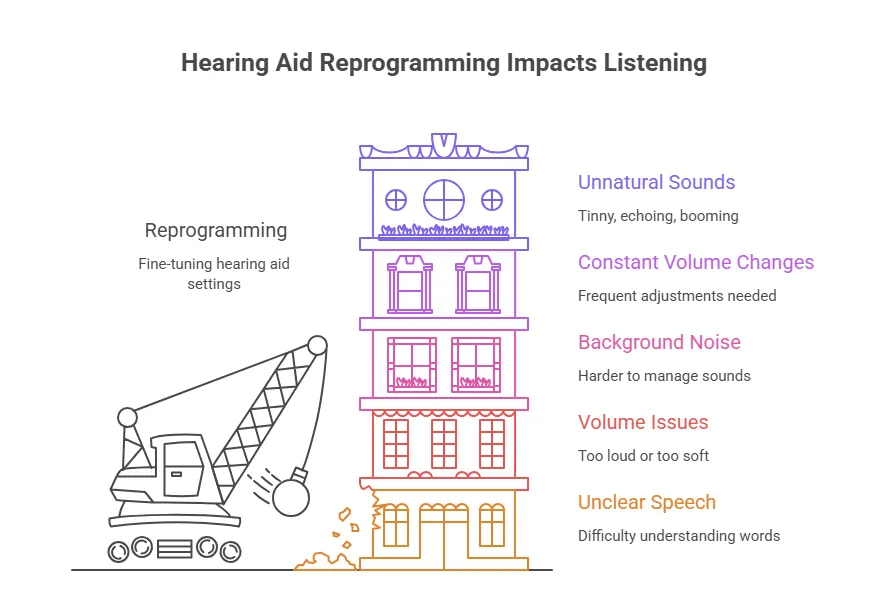
Your everyday listening experience usually gives the first clues.
Speech has started sounding unclear.
You may hear that someone is speaking but still miss individual words, especially during group conversations, television or meetings.
Your hearing aid feels too loud or too soft.
Common noises can suddenly seem painful, irritating, or loud. Other times, voices can be weaker than normal.
Simply increasing or reducing the overall volume may not solve the problem. An audiologist can adjust specific frequencies or listening settings instead.
Professional reprogramming will give the audiologist the ability to fine-tune specific frequencies or sounds instead of increasing or decreasing the volume of all sounds.
Background noise feels harder to manage.
Difficulty in restaurants, family gatherings, offices, traffic or other busy environments is a common reason to review hearing-aid settings.
A hearing aid does not eliminate background noise, but the noise management and microphone settings can be customised to lessen the impact of background noise in some situations.
You are constantly changing the volume.
Occasionally changing the volume is normal.
If you are having to turn the device up and down throughout the day, however, the current settings may no longer suit your listening needs.
Voices or sounds seem unnatural.
For some people who use hearing aids, sounds are:
- Tinny
- Echoing
- Booming
- Hollow
- Too sharp
- Muffled
Describing the sound in this way can help your audiologist understand what needs to be investigated or adjusted.
Why Can a Hearing Aid Need Reprogramming After It Was Already Fitted?
Your hearing and how you listen day to day may change.
Long-term changes in hearing may occur. If this occurs, settings made according to an older hearing test may not be the correct settings for amplification.
Your lifestyle can also change. You might begin to attend more meetings, travel more, spend more time in noisy places, or require more assistance from you and your family to have a good conversation.
New hearing aid wearers can also benefit from some adjustments as they acclimate to hearing sounds they haven’t heard in a while.
The first fitting is therefore not always the final setting. Follow-up visits are an important part of professional hearing aid aftercare.
How Can You Tell Whether the Problem Is Programming or a Hearing Aid Fault?
Not all hearing problems require hearing aid reprogramming.
An audiologist might test the hearing aid before making adjustments.
Sometimes the decreased performance is due to:
- A blocked wax filter means that a filter has become clogged.
- Weak or depleted batteries.
- Moisture inside the hearing aid
- Blocked microphones
- Damaged tubing
- Receiver problems
- Charging problems
- Poor physical fit
Wax in the ear canal can also cause problems with how sounds are heard in the ear and may lead to a poorer understanding of sound or feedback.
This is why the device should be checked before assuming that the programming is the problem.
When Should Your Hearing Be Tested Again Before Reprogramming?
If you have had a change in hearing since your hearing aid was programmed and the hearing test was performed a long time ago, then a new hearing test might be warranted.
The hearing test is updated to assess your current hearing ability to sounds of varying frequencies. The audiologist will then know if it is necessary to program the hearing aid according to the most recent results.
Consult a medical or audiological professional if you experience:
- Sudden hearing loss
- Severe ear pain
- Ear discharge
- New onset or worsening vertigo.
- Tinnitus that doesn’t go away or comes on suddenly.
- A sudden significant change in hearing.
Such symptoms should not just be managed by changing hearing aid settings.
You can also learn more about common ear symptoms and conditions and when professional assessment may be required.
What Happens During a Hearing Aid Reprogramming Appointment?
A strong appointment to adjust will begin by having a discussion about the symptoms you’re experiencing.
Here are some of the questions our audiologist might ask you:
- Do people seem to be “talking past” each other?
- Is the challenge primarily at home or in loud locations?
- Are some sounds too sharp?
- Do you have a hard time understanding phone calls?
- Is there a difference between the hearing aids?
The hearing aid and physical fit can be evaluated. A second hearing test might be requested if there is any doubt about a change in your hearing.
The hearing aid may then be plugged into professional programming software.
The audiologist may check amplification, frequency response, noise control, microphone response, feedback control, and listening programmes depending on the device and listening needs.
The aim is not just to simply increase the loudness of the hearing aid. The goal is to optimise audibility, understanding of speech, listening comfort and safe amplification.
You can learn more about how devices are selected and fitted on our hearing aids page.
Can Hearing Aid Reprogramming Help You Hear Better in Noisy Places?
Sometimes, depending on the cause of the difficulty.
An audiologist may be able to tweak the directional microphone, noise reduction settings, or a specific listening programme for difficult situations.
But even high-quality hearing aids can’t make every noisy situation simple.
You will also be affected by the nature of your hearing loss, how well the hearing aids fit you, the situation where you are listening, and the number of people talking.
If you have a meeting with your audiologist, be sure to explain the situation as best you can.
For instance, the phrase “It is hard to hear my family at a restaurant when they talk at once” offers more useful information than just “The hearing aid isn’t working right.
Should You Try to Reprogram Your Hearing Aid Yourself?
Most hearing aids offer standard controls which are safe for general use.
Depending on your device, you may be able to:
- Change the volume
- Choose a listening programme
- Make adjustments using a manufacturer-supported mobile application
Deeper programming changes should usually only be made by a hearing-care professional.
Professional programming changes should be made carefully because inappropriate settings can make sound uncomfortable, distort speech or provide unsuitable amplification.
For compatible devices and suitable concerns, remote support may sometimes be possible. Resonnocare also offers video consultation, although an in-clinic visit may still be needed when a hearing test or physical device examination is required.
How Often Should Hearing Aid Settings Be Reviewed?
There is no fixed reprogramming schedule that suits every hearing-aid user.
For new users, follow-up visits within the first few weeks or months to help them adapt to the amplification and new listening situations can be beneficial.
Hearing aid users who have established hearing aids should schedule a hearing aid review if they experience a significant change in:
- Speech clarity
- Hearing ability
- Listening comfort
- Sound quality
- Device performance
- Everyday communication
It is not necessary to wait until the hearing aid doesn’t work anymore.
Settings should be reviewed when your hearing, listening needs, comfort or experience with the device changes. Reprogramming is not required simply because a certain amount of time has passed.

What Should a Reprogramming Appointment Include?
A reprogramming appointment should begin with the listening problems you are experiencing rather than changing settings immediately. The audiologist may check the device, physical fit and current programming, review your hearing if necessary and then make targeted adjustments.
Find a Resonnocare Clinic Near You
Select your city to find the nearest Resonnocare clinic and book an appointment with our hearing care team.
Bangalore
Ear 360, Jayanagar
Ground Floor, Site No. 499, Municipal No. 499/97, East End Main Road, 9th Block, Jayanagar, Bangalore, Karnataka 560041
Timings: 10:00 AM to 7:00 PM
[Call] [Book an Appointment]
Ear 360, Spandana Sarjapura Hospital
239/205/34A, near Trinity Complex, Sompura Gate, Sarjapura Main Road, Bangalore, Karnataka 562125
Timings: 10:00 AM to 7:00 PM
[Call] [Book an Appointment]
Resonnocare, HSR Layout
150/5/72, 7th Cross, 24th Main, HSR Layout, Bangalore, Karnataka 560102
Timings: 10:00 AM to 7:00 PM
[Call] [Book an Appointment]
Resonnocare, Banashankari
272, 7th Cross Road, BSK 1st Stage, 2nd Block, Srinivasan Agra, 80 Feet Road, Bangalore, Karnataka 560050
Timings: 10:00 AM to 7:00 PM
[Call] [Book an Appointment]
Resonnocare, Indiranagar
34, Wind Tunnel Road, Murugeshpalya, Muniyappa Layout, Bangalore, Karnataka 560017
Timings: 10:00 AM to 7:00 PM
[Call] [Book an Appointment]
Delhi
Ear 360, Dr. Hans Anand Lok
46, Anand Lok Road, Anand Lok, Sadiq Nagar, New Delhi, Delhi 110049
Timings: 10:00 AM to 7:00 PM
[Call] [Book an Appointment]
Resonnocare, Dr. Hans Vasant Vihar
28, Basement, Paschimi Nagar, Vasant Vihar, New Delhi, Delhi 110057
Timings: 10:00 AM to 7:00 PM
[Call] [Book an Appointment]
Gurgaon
Resonnocare Head Office, M3M Urbana
Office 403, Office Block, 4th Floor, above Retail Blocks R1 and R5, M3M Urbana, Sector 67, Gurgaon, Haryana 122101
Timings: 10:00 AM to 7:00 PM
[Call] [Book an Appointment]
Resonnocare, Dr. Hans Sector 28
Plot No. 1SP, adjoining DLF Phase 1 Metro Station, Sector 28, Gurgaon, Haryana 122002
Timings: 10:00 AM to 7:00 PM
[Call] [Book an Appointment]
Ludhiana
Ear 360, BRS Nagar
963, Block B, BRS Nagar, Ludhiana, Punjab 141012
Timings: 10:00 AM to 7:00 PM
[Call] [Book an Appointment]
Resonnocare, Fawwara Chowk
565-A and 565-B, Upper Ground Floor, Cemetery Road, near Fawwara Chowk, West City, Ludhiana, Punjab 141001
Pune
Ear 360, Vighnaharta Healthcare Center
D-106-107, Choice Arcade, opposite Ruby Hall Hospital, Dhole Patil Road, Pune, Maharashtra 411001
Timings: 10:00 AM to 7:00 PM
[Call] [Book an Appointment]
Ear 360, Khan Parab ENT Hospital
Plot No. 102, Anand Nagar, Talegaon Dabhade, Taluka Maval, Pune, Maharashtra 410507
Timings: 10:00 AM to 7:00 PM
[Call] [Book an Appointment]
Tumkur
Resonnocare, Ashok Nagar
PID No. 3563, 8th Main, 8th Cross, Ashok Nagar, Tumkur, Karnataka 572103
Timings: 10:00 AM to 7:00 PM
[Call] [Book an Appointment]
When Should You Book an Appointment?
If your speech is becoming fuzzy, hearing aids are louder or softer, it is harder to hear someone when they are in noisy environments, or you are constantly adjusting the volume, you might need to see your audiologist for a professional hearing aid fitting.
Programming should be based on your current hearing and real-life listening needs rather than guesswork.
A professional evaluation may be helpful to determine if the issue is related to programming of the hearing aid, the hearing aid itself, earwax, fitting of the hearing aid, or a change in hearing.
FAQ’s
Can a hearing aid be reprogrammed?
Yes, most digital hearing aids today are adjustable by the audiologist. Volume, speech clarity, noise reduction, and listening programs can be adjusted to meet changes in your hearing or listening needs. The hearing aid that is properly reprogrammed regularly will perform the best.
What is a programmable hearing aid?
A programmable hearing aid is a digital hearing aid that is personalized with the aid of specialized software. Audiologists can fine-tune the sound settings, level of amplification, and listening program to the hearing loss of the person. This will provide a more customized and effective hearing experience than non-programmable hearing aids.
Can I download hearing aid programming software?
Most programming software is designed for trained audiologists and hearing care professionals, although some hearing aid manufacturers offer software for use by professionals. Some adjustments may impact how the hearing aid works: Professional fitting and programming are recommended for best performance and safety.
Does hearing-aid reprogramming require another hearing test?
Reprogramming is most useful when your hearing or listening needs have changed rather than being required on a fixed schedule.
What is the lifespan of a hearing aid?
The lifespan of most hearing aids is 3-7 years, depending on the type, use, care, and environment. Taking proper care of the device with regular cleaning, correct storage, and professional servicing can contribute to prolonging the device’s lifespan and maintaining its performance over time. Proper care of the device with regular cleaning, correct storage, and professional service can extend the life of the device and maintain its performance over time.