
TL; DR:
This blog is aimed at current hearing aid users who are experiencing issues such as no sound, weak or distorted sound, whistling, charging problems, or sudden changes in device performance.
- Common reasons a hearing aid may stop working properly include low battery, charging issues, earwax blockage, clogged wax guards or domes, moisture, damaged tubing, poor fit, programming changes, or internal device faults.
- Basic troubleshooting should start with checking whether the device is switched on, confirming the battery or charger is working, and inspecting the hearing aid for earwax, debris, or blockage.
- Users should avoid unsafe fixes such as using pins, needles, water, household cleaning liquids, unapproved chargers, or heat sources, as these can damage the hearing aid.
- If basic troubleshooting does not solve the problem, or if there is sudden hearing loss, severe ear pain, discharge, tinnitus, vertigo, or a sudden difference between the ears, professional assessment by an audiologist or medical professional is recommended.
If your hearing aid suddenly becomes weak, distorted, starts whistling, or stops charging, it does not necessarily mean the device has failed. A blocked wax guard, battery problem, moisture, poor fit or another relatively simple issue can cause similar changes.
A blocked wax guard, battery problem, moisture, poor fit or another relatively simple issue can cause similar changes
A few basic checks can be done safely at home. However, if the hearing aid appears to be working normally but your actual hearing has suddenly changed, the problem should not be treated as a device issue.
Why Is My Hearing Aid Not Working Properly?
A hearing aid can appear to be broken due to one of a number of issues.
Common causes include:
- A low or depleted battery
- Charging problems
- Earwax or debris blocking the sound outlet or receiver
- Clogged wax guard
- Moisture inside the device
- Damaged tubing
- Incorrect insertion
- Incorrect volume or programme settings
- Poor physical fit
- Internal device malfunction
- A change in your hearing.
Start by identifying exactly what has changed.
- Is there no sound at all?
- Is the volume decreased?
- Is speech distorted?
- Has the device started to whistle?
- Does it turn off automatically?
- Does it work in one ear and not the other?
Specificity in the problem helps the troubleshooting process.
Know More About
- When Your Hearing Aid Stops Working Well: Has the Device Changed or Has Your Hearing Changed?
- Signs Your Hearing-Aid Settings Need Adjustment
- Hearing Aid Machine Price: What Determines the Cost?
Hearing Aid Not Working at All? Start With These Checks
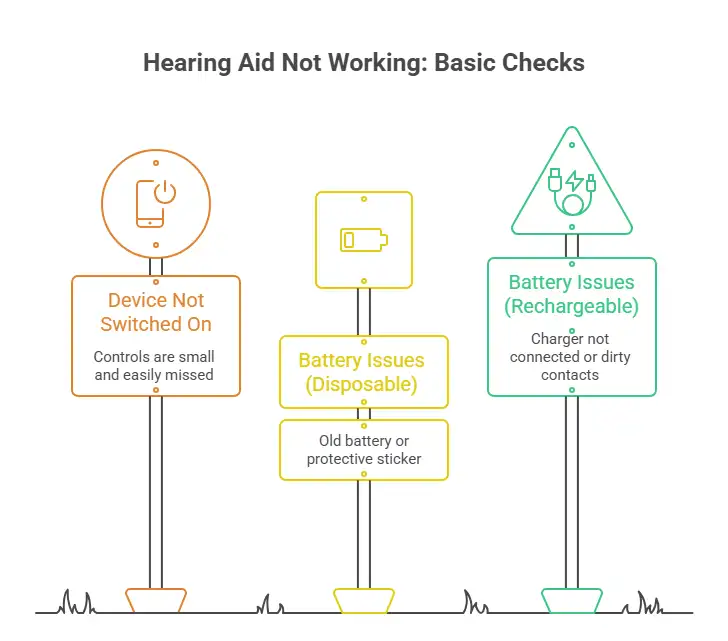
If the hearing aid is totally silent, start with the most basic options.
Check whether the device is switched on.
This may seem obvious, but hearing aid controls are small. It can easily be turned on or off while inserting and removing.
When taking out a rechargeable device, it can automatically turn on depending on the device type.
Check the battery
If you are using a disposable-battery hearing aid, use a new battery of the appropriate battery type.
Remove any protective sticker before putting it on. Remove the sticker and follow the manufacturer’s instructions before closing the battery compartment.
If the hearing aid is rechargeable, check to make sure that it’s been recharged.
Check whether:
- The charger is connected properly
- A number of charging indicators will be appearing.
- The hearing aid is properly positioned
- It looks as if the charging contacts are clean and dry.
Hearing Aid Not Working or Sounding Weak? Check for Earwax
A common cause of a hearing aid becoming quieter is earwax.
Wax or debris can plug the small opening into which sound is transmitted to the ear. Wax guards, filters, and domes can also become clogged over time.
Examine the hearing aid in a well-lit area.
When you can see wax on the dome or sound outlet, clean only the area(s) your audiologist has demonstrated how to clean.
Do not use:
- Pins
- Needles
- Toothpicks
- Metal objects
- Household cleaning liquids
- Water directly on the hearing aid
These can cause damage to fragile parts.
If you are unsure how to change a wax guard or clean a particular part, arrange professional hearing aid aftercare rather than forcing or dismantling anything.
fWhat If the Hearing Aid Sounds Distorted or Unclear?
A hearing aid may still produce sound but make speech seem muffled, crackly, sharp or distorted.
The sound can be described as:
- Muffled
- Crackling
- Distorted
- Too sharp
- Too soft
There are a number of problems that can lead to this.
If a component is blocked, it can have a negative impact on the sound quality. Moisture is also a factor that can affect performance. Or perhaps your hearing has changed, or the programming needs to be reviewed.
Do not keep increasing the volume if speech remains unclear. More loudness does not always mean better clarity.
Loudness is not a measure of clarity.
An audiologist can look at the device, listen to your hearing experience, and determine if a change in fitting, program, or device adjustment, or additional hearing testing is needed.
Modern hearing aids are programmed according to your hearing results and can require follow-up fine-tuning as your listening needs change.
Why Does My Hearing Aid Keep Whistling?
Feedback is a whistling or squealing sound that occurs in a hearing aid.
There can be occasional brief feedback when inserting or touching a device. Whistling during normal use should be investigated if it is a frequent occurrence.
Possible causes include:
- The hearing aid is not fitted in properly.
- The earmould dome is not tight.
- The ear canal is blocked by earwax.
- Tubing is cracked or damaged.
- The fitting is no longer good.
- The settings on the device must be adjusted.
Make sure to carefully reinsert the hearing aid.
If it persists, don’t decrease the volume of the whistle to silence it. This can also decrease the amount of speech information you will hear.
A good fit and device review will be more beneficial.
What Should You Do If a Rechargeable Hearing Aid Is Not Charging?
It is frustrating to have charging problems, particularly when you find them in the mornings.
If the hearing aid does not turn on after it’s left in the charger overnight, check the following:
- Is the charger connected to power?
- Does the hearing aid fit properly?
- Are charging contacts clean and dry?
- Are there any indicator lights?
- Does the other hearing aid charge its batteries regularly?
If one hearing aid charges normally and the other does not, the device that is not charging may need to be checked.
If the charger or cable/power source is not charging, check the charger, cable, or power source.
Don’t use chargers that are not approved by the manufacturer, unless they are recommended by the manufacturer.
If you have regular charging issues, you should consult an audiologist or authorised service provider.
Could Moisture Be the Reason Your Hearing Aid Is Not Working?
Hearing aids are worn for many hours and can come into contact with perspiration, humidity and even accidental moisture.
Moisture may cause:
- Intermittent sound
- Crackling
- Weak output
- Unexpected switching off
- Charging problems
Avoid inserting your hearing aids directly into water, unless the instructions say otherwise.
In general, hearing aids should be taken out prior to a bath or swim.
Put them on and wipe with a clean, dry cloth, and then put them away as directed by the manufacturer.
Avoid using a hair dryer, microwave, heater, or direct sunlight to dry a hearing aid. The electronics can be harmed due to overheating.
What If Only One Hearing Aid Stops Working?
If you have two hearing aids and one is weaker, compare them carefully if you use them at the same time.
Ask yourself:
- Is one battery low?
- Does one of the wax guards have a blockage?
- Is there any damage to one of the devices?
- Do any of the domes have wax blocking them?
- Has one hearing aid lost its charge?
- Does one ear suddenly sound worse than the other?
The last question is crucial.
If the hearing aid appears to be functioning normally but hearing suddenly drops in one ear, arrange prompt professional assessment rather than continuing to troubleshoot the device.
It is important to assess sudden hearing loss promptly.
When Should You Stop Troubleshooting and See an Audiologist?
While it’s good to know some troubleshooting skills for your home, there comes a time when it’s safer to call in the professionals.
Make an appointment for an audiological assessment if:
- The hearing aid continues to be silent after replacement/charging the battery.
- Cleaning visible debris doesn’t help make sound stronger.
- Speech sounds are persistently distorted.
- The device frequently switches off.
- Even though the item is fitted, feedback will still be received.
- Physical damage to the hearing aid.
- Sudden short battery life.
- The charger is not working normally.
- The hearing aid pinches or rubs on the ear or is painful to wear.
- You believe that your hearing has changed.
The aftercare process includes the following: Checking the physical condition of the hearing aid, the fit, device use, cleaning requirements, and programming requirements before determining the need for additional testing, replacement parts, or authorised aftercare.
When Is a Hearing Aid Problem Actually an Ear Problem?
Sometimes the hearing aid is working normally, but your ear or hearing has changed. This distinction is important because a new hearing problem may require assessment rather than cleaning, repair or reprogramming of the device. If you have any of the following, consult an audiologist or medical professional:
- Sudden hearing loss
- Severe ear pain
- Ear discharge or bleeding
- Persistent blocked-ear sensation
- New or suddenly worsening tinnitus
- New or severe dizziness or vertigo
- A sudden difference in hearing between the two ears.
When a hearing aid is working, but you still have hearing trouble, you may have difficulty hearing even with a functioning hearing aid.
In such cases, don’t just turn up the hearing aid.
It is important that hearing loss is evaluated as soon as possible, as some causes are time-sensitive, especially sudden hearing loss.
You can also review Resonnocare’s information on ear symptoms and conditions if you are unsure whether your symptoms may require further evaluation.
Can a Hearing Aid Be Reprogrammed Instead of Repaired?
Yes, in cases where appropriate.
If the hearing aid is operating well but the sound is no longer comfortable or clear, it is not necessarily a failure of the hearing aid, but may be a programming problem.
If the device is functioning but the sound is no longer clear or comfortable, the settings may need to be reviewed rather than the hearing aid being repaired.
- A soft voice is not easily heard.
- Background noises are overwhelming.
- Speech is audible but unclear.
- Sound is now too loud. The sound is now too loud.
- Your hearing test was different than the last one.
- The places you listen have changed.
The audiologist needs to first understand the issue and then change settings.
Can Hearing Aid Troubleshooting Be Done at Home?
Minimal troubleshooting and follow-up assistance may be available at home, particularly for the elderly or for patients who are unable to travel easily.
Resonnocare’s home hearing care service may help with selected device handling, charging, comfort, basic troubleshooting, and follow-up requirements, depending on what equipment and support are needed.
More complex repairs or specialist testing may still require a clinic or authorised service centre.

When Is Professional Troubleshooting Worth It?
Professional troubleshooting is useful when basic checks do not solve the problem. An audiologist can inspect the hearing aid, check the fit, clean or replace blocked components, review the programming and determine whether the device needs repair. If the hearing aid is working normally but you are still hearing less clearly, a hearing reassessment may also be recommended.
Resonnocare provides hearing-aid aftercare and troubleshooting for these concerns.
Find a Resonnocare Clinic Near You
Select your city to find the nearest Resonnocare clinic and book an appointment with our hearing care team.
Bangalore
Ear 360, Jayanagar
Ground Floor, Site No. 499, Municipal No. 499/97, East End Main Road, 9th Block, Jayanagar, Bangalore, Karnataka 560041
Timings: 10:00 AM to 7:00 PM
[Call] [Book an Appointment]
Ear 360, Spandana Sarjapura Hospital
239/205/34A, near Trinity Complex, Sompura Gate, Sarjapura Main Road, Bangalore, Karnataka 562125
Timings: 10:00 AM to 7:00 PM
[Call] [Book an Appointment]
Resonnocare, HSR Layout
150/5/72, 7th Cross, 24th Main, HSR Layout, Bangalore, Karnataka 560102
Timings: 10:00 AM to 7:00 PM
[Call] [Book an Appointment]
Resonnocare, Banashankari
272, 7th Cross Road, BSK 1st Stage, 2nd Block, Srinivasan Agra, 80 Feet Road, Bangalore, Karnataka 560050
Timings: 10:00 AM to 7:00 PM
[Call] [Book an Appointment]
Resonnocare, Indiranagar
34, Wind Tunnel Road, Murugeshpalya, Muniyappa Layout, Bangalore, Karnataka 560017
Timings: 10:00 AM to 7:00 PM
[Call] [Book an Appointment]
Delhi
Ear 360, Dr. Hans Anand Lok
46, Anand Lok Road, Anand Lok, Sadiq Nagar, New Delhi, Delhi 110049
Timings: 10:00 AM to 7:00 PM
[Call] [Book an Appointment]
Resonnocare, Dr. Hans Vasant Vihar
28, Basement, Paschimi Nagar, Vasant Vihar, New Delhi, Delhi 110057
Timings: 10:00 AM to 7:00 PM
[Call] [Book an Appointment]
Gurgaon
Resonnocare Head Office, M3M Urbana
Office 403, Office Block, 4th Floor, above Retail Blocks R1 and R5, M3M Urbana, Sector 67, Gurgaon, Haryana 122101
Timings: 10:00 AM to 7:00 PM
[Call] [Book an Appointment]
Resonnocare, Dr. Hans, Sector 28
Plot No. 1SP, adjoining DLF Phase 1 Metro Station, Sector 28, Gurgaon, Haryana 122002
Timings: 10:00 AM to 7:00 PM
[Call] [Book an Appointment]
Ludhiana
Ear 360, BRS Nagar
963, Block B, BRS Nagar, Ludhiana, Punjab 141012
Timings: 10:00 AM to 7:00 PM
[Call] [Book an Appointment]
Resonnocare, Fawwara Chowk
565-A and 565-B, Upper Ground Floor, Cemetery Road, near Fawwara Chowk, West City, Ludhiana, Punjab 141001
Pune
Ear 360, Vighnaharta Healthcare Center
D-106-107, Choice Arcade, opposite Ruby Hall Hospital, Dhole Patil Road, Pune, Maharashtra 411001
Timings: 10:00 AM to 7:00 PM
[Call] [Book an Appointment]
Ear 360, Khan Parab ENT Hospital
Plot No. 102, Anand Nagar, Talegaon Dabhade, Taluka Maval, Pune, Maharashtra 410507
Timings: 10:00 AM to 7:00 PM
[Call] [Book an Appointment]
Tumkur
Resonnocare, Ashok Nagar
PID No. 3563, 8th Main, 8th Cross, Ashok Nagar, Tumkur, Karnataka 572103
Timings: 10:00 AM to 7:00 PM
[Call] [Book an Appointment]
Conclusion: What to Do When Your Hearing Aid Is Not Working
If your hearing aid doesn’t function, go back to the basics.
Make sure the device is turned on. Check the battery or charger. Check for wax or obstruction in the tube. Check the hearing aid to ensure it is in place and hasn’t been wet.
If the issue persists, do not try to open and make repairs to the device, and do not try to turn the volume up and up again.
If these steps do not resolve the problem, arrange a professional device check rather than attempting to open or repair the hearing aid yourself.
Most importantly, if this change is coupled with abrupt hearing loss, extreme ear pain, ear discharge, vertigo, tinnitus, or a new ear symptom, get a professional assessment, not just assume that the hearing aid is the cause.
FAQ’s
How do you fix a hearing aid that has no sound?
If your hearing aid doesn’t make sound, check if the battery is charged or if it is in correctly, clean the microphone and receiver openings, and make sure the volume is not muted. Clean wax guards when they become blocked and check the tubing to see if it is blocked. If the problem persists, please contact your audiologist or hearing health care provider for professional servicing.
How do I reset my hearing aid?
Turn hearing aids off and on, or insert rechargeable models in the charger for a few seconds. A reset might be necessary on some devices via a mobile phone application. Refer to instructions from the manufacturer or your hearing care professional for model-specific instructions.
Why did my hearing aid just stop working?
A hearing aid can fail due to any of the following causes: earwax blockage, clogged filters, damaged tubing, software problems, or a dead battery. The first step is to inspect the battery and clean the device. When basic troubleshooting doesn’t resolve the problem, in-depth inspection might be required.
Can hearing loss be corrected?
Earwax buildup or middle ear infections may be treated to correct some types of hearing loss. Permanent SNHL is not reversible, but hearing aids, cochlear implants, and rehabilitation therapies can help you to hear and communicate much better.
Can earwax make my hearing aid sound weak?
Yes. Earwax can block the sound outlet, wax guard, dome, or receiver and make a hearing aid seem weak or muffled. If basic cleaning recommended for your device does not restore the sound, have the hearing aid and your ear checked professionally.