
TL;DR:
This blog is aimed for especially older adults, caregivers, and family members who have noticed that a hearing aid no longer seems as clear or effective as before and want to know whether the issue is with the device or a change in hearing.
- A hearing aid may seem less effective for more than one reason: Reduced clarity, muffled sound, feedback, intermittent sound, or needing higher volume can result from technical issues such as earwax, moisture, weak batteries, worn parts, or blocked microphones and receivers.
- Changes in hearing can also make an otherwise functional hearing aid feel ineffective: Hearing levels may gradually change because of ageing, noise exposure, medications, or other health factors, meaning previously programmed hearing aid settings may no longer match the user’s current hearing needs.
- A professional check helps distinguish device problems from hearing changes: An audiologist can inspect and clean the hearing aid, check its performance, repeat hearing tests where necessary, and compare new results with previous assessments to identify the actual cause.
- The solution may range from a simple adjustment to a new hearing aid: Depending on the findings, management may include cleaning, replacing parts, reprogramming the device, updating hearing aid settings, or considering a newer hearing aid if the existing device can no longer meet the user’s hearing requirements.
You wear your hearing aid, but you are still not able to hear well during conversations. The TV volume begins to rise again, or there is a repetition of certain details in family speech. The first thing you might think is, “My hearing aid doesn’t seem to work anymore.”
It is possible that your hearing aid may sound differently than it used to due to a number of reasons. In other cases, the problem lies with the device itself, e.g., a clogged microphone, low battery, broken ear tip, or a change in performance. Otherwise, a change in your hearing could have occurred since you last had an assessment, which may result in a change in your hearing aid settings to reflect this.
It is important to know what has changed: the hearing aid, your hearing, or both.
In this blog, we’ll discuss the symptoms to watch for, how an audiologist can help in determining the cause, and what to do before considering a repair or replacement.
What Does It Mean When a Hearing Aid Is Not Working Properly?
If your hearing aid does not seem to be helping the way it used to, it does not always mean the device is broken. Sometimes, the problem is with the hearing aid itself. In other cases, your hearing may have changed, and the current settings may no longer suit you.
You may notice that:
- Sounds seem softer or more muffled than before
- The hearing aid cuts in and out
- You need to increase the volume more often
- The device whistles or produces feedback
- Speech is still difficult to understand even when the hearing aid is on
- One hearing aid seems to work better than the other
These changes can happen for simple reasons, such as a low battery, earwax blocking the microphone or receiver, moisture in the device, or a worn ear tip.
But sometimes, the hearing aid may be working properly, and your hearing itself may have changed over time. In that case, the device may simply need to be rechecked and adjusted to match your current hearing needs.
Because both situations can feel very similar, it is better to have the hearing aid and your hearing checked rather than relying only on trial and error at home.
Know More About Hearing Aids
- Hearing Aid for Elderly People: Best Features to Look For
- Hearing Aid Trial: What to Expect Before Buying Hearing Aids
- Hearing Aid Price in India: Complete Cost Guide by Type & Features
Why Might a Hearing Aid Stop Working Well: Device Issues vs Hearing Changes?
If your hearing aid does not seem to be helping as much as it used to, it does not always mean that the device is broken. There are usually two possibilities: something has changed with the hearing aid, or something has changed with your hearing.
It could be a problem with the hearing aid
Sometimes, a small issue with the device can make sounds seem softer, unclear, or inconsistent. Common reasons include:
- A weak or low battery
- Earwax or debris blocking the microphone or receiver
- A damaged or worn ear tip
- Moisture inside the hearing aid
- The hearing aid cutting in and out
- Changes in the fit of the device
Many of these issues can be identified and corrected during a hearing aid check.
Your hearing may have changed
Hearing can gradually change over time, especially with age or certain ear and health conditions. If this happens, the hearing aid settings that worked well when the device was first fitted may no longer be suitable.
You may notice that:
- Speech sounds less clear than before
- You need people to repeat themselves more often
- You are increasing the television or phone volume again
- You can hear sounds but have difficulty understanding words
- The hearing aid does not seem loud or clear enough even after basic cleaning
This does not automatically mean that you need a new hearing aid. An audiologist can first test your hearing again and compare the results with your previous hearing test. If your hearing has changed, the device may simply need to be reprogrammed to match your current hearing needs.
The best way to find out what has changed is to have both your hearing and your hearing aid checked rather than trying to guess the cause at home.
What Causes These Changes to Happen?
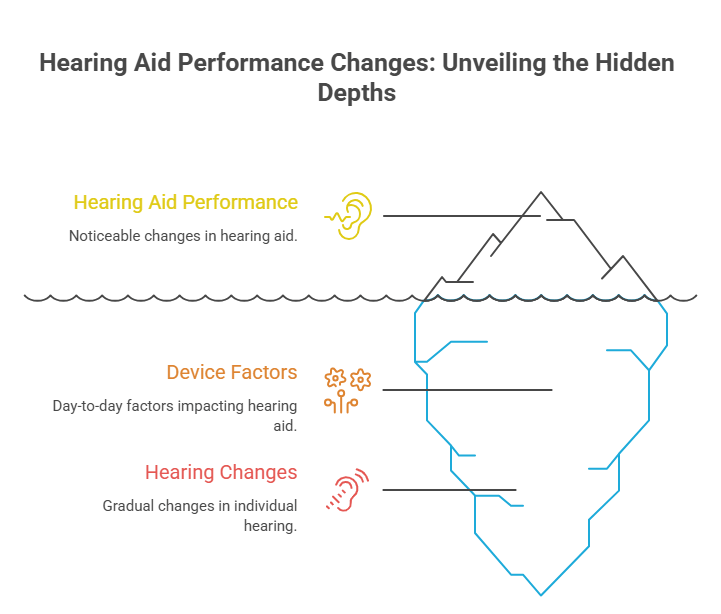
Hearing aids are used on a daily basis, and over time, they will naturally vary in their performance. Sometimes the change has to do with the device. Other times, it may have been a change that you noticed over time.
Changes in the hearing aid
Day to day factors that can impact the functioning of a hearing aid are:
- Wax in the ear preventing sound from reaching the microphone or receiver.
- Sweat or moisture getting into the device
- High humidity of the components inside.
- Dust or debris building up over time
- Wear caused by the normal use of the item.
In humid areas like many in India, hearing aids can be exposed to humidity and sweat for the majority of the year, making moisture an important factor.
Changes to your hearing
Your hearing may also begin to change over time, and may not be immediately noticeable. Possible reasons include:
- Accompanying natural changes of aging.Changes to hearing that occur with age naturally.
- Excessive exposure to noise.
- Some medicines that can impact hearing
- Over the years, changes in the inner ear.
These changes can occur slowly and may come to your attention when you begin to have difficulty understanding what people are saying or possibly when your hearing aid is no longer as effective as it once was.
Therefore, if a hearing aid suddenly doesn’t seem to work very well, that does not necessarily mean it is broken. It can be helpful to test the device and your level of hearing to determine what has really changed.
What Are the Early Signs You Should Pay Attention To?
Before assuming that your hearing aid is damaged, it helps to notice what has changed and whether the problem is happening regularly.
Some early signs to pay attention to include:
- Whistling or feedback sounds from the hearing aid
- Sounds becoming muffled, dull, or less clear than before
- Needing to increase the volume more often
- Finding it harder to understand speech, even in quiet surroundings
- Hearing more clearly in one ear than the other
- Feeling that the hearing aid is not providing the same benefit it used to
These changes can happen because of a problem with the hearing aid, a change in your hearing, or sometimes both.
It can also help to note when the problem started and whether it happens all the time or only in certain situations. For example, you may notice more difficulty during conversations, while watching television, or when you are in a noisy place. Sharing these details with your audiologist can make it easier to identify what may be causing the change.
If you are also experiencing symptoms such as ear pain, fullness, discharge, tinnitus, or dizziness, you can learn more on our ear symptoms and conditions page.
When Should You See an Audiologist?
If simple checks at home do not solve the problem, it is a good idea to have your hearing aid and your hearing professionally evaluated.
You can first try basic steps such as:
- Changing or charging the battery
- Cleaning the hearing aid carefully
- Checking whether the ear tip or dome is damaged or blocked
- Making sure the device is fitted correctly
If the hearing aid still does not seem to work properly after these checks, especially for more than a few days, an audiologist can help determine whether the problem is with the device, its settings, or a change in your hearing.
You should seek professional advice sooner if you also notice:
- Sudden hearing loss
- Ear pain
- Fluid or discharge from the ear
- New or worsening tinnitus
- Dizziness or balance problems
- A sudden difference in hearing between the two ears
These symptoms may be related to something other than the hearing aid itself and may need prompt medical assessment.
If visiting a clinic is not convenient, a video consultation can be a useful first step. You can explain what you are experiencing, and the clinician can guide you on whether the hearing aid needs servicing, your hearing needs to be tested again, or an in-person evaluation would be more appropriate.
How Is the Cause Identified?
If your hearing aid is not working as well as it used to, the first step is to find out whether the problem is with the device, its settings, or your hearing.
What happens during the assessment?
An audiologist will usually check this in a simple step-by-step way:
- Check the hearing aid: The device is inspected for earwax, moisture, blocked parts, battery issues, or signs of damage.
- Clean and test the device: The hearing aid may be cleaned and tested to make sure it is producing sound correctly.
- Review your current hearing: If the hearing aid appears to be working properly but you are still having difficulty, your hearing may be tested again.
- Compare your hearing tests: Your latest results can be compared with your previous hearing test to see whether your hearing levels have changed.
- Check the hearing aid settings: If your hearing has changed, the device may need to be reprogrammed so that it better matches your current hearing needs.
This process helps avoid unnecessary repairs or replacement. Sometimes a simple cleaning solves the problem. In other cases, adjusting the hearing aid settings may be all that is needed.
The aim is to understand what has actually changed before deciding on the next step. This structured approach is also part of the comprehensive assessment followed in our clinical excellence approach.
What Treatment or Management Options Are Available?
The right solution depends on whether the problem is with the hearing aid, its settings, or a change in your hearing.
Does this mean you need a new hearing aid?
Not necessarily. A hearing aid that feels less effective does not automatically mean that it has reached the end of its useful life. Sometimes cleaning, replacing a small component, adjusting the settings, or reprogramming the device after a new hearing test may restore the benefit.
Depending on what the evaluation shows, your audiologist may recommend:
- Cleaning the hearing aid: Earwax, moisture, or debris can sometimes affect sound quality and may only require professional cleaning.
- Replacing a small part: A damaged ear tip, dome, filter, receiver, or other component may need to be replaced.
- Adjusting the settings: If the device is working properly but sounds are no longer clear or comfortable, the hearing aid settings may need to be fine-tuned.
- Reprogramming the hearing aid: If your hearing levels have changed, the device can often be reprogrammed according to your latest hearing test results.
- Considering another hearing aid: If your current device can no longer provide the support you need, your audiologist may discuss other suitable options.
This does not automatically mean that you need to purchase a new hearing aid. If a different device is being considered, a free hearing aid trial can help you experience and compare suitable options before making a decision.
Regular aftercare is also important. Periodic cleaning, hearing checks, fitting adjustments, and device maintenance can help keep your hearing aid comfortable and performing as well as possible over time.

Why Choose Resonnocare for Hearing and Audiology Care?
Resonnocare takes every problem with a hearing aid not fitting properly as seriously as one during a fitting. Our audiologists and clinicians perform a competent diagnosis of your hearing to make sure your issue isn’t related to a hearing loss, but instead the device; a customized care plan is developed based on the facts of your hearing test. We can meet you at your door, re-program your device, offer new trials of hearing aids, video consultation, and aftercare support. See our comprehensive services on our services page.
Find a Resonnocare Clinic Near You
Select your city to find the nearest Resonnocare clinic and book an appointment with our hearing care team.
Bangalore
Ear 360, Jayanagar
Ground Floor, Site No. 499, Municipal No. 499/97, East End Main Road, 9th Block, Jayanagar, Bangalore, Karnataka 560041
Timings: 10:00 AM to 7:00 PM
[Call] [Book an Appointment]
Ear 360, Spandana Sarjapura Hospital
239/205/34A, near Trinity Complex, Sompura Gate, Sarjapura Main Road, Bangalore, Karnataka 562125
Timings: 10:00 AM to 7:00 PM
[Call] [Book an Appointment]
Resonnocare, HSR Layout
150/5/72, 7th Cross, 24th Main, HSR Layout, Bangalore, Karnataka 560102
Timings: 10:00 AM to 7:00 PM
[Call] [Book an Appointment]
Resonnocare, Banashankari
272, 7th Cross Road, BSK 1st Stage, 2nd Block, Srinivasan Agra, 80 Feet Road, Bangalore, Karnataka 560050
Timings: 10:00 AM to 7:00 PM
[Call] [Book an Appointment]
Resonnocare, Indiranagar
34, Wind Tunnel Road, Murugeshpalya, Muniyappa Layout, Bangalore, Karnataka 560017
Timings: 10:00 AM to 7:00 PM
[Call] [Book an Appointment]
Resonnocare, JC’s ENT Center Nagarbhavi
57, 3rd Main Road, 2nd Block, Govindaraja Nagar Ward, Kalyan Nagar, Nagarbhavi, Bengaluru, Karnataka 560072
Timings: 10:00 AM to 7:00 PM
[Call] [Book an Appointment]
Resonnocare, Dr Bhattacharyya ENT Clinic
No. 14, 17th Cross Road, Sector 7, HSR Layout, Bangalore, Karnataka 560102
Timings: 10:00 AM to 7:00 PM
[Call] [Book an Appointment]
Delhi
Ear 360, Dr Hans Anand Lok
46, Anand Lok Road, Anand Lok, Sadiq Nagar, New Delhi, Delhi 110049
Timings: 10:00 AM to 7:00 PM
[Call] [Book an Appointment]
Resonnocare, Dr Hans Vasant Vihar
28, Basement, Paschimi Marg, Vasant Vihar, New Delhi, Delhi 110057
Timings: 10:00 AM to 7:00 PM
[Call] [Book an Appointment]
Resonnocare, Clarity ENT Clinic
Clarity, 2-10, Hauz Khas, New Delhi, Delhi 110016
Timings: 10:00 AM to 7:00 PM
[Call] [Book an Appointment]
Resonnocare, Dr Hans Center for ENT Punjabi Bagh
2/5, West Avenue Road, West Punjabi Bagh, Punjabi Bagh, New Delhi, Delhi 110026
Timings: 10:00 AM to 7:00 PM
[Call] [Book an Appointment]
Gurgaon
Resonnocare Head Office, M3M Urbana
Office 403, Office Block, 4th Floor, above Retail Blocks R1 and R5, M3M Urbana, Sector 67, Gurgaon, Haryana 122101
Timings: 10:00 AM to 7:00 PM
[Call] [Book an Appointment]
Resonnocare, Dr Hans Sector 28 DLF Ph-1
Metro Station, Plot No. 1SP, adjoining DLF Phase 1, Sector 28, Gurgaon, Haryana 122002
Timings: 10:00 AM to 7:00 PM
[Call] [Book an Appointment]
Ludhiana
Ear 360, BRS Nagar
963, Block B, BRS Nagar, Ludhiana, Punjab 141012
Timings: 10:00 AM to 7:00 PM
[Call] [Book an Appointment]
Resonnocare, Fawwara Chowk
565-A and 565-B, Upper Ground Floor, Cemetery Road, near Fawwara Chowk, West City, Ludhiana, Punjab 141001
Timings: 10:00 AM to 7:00 PM
[Call] [Book an Appointment]
Pune
Ear 360, Vighnaharta Healthcare Center
D-106-107, Choice Arcade, opposite Ruby Hall Hospital, Dhole Patil Road, Pune, Maharashtra 411001
Timings: 10:00 AM to 7:00 PM
[Call] [Book an Appointment]
Ear 360, Khan Parab ENT Hospital
Plot No. 102, Anand Nagar, Talegaon Dabhade, Taluka Maval, Pune, Maharashtra 410507
Timings: 10:00 AM to 7:00 PM
[Call] [Book an Appointment]
Tumkur
Resonnocare, Ashok Nagar
PID No. 3563, 8th Main, 8th Cross, Ashok Nagar, Tumkur, Karnataka 572103
Timings: 10:00 AM to 7:00 PM
[Call] [Book an Appointment]
Resonnocare, Ganadhal ENT and Dental Hospital
3rd Cross, Somashekara Puram, Coffee Board Colony, Tumkur, Karnataka 572102
Timings: 10:00 AM to 7:00 PM
[Call] [Book an Appointment]
Mangalore
Ear 360, Bunts Hostel Circle
Shop No. 6 and 7, Basement Floor, Javed Plaza, Bunts Hostel Circle, Mangalore, Karnataka 575003
Timings: 10:00 AM to 7:00 PM
[Call] [Book an Appointment]
Resonnocare, Dr G K Hebbar ENT Clinic
M-2-153/6, K.S.R.M. Building, Lighthouse Hill Road, Mangaluru, Karnataka 575001
Timings: 10:00 AM to 7:00 PM
[Call] [Book an Appointment]
Resonnocare, Dr Navisha ENT Centre
3rd Floor, Falnir Health Center, Falnir Road, Falnir, Mangaluru, Karnataka 575002
Timings: 10:00 AM to 7:00 PM
[Call] [Book an Appointment]
Mysore
Ear 360, Ramaswamy Circle
371/A, Ramaswamy Circle, Mysore, Karnataka 570024
Timings: 10:00 AM to 7:00 PM
[Call] [Book an Appointment]
Hubli
Ear 360, Vidya Nagar
Srishti Elite, Shirur Park Road, Shirur Park, Vidya Nagar, Hubballi, Karnataka 580031
Timings: 10:00 AM to 7:00 PM
[Call] [Book an Appointment]
Davangere
Ear 360, P J Extension
Shop First Floor, 2nd Main, P J Extension, Davangere, Karnataka 577002
Timings: 10:00 AM to 7:00 PM
[Call] [Book an Appointment]
Indore
Resonnocare, Dr Navnit Jain ENT Hospital
Dr Navnit Jain ENT Hospital, C/o Unique Hospital, 335, Jawahar Marg, Opp. Nafees Bakery, Indore, Madhya Pradesh 452007
Timings: 10:00 AM to 7:00 PM
[Call] [Book an Appointment]
Resonnocare, Hearing Solutions Dr Agarwal
7, Gulmarg Complex, First Floor, near Sapna Sangeeta Lumiere, Indore, Madhya Pradesh 452001
Timings: 10:00 AM to 7:00 PM
[Call] [Book an Appointment]
Conclusion
If your hearing aid doesn’t work correctly, it can be frustrating, particularly once you’ve become accustomed to using it every day. But a hearing aid that feels less effective does not automatically mean that the device is broken or that you need a new one. What really matters is finding out what has changed: the hearing aid, your hearing, or both. The answer lies with the right diagnosis rather than a guess. A professional evaluation can determine whether the solution is as simple as cleaning or replacing a component, adjusting the programming, reassessing your hearing, or considering a different hearing solution. If your hearing aid isn’t working like it used to, contact Resonnocare to have it evaluated and get accurate information from a qualified audiologist about your hearing aid and what it needs. If your hearing aid doesn’t work correctly, it can be frustrating, particularly once you’ve become accustomed to using it every day. What really matters is if your sense of hearing has subtly shifted since your last hearing test.
Regardless, the answer lies with the right diagnosis rather than a guess. If your hearing aid isn’t working like it used to, contact Resonnocare to have it evaluated and get accurate information from a qualified audiologist about your hearing aid and what it needs.
FAQ’s
How can I tell whether my hearing aid or my hearing has changed?
You cannot always tell from the symptoms alone because device problems and hearing changes can feel very similar.A hearing-aid check combined with a hearing assessment, when appropriate, can help identify the cause.
Does a hearing aid that sounds weak always need repair?
No. A weak or muffled sound can be caused by a blocked microphone or receiver, moisture, a battery or charging issue, a worn component, changes in fit, or a change in hearing. The cause should be identified before deciding on repair or replacement.
Do I need a new hearing aid if my hearing has changed?
Not necessarily. If the hearing aid has enough capability to meet your current needs, reprogramming or fine-tuning may be sufficient. If it can no longer provide appropriate support, your audiologist may discuss other options.
Why can I hear sounds but still have trouble understanding speech?
Hearing sound and understanding speech are not exactly the same experience. Some people may continue to have difficulty understanding speech, particularly in challenging listening situations, even when sounds are audible. This is one reason to discuss the specific listening difficulty with your audiologist rather than simply increasing the volume.
What should I do if only one hearing aid seems to be working well?
Have both the device and your hearing checked. The difference could be due to a blocked or damaged component, a fitting issue, or a change in hearing in one ear.
How often should my hearing be checked?
The appropriate timing depends on your hearing history, age, symptoms, hearing-aid use, and clinical needs. Rather than waiting until the hearing aid seems to stop helping, discuss periodic hearing reviews with your audiologist.
How to improve hearing naturally?
Most hearing loss cannot be corrected with natural methods, but they can help maintain and support hearing health. Limit exposure to loud noises, wear hearing protection devices, engage in physical activity, eat a healthy diet, control diabetes and high blood pressure, and don’t smoke. Periodic hearing examinations can also be used to identify early hearing loss and to stop additional hearing loss.
What are the signs and symptoms of hearing loss?
Some of the common signs of hearing loss are: needing to raise voice and volume of TV or phone, frequent requests for repetition, difficulty hearing in loud environments, trouble understanding conversations, and tinnitus (ringing in the ears). Others also think that people are mumbling or speaking unclearly, particularly when they are talking in groups.
What medications are used to treat hearing loss?
Medications for hearing loss vary, depending on the cause. Sudden sensorineural hearing loss can be treated with corticosteroids, and infections can be treated with antibiotics. There are many different types of permanent hearing loss that cannot be treated with drugs, however, and are treated using hearing aids, cochlear implants, or hearing rehabilitation therapies.
What to do if you’re losing your hearing?
If you notice any changes in your hearing, get a hearing test as soon as possible. Early diagnosis will help determine the cause and prevent further deterioration. Treatment options will depend on the results and may be medical care, hearing aids, lifestyle changes, or hearing rehabilitation to help improve communication and quality of life.
What is the 60-60 rule for hearing loss?
The 60-60 rule is a guideline to consider an evaluation for advanced hearing solutions like cochlear implants for individuals with hearing thresholds of 60 dB or higher and those who are unable to recognize between 60% and 60% of speech sounds in quiet. It is useful in identifying people who may not benefit sufficiently from conventional hearing aids.
1 Comment
[…] When Your Hearing Aid Stops Working Well: Has the Device Changed or Has Your Hearing Changed? […]