
TL; DR:
This blog is aimed at adults experiencing hearing difficulties, older adults, caregivers, and family members who want to understand when hearing loss may require hearing aids and when they should consult an audiologist or ENT specialist.
- Hearing-aid recommendations are not based on decibel level alone. The blog explains that audiologists consider the severity and type of hearing loss, speech understanding, ear health, communication difficulties, lifestyle, and listening needs before recommending hearing aids.
- Even mild hearing loss may justify hearing aids. Mild hearing loss can affect speech clarity, high-frequency sounds, conversations in background noise, work, social interactions, and listening comfort, so patients should not wait for hearing loss to become severe before seeking an assessment.
- The blog helps patients understand hearing-loss levels and audiograms. It explains common hearing-loss ranges from slight and mild through moderate, severe, and profound hearing loss, while showing why an audiogram needs to be interpreted alongside real-world communication difficulties.
- Getting hearing aids is a clinical journey, not simply buying a device. If hearing aids are appropriate, effective care involves device selection, trial, proper fitting, personalised programming, real-life testing, and ongoing follow-up and fine-tuning with an audiologist.
Not all cases of hearing loss start with a significant hearing loss. The first changes many people notice are slight, such as speech doesn’t sound as clear; listening in restaurants gets tiring, or the TV volume continually goes up. This frequently results in the question, “At what point does hearing loss warrant hearing aids?
The one-size-fits-all approach to hearing aids doesn’t exist. Recommendations vary according to the severity and nature of the hearing loss, speech understanding ability, situations where you find yourself challenged, ear health, and communication needs. A professional hearing test combines all these factors.
What Are the Signs You May Need Hearing Aids?
If you have the following symptoms, think about having a hearing test:
- Have others repeat themselves.
- Feel that others are mumbling.
- Miss parts of group discussions.
- Have difficulty hearing others in noisy environments, e.g., restaurants or meetings.
- Loud music and loud mobile phones.
- Have difficulty hearing softer or higher-pitched voices.
- Experience fatigue from focusing on conversations.
It’s not too late to seek help when hearing loss is significant. On paper, the changes can seem minor, but in the real world, they can create difficulties in communication or make it very tiring.
Know More About
- Hearing Aid Prices in India by Type, Features and Technology
- Hearing Loss: Symptoms, Causes, Types & Treatment Options
- Sudden Hearing Loss: Symptoms, Causes & When It Is an Emergency
Does Mild Hearing Loss Require Hearing Aids?
Sometimes, yes. Soft speech, consonants, high-frequency sounds, and talking in background noise are among the areas affected by mild hearing loss. It may be possible to hear someone talking, but you may miss too many words to lose the meaning.
The answer to the question of what level of hearing loss needs hearing aids should not be taken for granted, so mild hearing loss shouldn’t be ruled out. If it is impacting work, family communication, social interaction, listening, comfort, or safety, an audiologist can discuss with family members the use of hearing aids or another appropriate hearing management option.
What Level of Hearing Loss Requires Hearing Aids?
The intensity of a sound is measured on a decibel hearing level (dB HL). Commonly used clinical ranges are:
Hearing Level | Approximate Hearing Threshold | What You May Notice |
Normal or near-normal | Up to about 15–20 dB HL | Most normal conversation is heard. |
Slight hearing loss | About 16–25 dB HL | Some very soft or distant voices may not be heard. |
Mild hearing loss | 26–40 dB HL | Some parts of speech and conversation may be hard to understand. |
Moderate hearing loss | 41–55 dB HL | Normal speech may not be easily understood. Speech may become garbled. |
Some degree of hearing loss (40- 70 dB). | 56–70 dB HL | Amplification is frequently seen as |
Severe hearing loss | 71–90 dB HL | Much ordinary speech may be missed without amplification |
Profound hearing loss | 91+ dB HL | Without the proper hearing technology, access to speech may be extremely restricted. |
These ranges are approximate, and the terms used to indicate the degree of hearing loss can differ slightly between clinical systems.
Hearing aids are typically recommended for mild to severe hearing loss if there is a clinically appropriate need for amplification and a measurable communication difficulty. An audiologist or ENT specialist may also discuss the need for further hearing technology or specialist evaluation for severe or profound hearing loss.
Understanding Your Audiogram and What Level of Hearing Loss Requires Hearing Aids
An audiogram is a chart that indicates the quietest sounds that can be heard at various pitches. Frequency or pitch is plotted on the horizontal axis, and hearing level (dB HL) is plotted on the vertical axis.
Individuals who have an average hearing level can experience different challenges. For instance, consonants like “s,” “f,” and “sh” might be difficult to hear in high-frequency hearing loss.
You might be able to hear a voice and feel the words are not clear.
That is why it’s important to take a look at more than one average number to understand what degree of hearing loss calls for hearing aids. The audiologist takes into account the extent, nature, and frequencies involved in the loss of hearing and how this affects speech comprehension.
Why Decibel Level Alone Does Not Decide Whether You Need Hearing Aids
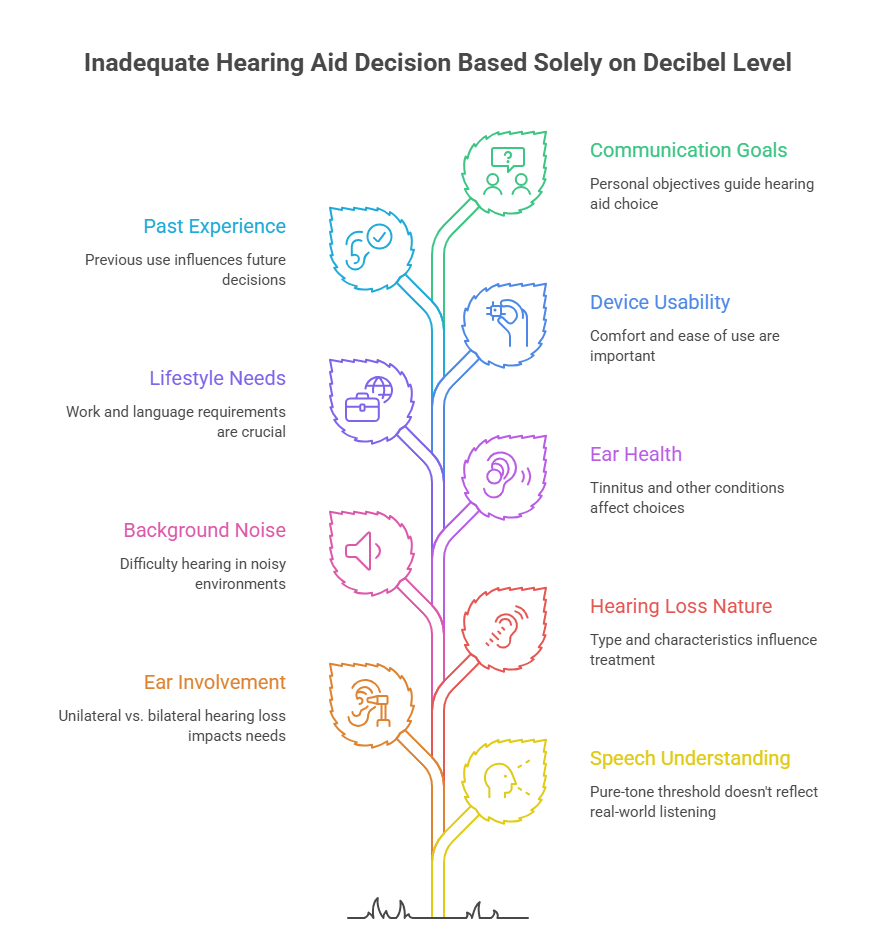
Pure-tone threshold gives us our threshold of detection in a quiet test environment. Listening each day is more complex.
The audiologist might also take into account:
- Speech understanding
- Which ear is affected or both ears.
- The nature and characteristics of hearing loss
- Challenge to hear particular sounds in the background.
- Cases of ear-health findings and tinnitus
- The work and language needs
- Your ability to comfortably handle and use a device
- Previous hearing-aid experience
- Your self-related communication objectives and choices.
The functional impact is therefore of importance, in addition to the audiogram.
A person with mild hearing loss who frequently goes to meetings or works in an environment where there is a lot of communication may find it more challenging than the other person who has a similar hearing loss but does not attend the meetings or have as many situations with a lot to hear.
How Does an Audiologist Decide What Level of Hearing Loss Requires Hearing Aids?
The process usually begins with your hearing history and a professional hearing assessment. Depending on your symptoms, testing may include pure-tone audiometry, speech testing, and middle-ear assessment.
The audiologist also looks at where communication breaks down in real life.
At Resonnocare, our approach to hearing care for all ages considers test findings together with daily listening needs.
If amplification is appropriate, the recommendation is matched to the degree and pattern of hearing loss, ear anatomy, lifestyle, handling needs, listening environment, and budget. You can also explore our hearing-aid options to understand the different solutions that may be considered after assessment.
The aim is not simply to provide a hearing device because a test shows hearing loss. The aim is to understand whether amplification is likely to address the hearing difficulties you experience in everyday life.
When Should You See an Audiologist or ENT Doctor?
Schedule an audiology evaluation if a person is having persistent or worsening hearing problems, or if hearing issues are beginning to impact their work, relationships, safety, or daily life.
It is especially important to seek professional medical evaluation if you experience:
- Acute deafness, one-sided or both-sided.
- Severe ear pain
- Ears or ear discharge or bleeding.
- Any new or bothersome tinnitus.
- Dizziness or severe unsteadiness.
- A sudden sensation of blocked ears which is accompanied by hearing changes
- Noticeable difference in hearing between the two ears
If someone has sudden hearing loss, it shouldn’t be a routine hearing-aid appointment. It must be treated as soon as possible, as some of its causes need timely treatment.
What Happens If Hearing Aids Are Recommended?
If it is decided that hearing aids are a necessary intervention, the next step is not just to pick one of the items from a catalogue.
Good hearing care involves choosing the right technology, fitting it properly, programming it to your individual hearing profile and testing it out in “real life” situations.
A hearing aid cannot restore natural hearing, but can help with clear communication in everyday situations with the right fitting and programming.
Your audiologist should also talk to you about what things you can do to make it better, what things you might still have trouble with, and how you can gradually settle into the amplified sound.
Hearing-Aid Trial → Fitting → Programming → Follow-up
A structured hearing-aid journey usually includes four important stages.
1. Hearing-Aid Trial
Selected devices can be tested for comfort and clarity in real-life situations. A trial gives you an opportunity to notice how speech sounds at home, during conversations, outdoors, or in other environments that matter to you.
Resonnocare offers a free hearing-aid trial for eligible patients and selected devices.
2. Fitting
The hearing aid is properly sized, positioned, comfortable, and retained. Important factors for comfortable usage during the day are device style and physical fit.
3. Programming
The hearing aid is tailored to your listening requirements and hearing chart. Additional adjustments may be needed as one gets used to high volume.
4. Follow-up
Your audiologist evaluates comfort, use, communication benefit, and situations that are still challenging. The setting may then be adjusted as needed.
Hearing-aid care doesn’t start with the hearing aid. Helping the device meet your hearing needs is a continuous process, and follow-up and fine-tuning are a vital component.

Why Choose Resonnocare for Hearing and Audiology Care?
At Resonnocare, hearing care is not device-driven; it’s clinically driven. Our first goal is to get to know your hearing, symptoms, test results, and the communication challenges you are having.
Our approach includes:
- Clinically guided care: recommendations are based on the assessment results and your functional hearing needs.
- Reliable audiology and clinicians: Guidance and experience with assessment, device selection, fitting, and follow-up.
- Accurate hearing evaluations: Proper testing procedures can determine the type, severity, and course of hearing loss.
- Personalized care plans: recommendations take into account your age, lifestyle, listening needs, comfort, preferences, and individual hearing profile.
- Continuity of care: Hearing aids, hearing tests, home visits, video consultation and aftercare can be integrated if applicable to your care.
Our clinical excellence approach focuses on structured assessment, personalised recommendations, rehabilitation, patient education, and continued hearing-care support.
Find a Hearing Aid Clinic Near You
Select your city to find the nearest Resonnocare clinic and book an appointment with our hearing care team.
Bangalore
Ear 360, Jayanagar
Ground Floor, Site No. 499, Municipal No. 499/97, East End Main Road, 9th Block, Jayanagar, Bangalore, Karnataka 560041
Timings: 10:00 AM to 7:00 PM
[Call] [Book an Appointment]
Ear 360, Spandana Sarjapura Hospital
239/205/34A, near Trinity Complex, Sompura Gate, Sarjapura Main Road, Bangalore, Karnataka 562125
Timings: 10:00 AM to 7:00 PM
[Call] [Book an Appointment]
Resonnocare, HSR Layout
150/5/72, 7th Cross, 24th Main, HSR Layout, Bangalore, Karnataka 560102
Timings: 10:00 AM to 7:00 PM
[Call] [Book an Appointment]
Resonnocare, Banashankari
272, 7th Cross Road, BSK 1st Stage, 2nd Block, Srinivasan Agra, 80 Feet Road, Bangalore, Karnataka 560050
Timings: 10:00 AM to 7:00 PM
[Call] [Book an Appointment]
Resonnocare, Indiranagar
34, Wind Tunnel Road, Murugeshpalya, Muniyappa Layout, Bangalore, Karnataka 560017
Timings: 10:00 AM to 7:00 PM
[Call] [Book an Appointment]
Conclusion: What Level of Hearing Loss Requires Hearing Aids?
So, what level of hearing loss do hearing aids help? No set criterion is applied to everyone.
Hearing aids may be considered for moderate loss, or when the hearing loss is having an impact on speech understanding or daily functioning. When clinically appropriate for someone with moderate or more hearing loss, they are often recommended, but that’s not the only factor to consider.
The correct recommendation is a balance of your audiogram, speech understanding, ear health, and how you listen in everyday situations, along with a professional assessment.
If you are having trouble hearing, the next step is an appropriate hearing evaluation assessment, not guessing from a decibel, and no device without evaluation.
Schedule a hearing assessment appointment with Resonnocare to learn about your hearing levels and decide if monitoring, medical referral, hearing aids, or another option for hearing care is right for you.
FAQ’s
How much hearing loss qualifies for hearing aids?
If the hearing loss is at the mild level or equal to or above 26 dB and it is starting to interfere with the way the person communicates, hearing aids are often recommended. Even slight hearing loss can make it hard to talk to others, particularly in noisy places. A hearing evaluation provides the information needed to determine if the hearing aids will make a difference in your hearing and quality of life.
What is the most common cause of sudden hearing loss?
Sudden sensorineural hearing loss (SSNHL) is the most common cause of sudden hearing loss, affecting the inner ear or auditory nerve. The exact cause is unknown, but it’s thought to be due to viral infections, inflammation, and circulation disorders. Prompt treatment is crucial, as early treatment can get the best results.
Is profound hearing loss permanent?
When the hearing loss is severe, it is usually permanent, especially if caused by damage to the inner ear or auditory nerve. Treatment for hearing loss, including hearing aids, cochlear implants and auditory rehabilitation, can help to enhance communication function and hearing. Early diagnosis is critical for optimum results.
At what stage do I need hearing aids?
Hearing loss may start to affect your ability to communicate with others, especially in conversation, at work, in social situations and more, and you might find that hearing aids will help you. Many people start wearing hearing aids when their hearing loss is mild to moderate. Early use can enhance speech intelligibility, decrease listening effort, and promote hearing health.
What percentage of 75-year-olds need hearing aids?
Research indicates that a majority of adults over the age of 75 (between 50-70%) experience hearing loss that may be treated with hearing aids. But a lot of people forgo treatment even though they have hearing problems. The best way to detect hearing loss early and intervene properly for good communication and quality of life is to get regular hearing tests.