


TL;DR:
The blog is intended for people comparing hearing aid prices in India, patients recently diagnosed with hearing loss, and families exploring suitable hearing aid options for children, adults, or older family members.
- Price Varies by Hearing Aid Style: It explains how Behind-the-Ear, In-the-Ear, In-the-Canal, Completely-in-Canal, and Invisible-in-Canal devices may differ in cost because of their size, customisation, design, and manufacturing requirements.
- Technology Level Influences Cost: The blog compares basic, mid-range, and advanced hearing aids. Higher technology levels may offer improved noise reduction, speech clarity, directional microphones, feedback control, and automatic adjustment in different listening environments.
- Additional Features Affect Pricing: It highlights features such as rechargeable batteries, Bluetooth streaming, smartphone controls, tinnitus masking, and multiple listening programs, while explaining that not every patient needs every available feature.
- Assessment, Trial, and Resonnocare Support: The blog emphasises choosing a hearing aid based on hearing-test results, lifestyle, comfort, and budget rather than price alone. Resonnocare provides hearing assessments, a free hearing aid trial, home consultations, personalised recommendations, and continued aftercare.
Outside, hearing aids might look alike, but in everyday situations, they can be dramatically different. When these terms are used on the product, like basic, mid-range, automatic, premium, rechargeable, and Bluetooth, it can be confusing to determine which will have a positive effect on communication.
This guide is designed to give you a basic understanding of the primary technology, styles, and functional characteristics of hearing aids before you talk to an audiologist about a hearing aid recommendation.
Why Can Two Hearing Aids That Look Similar Perform Differently?
It’s typically a problem within the device. Hearing aids with digital processors are designed to detect, block out unwanted noises, reduce feedback, and amplify speech, but not every processor handles these tasks equally well. Here’s how that plays out in everyday situations:
- Dining in a loud restaurant: Scenario A (Basic) struggles to separate voices from clattering dishes and background chatter. Scenario B (Premium) isolates speech from noise, so conversation stays clear.
- In a busy market: Scenario A (Basic) can feel overwhelming, with traffic and crowd noise competing with speech. Scenario B (Premium) filters out steady background sound and keeps the focus on the person talking.
- At work or in a meeting room: Scenario A (Basic) may pick up hums from air conditioning or projectors along with voices. Scenario B (Premium) suppresses these constant background sounds automatically.
- In a family room with several people talking: Scenario A (Basic) can find it hard to keep up when multiple conversations overlap. Scenario B (Premium) can shift focus toward whoever you’re facing.
- In a quiet library: Both scenarios perform reasonably well here, since there’s little competing noise — the real difference shows up in noisier environments.
How Hearing Aid Design Affects Everyday Use
Hearing aid style impacts comfort, visibility, handling, the amount of power, and cleaning or upkeep:
- Behind-the-Ear (BTE) and Receiver-in-Canal (RIC/RITE): These are placed behind the ear and inserted into the ear canal via a tube, wire, or receiver. They can fit a wide variety of hearing requirements, space for larger batteries or rechargeable systems, and are easier to control.
- In-the-Ear (ITE) / In-the-Canal (ITC): These are individually fitted to the ear shape. They might be more streamlined in size without sacrificing controls that are easier to operate than extremely small canal devices.
- Completely-in-Canal (CIC) & Invisible-in-Canal (IIC): These are devices placed further in the ear canal that are not easily visible. They may not have a good battery life or manual controls due to their small size,e and they may not fit into all ears, with all levels of hearing loss and people with reduced manual dexterity.
This should take into account hearing-test results, ear shape, comfort, visibility, exposure to wax/moisture, and the ability to insert, remove, and clean the device.
How Hearing Aid Technology Levels Differ
The technology level primarily refers to the amount of sound processing and automatic adjustment that a hearing aid can offer in various listening environments:
- Basic technology: Typically can serve simple listening requirements in less distracting/less complex settings. It can be needed for certain amplification and feedback control, but might be less automatic for complex noise.
- Mid-range technology: Offers better speech enhancement, better noise management, and greater mobility in home/social/medium noise situations.
- Advanced or premium technology: For individuals who need to communicate frequently in a fluctuating or challenging setting. It could have more advanced directionality, automatic detection of the scene, better noise reduction, and greater connectivity.
Depending on how and where you communicate, the appropriate technology level varies. Someone who primarily has one-to-one conversations at home might also require a variety of processing compared to someone who spends time in meetings, travels often, or goes to restaurants and large gatherings.
Hearing Aid Price in India by Additional Features
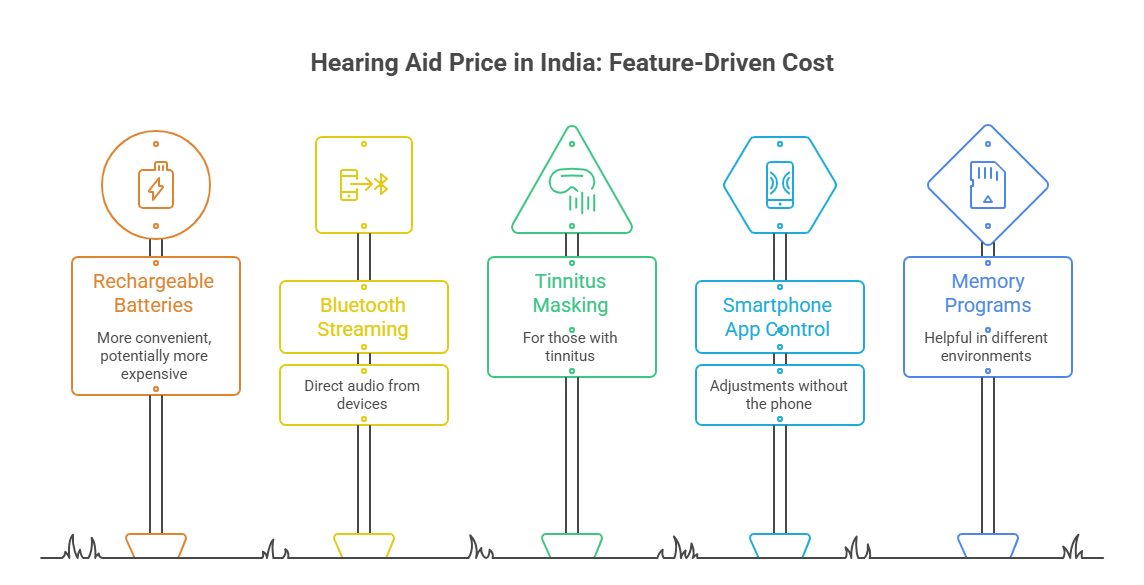
Some additional factors contribute to the price difference of hearing aids in India, such as:
- Rechargeable batteries, which are a lot more convenient but may be more expensive than standard battery models.
- Direct streaming of audio from smartphones and other devices via Bluetooth,
- Tinnitus masking – designed for those who hear tinnitus in addition to their hearing loss.
- Smartphone app control, which allows the user to make adjustments and change volume without the phone.
- Several memory programs, which are very helpful for those who are in many different environments where they have to listen very differently throughout the day.
Not all patients will require all features, and part of Resonnocare’s job is to help you identify which additions will be useful and not simply increase the cost.
What Causes Hearing Loss That May Require a Hearing Aid?
Most often, hearing aids are recommended after the person has been diagnosed with a hearing loss, which may be due to several factors:
- Changes in the inner ear that occur as part of the aging process.
- Excessive noise over an extended period of time.
- An untreated ear infection or buildup of fluid in the ear.
- Genetic or congenital causes.
- Some drugs that impact hearing.
- Exposure to head trauma or loud noises.
Once you determine the cause, your audiologist will be able to give you a hearing aid price in India and a choice that suits your condition and not just a random one.
What Are the Early Signs You May Need a Hearing Aid?
Early signs may be detected to seek evaluation before hearing difficulty develops. Watch for:
- Repeating yourself often and using repetition in your speech
- Turning up the TV or cell phone volume louder than usual
- Problems understanding speech in loud environments
- A feeling of “gummisapien”
- Tinnitus (ringing or buzzing noises in the ears)
- Social isolation as a result of their hearing loss
If these signs sound familiar, reviewing common ear symptoms and conditions can help clarify whether a hearing evaluation is a reasonable next step.
When Should You See an Audiologist or Doctor?
Although hearing changes are normal, some symptoms require immediate evaluation, no matter how far or near you are in your hearing aid price in India options. If you hear any of the following, please seek the advice of an audiologist or ENT specialist immediately:
- Sudden hearing loss in one or both ears
- Severe ear pain
- Discharge from the ear
- Dizziness or vertigo that won’t go away
- Persistent tinnitus that doesn’t get better.
- Difficulty hearing for more than a couple of weeks.
These symptoms could indicate an underlying health issue that needs to be treated before a hearing aid is recommended.
How Are the Right Hearing Aid Features Selected?
Before recommending a device, an audiologist usually reviews Pure Tone Audiometry, speech-testing results, ear health, listening difficulties, lifestyle, dexterity, and comfort preferences. These findings help determine the required power, device style, noise-management capability, connectivity, and other features. This individualised process is important across all age groups because children, working adults, and older users may have very different communication needs.
How Can a Hearing Aid Trial Help?
A real-world trial can show whether a proposed technology level provides a noticeable benefit in the situations that matter to you. During the trial, pay attention to speech clarity, comfort, handling, background-noise performance, phone use, and listening fatigue. Feedback from the trial can then guide programming adjustments or help determine whether a different feature set would be more suitable.
How Can Resonnocare Help?
At Resonnocare, choosing a hearing aid always begins with a proper hearing assessment, not a price list. Our audiologists explain which style, technology level, and features are actually relevant to your hearing loss and daily life, helping you understand hearing aid price in India in a way that feels transparent rather than overwhelming. Explore the complete range of hearing aids available through Resonnocare.

Why Choose Resonnocare for Hearing and Audiology Care?
At Resonnocare, hearing care is always clinically guided, ensuring every recommendation is based on an accurate assessment of your specific hearing profile. Our team of experienced audiologists and clinicians takes time to understand your lifestyle before suggesting where you should look on the hearing aid price in India spectrum.
Beyond selection and fitting, we build personalized care plans that consider comfort, budget, and long-term use. For patients who prefer not to visit a clinic in person, home visit consultations bring the assessment to you, and our dedicated aftercare support ensures your hearing aid continues performing well long after the initial purchase.
Find a Resonnocare Clinic Near You
Select your city to find the nearest Resonnocare clinic and book an appointment with our hearing care team.
Bangalore
Ear 360, Jayanagar
Ground Floor, Site No. 499, Municipal No. 499/97, East End Main Road, 9th Block, Jayanagar, Bangalore, Karnataka 560041
Timings: 10:00 AM to 7:00 PM
[Call] [Book an Appointment]
Ear 360, Spandana Sarjapura Hospital
239/205/34A, near Trinity Complex, Sompura Gate, Sarjapura Main Road, Bangalore, Karnataka 562125
Timings: 10:00 AM to 7:00 PM
[Call] [Book an Appointment]
Resonnocare, HSR Layout
150/5/72, 7th Cross, 24th Main, HSR Layout, Bangalore, Karnataka 560102
Timings: 10:00 AM to 7:00 PM
[Call] [Book an Appointment]
Resonnocare, Banashankari
272, 7th Cross Road, BSK 1st Stage, 2nd Block, Srinivasan Agra, 80 Feet Road, Bangalore, Karnataka 560050
Timings: 10:00 AM to 7:00 PM
[Call] [Book an Appointment]
Resonnocare, Indiranagar
34, Wind Tunnel Road, Murugeshpalya, Muniyappa Layout, Bangalore, Karnataka 560017
Timings: 10:00 AM to 7:00 PM
[Call] [Book an Appointment]
Delhi
Ear 360, Dr. Hans Anand Lok
46, Anand Lok Road, Anand Lok, Sadiq Nagar, New Delhi, Delhi 110049
Timings: 10:00 AM to 7:00 PM
[Call] [Book an Appointment]
Resonnocare, Dr. Hans Vasant Vihar
28, Basement, Paschimi Nagar, Vasant Vihar, New Delhi, Delhi 110057
Timings: 10:00 AM to 7:00 PM
[Call] [Book an Appointment]
Gurgaon
Resonnocare Head Office, M3M Urbana
Office 403, Office Block, 4th Floor, above Retail Blocks R1 and R5, M3M Urbana, Sector 67, Gurgaon, Haryana 122101
Timings: 10:00 AM to 7:00 PM
[Call] [Book an Appointment]
Resonnocare, Dr. Hans Sector 28
Plot No. 1SP, adjoining DLF Phase 1 Metro Station, Sector 28, Gurgaon, Haryana 122002
Timings: 10:00 AM to 7:00 PM
[Call] [Book an Appointment]
Ludhiana
Ear 360, BRS Nagar
963, Block B, BRS Nagar, Ludhiana, Punjab 141012
Timings: 10:00 AM to 7:00 PM
[Call] [Book an Appointment]
Resonnocare, Fawwara Chowk
565-A and 565-B, Upper Ground Floor, Cemetery Road, near Fawwara Chowk, West City, Ludhiana, Punjab 141001
Pune
Ear 360, Vighnaharta Healthcare Center
D-106-107, Choice Arcade, opposite Ruby Hall Hospital, Dhole Patil Road, Pune, Maharashtra 411001
Timings: 10:00 AM to 7:00 PM
[Call] [Book an Appointment]
Ear 360, Khan Parab ENT Hospital
Plot No. 102, Anand Nagar, Talegaon Dabhade, Taluka Maval, Pune, Maharashtra 410507
Timings: 10:00 AM to 7:00 PM
[Call] [Book an Appointment]
Tumkur
Resonnocare, Ashok Nagar
PID No. 3563, 8th Main, 8th Cross, Ashok Nagar, Tumkur, Karnataka 572103
Timings: 10:00 AM to 7:00 PM
[Call] [Book an Appointment]
Conclusion
The best hearing aid technology is not necessarily the option with the longest feature list. It is the device that provides sufficient speech clarity, comfort, noise management, and ease of use for your hearing profile and daily routine.
A professional hearing assessment and guided trial can help you understand which design and technology level are appropriate before you make a decision. Contact Resonnocare to discuss your hearing needs, compare suitable features, and arrange a clinically guided hearing aid trial.
FAQs
Does hearing aid price in India depend on the brand?
Though the price of the hearing aid in India is influenced by style, technology level, and features, the brand also plays its part. When choosing between hearing aid brands, it is advisable to compare the hearing aids according to your particular hearing requirements.
Are invisible hearing aids more expensive?
Generally yes. The design of COMPLETELY IN CANAL and invisible style makes them costly in the price range of hearing aids in India.
Do all hearing aids need Bluetooth or app connectivity?
No, it is not mandatory but is an additional feature to the hearing aid price in India. However, they can be helpful in some patients but not all.
Is a higher hearing aid price always better for severe hearing loss?
Not necessarily. This depends on the type and degree of hearing loss, and is best determined by a proper hearing assessment, not by price.
Can you compare hearing aid prices in India before committing?
Yes, Resonnocare has a free hearing aid trial period so that people can try out a hearing aid and then gauge the worth of the hearing aid before they settle for a particular hearing aid price in India range.