

TL; DR:
This blog is aimed at seniors with hearing loss, older adults considering hearing aids, and their family members or caregivers who want to understand which hearing-aid style RIC, BTE, ITE, or smaller in-ear devices may be easiest and most suitable for everyday use.
- There is no single best hearing-aid style for every senior. The right choice depends on hearing loss, ear anatomy, dexterity, vision, lifestyle, comfort, communication needs, and personal preferences rather than age alone.
- RIC, BTE, and ITE hearing aids each suit different needs. RIC devices can be lightweight and discreet, BTE models may be easier to handle, while ITE devices offer larger controls that can be more convenient for some older adults.
- Ease of use is especially important for seniors. Arthritis, tremors, reduced finger sensation, poor vision, and mobility limitations can make small devices or batteries difficult to manage, making larger or rechargeable hearing aids more practical.
- A professional hearing assessment and trial should guide the final decision. The blog emphasizes evaluating hearing levels and real-world listening needs, followed by trying the device for comfort, speech clarity, charging, controls, and everyday usability before making a final choice.
When selecting a hearing aid for an older adult, it’s not just about choosing the smallest or the most advanced. The most appropriate hearing aid for a senior should complement the individual’s hearing loss, yet must be comfortable, convenient, and functional to wear every day.
A receiver-in-canal (RIC) device could be ideal for some seniors. Others may prefer to wear a behind-the-ear (BTE) or in-the-ear (ITE) model device. We take your hearing levels, communication needs, health of your ears, dexterity, vision, lifestyle, and personal preferences into account when recommending a style at Resonnocare.
What Makes the Best Hearing Aid Type for Seniors Senior-Friendly?
A good hearing aid for older people should help them hear better without causing hearing aid maintenance to be a chore.
Important factors include:
- Easy insertion and removal.
- Comfortable fit
- The controller features simple charging/battery management.
- Controls are easily operated.
- Communicate effectively in normal, common contexts.
- Easy cleaning and maintenance
- Reliable audiologist support
There are no age restrictions on the best aid type for seniors. If two people are the same age, they may require different devices due to their varying hearing, sight, hand function, or routines.
Know More About
- Hearing Aid Prices in India by Type, Features and Technology
- Hearing Aid Machine Price: What Determines the Cost?
- Hearing Aids Near Me: How to Choose the Right Hearing Aid Center
RIC vs BTE vs ITE: Which Is Easier for Seniors?
Style | Potential Advantages | Points to Consider |
RIC | Light, inconspicuous, and appropriate for a wide range of hearing loss patterns | Small receiver/dome requires special care |
BTE | Strong, practical, and easily manageable. | The ears are more visible behind the ears. |
ITE | Made specifically for them; larger controls may be easier for some seniors | The suitability is dependent on the ear shape and level of hearing. |
A senior with an acceptable hand control could be comfortable and discreet in RIC. A person who has arthritis, tremor, or diminished finger sensation will find a larger BTE or ITE model to be more suitable.
No overall winner. Usability is best evaluated by going to the site.
Which Hearing Aid Styles Are Available?
Modern hearing aids are available in several styles.
1. Receiver-in-Canal (RIC):
The main body is positioned behind the ear with a small receiver in the ear canal. These devices are small and widely used in many different ranges of hearing loss.
2. Behind-the-Ear (BTE):
Device worn behind the ear, with sound directed through tubing or earmould. It may be easier to handle for some seniors due to its size.
3. In-the-Ear (ITE):
These are custom-made devices that fit in the outer ear. They are larger in size and may be easier to insert and easier to manipulate controls.
4. ITC, CIC and IIC:
These are placed partially or completely in the ear canal. They are inconspicuous, but might be cumbersome to use on a daily basis due to their small size.
Is RIC the Best Hearing Aid Type for Seniors?
RIC devices are often well suited for older people as they can be both comfortable and discreet, and fit many types of hearing loss.
But RIC is not the top choice of hearing aids for seniors, however.
It may be difficult for a person with arthritis, tremor, poor vision, or decreased finger sense to handle a small dome or receiver. If this is the case, a bigger or rechargeable device might make more sense.
This should be based on the hearing test, the ear anatomy, and the person’s comfort level in using the device.
Are Invisible Hearing Aids Better for Seniors?
Not necessarily.
Invisible devices are great for those who want to be inconspicuous; however, smaller is not necessarily less convenient. You may find that a small hearing aid is more difficult to wear, remove, clean, or operate, particularly if you have poor eyesight or poor dexterity in your fingers.
They do work very well for some people. Others may prefer a slightly larger size for the greater convenience of everyday use.
If your appearance is important, consult with your audiologist about it to ensure a balance of discretion, comfort and hearing needs.
How Dexterity, Vision and Mobility Affect Hearing-Aid Choice
Fine motor coordination and sight can be of crucial importance for everyday function.
For a person living with arthritis, larger controls or rechargeable hearing aids that minimize the use of small disposable batteries can help. Small battery doors, filters or markings may be hard to see with reduced vision.
If frequent clinic visits are difficult, ask whether home visit support or remote guidance is appropriate.
A device should be selected for the person who will actually use it every day.
What Features Matter Most for Seniors?
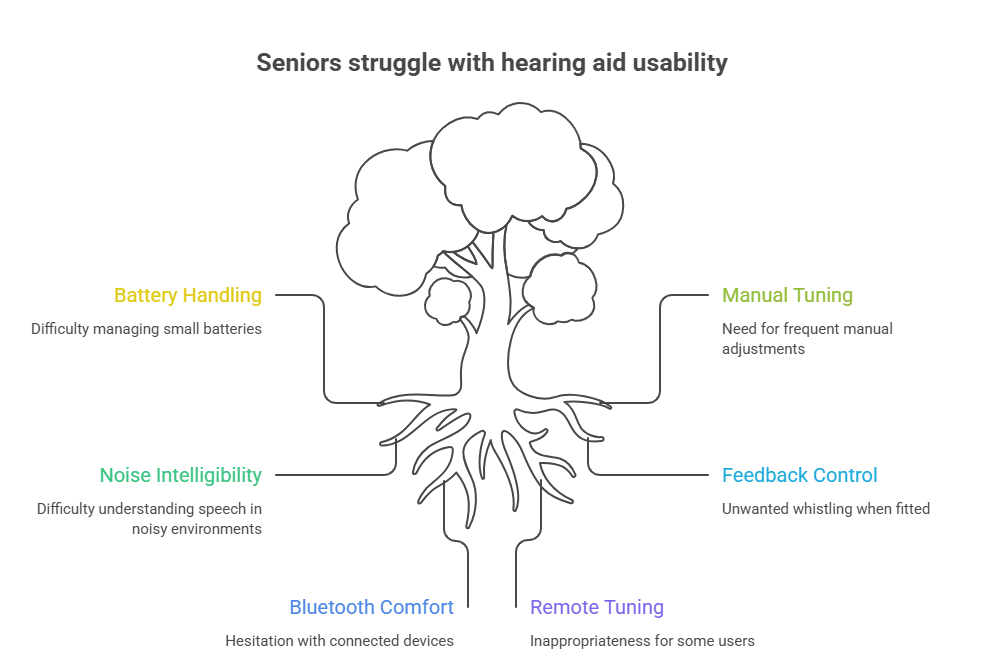
Some of the useful features that would be included include:
- Rechargeable batteries: These can help anyone who has trouble handling small batteries manage their day with ease.
- Automatic listening programmes: These can lessen the need for manual tuning when transitioning between different listening areas.
- Directional microphones and noise management: These can assist with the intelligibility of speech in the presence of other noises.
- Feedback control: This is important to control unwanted whistling when fitted and programmed correctly.
- Bluetooth: This could come in handy for making phone calls, video calls, or hearing television through a Bluetooth connection, if the person is comfortable with using connected devices.
- Fine tuning remotely: If appropriate, some fine tuning can be done remotely.
Additional features can come at the cost of worse hearing. The best equipment to use is the one that fits the needs of the user.
How Does Hearing Loss Affect the Style You Need?
The extent and type of hearing loss are key to choosing a hearing aid.
For someone with mild or moderate hearing loss, there are a number of styles to choose from. If hearing loss is more severe, a device with a higher power level and more fit options may be needed.
Other factors such as ear anatomy, earwax, and frequent ear issues may also affect the selection.
This is why only appearance and cost don’t determine the best type of hearing aid for seniors. An online-appealing device may not be the best option for the person’s hearing sensitivity and ear structure.
How Is Hearing Loss Assessed Before Choosing?
An audiologist needs to know and be aware of the person’s difficulties in the real world as well as the hearing test before recommending a hearing aid.
Assessment may include:
- Audiological history and medical history
- An examination of the ear.
- Pure-tone audiometry
- Speech testing as appropriate.
- If necessary, middle ear testing will be performed. If needed, middle ear testing will be done.
- Talk about the struggles with listening that occur on a daily basis
At Resonnocare, our approach to hearing care for all ages starts with understanding the hearing problem before recommending technology.
Evaluation by a professional is particularly significant when experiencing sudden hearing loss, severe ear pain, ear discharge, vertigo, and troublesome tinnitus or persistent unexplained hearing symptoms.
Sudden or progressively severe hearing loss should not be treated with the purchase of a hearing aid. It is necessary to undergo a proper medical evaluation.
Can You Try a Hearing Aid Before Buying?
A trial can be particularly beneficial for seniors, as specifications do not easily discern the ease of use and comfort.
Notice: During a trial:
- The ease of insertion and extraction of the device.
- Does it stay comfortable after several hours? Does it stay comfortable after a few hours?
- Whether you can hear what family members are saying or not
- Whether it is simpler to watch TV and talk on the phone.
- How well it functions in more populated areas
- If it is easy to charge or not.
- If you’re able to control the controls without help.
Resonnocare offers a free hearing-aid trial for eligible patients and selected devices as part of a professionally guided hearing-aid process.
A trial can help determine whether a device that appears suitable clinically is also comfortable and manageable in everyday life.
What Should Families and Caregivers Consider?
It is common for the person with the difficulty not to notice it as much as the family member does. They can be helpful in understanding missed conversations, TV sounds, or group communication problems.
Families may also want to think about the senior’s ability to charge, clean, and insert the device.
The user of the Hearing Aid, however, should be the key factor in the decision. A device that has been selected primarily due to the preferences of a family member might not be the most user-friendly device for the senior.
The ideal senior hearing aid should perform as the individual really needs it to, rather than impress people during a demonstration.
What Happens After You Choose a Hearing Aid?
The style is just the first step.
Adjust the hearing aid to the hearing assessment and program it. Follow-up visits enable the audiologist to monitor the comfort, intelligibility, and duration of use and performance in varied environments.
For new users, it may be necessary to take time to get used to the amplified sounds. The first program settings are not always the last, however. Modifications may be necessary following the hearing aid is used at home, during conversation, and in noisier settings.
Avoiding these issues will also be part of the ongoing care plan and should involve instruction on cleaning, charging, storage and maintenance. Therefore, re-assessment can also be recommended when clinically appropriate, as hearing levels may change over time.

Why Choose Resonnocare for Hearing and Audiology Care?
Hearing-aid recommendations at Resonnocare are based on clinical, and not one style, brand or price.
Our approach includes:
- Clinically guided care: Your recommendations are made based on your hearing-test results and the communication challenges you have in daily life.
- Our staff of experienced: Audiologists and clinicians can help your patient and family with assessment, device selection, fitting and follow-up.
- Proper hearing testing: It enables the establishment of the nature, extent and form of hearing loss before choosing a device.
- Personalised care plans: They take into account the individual’s hearing level, lifestyle, dexterity, vision, comfort and technology needs and preferences.
- Continuity of hearing care: Depending on the individual’s need, this can involve hearing tests, home visits, hearing aids, video consultation and aftercare.
To help you discover a hearing solution that you can hear well with, wear comfortably and manage confidently in your daily life.
Find a Hearing Aid Clinic Near You
Select your city to find the nearest Resonnocare clinic and book an appointment with our hearing care team.
Bangalore
Ear 360, Jayanagar
Ground Floor, Site No. 499, Municipal No. 499/97, East End Main Road, 9th Block, Jayanagar, Bangalore, Karnataka 560041
Timings: 10:00 AM to 7:00 PM
[Call] [Book an Appointment]
Ear 360, Spandana Sarjapura Hospital
239/205/34A, near Trinity Complex, Sompura Gate, Sarjapura Main Road, Bangalore, Karnataka 562125
Timings: 10:00 AM to 7:00 PM
[Call] [Book an Appointment]
Resonnocare, HSR Layout
150/5/72, 7th Cross, 24th Main, HSR Layout, Bangalore, Karnataka 560102
Timings: 10:00 AM to 7:00 PM
[Call] [Book an Appointment]
Resonnocare, Banashankari
272, 7th Cross Road, BSK 1st Stage, 2nd Block, Srinivasan Agra, 80 Feet Road, Bangalore, Karnataka 560050
Timings: 10:00 AM to 7:00 PM
[Call] [Book an Appointment]
Resonnocare, Indiranagar
34, Wind Tunnel Road, Murugeshpalya, Muniyappa Layout, Bangalore, Karnataka 560017
Timings: 10:00 AM to 7:00 PM
[Call] [Book an Appointment]
Conclusion: What Is the Best Hearing Aid Type for Seniors?
The best hearing aid type for seniors is the one that is tailored to the hearing loss, the ear anatomy, the communication requirements, and the individual’s dexterity.
RIC hearing aids can work well for many seniors, though BTE or ITE hearing aids might be more comfortable for those who prefer larger controls or easier to use. Though smaller doesn’t necessarily mean better, invisible hearing aids may be suitable for certain individuals.
If you or an older family member needs help with conversations, watching television, phone calls, or hearing in groups, get a hearing exam from a professional before purchasing a hearing aid just because the device looks good, is inexpensive, or has good online reviews.
Schedule a hearing aid appointment with Resonnocare, discuss the type of hearing aids you need, shop around for the best options, and, if needed, test the hearing aids you’re considering before you commit.
Medical Note: This article is for general information only and should not be considered a substitute for a personal diagnosis, hearing screening, or hearing treatment by an audiologist, otolaryngologist, or other qualified health professional.
FAQ’s
What type of hearing aid is best for older people?
An older adult’s best hearing aid is usually behind-the-ear (BTE) or receiver-in-canal (RIC) type. They are user-friendly, comfortable, and appropriate for various degrees of deafness. Some features, such as rechargeable batteries, auto sound adjustment, and noise reduction, will make it easier for seniors to hear conversations and enhance their daily communication.
What hearing aid do most audiologists recommend?
Audiologists have found that many people appreciate the combination of the best sound quality, comfort, and discreet design that the RIC (Receiver-in-Canal) hearing aid offers. Because of the wide range of capabilities, RIC devices are a popular choice among hearing care professionals. They are suitable for mild to severe hearing loss, with some devices containing advanced features like Bluetooth, speech enhancement, and background noise reduction.
What is the number one ranked hearing aid?
The best hearing aid is different from person to person depending on the individual’s hearing loss, lifestyle, and preferences, so there is no one best hearing aid. Advanced digital hearing aids that offer superior sound processing, rechargeable batteries, and wireless connections are usually highly rated hearing aids. A professional hearing evaluation aids in identifying which hearing aid will be most useful to an individual user.
How much should I pay for a good hearing aid?
The price of the digital hearing aid in India ranges from ₹20,000 to ₹80,000 per ear. These devices typically provide good sound quality, speech enhancement, and noise reduction. AI-powered, Bluetooth-enabled, and fully customizable premium models could be more expensive.
How much does Medicare cover for a hearing aid?
Generally, traditional Medicare in the U.S. does not provide coverage for hearing aids or fittings. Some Medicare Advantage plans may offer limited coverage or hearing benefits. The amount of coverage you receive depends on the insurance plan, and you should consult with the insurance provider to determine what they cover in terms of hearing aids and what you will have to pay out-of-pocket.