

TL; DR:
This blog is aimed at people considering hearing aids, first-time hearing-aid users, seniors, and family members/caregivers who want to know what they should test during a hearing-aid trial before deciding whether a device is suitable for everyday use.
- A hearing-aid trial should test real-life performance, not just clinic sound. The blog explains that users should try the device during conversations at home, in background noise, at family gatherings, while watching TV, and during phone calls to understand how well it actually supports daily communication.
- Speech clarity, background noise, and comfort are the most important areas to evaluate. Users should check whether speech becomes clearer, whether conversations are easier to follow in noisy environments, and whether the device remains physically comfortable after several hours of wear.
- Practical usability matters as much as sound quality. The hearing-aid trial should also include testing phone calls, TV, Bluetooth connectivity, charging, controls, cleaning, insertion, and removal, especially for seniors or users with reduced vision or dexterity.
- Users should document their experience and review problems with an audiologist. Keeping notes on situations that were better, unchanged, or difficult can help the audiologist identify whether programming, volume, physical fit, noise-management settings, or even the hearing-aid style needs adjustment.
Although a hearing aid may sound good in a short clinic demonstration, it is not until you use it in your day-to-day activities that you will truly know. Some of the answers may be found in conversations at home, the noise of traffic, family gatherings, television, and phone calls, that won’t be found in a few minutes in a quiet room.
This is why it’s helpful to have a hearing aid trial checklist. It will assist you in considering the clarity of speech, the comfort of the device, and how listening to the device makes it easier to hear what others are saying.
We at Resonnocare want patients to feel free to use a hearing-aid trial to learn how the device that we recommend works in the situations that really matter to them.
Before Your Hearing-Aid Trial: Know What You Struggle With
Consider situations in which hearing will be challenging when you are considering using a device.
For example:
- Lack of family conversation?Have to miss out on parts of conversations with family?
- Are you having trouble understanding the restaurant conversation?
- Are you loath to attend meetings?
- When a person speaks while watching television, is it hard to understand?
- Do you find it hard to talk on the phone?
- Do you frequently ask people to repeat themselves?
- Are some voices more difficult to hear?
These scenarios are your test environments.
A hearing aid should be selected after an appropriate hearing assessment rather than simply because a particular model is popular. Resonnocare’s hearing-aid services follow an assessment-led process in which hearing levels, listening needs, lifestyle and comfort are considered before device selection.
Know More About
- Hearing Aid for Elderly People: Best Features to Look For
- Hearing Aid Trial: What to Expect Before Buying Hearing Aids
- Hearing Aid Center Near Me: Checklist Before Booking an Appointment
Hearing Aid Trial Checklist: What to Test
A helpful trial should address this question: Does the hearing aid help you to communicate more comfortably with people in your everyday life?
Follow the seven areas below to use as a hearing aid trial checklist.
1. Test Speech Clarity in Quiet
Start in a quiet room with a one-on-one conversation.
Rather than asking the question, “Can you hear the person?”, why not ask:
- Do words seem more distinct?
- If you feel like you need fewer reps, then reduce them.
- Are you able to hear quieter voices?
- Is it fluent enough to understand easily?
Though hearing aids are designed to make sound easier to hear, clarity of speech is a more important factor in the effectiveness of communication than is simply loudness.
Try speaking to other members of the family as voices are different in pitch and volume.
2. Test Conversations in Background Noise
One of the most critical situations to test is background noise.
Test the hearing aid in a typical setting like a café, family gathering, shopping centre or other environment you are likely to find yourself in from time to time. It’s not a matter of having to pick a very loud area. The aim is to understand the person talking when there are other noises.
Ask yourself:
- Are conversations more easily understood?
- Does background sound bother you?
- Is it possible to listen to what the speaker is saying?
- Do you need to rely less on lip-reading or repeating your sentences?
No hearing aid can eliminate all unwanted noises. The realistic target is to obtain better access to speech and a less intense listening experience.
3. Test Your Own Voice and Everyday Sounds
Hearing aids may cause some changes in the sound of your own voice. It was described by some users as sounding more “full” or “unfamiliar” – especially in the first few days.
Also notice everyday sounds such as:
- Running water
- Cutlery
- Fans
- Traffic
- Footsteps
- Doorbells
- Paper rustling
- Kitchen sounds
Other sounds might be more obvious just because you haven’t heard them clearly for a while.
Allow reasonable time to get used to them, but inform your audiologist of sounds that are still too sharp, too uncomfortable, or distracting. Maybe you need to make some programming changes.
4. Check Fit and Comfort Over Several Hours
A hearing aid that is comfortable for 10 minutes can get uncomfortable after a few hours.
Use while performing regular activities and check:
- Is it still comfortable?
- Does it feel loose?
- Are there earaches?
- Does it move when talking and chewing?
- Will it get in the way of wearing glasses?
- Is it comfortable to wear for the suggested amount of time?
There will be some degree of awareness of a new device at first, but persistent pain should not be disregarded.
Physical fit is important because if it doesn’t fit properly, hearing aids are not used regularly.
5. Test the Hearing Aid in Your Normal Routine
Many of the biggest errors made during a trial occur when the hearing aid is only tested at home.
This is the regular social gathering you might have at the office, market, temple, family, park, restaurant, public transport, or any social meeting. Utilize the device in the scenarios that are a component of your actual routine.
The hearing aid trial checklist should be yours, and not someone else’s.
For instance, a working person might be more interested in meetings and calls, while an older person might be more interested in family time or watching TV or socializing.
Resonnocare offers a free hearing-aid trial for eligible patients and selected hearing devices, allowing real-world evaluation with audiologist guidance.
6. Test Phone Calls, TV and Bluetooth
If you need to use the phone or watch TV, try them out during the trial.
Check whether:
- Speaking on the phone is more easily understood.
- The caller can be heard clearly.
- Increased clarity of TV dialogue.
- It is simple to pair a Bluetooth device.
- Streaming stays steady when supported by the device.
- The required controls can be used with ease.
While it’s great to have Bluetooth, it shouldn’t be a hassle. Let your audiologist know if you don’t use a smartphone or stream often. Technology should complement your lifestyle, not complicate it.
7. Check Charging, Controls and Handling
Even the best hearing aids will be of no benefit if you cannot maintain them.
Test:
- To insert and remove the device.
- Using the charger
- Replace batteries (if necessary)
- Recognising right and left devices
- Using volume or programme controls
- Cleaning the device
- Putting it securely in its case
Especially for older people who have limited vision, arthritis, a tremor or limited dexterity of the fingers.
Depending on the user, rechargeable devices can help to decrease the need to use small, disposable batteries.
What Should You Write Down in Your Hearing Aid Trial Checklist?
Try not to use your memory only.
Write down some basic notes for a couple of key listening moments. You can use a table such as:
Situation | What Happened? | Better / Same / Difficult |
Conversation at home | May take on the role of spouse without repetition | Better |
Television | Increased clarity of dialogue, at lower levels of volume. | Better |
Restaurant | Background noise distracting | Difficult |
Phone call | Caller sounded clear | Better |
5-hour wear | Some slight discomfort in the right ear | Needs review |
There is no technical requirement for your notes.
Audible phrases like “children’s voices still unclear” or “traffic sounded too sharp” can help your audiologist fine-tune your hearing aids.
How Do You Know Whether Your Hearing Aid Trial Checklist Was Successful?
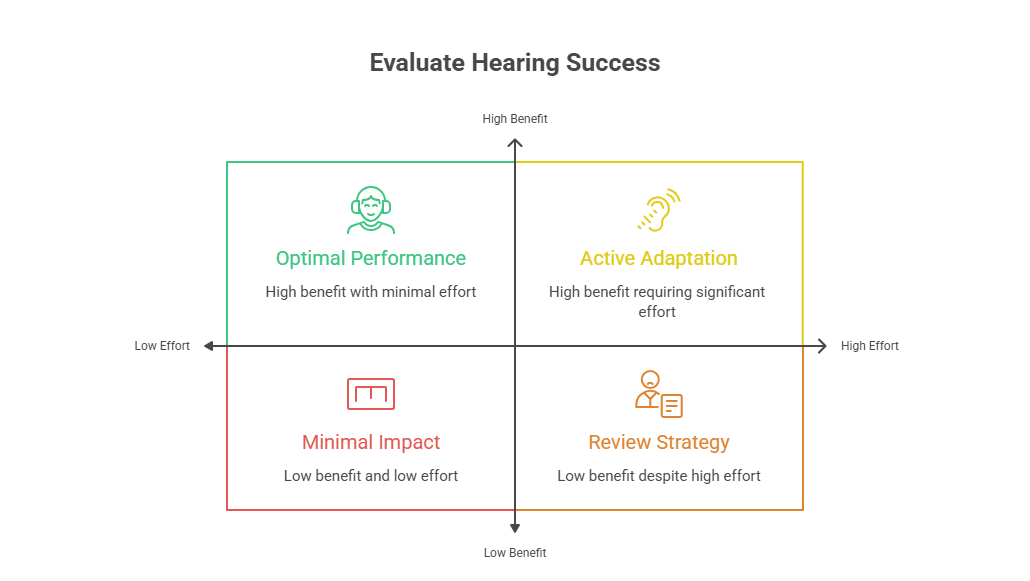
Success is no guarantee that everything will be perfect when you listen.
For meaningful changes, look for the following:
- Fewer reps requested
- Clearer everyday conversations
- Improved knowledge of beneficial noises
- Revised comfort while listening.Listening comfort improvements.
- Television or telephone that is easier to listen to.
- The student has to make less effort to follow speech. The student requires less effort to follow speech.
- Reliable and easy-to-use device usage
Your trial hearing aid checklist should include if and when the hearing aid will be helpful for you in the most important listening environment.
The sound will still sound different at first. Users need to get used to their hearing aids, and using them regularly can assist in adapting to amplified sound, NIDCD states.
What If Your Hearing Aid Trial Checklist Shows Problems?
Don’t think that if it is harder to hear, it is not working.
For instance, while the speech may sound clear in quiet settings, it can be difficult to understand in noisy environments. You may sound different when hearing yourself. After a few hours, one ear may feel uncomfortable.
The following information can assist the audiologist to determine if the hearing aid is required to:
- Programming changes
- Volume adjustment
- Physical fit changes
- A new dome/earmould
- The noise-management settings have been changed.
- Additional counselling and settling-in period.
- A different type or kind of hearing aids
Don’t expect the initial settings to be flawless for all users – Resonnocare’s trial process offers a chance to review and fine-tune settings if necessary.
When Should You Contact an Audiologist or Doctor?
If the hearing aid continues to cause discomfort, feedback, or poor speech clarity, or sound is still too loud or too unpleasant, contact your audiologist.
If you have any of the following symptoms, a medical evaluation is particularly important:
- Sudden hearing loss
- Severe ear pain
- Ears leaking or blood loss from the ears
- Tinnitus for the first time or a new onset of tinnitus that causes trouble.
- Major dizziness or unsteadiness
- Sudden change in hearing between the ears
- Persistent ear symptoms
Sudden hearing loss that is not easily corrected by changing the setting of the hearing aid. It should be addressed promptly by a trained medical professional.
What Happens at the Follow-Up Appointment?
Take notes for the follow-up.
Your audiology professional will ask about the places that were successful and where you had difficulty. The physical fit will be tested, and the program may be modified if necessary.
The follow-up could include:
- Speech clarity
- Background-noise experience
- Comfort and fit
- Wearing time
- Charging and handling
- Using a cell phone, Bluetooth, or other wireless devices
- Remaining listening difficulties
That’s why you need to have a hearing aid trial checklist. Rather than just stating that the hearing aid was “good” or “not good,” you can go into detail about what happened.
Hearing-aid care often continues after the initial fitting. Resonnocare’s hearing-aid aftercare includes support for fitting, sound clarity, programming, cleaning, and device-related concerns.

Why Choose Resonnocare for Hearing and Audiology Care?
A hearing-aid trial is not just a product demonstration; it’s part of a clinically guided hearing-care process at Resonnocare.
Our approach includes:
- Clinically guided care: Aids are recommended based on the results of the hearing test and the communication needs and difficulties of an individual.
- Our team of experienced: Audiologists and clinicians helps patients with the hearing assessment, hearing aid selection, hearing aid trial, fitting, and follow-up.
- Correct hearing evaluations: Knowing the nature and extent of hearing loss will help define which type and level of hearing aid to consider.
- Individual care plans: Lifestyle, listening environments, comfort, technology and personal preferences are taken into account.
- Continuity of care: This may involve hearing aids, hearing tests, home visits, video consultation and aftercare depending on individual needs.
Our clinical approach to hearing care places assessment, professional guidance and ongoing support at the centre of the hearing-aid journey.
Find a Hearing Aid Clinic Near You
Select your city to find the nearest Resonnocare clinic and book an appointment with our hearing care team.
Bangalore
Ear 360, Jayanagar
Ground Floor, Site No. 499, Municipal No. 499/97, East End Main Road, 9th Block, Jayanagar, Bangalore, Karnataka 560041
Timings: 10:00 AM to 7:00 PM
[Call] [Book an Appointment]
Ear 360, Spandana Sarjapura Hospital
239/205/34A, near Trinity Complex, Sompura Gate, Sarjapura Main Road, Bangalore, Karnataka 562125
Timings: 10:00 AM to 7:00 PM
[Call] [Book an Appointment]
Resonnocare, HSR Layout
150/5/72, 7th Cross, 24th Main, HSR Layout, Bangalore, Karnataka 560102
Timings: 10:00 AM to 7:00 PM
[Call] [Book an Appointment]
Resonnocare, Banashankari
272, 7th Cross Road, BSK 1st Stage, 2nd Block, Srinivasan Agra, 80 Feet Road, Bangalore, Karnataka 560050
Timings: 10:00 AM to 7:00 PM
[Call] [Book an Appointment]
Resonnocare, Indiranagar
34, Wind Tunnel Road, Murugeshpalya, Muniyappa Layout, Bangalore, Karnataka 560017
Timings: 10:00 AM to 7:00 PM
[Call] [Book an Appointment]
Conclusion: Use a Hearing Aid Trial Checklist Before You Decide
You should learn a lot more than just if a hearing aid makes sounds louder during a hearing-aid trial.
The hearing aid trial checklist can assist you in testing for speech clarity, conversations in noise, hearing yourself, physical comfort, daily activities, TV and phone listening, charging and handling.
Most importantly, wear the hearing aid where you need it – where you will get better communication.
If certain scenarios are still problematic, consult with your Audiologist prior to concluding the device is not suitable. A fine-tune, fitting changes, or another device might sometimes make a more precise fit.
Resonnocare offers a hearing assessment and, for those thinking of hearing aids, a guided hearing-aid trial. Our team can assist you in understanding your levels, explain the type of devices available, and determine how they work for you before you make an informed decision.
Medical Disclaimer: This article contains general education information and is not intended as a replacement for a particular diagnostic hearing evaluation or treatment plan from an audiologist, otolaryngologist (ENT), or another qualified healthcare professional.
FAQ’s
What is a hearing aid trial?
A hearing aid trial is the time that a person can try a hearing aid before deciding to buy it. A trial will enable the user to test comfort, sound, and performance in their everyday environment. Most hearing clinics will provide a trial period to allow patients to make sure the device fits their lifestyle and hearing needs.
What are the 4 P’s of hearing loss?
The 4 P’s of hearing loss often include: Prevention, Protection, Prompt Diagnosis, and Proper Treatment. The rules are: limit exposure to noise, make sure to keep your ears healthy, and get early detection and treatment (including hearing aids or medical services) to prevent additional hearing loss.
What is the 60-60 rule in audiology?
The 60-60 rule refers to the populations for whom a combination of a hearing threshold of 60 dB or higher and a speech understanding score of less than 60% may be an indication that advanced hearing solutions, such as cochlear implants, might be of benefit. This helps find people who might be in need of something other than a conventional hearing aid.
What is the 1-3-6 rule in audiology?
The 1-3-6 rule is an important guideline for infant hearing care. It suggests screening infants for hearing loss by 1 month, diagnosis within 3 months of age if a hearing loss is found, and initiation of intervention services by 6 months of age. Early identification and treatment help children achieve good speech, language, and developmental outcomes.
What are the 5 components of a hearing aid?
There are five parts to a hearing aid: the microphone, amplifier, processor, receiver (speaker), and battery. This is accomplished through the microphone receiving sounds, the processor and amplifier enhancing and amplifying the sounds, and the sounds being passed through to the ear. These work together to enhance the clarity of hearing and understanding of speech in persons with hearing loss.