

TL: DR;
- A hearing aid trial reduces doubt: It helps you try hearing aids before making a purchase decision.
- You test them in real life: Use them at home, work, outdoors, and in conversations to judge performance.
- The process is audiologist-guided: It includes hearing assessment, device selection, fitting, usage support, and adjustments.
- Comfort and clarity matter: Notice speech clarity, background noise handling, ease of use, and overall comfort.
- Feedback helps fine-tune fit: Share issues like whistling, unclear sound, or unnatural voice quality with your audiologist.
- Get a free trial at Ear360 clinics: Visit Ear360 clinics for hearing aid trials, expert guidance, and personalized hearing care.
The decision of which hearing aid to select can be daunting. Not only is it a medical choice, it is also a personal and financial choice. This is often a point people arrive at after months or years of having to ask others to repeat themselves, or of avoiding large crowds and places with a lot of noise, or of feeling left out of conversations that once came easily.
When there are many hearing aid manufacturers and models available, it’s natural to ask yourself which hearing aid will work best for your lifestyle, hearing needs, comfort, and budget. No one wants to buy a hearing aid and discover that it doesn’t fit within their daily routine.
You can make that decision with confidence after undergoing a hearing aid trial. Don’t just read about or be told what the device does, test it out in the real world: at home, at work, during discussions, and in the places where you need to hear it the most. At ResonnoCare, we offer a free hearing aid trial so you can experience the difference before committing. This guide explains how the trial works, what to expect, and how it can help you choose the right hearing aid for your hearing health.
What Is a Hearing Aid Trial?
A hearing aid trial is a structured period during which patients can try a hearing aid selected for their individual hearing profile before making a purchase. It is not just a quick demonstration or a listen-in. A well-designed trial, which typically runs for 3-5 days, takes place in real-world environments that matter to you, such as your home, workplace, family gatherings, and noisy public places.
The goal of a hearing aid trial is to ask a practical question: Will this hearing aid make a difference in my life, in my hearing, and in my communication? That is something that can’t be recreated in a showroom. It’s only through experience with a hearing aid in various listening contexts that you’ll get the proof you need.
A trial also gives your audiologist time to fine-tune device settings based on your feedback, and the experience you have during the trial accurately reflects what the device can do once it’s fitted to you.
What Should Happen Before the Hearing Aid Trial Starts?
A useful hearing aid trial should begin before you leave the clinic with the device. The hearing aid first needs to be selected and programmed using your hearing-test results rather than being handed over with generic settings.
Before the trial begins, the audiologist should ideally review:
- Your audiogram and degree of hearing loss
- Whether one or both ears may benefit from amplification
- Speech-understanding results where available
- The situations in which you struggle most
- Your work and social listening environments
- Telephone and television use
- Your ability to insert, remove, clean, and charge the device
- Whether dexterity, vision, or memory could affect device use
- The physical comfort of the hearing aid
- The initial programming and listening settings
The aim is to make the starting point clinically appropriate. A trial is less useful if an unsuitable or poorly programmed device is tested and the patient then assumes that all hearing aids will perform the same way.
Who Should Consider a Hearing Aid Trial?
If a hearing assessment has confirmed mild-to-profound hearing loss and an audiologist has recommended amplification, a hearing aid trial is the next logical step before purchasing a device.
A trial might be helpful if you:
- You’ve been diagnosed with hearing loss and are not sure if you are ready for a hearing aid.
- You have used hearing aids before but want to try a newer model or a different style.
- You want an elderly parent or family member to experience the benefits of hearing aids firsthand.
- You are unsure about the cost and want to understand the value before making an investment.
- You have previously used a hearing aid for a short time but found it uncomfortable or unhelpful.
A trial eliminates the uncertainty. Instead of thinking, “It might help,” you can confidently say, “Yes, this works for me,” or “Let’s try something different.”
Our hearing care for all ages service means that whether you are arranging a trial for a young adult with hearing loss or an elderly parent who has been resisting hearing aids for years, we have the experience to guide the process thoughtfully.
How Long Is Enough to Judge a Hearing Aid Trial?
There is no single number of days that guarantees a decision. The existing trial period should give you enough opportunity to test the device in the situations that matter to you rather than judging it only from a short clinic demonstration.
A trial is more informative when you have had the chance to test:
- A quiet one-to-one conversation
- A family or group conversation
- Television
- Telephone calls
- Outdoor sound
- A moderately noisy environment
- A difficult environment that you regularly visit
- Several hours of physical comfort
- Insertion, removal, charging, and cleaning
If an important situation does not occur during the trial, tell your audiologist before making a final decision. The quality of the trial matters more than simply counting the number of days.
What Happens During a Hearing Aid Trial?
Knowing what to expect allows you to get the most out of the adventure.
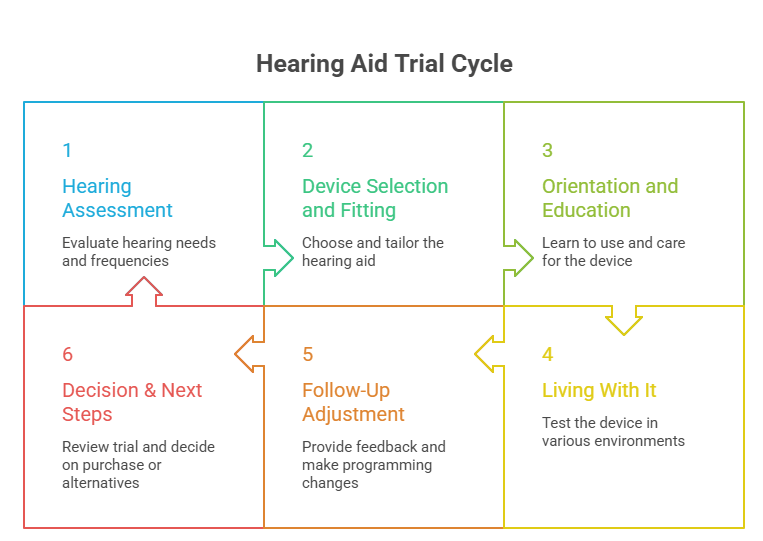
Step 1: Hearing Assessment:
A complete hearing test is performed before a particular hearing device is chosen. The frequencies and volume levels that need amplification will depend on your audiogram. Choosing a hearing aid without this test would be like prescribing glasses without checking vision. At Resonnocare, each hearing aid trial starts with a clinically accurate assessment.
Step 2: Device Selection and Fitting:
Your audiologist will choose the appropriate hearing aid model(s) for you based on your audiogram, hearing needs, lifestyle, and preferences. This device can then be tailored to your hearing levels. It is important to check the fit carefully because even a technically good hearing aid may not feel comfortable or perform well if it does not fit properly.
Step 3: Orientation and Education:
Before you leave with the device, your audiologist will show you how to insert and remove it, use the controls, clean and care for it, and replace the batteries or charge it, if applicable. Before the trial, you should feel comfortable using the device.
Step 4: “Living With It”:
This is the most crucial step. Use the hearing aid in different environments: at home, during family conversations, in busy markets, while watching TV, on phone calls, and outdoors. Pay attention to which is easier and which is still difficult. Numerous audiologists offer a basic feedback diary for making observations.
Step 5: Follow-Up Adjustment:
After about the middle or end of the trial, you go back to the clinic to give feedback about your experience. This feedback allows your audiologist to make adjustments to the device’s programming. Some people need only minor adjustments, while others may feel comfortable with the first fitting itself. In either case, it is critical to know what needs to be done in the follow-up.
Step 6: Decision & Next Steps:
You and your audiologist review your hearing aid trial together at the end. If it has been helpful, the dialogue progresses towards closing the deal. Otherwise, the audiologist may suggest other options, such as switching to another model, adjusting the settings, or trying a different approach.
Specific Listening Situations to Test During Your Hearing Aid Trial
Do not test the hearing aid only by asking whether sounds are louder. Test whether communication becomes easier in the situations that matter in your normal day.
Situation to test | What to notice |
Quiet conversation | Can you follow speech without repeatedly asking for repetition? |
Family conversation | Can you follow different speakers more comfortably? |
Restaurant or café | Can you understand the person you are speaking with despite background sound? |
Television | Can you understand speech at a more comfortable volume for everyone? |
Phone call | Is speech clearer, and is the hearing aid easy to use with your phone? |
Video call | Can you follow speech comfortably through the device or connected audio? |
Car journey | Can you communicate without road noise becoming overwhelming? |
Outdoor environment | How does traffic, wind, and environmental sound feel? |
Work meeting | Can you follow speakers at different distances or around a table? |
Shopping or market | Can you communicate while other conversations and environmental sounds are present? |
Conversation from another room | Does distance remain difficult, and is that difficulty realistic for the device? |
Several hours of wear | Does the physical fit remain comfortable? |
You do not need perfect performance in every situation. The aim is to understand where the device helps, where difficulty remains, and which problems may need programming changes or another solution.
Daily Hearing Aid Trial Scorecard
A simple daily scorecard can make your follow-up appointment more useful because it turns “it was good” or “it did not work” into specific feedback the audiologist can act on.
Score each item from 1 to 5:
1 = very poor / major difficulty
2 = poor
3 = acceptable but needs improvement
4 = good
5 = very good
Trial area | Day 1 | Day 2 | Day 3 | Day 4/5 if applicable | Notes |
Speech in quiet | __/5 | __/5 | __/5 | __/5 | What improved or remained difficult? |
Speech in noise | __/5 | __/5 | __/5 | __/5 | Where did you test it? |
Television | __/5 | __/5 | __/5 | __/5 | Was speech clearer? |
Phone | __/5 | __/5 | __/5 | __/5 | Any connectivity/use issue? |
Own voice | __/5 | __/5 | __/5 | __/5 | Natural, hollow, loud, blocked? |
Background sounds | __/5 | __/5 | __/5 | __/5 | Too loud or becoming easier? |
Physical comfort | __/5 | __/5 | __/5 | __/5 | Pain, pressure, slipping? |
Insertion/removal | __/5 | __/5 | __/5 | __/5 | Independent or needs help? |
Battery/charging | __/5 | __/5 | __/5 | __/5 | Enough for daily use? |
Overall usefulness | __/5 | __/5 | __/5 | __/5 | Would you want to keep using it? |
Bring these observations to your follow-up. A repeated low score in one situation may indicate the need for an adjustment, different feature, accessory, physical-fit change, or another hearing aid option.
What Should You Pay Attention to During the Trial?
A trial is designed to be a collaborative process that is most effective when participants participate. Take note of the following:
- Speech clarity: Is speech clearer and easier to understand, particularly in noisy environments? Do you hear the consonants better?
- Comfort: Does the device stay securely in place? Does there appear to be any irritation in the ear canal after prolonged use?
- Background noise: Some hearing aids can cope better with background noise than others. See if the noise seems like too much.
- It’s very common for new hearing aid wearers to discover that their own voice sounds different when they first wear a hearing aid. This is typically resolved within a week. If it doesn’t, your audiologist can make adjustments.
- Feedback or whistling: If whistling or feedback occurs occasionally when something approaches the ear, it is normal. If you have ongoing feedback, report it to your audiologist for adjustments.
- Ease of use: Are controls easy to use? Are you able to run the device without assistance, or do you require ongoing support?
What Is Normal Adaptation and What Should Be Reported?
A new hearing aid changes the amount and balance of sound reaching you. Some sounds that have been less noticeable may suddenly become audible again, so the first impression does not always represent the final experience after appropriate adjustment and adaptation.
Experience | What to do |
Your own voice sounds different | Note how it sounds and whether the sensation becomes easier with use. Discuss persistent discomfort with the audiologist. |
Everyday sounds seem more noticeable | Observe whether they remain overwhelming or gradually become easier to tolerate. |
Speech is clearer but slightly unfamiliar | Continue testing and provide specific feedback. |
Persistent physical pain | Report it rather than forcing yourself to continue wearing an uncomfortable device. |
Sound is painfully loud | Contact the audiologist for review rather than simply trying to tolerate it. |
Speech remains unclear despite being louder | Record the situations in which this occurs so programming or technology can be reviewed. |
Constant whistling or feedback | Report when and where it happens. |
The device repeatedly falls out | The physical fit or retention may need review. |
Adaptation should not be used as a reason to ignore pain, excessive loudness, persistent feedback, or a clearly poor physical fit.
Why Does the Hearing Aid Sometimes Sound Better in the Clinic Than at Home?
A clinic is only one listening environment. It is often quieter, the speaker is nearby, and the audiologist can control the conversation. Home, work, restaurants, traffic, television, and group conversations create very different listening demands.
If the device sounded good in the clinic but not at home:
- Do not immediately conclude that all hearing aids will fail.
- Write down the exact environment where the difficulty occurred.
- Describe who was speaking, how far away they were, and how much background noise was present.
- Note whether the problem was clarity, loudness, comfort, noise, or handling.
- Take the feedback to your audiologist for programming review.
- Retest the same situation after the adjustment when practical.
This is one of the main reasons a real-life hearing aid trial can provide more useful information than a clinic demonstration alone.
Can Hearing Aid Settings Be Changed During the Trial?
Yes. A trial is not necessarily a test of one fixed set of settings. Your feedback can help the audiologist identify whether programming changes are appropriate.
Adjustment may involve reviewing:
- Overall amplification
- Specific frequency regions
- Comfort for louder sounds
- Noise-management settings
- Directional microphone behaviour
- Listening programs
- Feedback management
- Own-voice comfort
- Phone or connectivity settings where supported
The purpose of an adjustment is not simply to make the hearing aid louder. It is to improve the balance between audibility, speech clarity, comfort, and the situations you are trying to manage.
Useful Adjustment Checkpoints During a Hearing Aid Trial
Instead of waiting until the final day when several problems may be difficult to remember, use clear checkpoints.
Checkpoint 1: First Day
Focus on physical comfort, insertion/removal, basic sound comfort, own voice, controls, and charging.
Checkpoint 2: After Testing Key Everyday Situations
Evaluate conversation, television, telephone, family interactions, workplace needs, and at least one background-noise situation.
Checkpoint 3: After Any Programming Change
Return to the listening situations that were difficult and check whether the change actually improved them.
Checkpoint 4: End of the Trial
Review whether the device provides enough benefit to justify continued use and whether any remaining difficulty is likely to improve through adjustment, adaptation, accessories, or a different device.
Poor Physical Fit, Wrong Settings, or Wrong Technology?
A disappointing trial does not always mean that hearing aids cannot help. The reason the trial is unsuccessful needs to be understood.
Problem | What you may notice | Possible next discussion |
Poor physical fit | Pain, pressure, slipping, difficulty inserting, or device falling out | Fit, dome, earmould, receiver, retention, or style |
Programming issue | Sound too sharp, too loud, too soft, or uncomfortable in specific situations | Fine-tuning and verification |
Background-noise difficulty | Quiet speech improves but restaurants remain very difficult | Noise-management technology, directional features, expectations, or accessories |
Handling problem | Difficulty with small controls, batteries, insertion, or cleaning | Larger style, rechargeability, caregiver support, or another design |
Connectivity problem | Phone streaming or app does not work as expected | Compatibility, pairing, settings, or another model |
Technology mismatch | The device lacks a feature required for frequent real-life listening situations | Compare another technology level or model |
Limited speech understanding | Sound becomes louder but words remain difficult to understand | Review speech-test results, expectations, programming, and other rehabilitation needs |
The question at follow-up should therefore be, “Why did this situation remain difficult?” rather than immediately asking for the loudest, smallest, newest, or most expensive hearing aid.
What If You Cannot Decide After the Trial?
Needing more discussion does not automatically mean the trial failed. Before deciding, identify what is still uncertain.
Ask whether the uncertainty is about:
- Comfort
- Speech clarity
- Background-noise performance
- Handling
- Battery or charging
- Appearance
- Phone connectivity
- Price
- Whether one or two devices are needed
- Whether another technology level would provide better value
- Whether more programming is required
- Whether expectations need to be adjusted
A useful trial should make the next decision clearer, even when the decision is to change the device or settings rather than purchase the first option tested.
Questions to Ask at the End of a Hearing Aid Trial
Before making a purchase decision, review the trial with your audiologist and ask:
- Which situations improved most?
- Which situations are still difficult?
- Can the remaining problems be improved through programming?
- Would another style or technology level address them better?
- Am I paying for features that I did not use during the trial?
- Is there a lower-priced suitable option I should compare?
- Would a higher technology level solve a specific problem I experienced?
- How will the final hearing aid be fitted and verified?
- What follow-up adjustments are included after purchase?
- What warranty and repair support is included?
- What is the final price for one device or a pair?
- What accessories or recurring costs should I expect?
- What happens if my hearing changes later?
These questions connect the trial experience directly to device selection, price, fitting, and long-term aftercare.
Confirm Trial and Return Terms Before You Start
Trial arrangements can vary by device, clinic, and individual circumstances. Do not assume that every hearing aid trial has identical duration, deposit, return, or exchange conditions.
Before taking a device home, confirm:
- How long the trial lasts
- Which hearing aid model or models are included
- Whether one or two devices will be trialled
- Whether a deposit or other payment is required
- Whether programming adjustments during the trial are included
- What happens if another model needs to be tested
- The condition in which the device must be returned
- Whether any trial-related charge is refundable
- What happens if the device is damaged or lost
- What happens at the end of the trial if you do not purchase
- Which follow-up appointments are part of the trial
For current Resonnocare trial information, review the free hearing aid trial service and confirm the applicable terms with the clinic before starting, as the specific conditions for your device and location should be explained directly.

Why Choose Resonnocare for Hearing and Audiology Care
At Resonnocare, the hearing aid trial experience is built around clinical rigor and genuine patient care. We do not rush decisions, and we do not push products. Our approach is guided entirely by what is right for your hearing health.
- Experienced audiologists and clinicians: Every trial at Resonnocare is overseen by trained audiologists who understand both the technical side of hearing devices and the very human experience of adjusting to one.
- Accurate hearing assessments: No trial begins without a proper audiological evaluation. The right device can only be selected when the full picture of your hearing is understood.
- Personalized care plans: Your trial is not a generic process. The device chosen, the settings programmed, and the follow-up provided are all tailored to your audiogram, lifestyle, and communication goals.
- Ongoing aftercare: Once a decision is made and a hearing aid is purchased, our aftercare services ensure that your device continues to perform well and that you always have support when you need it.
- Flexible access: Whether you come to our clinic, request a home visit, or prefer to start with a video consultation to discuss your options, Resonnocare makes hearing care accessible on your terms.
Conclusion
Purchasing a hearing aid without doing a test fit is akin to buying a car without taking a test drive. During a hearing aid trial, you will gain real-world experience, professional help, and the confidence that will help you make the right decision, not only in the clinic, but in your daily life.
Contact Resonnocare today if you or a family member has been advised to have a hearing test, or if you’re just interested in whether hearing aids will help you. Schedule a free hearing assessment, and begin to hear the world more clearly on your own terms with a pair of hearing aids.
This article is authored by:- Dr. Narthana Yuvraj
FAQ’s
What is a hearing aid trial?
A hearing aid trial is the period of evaluation that a hearing aid user gives before buying a hearing aid. Comfort, Sound Quality, Speech Clarity, and daily performance in various environmental settings are assessed during the trial to determine whether the device is a good fit for the user’s hearing needs.
How do you qualify for a free hearing aid?
Free or reduced-cost hearing aids are available through government programs, insurance, disability, income, or veteran benefits. A hearing evaluation is typically conducted by an audiologist (usually Pure Tone Audiometry) to confirm hearing loss prior to approval.
How to reverse hearing loss naturally?
Infections, earwax, and noise exposure are possible causes of temporary hearing loss, which may improve without medical intervention or hearing devices; however, permanent hearing loss is generally not completely reversible without medical intervention or hearing devices. Avoiding exposure to loud noises, promoting blood flow, reducing stress, and having a healthy diet can help maintain normal hearing.
Which hearing aid is best for otosclerosis?
Anytime someone is diagnosed with Otosclerosis, fairly high amplification and clear speech processing hearing aids are generally suggested. It is best to discuss which of these would be best based on the severity of the hearing loss, ear anatomy, and whether an ENT specialist is also proposing surgery.
What hearing aid do most audiologists recommend?
Typically, an audiologist will recommend a hearing aid based on a person’s hearing test results, lifestyle, and budget rather than suggesting a one-size-fits-all device. For the best in speech clarity and listening comfort in everyday situations, modern digital hearing aids are often recommended, offering noise reduction, directional microphones, Bluetooth compatibility, and tinnitus assistance.