
TL; DR:
This blog is aimed at current hearing-aid users, seniors, caregivers, and family members who are trying to decide whether a poorly performing or unreliable hearing aid should be repaired, adjusted, or replaced.
- Repair is usually suitable when the hearing aid still meets the user’s hearing needs. Repair may make sense if the problem is limited to one component, replacement parts are available, the device has otherwise been reliable, and the current hearing loss still falls within the device’s fitting capability.
- Replacement becomes more appropriate when problems are frequent, or the device no longer meets current needs. Repeated breakdowns, unavailable parts, unreliable charging, poor comfort, changing communication needs, or an inability to program the device properly can all support considering a replacement.
- A poorly performing hearing aid does not always mean the device is faulty. The blog explains that hearing itself may have changed, so users experiencing reduced speech clarity, increased volume needs, or differences between the ears may need a new hearing test before deciding to replace the device.
- The final decision should be based on a professional assessment, not just the age of the hearing aid. An audiologist can review current hearing levels, speech understanding, device condition, programming, repair history, comfort, listening needs, and parts availability to determine whether adjustment, repair, or replacement is the most appropriate next step.
Sometimes a weak, intermittent, uncomfortable, or unreliable hearing aid is not the first solution. Whether it is the hearing aid repair or replacement that is the better option will depend on the problem, the hearing aid’s level of effectiveness, its condition, and whether your hearing has changed.
Sometimes the problem is as simple as a blocked wax filter or worn dome. In other cases, frequent failures, a loss of parts, or a change in hearing can make replacement a more viable option.
To make sure, at Resonnocare, we suggest that both your hearing and device be tested before making a decision.
Quick Answer: Hearing Aid Repair vs Replacement
That’s typically when repair is a good option: if the hearing aid fits your hearing loss, you can fix it, replacement parts can be found, and you’ve had a pretty solid hearing aid so far.
Replacement may be more appropriate if the hearing aid experiences frequent problems, fails to meet your needs for amplification, some parts cannot be repaired, or if your hearing and listening needs have significantly changed.
The optimal choice is thus not solely the age of the device.
Know More About
- Hearing Aid for Elderly People: Best Features to Look For
- Hearing Aids Near Me: How to Choose the Right Hearing Aid Center
- Hearing Aid Center Near Me: Checklist Before Booking an Appointment
Before You Decide: Could It Be a Simple Problem?
If the hearing aid suddenly appears weak or ceases to function, it might not be something that needs a big repair job.
Please check before booking a service appointment:
- Has the device reached 100% charge?
- Do you need to change the batteries in the disposable battery?
- Does the wax filter need to be replaced?
- Is the dome/tubing clogged or broken?
- Has the hearing aid been put in properly?
- Are charging contacts clean?
- Could Bluetooth have lost its connection with your cell phone?
Clean according to the instructions given for your device. Do not put pins, needles, water, household chemicals, or anything that could harm the hearing aid into the case.
If basic checks do not solve the problem, professional hearing-aid aftercare can help identify whether the issue involves cleaning, fit, programming, servicing, or repair.
Signs Your Hearing Aid May Need Repair
Some symptoms of technical issues are:
- The device continues to shut off.
- The sound cuts in and out.
- The hearing aid does not charge properly.
- Suddenly, the battery life is drastically reduced.
- Cleaned and distorted sound is still heard.
- Buttons or controls freeze.
- The casing (or other part) is damaged.
- One hearing aid is considerably quieter than the other.
- It seems that moisture has had an impact on performance.
These symptoms are not an indicator of a damaged or broken hearing aid. The device needs to be checked by an audiologist or service technician before making a decision about what repair is necessary.
When Hearing Aid Repair vs Replacement Favors Repair
If the hearing loss originally occurred in a device that was functioning properly, repair may be worthwhile if the loss remains in that device.
Repair is appropriate when:
- The problem only involves one component.
- Appropriate parts are still on offer.
- The hearing aid is otherwise reliable and working properly.
- Your current hearing levels are in the proper fit range of the device.
- You are comfortable with the style and controls.
- The repair price is acceptable when the device is replaced.
- The warranty still covers the hearing aid.
If something is working fine and a repair is needed, there is not much reason to change it just for that.
When Replacement May Be the Better Option
Replacement becomes more of a possibility when operating the existing device is no longer clinically or practically useful.
If your audiologist suggests replacement, they might explain the reasons for it, such as:
- There is an increasing frequency of breakdowns.
- Repairs are repeated on a regular basis.
- Parts and servicing are not readily available.
- It can’t be programmed properly for your hearing.
- You’ve experienced a change in your communication requirements.
- It has become hard to handle physically.
- The hearing aid is always uncomfortable.
- After servicing, battery or charging performance is not reliable.
Not always is the most expensive or technologically advanced hearing aid the replacement. The goal is to identify a suitable hearing device for your hearing, lifestyle, comfort, and budget.
Hearing Aid Repair vs Replacement: Side-by-Side Comparison
Factor | Repair May Make Sense | Replacement May Make Sense |
Current performance | Functioned normally in the past | There have been repeated drops in performance. |
Repair frequency | Occasional problem | Frequent breakdowns |
Hearing needs | The ability to hear is well matched to the devices. | The needs of people with hearing loss have evolved. |
Parts availability | Components readily available | Replace components that are hard or can’t be found. Replace hard-to-find or non-existent parts. |
Comfort | Device remains comfortable | Fit/handling is consistently challenging |
Technology needs | Avoid the drab features of the past by sticking with current features that are useful. | Key communication needs are not being addressed |
Cost | The cost of repair depends on the value of the device | Repair costs are becoming unaffordable due to repeated repairs. |
Reliability | Device in general has been reliable | Operating experience is impacting reliability |
This is a good starting point for the hearing aid repair vs replacement comparison. The device should be evaluated in conjunction with your existing hearing evaluation by an audiologist.
Does the Age of the Hearing Aid Matter?
Yes, but age is not a “rule of replacement”.
With age, parts of the hearing aids may wear, batteries may not function as well, and parts or manufacturer support may be reduced. Some older devices, however, are still working well and continue to provide the user with the hearing that they require.
Don’t just ask the question: “How old is the hearing aid?”, but rather:
Does it work well, is it reparable, comfortable, and suitable for your hearing?
This provides a more meaningful basis for considering whether to repair versus replace a hearing aid.
Could Your Hearing Have Changed Instead?
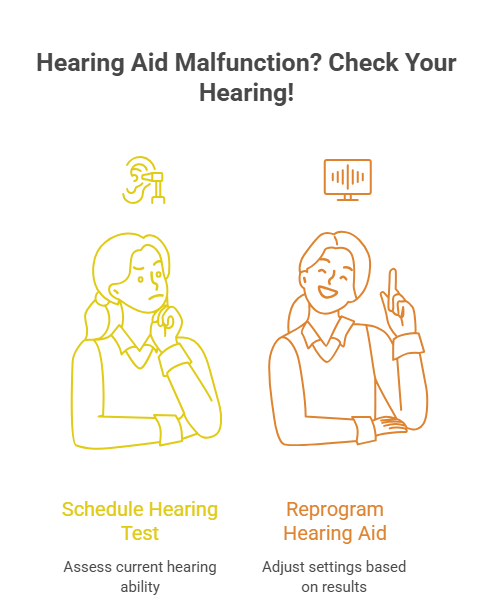
Although a hearing aid may function normally, sometimes it seems to be working poorly.
Your hearing ability may have changed.
Look for a new hearing test if:
- Speech has slowly become incoherent.
- You require higher volume than usual.
- Easier things are harder to do.
- There is a difference in the ears.
- Your last hearing test was some time ago.
Resonnocare provides hearing care for all ages with assessment-led guidance when hearing needs change.
Reprogramming an existing device may sometimes be appropriate if your new hearing results remain within its capabilities.
Does Your Hearing Aid Need Adjustment, Repair or Replacement?
These are three distinct options, which address three different problems.
Adjustment is typically indicated when the hearing aid is functioning, but the sound output, programming, or the physical fit of the hearing aid requires adjustment.
Repair: Used when a technical component or part is malfunctioning.
When the hearing device is not reliable or repairable, or is not appropriate for the hearing and daily needs of you and your family, replacement may be considered.
For instance, if speech is too loud and not clear enough, programming may be necessary. If the receiver is cracked or has a charging fault, it could need repair. A device that keeps failing and no longer meets the new hearing requirements may be a good reason to replace it.
If you can narrow down the cause first, then you won’t incur needless costs.
How Does an Audiologist Decide?
An audiologist can analyze:
- The current level of hearing you have.
- Speech-understanding difficulties.
- The physical condition of the hearing aid.
- Wax guards, domes, tubing, receivers and earmoulds.
- Battery charging or Battery performance.
- Current programming.
- History of repairs and servicing.
- Ease of handling and comfort.
- Your everyday listening needs.
- Availability and usability of repairs.
It is not about suggesting a new hearing aid every time there is a problem. The purpose is to determine the best course of action going forward.
Resonnocare’s hearing-aid care includes assessment, fitting, programming, and follow-up based on individual hearing and communication needs.
Is Upgrading to a Newer Hearing Aid Worth It?
Sometimes, but never, newer tech is helpful if there’s a problem you have.
Modern devices might contain the following features:
- Rechargeable batteries
- Automatic listening programmes
- Directional microphones
- Improved noise-management options
- Smartphone connectivity
- Direct audio streaming
- Remote programming capabilities
A person who has difficulty disposing of batteries, for instance, might prefer a rechargeable one. Some may need to connect to make regular phone calls.
But, swapping a working device just for getting some features that you probably will not use is not that beneficial.
Can You Try a New Hearing Aid Before Replacing Yours?
If it is appropriate, a trial can help you make the decision on whether to repair or replace the hearing aid.
By using a recommended device, you can make comparisons:
- Speech clarity
- Comfort
- Background-noise performance
- Handling
- Charging
- Phone use
- Everyday listening
Resonnocare offers a free hearing-aid trial for eligible patients and selected devices, with professional fitting, programming, real-life use, and follow-up adjustment.
A trial allows you to judge whether replacement provides a meaningful practical benefit instead of deciding from specifications alone.
How Can You Make Your Current Hearing Aid Last Longer?
Avoidable problems can be minimised with good care.
To ensure good performance:
- Be sure to keep hearing aids dry.
- Clean them with a clean, dry cloth.
- Regularly review wax guards and domes.
- Use the proper charging procedure.
- Change out used batteries as necessary.
- Avoid high temperatures.
- Keep them in a secure place when not in use.
- Don’t use hairspray or other sprays while wearing them.
- Make sure worn tubing, domes, or other components have been checked if needed.
- Follow up with appointments if there are changes in sound quality.
Don’t attempt to open or repair inside electronic parts at home.
When Ear or Hearing Symptoms Need Medical Attention
Sometimes a hearing aid problem and a medical hearing problem can be confused.
If you have symptoms of:
- Sudden hearing loss
- Severe ear pain
- Earache or bleeding from the ears
- Tinnitus that is new or unusual.
- Marked vertigo/imbalance
- Sudden onset of hearing loss, usually affecting one ear, but occasionally both.
- Persistent ear symptoms
Sudden hearing loss should NOT be treated by increasing the hearing aid setting or waiting for a hearing aid appointment. It should be assessed medically at the right time.

Why Choose Resonnocare for Hearing and Audiology Care?
At Resonnocare, the most important issue isn’t hearing aid repair versus replacement; it’s a clinical one.
Our approach includes:
- Clinically guided care: Identifying the problem with the hearing, programming, fit, maintenance, or the device itself.
- Clinicians and experienced audiologists: We assist with hearing assessment, fitting, troubleshooting, programming, and follow-up.
- Reliable hearing testing: When hearing changes are suspected, it is retested before deciding whether to replace the device.
- Recommendations include personalized care plans, taking into account hearing levels, communication needs, comfort, handling, and budget.
- Continuity of care: Assistance with hearing aids, audiological assessment, home visits, video consultation, post-testing, and repair support as appropriate.
The goal is to suggest what your hearing needs are, not to replace an unnecessary hearing device.
Find a Hearing Aid Clinic Near You
Select your city to find the nearest Resonnocare clinic and book an appointment with our hearing care team.
Bangalore
Ear 360, Jayanagar
Ground Floor, Site No. 499, Municipal No. 499/97, East End Main Road, 9th Block, Jayanagar, Bangalore, Karnataka 560041
Timings: 10:00 AM to 7:00 PM
[Call] [Book an Appointment]
Ear 360, Spandana Sarjapura Hospital
239/205/34A, near Trinity Complex, Sompura Gate, Sarjapura Main Road, Bangalore, Karnataka 562125
Timings: 10:00 AM to 7:00 PM
[Call] [Book an Appointment]
Resonnocare, HSR Layout
150/5/72, 7th Cross, 24th Main, HSR Layout, Bangalore, Karnataka 560102
Timings: 10:00 AM to 7:00 PM
[Call] [Book an Appointment]
Resonnocare, Banashankari
272, 7th Cross Road, BSK 1st Stage, 2nd Block, Srinivasan Agra, 80 Feet Road, Bangalore, Karnataka 560050
Timings: 10:00 AM to 7:00 PM
[Call] [Book an Appointment]
Resonnocare, Indiranagar
34, Wind Tunnel Road, Murugeshpalya, Muniyappa Layout, Bangalore, Karnataka 560017
Timings: 10:00 AM to 7:00 PM
[Call] [Book an Appointment]
Conclusion
The first step to making a good decision between a hearing aid repair and a hearing aid replacement is to determine the actual issue.
Avoid switching to a new hearing aid only because it has one fault, and keep paying for repairs if the hearing aid doesn’t address your hearing needs.
Schedule an evaluation appointment for hearing aids with Resonnocare. Our audiology staff will evaluate your hearing and current device, talk with you about possible solutions to adjust, repair, or replace your device, and guide you to determine which is the best option moving forward.
Medical Note: This article is intended for general information purposes only and should not be used as a substitute for a specific hearing test, diagnosis, or treatment plan provided by an audiologist, otorhinolaryngologist, or other qualified healthcare professional.
FAQ’s
Should I buy a new or repair my hearing aid?
Deciding when to repair and when to replace a hearing aid will depend on the hearing aid’s age, condition, and the cost to repair the hearing aid. Sometimes it is easy to repair the device if the device is less than 5 years old, and the repairs are minor. If it is old (more than 5–7 years), has poor performance, or needs frequent repairs, however, it may be time to upgrade to a newer model that will offer better sound quality and features.
What is the average lifespan of a hearing aid?
The average lifespan of most hearing aids is 3- 7 years, depending on their use, maintenance, and environment. Maintaining an extended lifespan through regular cleaning, appropriate storage, and professional servicing. Many users opt for a new instrument earlier because of the technological improvements and better performance of hearing aids.
Can you replace just one hearing aid?
Yes, you can replace just one hearing aid if one happens to be lost, damaged, or out of order. If you have a hearing aid in both ears, though, your audiologist might recommend even leveling the technology to guarantee similar hearing and sound quality.
How often should a hearing aid be replaced?
The general rule for the lifetime of hearing aids is to replace them every 5–7 years. Hearing needs can change over time, and newer hearing aids may provide better clarity, noise reduction, connection, and comfort. Scheduled hearing evaluations can assist in identifying when improvement is needed.
What is the number one ranked hearing aid?
No one hearing aid is the top hearing aid for everybody. Choosing the best hearing aid is based on the user’s lifestyle, degree of hearing loss, and preferences. Highly-rated digital hearing aids usually offer superior performance and satisfaction, including features such as Bluetooth connectivity, rechargeable batteries, and AI sound processing.
How long do hearing aids usually last?
Hearing aids often last around 3 to 7 years, depending on the device, how well it is maintained, exposure to moisture and earwax, daily use, and changes in your hearing. Some devices may last longer with regular servicing.
When should a hearing aid be repaired rather than replaced?
Repair may make sense if the device is still meeting your hearing needs and the problem is limited to a replaceable or serviceable part. Replacement may be considered if repairs are becoming frequent, the device is no longer reliable, important parts are no longer supported, or it can no longer provide suitable amplification for your hearing.
Can an older hearing aid be reprogrammed?
Often, yes. If the hearing aid is still functioning and has enough programming flexibility, an audiologist may be able to adjust it based on a newer hearing test. However, older devices can have limits in their fitting range, software support, or available features.
What if my hearing has changed since I bought the device?
If your hearing has changed, you should have a repeat hearing assessment. Your audiologist can compare the new results with your previous audiogram and determine whether the existing hearing aid can be reprogrammed or whether another solution is more appropriate.
Should I upgrade just because newer technology is available?
Not necessarily. Newer technology alone is not a reason to replace a hearing aid that is working well for you. An upgrade is more relevant if your current device no longer meets your hearing or communication needs, is unreliable, lacks features you now require, or cannot be programmed appropriately for changes in your hearing.
What signs suggest I need a new hearing aid?
You may need to consider replacement if speech remains difficult despite appropriate adjustments, the hearing aids require frequent repairs, sound quality has become unreliable, your hearing has moved outside the device’s suitable fitting range, or the devices no longer support your everyday listening needs.
How should I compare a new hearing aid with my current one?
Compare them in the situations that matter most to you, such as one-to-one conversations, family gatherings, restaurants, meetings, television, phone calls, and outdoor environments. Focus on speech clarity, listening effort, comfort, background-noise performance, ease of use, and reliability, rather than judging the new device only by whether it sounds louder.