
TL;DR:
This blog is aimed for Parents of newborns and infants, especially those whose baby has had an inconclusive newborn hearing screening, received a “refer” result, has hearing-loss risk factors, or has been advised to undergo OAE or BERA testing.
- OAE is usually the first-level hearing screening: OAE is a quick, painless, and non-invasive test that checks how well the cochlea or inner ear responds to sound and is commonly used for newborn hearing screening.
- BERA provides a more detailed assessment: BERA evaluates how sound signals travel from the ear through the auditory nerve to the brainstem, making it useful when OAE results require further confirmation or detailed diagnosis.
- OAE and BERA complement each other: The blog explains that it is not simply a choice of OAE vs BERA OAE is generally used for initial screening, while BERA may be recommended as the next diagnostic step when needed.
- Early testing supports timely hearing and speech development: The blog guides parents on warning signs, when to consult an audiologist, possible next steps after testing, and how Resonnocare supports families through assessment, follow-up, and hearing care.
Your baby could be seen as being just fine, hearing your voice, and still need to have another hearing test following newborn screening. Of course, that raises questions in the minds of many parents: What was the problem with the first test? Is my baby experiencing a hearing loss? So what are OAE and BERA tests?
The good news is that a referral for further testing does not necessarily indicate your baby has a hearing loss. In some cases, the first screening might simply be confused due to ear fluid, movement during the screening, background noise, or temporary conditions.
This is where the OAE and BERA tests can assist doctors and audiologists in understanding your baby’s hearing. Both are non-invasive hearing screenings and are performed in children, but they test different components of the hearing pathway and could be ordered at different times.
Here we break down what OAE is and what BERA is in simple terms, what each test checks, when OAE might be sufficient and when BERA might be suggested, and what parents should expect next.
What Is the OAE Test for Babies?
What Does an OAE Result Actually Tell You?
An OAE mainly reflects the function of the cochlea’s outer hair cells. A “pass” result is reassuring, but it should not be interpreted as proof that every part of the auditory system is normal or that the baby has completely normal hearing at every frequency.
A baby may receive a “refer” result even when permanent hearing loss is not present. Common factors include vernix or debris in the ear canal, middle-ear fluid, a poor probe fit, crying or movement, and environmental noise. For this reason, a refer result should be followed according to the recommended newborn hearing-screening pathway rather than being treated as a diagnosis by itself.
OAE Screening: What It Can and Cannot Do
OAE can help identify:
- Whether cochlear outer hair-cell responses are detectable.
- Babies who may need repeat screening or diagnostic evaluation.
- Some cochlear hearing problems that affect the measurable OAE response.
OAE cannot, by itself, establish:
- The exact degree of hearing loss.
- Whether the auditory nerve and brainstem pathway are functioning normally.
- The complete type and configuration of hearing loss.
- Whether a baby with a “pass” will necessarily develop normal hearing and speech-language skills later.
This distinction is important when explaining the result to parents: OAE is a screening window into cochlear function, not a complete hearing assessment.
Your baby will likely first get an OAE (Otoacoustic Emissions) hearing test–this is often the first test they will receive, often already in the first few days after birth. A soft probe is inserted into your baby’s ear canal and then plays a soft sound in the ear. If the ear is functioning normally, the ear will echo a sound at a low volume, which the machine will detect and record.
It is painless, requires only a few minutes, and is performed while your baby is sleeping or resting quietly. It is not uncomfortable and does not need sedation. OAE is employed in hospitals and clinics as a first-level newborn hearing screening due to its quickness, non-invasiveness, and reliability.
In simple terms: OAE asks, *“Is the inner ear responding to sound?”* It is a useful first step, but it does not answer every question about the baby’s entire hearing pathway.
Know More About
- BERA Test: Procedure, Uses, Results & When It Is Needed
- BERA Test Price in India: Cost, Procedure & Where to Get Tested
- BERA Test: Purpose, Procedure, Results and Who Needs It
What Is the BERA Test for Babies?
BERA, ABR and AABR: Are They the Same?
Parents may encounter several terms that sound different but are closely related. BERA (Brainstem Evoked Response Audiometry) is commonly used to describe an auditory evoked-potential assessment of the pathway from the ear to the brainstem. In current clinical practice, the term ABR (Auditory Brainstem Response) is also widely used.
AABR (Automated ABR) is generally designed for automated screening and produces a pass/refer type screening outcome. A diagnostic ABR/BERA is more detailed and can be used by an audiologist to estimate hearing sensitivity and assess neural synchrony using appropriate stimuli and protocols.
Therefore, parents should not assume that every test called “BERA” has exactly the same purpose. The clinician should explain whether the appointment is for screening, diagnostic hearing estimation, or assessment of the auditory pathway.
Why Sleep Matters During BERA/ABR
The test records very small electrical responses generated by the auditory system. Movement, muscle activity, crying and electrical interference can obscure these responses. A naturally sleeping baby is therefore ideal for many infant ABR assessments.
Some babies may not sleep sufficiently for a reliable diagnostic recording. Depending on the child’s age, medical history and the protocol being used, the audiologist and physician may discuss whether another appointment, a different preparation strategy, or medically supervised sedation is appropriate. Sedation is not automatically required for every baby undergoing BERA/ABR.
What Parents Can Expect During the Test
A typical assessment may involve:
- Checking the ears and reviewing the baby’s history.
- Placing small recording electrodes on the scalp/forehead and near the ears.
- Presenting sounds through insert earphones or other appropriate transducers.
- Recording the auditory response while the baby remains quiet or asleep.
- Repeating or varying stimuli when clinically necessary.
- Discussing the findings and recommending the next step.
The exact protocol and duration vary with the baby’s age, clinical question, equipment and whether the assessment is a screening or diagnostic study.
Brainstem Evoked Response Audiometry (BERA) is a more in-depth hearing test. It not only assesses the inner ear, but it also assesses how sound is conducted from the ear to the auditory nerve to the brainstem. A series of small sensors are placed on your baby’s scalp and earlobes, soft earphones are used to present sounds, and the equipment measures the baby’s brain’s electrical response to the sound.
BERA is longer and requires around 30-60 minutes (compared to the 5 minutes for OAE), and your baby must be in a natural sleep state for accurate readings. That’s why audiologists draw on nap time as their preferred time to conduct this test. BERA provides a more comprehensive view of the auditory pathway, beyond the outer ear, as compared to OAE.
OAE vs BERA Test: What’s the Difference?
The Key Clinical Difference: Screening vs Diagnostic Assessment
The easiest way for parents to understand the difference is not simply “OAE is a small test and BERA is a big test.” The more useful distinction is the clinical question each test helps answer.
- OAE: “Are measurable cochlear responses present?”
- ABR/BERA: “How does the auditory system respond to sound along the pathway from the ear toward the brainstem, and can the response help us estimate hearing or identify neural abnormalities?”
This is why an audiologist may recommend both tests. One does not necessarily replace the other.
Why Can a Baby Pass OAE but Still Need BERA/ABR?
A pass OAE is reassuring about the cochlear response measured by the test, but it does not evaluate the entire auditory pathway. Additional assessment may therefore be considered when there are significant risk factors, neurological concerns, developmental concerns, inconsistent findings, or a clinical suspicion that cannot be explained by OAE alone.
One important example is auditory neuropathy spectrum disorder (ANSD), in which cochlear outer-hair-cell function may be preserved while transmission or synchrony of neural signals is abnormal. In appropriate clinical situations, ABR and other tests may therefore provide information that OAE alone cannot.
Why Can a Baby Fail or “Refer” on OAE Without Having Permanent Hearing Loss?
A refer result may occur because of temporary or technical factors such as:
- Middle-ear fluid after birth.
- Vernix or debris in the ear canal.
- Poor probe placement or an imperfect seal.
- Baby movement or crying.
- Excessive environmental noise.
This is why parents should hear “refer means more testing is needed”, rather than “refer means your baby has hearing loss.”
It is important to note that parents asking about the difference between the OAE and BERA should consider that these tests are two levels of hearing rather than two different tests.
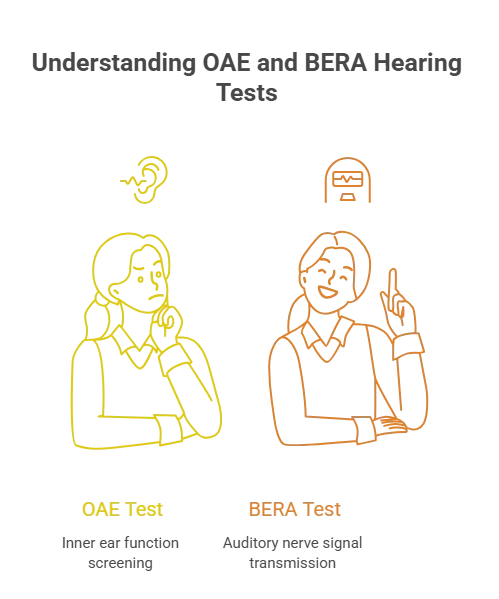
- OAE tests if the inner ear (cochlea) is working and reacting to sound.
- BERA is used to determine if this sound signal is traveling properly to the brain via the auditory nerve.
- OAE is faster, screening, and is usually the first test done.
- BERA is detailed, diagnostic, and is typically performed when OAE results are in need of further confirmation.
Often both tests are used together. Depending on the outcome of the OAE, your audiologist may recommend BERA for a more complete diagnosis, or your baby may pass (or “refer” them), and no further testing is necessary. This is the main point most parents are seeking clarity on in the OAE vs BERA test.
Factor | OAE Test | BERA Test |
What it checks | Checks whether the cochlea, or inner ear, is responding normally to sound | Checks how sound signals travel from the ear through the auditory nerve to the brainstem |
Main purpose | Hearing screening | Detailed hearing assessment |
When it is usually done | Often used as the first hearing test for newborns and babies | Usually recommended when OAE results are unclear, referred, or require further evaluation |
How the test is performed | A small probe is gently placed in the baby’s ear to measure the cochlea’s response to sound | Small sensors are placed on the baby’s scalp and earlobes, while sounds are played through soft earphones |
Approximate duration | Usually around 5 minutes when the baby is settled | Usually around 30 to 60 minutes |
Does the baby need to sleep? | Not always, but the baby should be quiet and still | The baby generally needs to be asleep or very still for accurate readings |
Level of detail | Provides a quick indication of cochlear function | Provides a more detailed picture of the auditory pathway |
What happens next? | A clear result may mean no further testing is needed | Helps the audiologist assess hearing more thoroughly when additional information is required |
What Should Parents Do After an OAE or BERA Test?
A test result is only one part of the overall picture. What happens next depends on the result, your baby’s history, and the audiologist’s clinical assessment.
If the screening result is clear: your audiologist may recommend routine monitoring and attention to your baby’s hearing and communication milestones.
If the result is a “refer” or inconclusive: this does not automatically mean hearing loss. The next step may be a repeat screening or a more detailed diagnostic assessment.
If hearing loss is confirmed: your audiologist will discuss the type and degree of hearing loss and explain appropriate next steps and early-intervention options.
If you remain concerned despite a “pass”: tell your audiologist. A screening result should always be considered alongside your baby’s history, development, and responses to sound.
The most important thing is not to panic after a “refer” result or delay follow-up because your baby appears to hear normally at home. Timely follow-up gives families clearer answers and, when support is needed, allows it to begin as early as possible.
What Causes Hearing Issues in Newborns?
Hearing concerns in babies can happen for many different reasons, and sometimes there may be no obvious cause at all. Having a risk factor also does not necessarily mean that a baby will have hearing loss.
Some babies may be more likely to need closer hearing monitoring if there is a family history of hearing loss, if they were born prematurely or with a low birth weight, or if they needed a longer stay in the NICU after birth. Certain birth complications, severe jaundice requiring treatment, infections during pregnancy, or exposure to specific medications can also increase the risk of hearing difficulties.
In some cases, however, a baby may have hearing loss even when none of these risk factors are present. This is why early hearing screening is so important. Tests such as OAE and BERA can help audiologists check how well a baby is hearing and identify concerns early, when timely support can make the greatest difference.
What Are the Early Signs Parents Should Watch For?
Along with hearing tests, the way your baby responds to sounds at home can also give useful clues about their hearing development. Every baby develops at a slightly different pace, but there are a few signs parents can keep an eye on.
You may want to speak with an audiologist if your baby does not startle or react to sudden loud sounds, does not begin to turn towards your voice or familiar sounds by around four to six months, makes very few babbling sounds by around nine months, or does not seem comforted by a familiar voice.
These signs do not automatically mean that your baby has hearing loss. However, if something about your baby’s response to sound is worrying you, it is worth discussing it with a hearing professional rather than waiting. You can also read more about common ear symptoms and conditions.
When Should You See an Audiologist for Your Baby?
It is a good idea to arrange a hearing evaluation if your baby received a “refer” result instead of a “pass” on the newborn hearing screening, has a family history of hearing loss, spent time in the NICU, or is not responding to sounds in the way you would expect for their age.
Seeing an audiologist does not mean that something is definitely wrong. The purpose is simply to check your baby’s hearing more carefully and make sure that any concern, if present, is identified as early as possible.
If you are unsure whether your baby needs an OAE, BERA, or another hearing assessment, a video consultation can also help you discuss your baby’s history and understand the most appropriate next step.
How Is Hearing Loss Diagnosed: OAE vs BERA Test Together?
Often no single test is used to diagnose a condition. OAE is typically performed as a screening test first for most infants. Then BERA is performed as a confirmatory diagnostic test if results are not clear or possibly suggest a problem. The OAE vs BERA test process is a layered approach which helps audiologists determine whether the problem is temporary, like fluid in the ear, or permanent and requires early intervention. We have a hearing care for all ages programme to help and assist with this kind of full assessment for infants and young children.
Why Middle-Ear Status Matters
A newborn or infant can have temporary middle-ear changes that influence sound reaching the cochlea. This is one reason an OAE may be absent even when permanent sensorineural hearing loss is not present. When an OAE result is unclear, the clinician may therefore consider the ear canal and middle-ear status as part of the overall assessment.
What If OAE and BERA Results Do Not Match?
A mismatch does not automatically mean that one test is “wrong.” Different tests measure different parts of the auditory system and can be affected by different factors. When results do not agree, the audiologist should review the test conditions, ear status, stimulus used, recording quality, developmental history and other clinical information before deciding what additional testing is appropriate.
Often no single test is used to diagnose a condition. OAE is typically performed as a screening test first for most infants. Then BERA is performed as a confirmatory diagnostic test if results are not clear or possibly suggest a problem. The OAE vs BERA test process is a layered approach which helps audiologists determine whether the problem is temporary, like fluid in the ear, or permanent and requires early intervention. We have a hearing care for all ages programme to help and assist with this kind of full assessment for infants and young children.
What Treatment or Management Options Are Available for Baby Hearing Loss?
The next step depends on what your baby’s hearing tests show. In many cases, the results may confirm that hearing is developing normally, and no treatment is needed beyond routine developmental monitoring.
Sometimes, the audiologist may recommend repeating the test after a few weeks, particularly if the result may have been affected by temporary factors such as fluid in the ear or an unclear first screening.
If hearing loss is confirmed, the focus shifts to supporting your baby’s hearing and communication development as early as possible. Depending on the type and level of hearing loss, this may include regular hearing checks, hearing aids, medical evaluation, or other early intervention support.
Parents are an important part of every decision, and the recommended approach should always be explained clearly so you understand what is being advised and why. Ongoing follow-up and aftercare are also important to make sure your baby’s hearing needs continue to be supported as they grow and develop speech and language skills.

Why Choose Resonnocare for Hearing and Audiology Care?
There’s no guessing when it comes to assessing infants and paediatric hearing health care with Resonnocare. We know how fragile this time can be for families, and each evaluation is conducted with patience and care that is comfortable for a baby. We are committed to your child’s hearing health and communicating with parents throughout the process of accurate OAE and BERA testing, as well as providing personalised care plans based on your baby’s test results. This can include hearing assessments, referrals for hearing aids, home visits to help your baby feel comfortable, video consultations to help you get the discussion started, as well as a structured follow-up to help monitor progress over time. You can explore our full range of offerings on our services page.
Find a Resonnocare Clinic Near You
Select your city to find the nearest Resonnocare clinic and book an appointment with our hearing care team.
Bangalore
Ear 360, Jayanagar
Ground Floor, Site No. 499, Municipal No. 499/97, East End Main Road, 9th Block, Jayanagar, Bangalore, Karnataka 560041
Timings: 10:00 AM to 7:00 PM
[Call] [Book an Appointment]
Ear 360, Spandana Sarjapura Hospital
239/205/34A, near Trinity Complex, Sompura Gate, Sarjapura Main Road, Bangalore, Karnataka 562125
Timings: 10:00 AM to 7:00 PM
[Call] [Book an Appointment]
Resonnocare, HSR Layout
150/5/72, 7th Cross, 24th Main, HSR Layout, Bangalore, Karnataka 560102
Timings: 10:00 AM to 7:00 PM
[Call] [Book an Appointment]
Resonnocare, Banashankari
272, 7th Cross Road, BSK 1st Stage, 2nd Block, Srinivasan Agra, 80 Feet Road, Bangalore, Karnataka 560050
Timings: 10:00 AM to 7:00 PM
[Call] [Book an Appointment]
Resonnocare, Indiranagar
34, Wind Tunnel Road, Murugeshpalya, Muniyappa Layout, Bangalore, Karnataka 560017
Timings: 10:00 AM to 7:00 PM
[Call] [Book an Appointment]
Resonnocare, JC’s ENT Center Nagarbhavi
57, 3rd Main Road, 2nd Block, Govindaraja Nagar Ward, Kalyan Nagar, Nagarbhavi, Bengaluru, Karnataka 560072
Timings: 10:00 AM to 7:00 PM
[Call] [Book an Appointment]
Resonnocare, Dr Bhattacharyya ENT Clinic
No. 14, 17th Cross Road, Sector 7, HSR Layout, Bangalore, Karnataka 560102
Timings: 10:00 AM to 7:00 PM
[Call] [Book an Appointment]
Delhi
Ear 360, Dr Hans Anand Lok
46, Anand Lok Road, Anand Lok, Sadiq Nagar, New Delhi, Delhi 110049
Timings: 10:00 AM to 7:00 PM
[Call] [Book an Appointment]
Resonnocare, Dr Hans Vasant Vihar
28, Basement, Paschimi Marg, Vasant Vihar, New Delhi, Delhi 110057
Timings: 10:00 AM to 7:00 PM
[Call] [Book an Appointment]
Resonnocare, Clarity ENT Clinic
Clarity, 2-10, Hauz Khas, New Delhi, Delhi 110016
Timings: 10:00 AM to 7:00 PM
[Call] [Book an Appointment]
Resonnocare, Dr Hans Center for ENT Punjabi Bagh
2/5, West Avenue Road, West Punjabi Bagh, Punjabi Bagh, New Delhi, Delhi 110026
Timings: 10:00 AM to 7:00 PM
[Call] [Book an Appointment]
Gurgaon
Resonnocare Head Office, M3M Urbana
Office 403, Office Block, 4th Floor, above Retail Blocks R1 and R5, M3M Urbana, Sector 67, Gurgaon, Haryana 122101
Timings: 10:00 AM to 7:00 PM
[Call] [Book an Appointment]
Resonnocare, Dr Hans Sector 28 DLF Ph-1
Metro Station, Plot No. 1SP, adjoining DLF Phase 1, Sector 28, Gurgaon, Haryana 122002
Timings: 10:00 AM to 7:00 PM
[Call] [Book an Appointment]
Ludhiana
Ear 360, BRS Nagar
963, Block B, BRS Nagar, Ludhiana, Punjab 141012
Timings: 10:00 AM to 7:00 PM
[Call] [Book an Appointment]
Resonnocare, Fawwara Chowk
565-A and 565-B, Upper Ground Floor, Cemetery Road, near Fawwara Chowk, West City, Ludhiana, Punjab 141001
Timings: 10:00 AM to 7:00 PM
[Call] [Book an Appointment]
Pune
Ear 360, Vighnaharta Healthcare Center
D-106-107, Choice Arcade, opposite Ruby Hall Hospital, Dhole Patil Road, Pune, Maharashtra 411001
Timings: 10:00 AM to 7:00 PM
[Call] [Book an Appointment]
Ear 360, Khan Parab ENT Hospital
Plot No. 102, Anand Nagar, Talegaon Dabhade, Taluka Maval, Pune, Maharashtra 410507
Timings: 10:00 AM to 7:00 PM
[Call] [Book an Appointment]
Tumkur
Resonnocare, Ashok Nagar
PID No. 3563, 8th Main, 8th Cross, Ashok Nagar, Tumkur, Karnataka 572103
Timings: 10:00 AM to 7:00 PM
[Call] [Book an Appointment]
Resonnocare, Ganadhal ENT and Dental Hospital
3rd Cross, Somashekara Puram, Coffee Board Colony, Tumkur, Karnataka 572102
Timings: 10:00 AM to 7:00 PM
[Call] [Book an Appointment]
Mangalore
Ear 360, Bunts Hostel Circle
Shop No. 6 and 7, Basement Floor, Javed Plaza, Bunts Hostel Circle, Mangalore, Karnataka 575003
Timings: 10:00 AM to 7:00 PM
[Call] [Book an Appointment]
Resonnocare, Dr G K Hebbar ENT Clinic
M-2-153/6, K.S.R.M. Building, Lighthouse Hill Road, Mangaluru, Karnataka 575001
Timings: 10:00 AM to 7:00 PM
[Call] [Book an Appointment]
Resonnocare, Dr Navisha ENT Centre
3rd Floor, Falnir Health Center, Falnir Road, Falnir, Mangaluru, Karnataka 575002
Timings: 10:00 AM to 7:00 PM
[Call] [Book an Appointment]
Mysore
Ear 360, Ramaswamy Circle
371/A, Ramaswamy Circle, Mysore, Karnataka 570024
Timings: 10:00 AM to 7:00 PM
[Call] [Book an Appointment]
Hubli
Ear 360, Vidya Nagar
Srishti Elite, Shirur Park Road, Shirur Park, Vidya Nagar, Hubballi, Karnataka 580031
Timings: 10:00 AM to 7:00 PM
[Call] [Book an Appointment]
Davangere
Ear 360, P J Extension
Shop First Floor, 2nd Main, P J Extension, Davangere, Karnataka 577002
Timings: 10:00 AM to 7:00 PM
[Call] [Book an Appointment]
Indore
Resonnocare, Dr Navnit Jain ENT Hospital
Dr Navnit Jain ENT Hospital, C/o Unique Hospital, 335, Jawahar Marg, Opp. Nafees Bakery, Indore, Madhya Pradesh 452007
Timings: 10:00 AM to 7:00 PM
[Call] [Book an Appointment]
Resonnocare, Hearing Solutions Dr Agarwal
7, Gulmarg Complex, First Floor, near Sapna Sangeeta Lumiere, Indore, Madhya Pradesh 452001
Timings: 10:00 AM to 7:00 PM
[Call] [Book an Appointment]
Conclusion
Comparing the difference between the OAE and BERA tests can help make this very stressful time a bit less stressful. OAE is a simple and rapid initial screening, whereas BERA is more in-depth and diagnostic in evaluating the pathway for sound through your baby’s auditory system. They provide audiologists with a dependable, evidence-based tool to learn about your baby’s hearing health. If your baby’s screening result raises questions or you just want peace of mind, contact Resonnocare to arrange for your baby to have a hearing screening and meet with an audiologist for a detailed explanation and support through the OAE vs BERA testing process.
FAQ’s
Can a baby have normal-looking behaviour and still have hearing loss?
Yes. Babies may respond to loud sounds or familiar voices through vibration, visual cues, or changes in routine, and these responses do not reliably establish normal hearing. Objective screening and, when indicated, diagnostic assessment are important.
If my baby passes OAE, do we need BERA?
Not necessarily. The need for BERA/ABR depends on the screening result, risk factors, clinical findings and the audiologist’s assessment. A pass OAE is reassuring, but additional testing may still be appropriate in selected situations.
If my baby refers on OAE, does that mean hearing loss?
No. A refer result means the screening did not produce the expected response and that repeat screening or further assessment may be required. Temporary ear conditions, movement, noise and technical factors can contribute to a refer result.
Does BERA/ABR tell us the exact hearing level?
Diagnostic ABR can provide clinically useful estimates of hearing sensitivity, especially when behavioural testing is not yet reliable. The amount of information obtained depends on the protocol, stimulus, frequency-specific testing and the child’s test conditions. Audiologists interpret ABR alongside other findings rather than treating it as an isolated number.
Does every baby need sedation for BERA?
No. Many infants can complete ABR while naturally asleep. Sedation may be considered in selected cases when reliable testing cannot otherwise be obtained, and any decision about sedation should be made by the appropriate medical team based on the child’s individual circumstances.
Can hearing loss develop after a baby passes newborn screening?
Yes. Newborn screening is an important early check, but it cannot guarantee that hearing will remain normal throughout childhood. Parents should continue to monitor hearing, speech and language development and seek reassessment if concerns arise.
What should parents bring to the appointment?
If available, bring the newborn screening report, previous OAE/ABR reports, relevant medical or NICU records, medication information, and any details about family history or concerns about the baby’s responses to sound. For a naturally sleeping ABR, the clinic may also provide specific feeding and sleep instructions beforehand; parents should follow the clinic’s instructions rather than relying on a generic preparation plan.
Is an OAE test mandatory?
OAE testing is not required for all individuals; however, it is recommended for newborn hearing screening and testing hearing in infants and young children. It is a fast, non-invasive screening performed with minimal discomfort to identify potential hearing issues early, so that appropriate intervention can be made and maximize speech and language development.
What is a normal OAE result?
When the outer hair cells in the inner ear are normal, a normal OAE will often be reported as “Pass”. A pass grade indicates normal or near-normal hearing, but it doesn’t exclude all types of hearing loss. If still concerned about hearing, more testing may be required.
Is the BERA test accurate?
Yes, Brainstem Evoked Response Audiometry (BERA) provides a very accurate measurement of hearing and the auditory nerve pathway. It is particularly helpful for babies, small children, or those who can’t take a hearing test. BERA can be used to identify hearing loss and abnormalities of the nervous system that regulate hearing.
At what age is the BERA test done?
BERA testing can be carried out at any age but is performed most frequently in newborns, infants, and children with suspected hearing loss. It is also performed in adults to assess hearing disorders, disorders of the auditory nerves, and some neurological disorders that affect the hearing pathway.
What is the difference between the OAE and BERA tests?
OAE and BERA measure different areas of the sound pathway. OAE assesses the activity of the inner ear (cochlea) and the outer hair cells, and BERA tests the pathway from the ear to the brainstem. OAE is typically used to screen for hearing, while BERA is used to assess the auditory pathway and hearing function more specifically.