
TL; DR:
This blog is intended for parents of newborns and young children, adults with suspected hearing problems, caregivers, and individuals who need a clear understanding of BERA testing, hearing loss diagnosis, and auditory nerve health.
- Explains the Purpose of BERA Testing: The article describes how Brainstem Evoked Response Audiometry (BERA) measures the transmission of sound signals from the ear to the brainstem, making it especially useful for infants and people who cannot participate in conventional hearing tests.
- Identifies When a BERA Test Is Needed: The blog outlines common reasons for recommending a BERA test, including failed newborn hearing screenings, developmental delays, suspected auditory nerve disorders, unexplained hearing loss, and inconclusive audiometry results.
- Details the Procedure and Results: Readers learn what happens during a BERA test, including electrode placement, sound stimulation, brain response recording, and how audiologists interpret waveform patterns to assess hearing levels and nerve function.
- Highlights Early Diagnosis and Treatment Benefits: The article emphasizes the importance of timely hearing assessment, explains potential treatment and management options after testing, and shows how Resonnocare supports patients and families through diagnosis, hearing aid solutions, and ongoing hearing care.
A BERA is a test recommended for babies who do not respond to loud noise, or for adults with hearing impairment when behavioral tests have not fully explained the loss. One of the most frequently asked questions from parents and patients at Resonnocare is: What does a BERA test actually measure, and how is it different from a normal hearing test? This guide makes it easy for you to understand.
What Is a BERA Test?
Brainstem Evoked Response Audiometry (BERA) is a hearing test that measures how sound signals travel from the inner ear through the auditory nerve to the brainstem. In a BERA test, the brain’s electrical activity is recorded in response to clicks or tones played through headphones, whereas a normal hearing test requires an active response, such as pressing a button when a sound is heard.
This is particularly important for newborns, infants, and those unable to respond accurately, such as because of age, cognitive status, or other factors.
What Is the Purpose of a BERA Test?
The main goal of a BERA test is to assess the health of the auditory pathway (from the inner ear (cochlea) to the brainstem). It helps identify:
- Whether hearing loss is present and the approximate degree of hearing loss.
- If the hearing nerve is working fine or not.
- If it’s in the ear or in the nerve that leads from the ear to the brain (auditory nerve)
- Hearing concerns in infants who cannot undergo reliable behavioral hearing tests.
As it does not need the patient’s cooperation, a BERA test is sometimes regarded as an objective hearing assessment that can be used in situations where subjective testing is not possible.
What Causes the Need for a BERA Test?
There are a few scenarios that can prompt an ENT specialist or audiologist to order a BERA test:
- Failing newborn hearing screening
- A family history of hearing loss or hearing problems that are genetically linked
- Auditory neuropathy, a condition in which sound enters the ear normally but is not transmitted properly along the auditory nerve.
- Failure to get reliable data from standard audiometry tests
- Tumors or lesions that are suspected along the auditory nerve pathway
- Developmental delays when hearing loss is not suspected as a cause of the delay.
If a child or family member has noticed unusual signs alongside hearing concerns, it may help to review general ear symptoms and conditions so your audiologist has a complete picture before testing begins.
What Are the Early Signs That a BERA Test May Be Needed?
Given the frequency with which a BERA test is performed in babies and young children, it is common for signs to be detected by parents rather than by the child. These may include:
- Lack of reaction to unexpected, sudden noises
- Failure to respond to environmental sounds and voices.
- Language delay and/or language disorders in speaking and/or language disorders in listening comprehension.
- Failure to respond to sound by expected developmental milestones
- A newborn hearing screening that was failed, missed, or produced inconclusive results.
A BERA test might be ordered for adults when hearing loss is not typical, or when nerve-related hearing loss is suspected.
How Is a BERA Test Performed?
The procedure for a BERA is not painful, and it usually goes through the following steps:
Preparation:
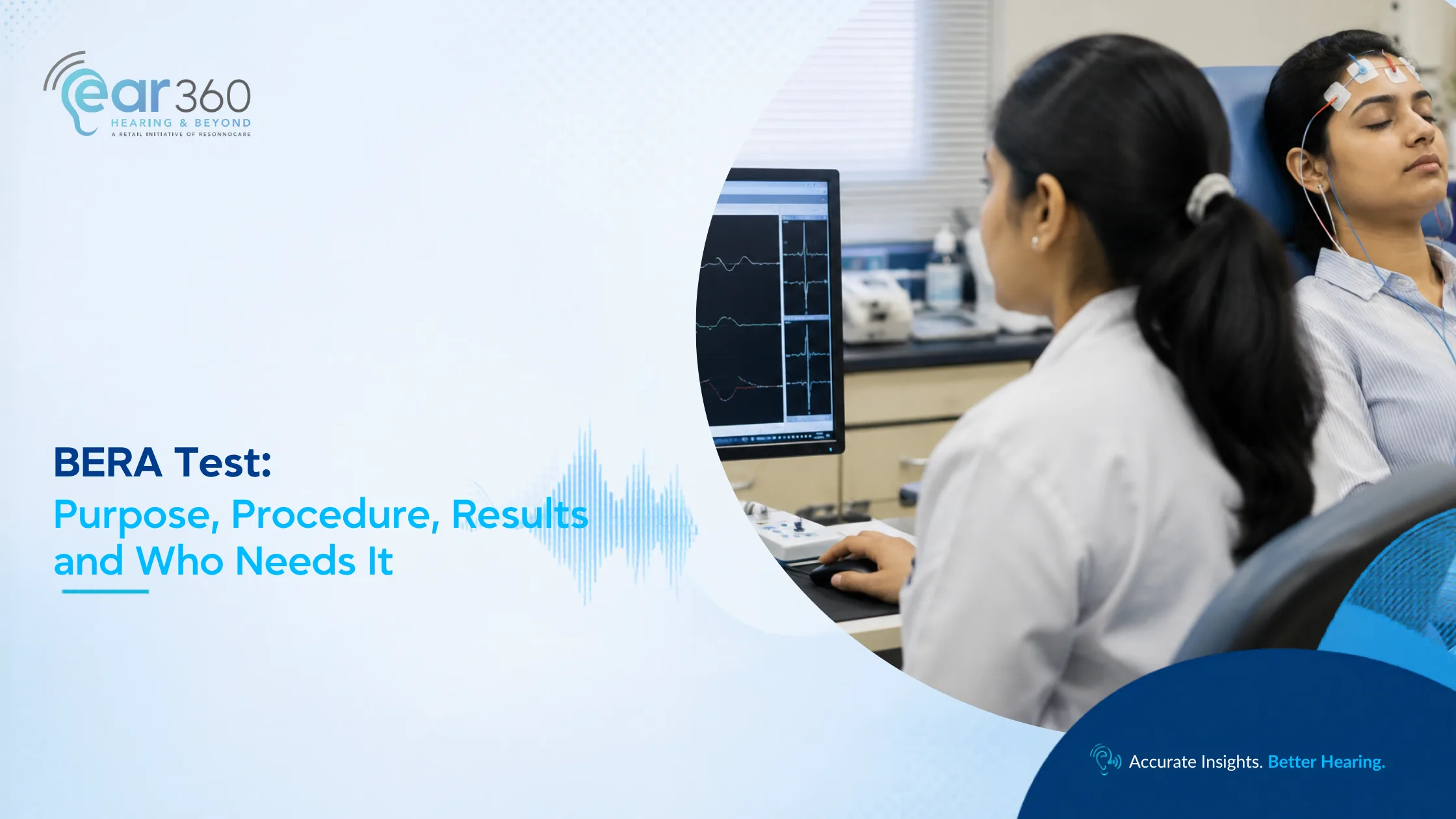
As with an ECG, small electrodes are carefully placed on the scalp and earlobes to capture brain waves.
Tone bursts or clicking sounds:
These sounds are played through soft earphones, one ear at a time.
Brain response recording:
The electrodes record the brainstem’s response to these sounds and measure how effectively the auditory pathway responds.
Natural sleep or optional sedation (if necessary):
In infants or young children who must be still, natural sleep or mild sedation (as indicated) may be used.
Waveform analysis:
The recorded waveforms are evaluated by an audiologist to estimate hearing thresholds and assess auditory nerve function.
The entire test usually takes between 45 minutes and a couple of hours, depending on the patient’s age and cooperation.
What Do BERA Test Results Mean?
The BERA results are reported as waveforms that demonstrate the response of the auditory nerve and brainstem to sound at various intensities. This will help your audiologist to decide:
- Whether hearing levels fall within the normal range
- The severity of the hearing loss (mild, moderate, severe or profound)
- Whether the response pattern is indicative of a cochlear or neural problem
Please note: A BERA test result is not a diagnosis in itself. It’s usually read in conjunction with other tests, medical history, and clinical observations, as waveform patterns can change with age, sedation, and test conditions. An audiologist or an ENT specialist should always interpret the results.
When Should You See an Audiologist or Doctor?
Some of the signs may require immediate professional attention without regard to age, although a pediatrician or ENT specialist may recommend a BERA test:
- When infants do not react to loud noises.
- Sudden or unexplained hearing loss.
- Ringing in the ears, or tinnitus, that lasts a long time.
- Ear pain, discharge, or a feeling of fullness in the ear.
- Dizziness or loss of balance and changes in hearing
- Children’s speech delay
Early evaluation will normally lead to better management, especially in infants, who will benefit from early intervention for speech and language development.
What Treatment or Management Options Are Available After a BERA Test?
Treatment after a BERA test will be based on the results. Your audiologist may recommend:
- Additional diagnostic testing to confirm or clarify the findings.
- Diligent hearing monitoring of mild or borderline results.
- Hearing aids may be recommended for individuals with confirmed sensorineural hearing loss.
- Early intervention services for infants and children.
- Referral for structural or neurological evaluation by ENT specialist
If hearing aids are recommended for a child or adult, Resonnocare’s free hearing aid trial allows the family to experience the device before committing, which is often reassuring during an emotionally significant decision.
How Can Resonnocare Help?
Resonnocare provides diagnostic testing for patients of any age, explains when a BERA test is recommended, and makes sense of the results in real-world terms. We work closely with families, explaining each step in clear language and helping them make informed decisions at their own pace.
For families managing this journey with a young child, Resonnocare’s hearing care for all ages approach ensures that testing and follow-up care are adapted to the child’s comfort and developmental stage, rather than treated as a one-size-fits-all process.

Why Choose Resonnocare for Hearing and Audiology Care?
Resonnocare is based on patient-centered, clinically directed hearing health care. Our audiologists and clinicians have extensive experience performing accurate hearing assessments, particularly when detailed testing such as BERA is required. Each finding is presented clearly and is accompanied by a customized care plan for the patient based on their age, needs, and family situation.
Beyond diagnostic testing, Resonnocare supports the full hearing care journey, including hearing aid fitting, home visit and video consultation options for added convenience, and structured aftercare to ensure any recommended intervention continues to work well over time.
Conclusion
The BERA test is an important part of the hearing health picture, particularly for babies and patients who cannot undergo a traditional hearing test. This test quantifies the sound’s transit through the auditory nerve to the brainstem, providing important objective information that helps to facilitate appropriate and timely decisions.
If you have been referred to a BERA test, or if you or your child have developed early signs of hearing concerns, Resonnocare’s clinical team is there to help you navigate the process with clarity and care. Schedule a consultation today with Resonnocare to get a better idea of how your family’s hearing health is affected.
FAQ’s
At what age is the BERA test done?
Brainstem Evoked Response Audiometry (BERA) can be used for all ages – newborns, infants, children, and adults. It is widely used to test infants’ hearing and to evaluate people who are unable to respond reliably to conventional hearing assessments. Since BERA does not involve the person being tested, it is particularly valuable when testing a very young child or a person with communication issues.
What is a normal BERA result?
If the BERA is normal, then sound signals are clearly being conducted along the ear to the brainstem. Specific wave patterns recorded during the test fall within the expected time ranges. Normal results indicate a healthy auditory pathway, and delayed or missing waves can signal hearing loss and neurological abnormalities that require further evaluation.
What if the BERA test fails?
If a child fails a BERA test, it doesn’t necessarily lead to permanent hearing loss. Fluid in the ears, excessive movement, background noise, or temporary hearing loss can affect results. Further tests are typically ordered to confirm the diagnosis. Prompt follow-up is necessary to determine the cause and start treatment and/or hearing management, if necessary.
Is the BERA test painful?
No, the BERA test is not at all painful and is non-invasive. Electrodes are attached to the scalp and ears to measure the electrical response to sounds presented to the person through earphones. There are no needles or discomfort involved with the procedure. The test is performed while the patient is relaxed or asleep, and can be done on newborns and small children.
What are the disadvantages of the BERA test?
Although BERA is very accurate, it also has a number of limitations. Testing may be longer than regular hearing tests, and infants or young children may need to sleep while the test is being performed. It primarily tests the auditory nerve and brainstem pathways and may not detect all cases of hearing loss. So, BERA is frequently used alongside other hearing tests to get the full picture.