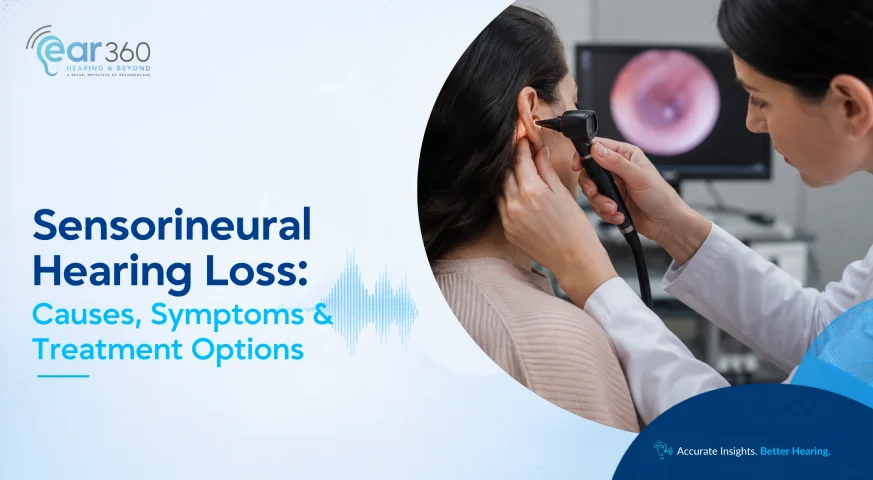
Sensorineural Hearing Loss: Causes, Symptoms & Treatment Options
TL: DR; This blog is written for people experiencing hearing difficulties, tinnitus, or trouble understanding speech; parents concerned about a child’s hearing; and family members seeking treatment options for sensorineural hearing loss. Sensorineural hearing loss occurs when the inner ear or auditory nerve is damaged, making it a more permanent type of hearing loss than conductive hearing loss. Common causes include aging, long-term noise exposure, infections, ototoxic medicines, head trauma, family history, Meniere’s disease, acoustic neuroma, and sudden unexplained hearing loss. Early signs include difficulty hearing in noisy places, asking people to repeat, increasing TV or phone volume, muffled hearing, tinnitus, and trouble understanding phone conversations. Treatment depends on the severity and may include hearing aids, cochlear implants for severe cases, auditory rehabilitation, tinnitus support, home visits, video consultations, and long-term aftercare. Hearing loss isn’t necessarily silence. Many individuals perceive it as “mumbling,” “can’t hear in a crowd,” or “unclear speech. Sounds can still be heard, but it can be a challenge to understand conversations, particularly in loud environments. A common cause of this is sensorineural hearing loss. Typically occurs when the inner ear/hearing nerve is damaged. It can arise gradually over time, as a result of age, chronic exposure to noise, various diseases, or other health conditions. The change is usually slow, and the individual neglects it for months or even years. Knowing what sensorineural hearing loss is can help you make the appropriate move at the right time. If you have a proper hearing test, your audiologist will be able to determine the level of hearing loss, explain the results, and provide information on the best hearing solutions. Our audiologists frequently evaluate and aid patients with sensorineural hearing loss at Resonnocare. This guide describes what it is, why it occurs, how it is assessed, and how you might hear better and communicate more effectively. What Is Sensorineural Hearing Loss? Sensorineural hearing loss is caused by damage to the inner ear (cochlea) or to the auditory nerve, which transmits sound signals to the brain. While conductive hearing loss, which affects the outer or middle ear, can be caused by blockage or structural problems, sensorineural hearing loss usually reflects permanent damage within the inner ear or auditory pathway. The tiny hair cells within the cochlea convert sound vibrations into electrical signals. If these hair cells have been damaged, they will not regenerate. Hence, sensorineural hearing loss is sometimes called “permanent,” but in many instances, it can be managed effectively with the proper support. Some individuals have mixed hearing loss, which combines sensorineural and conductive hearing loss. It is important to have a proper diagnosis and a hearing assessment to determine the type of hearing loss you have. What Does Sensorineural Hearing Loss Usually Look Like on an Audiogram? On an audiogram, sensorineural hearing loss typically shows reduced air-conduction and bone-conduction thresholds without a significant air-bone gap. This means sound sensitivity is reduced even when much of the outer- and middle-ear pathway is bypassed during bone-conduction testing. The exact pattern can vary. Your audiogram may show: Greater hearing loss at higher frequencies A relatively flat loss across several frequencies Different degrees of hearing loss in the right and left ears Mild, moderate, severe, or profound thresholds A gradual or more sharply sloping pattern The audiogram shows hearing sensitivity, but it does not by itself explain how clearly you understand speech or identify the exact medical cause. Speech testing, symptoms, case history, and other assessments may also be needed. What Does Sensorineural Hearing Loss Feel Like in Everyday Life? Sensorineural hearing loss often affects clarity as well as volume. A person may hear that somebody is speaking but still miss parts of the words, particularly when there is distance or background noise. Everyday situation Possible difficulty Quiet conversation You may hear reasonably well when the speaker is close and clearly visible. Restaurant or café Background noise may make speech much harder to separate. Family gathering Following several speakers or rapid conversation may be difficult. Work meeting Soft-spoken or distant colleagues may be harder to understand. Telephone call Speech can sound audible but unclear without visual cues. Television Dialogue may be harder to understand even when other sounds seem loud enough. Conversation from another room Distance can make softer parts of speech easier to miss. Higher-pitched voices Women’s or children’s voices may be more difficult when higher frequencies are affected. The functional impact matters because two people with similar audiograms can experience very different communication difficulties depending on their work, social life, age, listening environment, and speech-understanding ability. What Causes Sensorineural Hearing Loss? There is no one cause. Sensorineural hearing loss can have several causes, and more than one factor may contribute. The most frequent cause is age-related hearing loss (presbycusis). The hair cells in the cochlea begin to deteriorate with age. Usually, it starts out with problems hearing high-pitched sounds and gradually worsens over time. Another major cause is noise exposure, especially for individuals who are exposed to high levels of noise at work (e.g., in factories, construction sites, music venues) or who listen to earphones at high volume for long periods. Some cases are congenital, while others develop later in life without an obvious cause. Infections such as meningitis, mumps, measles, or other serious viral diseases may affect the inner ear, sometimes very quickly. Some drugs may have a side effect of damaging the hair cells in the inner ear (ototoxic). Sudden sensorineural hearing loss is an emergency, usually affecting one ear and occurring without warning. If you have a sudden, unexplained hearing loss, please seek medical attention on the day you notice it. Less common causes include autoimmune disorders, Ménière’s disease, acoustic neuroma, and head trauma. Can Sensorineural Hearing Loss Be Reversed? Long-standing sensorineural hearing loss associated with permanent inner-ear or auditory-nerve damage is generally managed rather than reversed. However, not every sensorineural hearing change should automatically be treated as a stable, permanent condition without assessment. The timing and cause matter. For example: Gradual age- or noise-related loss may
Read More