
TL: DR;
This blog is written for adults, parents, caregivers, and families who are noticing muffled hearing, ear blockage, ear pain, repeated ear infections, or hearing difficulty in children or older adults.
- Conductive hearing loss occurs when sound cannot pass properly through the outer or middle ear to reach the inner ear, often due to a physical or mechanical issue.
- Common causes include earwax blockage, middle ear infections, glue ear in children, perforated eardrum, otosclerosis, Eustachian tube dysfunction, foreign objects, or structural ear problems.
- Key symptoms include muffled hearing, reduced sound clarity, ear fullness or pressure, mild pain, ear discharge, tinnitus, increased TV or phone volume, and delayed speech or inattentiveness in children.
- Conductive hearing loss is often treatable with the right diagnosis and may be managed through earwax removal, infection treatment, medications, surgery, hearing aids, bone-anchored hearing aids, home visits, online consultations, and aftercare support.
When sound is blocked, hearing is muffled, the ear hurts, there are frequent ear infections or difficulty hearing clearly after a cold, it can feel worrying. These symptoms often occur when sound is not conducted normally through the outer and/or middle ear.
This is referred to as conductive hearing loss. It indicates that something might be wrong with the portion of the ear that conducts sound to the inside, including the ear canal, eardrum, or middle ear. May occur from earwax, fluid, infection, eardrum issues, or other middle ear problems.
The good news is that once the cause of conductive hearing loss is properly diagnosed, it can be treated or improved. This is why it is important not to ignore the symptoms or assume the hearing loss is permanent, but to undergo a proper hearing assessment.
Our audiologists evaluate hearing issues in children, adults, and seniors at Resonnocare. This guide can help you understand the following: What is conductive hearing loss? Some common causes of conductive hearing loss. What signs to look for. How is conductive hearing loss diagnosed? What treatment options are available?
What Is Conductive Hearing Loss?
Conductive hearing loss occurs when sound does not pass through the outer ear or middle ear. Although sound can reach the inner ear, it may be weak, blocked, or unclear.
To gain a better understanding, it is useful to know how hearing works normally. Sound first passes through the external (outside) ear and down the ear canal. It is then transmitted to the drum and then passes through three small bones within the middle ear. The vibrations then pass into the inner ear, where they are converted into a signal the brain can interpret.
In conductive hearing loss, the issue typically occurs before sound reaches the inner ear. This is why people often feel that their hearing is blocked, muffled, or even diminished, rather than a total loss of hearing.
Conductive hearing loss is not the same as sensorineural hearing loss, which is typically associated with the inner ear or the hearing nerve. It also differs from mixed hearing loss, in which both the external ear (conductive) and the inner ear (sensorineural) are involved.
An appropriate hearing test can indicate the nature of the hearing loss and the potential cause. This is crucial as the next step in the care pathway will depend on the site of the hearing problem.
What Does Conductive Hearing Loss Look Like on an Audiogram?
A typical conductive hearing-loss pattern may show poorer air-conduction hearing thresholds while bone-conduction thresholds remain better. The difference between these two measurements is commonly described as an air–bone gap.
In simple terms, the pattern suggests that the inner ear can respond to sound better than sound can travel through the outer or middle ear. However, an audiogram pattern by itself does not identify the exact cause of the blockage or mechanical problem.
The audiologist may consider:
- Air-conduction thresholds
- Bone-conduction thresholds
- Whether an air–bone gap is present
- Whether one or both ears are affected
- The degree and shape of hearing loss
- Tympanometry findings
- Ear examination findings
- The patient’s symptoms and medical history
For example, earwax, middle-ear fluid, an eardrum problem, and an ossicular problem can all produce conductive hearing loss but may require very different treatment.
What Causes Conductive Hearing Loss?
There are several common causes, and treatment depends on identifying the correct one. There are simple and reversible causes. Others need medical or surgical treatment.
In clinical practice, one of the most common causes is earwax blockage. Wax builds up and hardens in the ear canal, blocking sound from reaching the eardrum. It can occur in anyone at any age.
Middle ear infection (otitis media) is very common in children. Fluid or pus accumulates behind the eardrum, reducing its ability to vibrate freely. A chronic form of the condition known as glue ear, in which thick, sticky fluid builds up in the middle ear without infection, is a common cause of conductive hearing loss in school-age children.
Depending on the size and location of the perforation, a perforated eardrum can also drastically affect hearing, which may result from infection, trauma, or sudden changes in pressure.
Otosclerosis is a disorder that affects the middle ear, in which abnormal bone growth causes one of the three ossicles (usually the stapes) to become stuck and to move incorrectly. It causes progressive conductive hearing loss and is more common in young and middle-aged adults.
Foreign objects in the ear canal, abnormal growths such as cholesteatoma, and congenital structural abnormalities can also cause similar symptoms. In certain patients, Eustachian tube dysfunction may make it difficult for the middle ear to maintain normal pressure, leading to a feeling of fullness or muffled hearing.
What Are the Symptoms of Conductive Hearing Loss?
Conductive hearing loss can make sounds seem as though you are hearing through a filter or with your fingers in your ears. Sounds quieter, less distinct, or muffled. You might find yourself having to turn up the volume on your television, phone, or computer, hearing only half of what people are saying, or not hearing well in noisy places.
Common associated symptoms include a feeling of fullness or pressure in the ear, mild pain or discomfort, ear leakage if infected, and, in some patients, tinnitus (a ringing or buzzing sound in the affected ear).
Children with conductive hearing loss may seem inattentive, speak more loudly, and experience delays in speech and language development. These are easy to overlook or mistake for other reasons, making it crucial to do a formal hearing exam.
Visit the Resonnocare ear symptoms and ear conditions page for details on all of the ear symptoms and conditions that could relate to your hearing.
How Conductive Hearing Loss Can Affect Everyday Life
Conductive hearing loss does not always feel like complete hearing loss. The practical effect depends on how much sound transmission is reduced, whether one or both ears are affected, and the underlying cause.
Situation | What the person may notice |
Conversation at home | Voices may seem quieter or muffled, especially when the speaker is farther away. |
Telephone calls | The person may increase call volume or prefer one ear over the other. |
Television | Higher volume may be needed than other family members prefer. |
Classroom | A child may miss instructions, appear inattentive, or struggle when the teacher is at a distance. |
Background noise | Following conversation can become harder because reduced sound access adds to an already challenging listening environment. |
One-sided hearing loss | The person may turn the better-hearing ear toward the speaker or have difficulty locating sounds. |
Ear infection or pressure problem | Hearing may fluctuate along with blockage, pain, fullness, or pressure. |
These real-life difficulties are useful to describe during a hearing assessment because the audiogram alone does not show how much the problem is affecting communication at home, school, work, or socially.
How Is Conductive Hearing Loss Diagnosed?
Conductive hearing loss is discovered during a thorough hearing test by a trained audiologist. The aim is to determine the source of the hearing loss and what may be interfering with or impeding sound transmission.
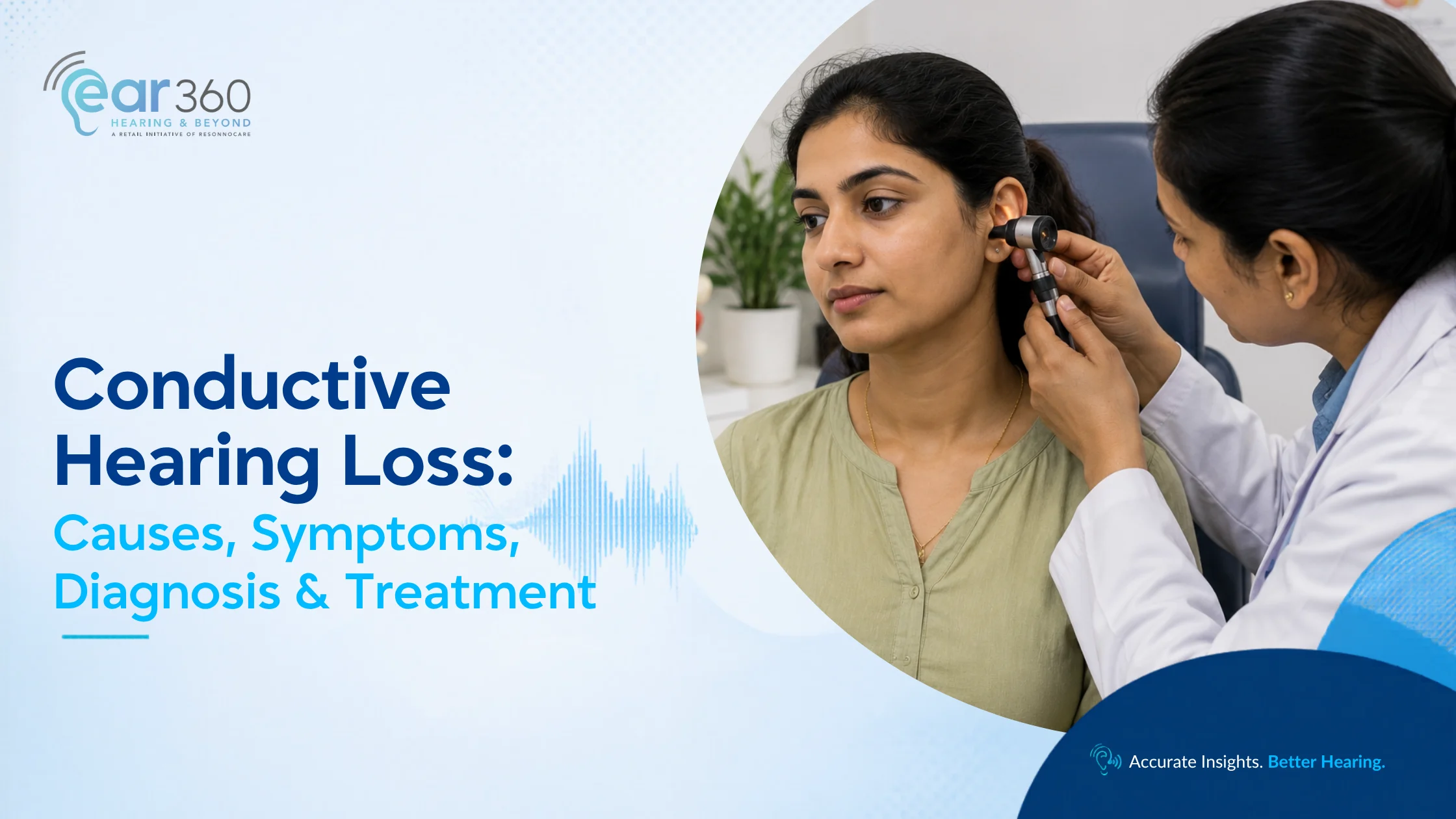
The exam typically starts with an ear exam. The audiologist uses a small device to examine the inner ear canal and eardrum. This is to see if there is any earwax, an infection, an eardrum injury, fluid, or a visible blockage.
The next step is typically a hearing test known as pure-tone audiometry. In this test, sounds of varying pitch and intensity are presented for hearing. The audiologist tests whether sound is conducted through the normal hearing pathway and whether the inner ear responds to vibration.
This is a significant comparison. The inner ear can still respond normally or nearly normally even when sound passing through the outer and middle ears is reduced, as in conductive hearing loss. This pattern helps the audiologist determine that the hearing loss is conductive.
A tympanometry test may also be performed to determine whether the eardrum is moving properly and whether there are any pressure, fluid, or other middle ear issues. Sometimes, a speech test is also performed to determine the clarity of your hearing and ability to comprehend speech.
These tests help the audiologist determine whether conductive hearing loss is present and what may be causing it. Having understood the cause, the appropriate next step can be advised, for example, medical treatment, hearing support, earwax removal, further ENT assessment, or follow-up.
Diagnostic Pathway for Conductive Hearing Loss
The aim of testing is not only to confirm that hearing is reduced, but also to understand where the sound-transmission problem may be occurring and whether medical treatment is needed.
Step 1: Review the Symptoms
The audiologist asks when the problem started, whether one or both ears are affected, whether hearing fluctuates, and whether there is pain, discharge, pressure, tinnitus, dizziness, infection, trauma, or previous ear surgery.
Step 2: Examine the Ear
Otoscopy can help identify visible earwax, discharge, foreign objects, eardrum abnormalities, or other findings that may require medical attention.
Step 3: Measure Air-Conduction Hearing
Pure-tone audiometry measures the softest sounds heard through the usual outer-ear and middle-ear pathway.
Step 4: Measure Bone-Conduction Hearing
Bone-conduction testing bypasses much of the outer and middle ear and helps the audiologist compare inner-ear response with the air-conduction result.
Step 5: Assess Middle-Ear Function
Tympanometry can provide additional information about eardrum movement, middle-ear pressure, and certain middle-ear problems.
Step 6: Assess Speech Understanding Where Appropriate
Speech testing helps show how hearing loss is affecting the ability to detect or understand spoken words.
Step 7: Decide the Next Clinical Step
Depending on the findings, the next step may involve monitoring, earwax management, ENT evaluation, medical treatment, surgery, hearing support, or further testing.
Why Is Speech Understanding Tested?
A pure-tone audiogram shows the softest tones a person can hear, but everyday communication depends on understanding speech. Speech testing can therefore add useful functional information to the hearing assessment.
The audiologist may use speech results to understand:
- How clearly words can be recognized
- Whether reduced audibility is contributing to communication difficulty
- Whether speech performance is consistent with the hearing thresholds
- Whether additional testing may be required
- What communication difficulties should be monitored after treatment
In a straightforward conductive problem, improving sound transmission or providing appropriate amplification may improve access to speech. However, the expected result depends on the underlying condition and whether there is any additional inner-ear involvement.
What Are the Treatment Options for Conductive Hearing Loss?
A characteristic of conductive hearing loss is that it is often curable or can be corrected to a great extent by proper treatment. The appropriate treatment is dependent upon the cause.
If earwax is blocking the ear, a hearing test can be done right away, as earwax can be removed safely by a trained clinician. Ear drops containing antibiotics or antifungals may help cure infection-induced hearing loss. Eustachian tube dysfunction can be helped with nasal sprays and decongestants. The initial strategy for children with glue ear is to observe them, and surgical insertion of grommets may be recommended if the ear persists.
In less severe cases, the eardrum may heal on its own, but in more severe cases, surgery called myringoplasty may be necessary to close it. Most often, treatment consists of surgery, a stapedectomy, which involves replacing the fixed bone with a prosthesis.
Where surgery is not possible or not preferred, well-fitted hearing aids can be highly effective for conductive hearing loss. Because the inner ear is often functioning normally, patients frequently experience excellent outcomes with amplification. Bone-anchored hearing aids are another option for specific cases where conventional aids are not suitable.
Cause of Conductive Hearing Loss | What It Means | Possible Treatment / Next Step |
Earwax blockage | Sound may not pass clearly through the ear canal because wax is blocking the pathway. | Safe earwax removal by a trained clinician. A hearing test may be done after the blockage is cleared. |
Ear infection | Ear infection can cause temporary hearing difficulties, pain, discharge, or a blocked sensation. | Medical treatment such as antibiotic or antifungal ear drops may be advised by a clinician. |
Eustachian tube dysfunction | Pressure imbalance in the middle ear can make the ear feel blocked, heavy, or full. | Nasal sprays, decongestants, or other medical care may be advised depending on the cause. |
Glue ear in children | Fluid collects behind the eardrum and affects how sound moves through the middle ear. | The child may be observed for some time. If the fluid continues, grommet surgery may be recommended. |
Eardrum perforation | A hole or tear in the eardrum can reduce how well sound is carried to the middle ear. | Small perforations may heal naturally. Larger or long-lasting perforations may need surgery such as myringoplasty. |
Stapes or middle ear bone problem | One of the tiny bones in the middle ear may not move properly, affecting sound transfer. | Surgery such as stapedectomy may be recommended in suitable cases. |
Our team also offers a free hearing aid trial so you can experience how a device performs in your own daily life before making a decision.
Can Conductive Hearing Loss Be Reversed?
Sometimes, but not in every case. Whether conductive hearing loss improves depends primarily on its cause and how that cause can be managed.
For example, hearing may improve substantially when a temporary obstruction or middle-ear problem is successfully treated. Other conditions involving long-standing structural changes may require surgery, hearing devices, or ongoing monitoring rather than a simple reversible treatment.
This is why the diagnosis should come before assumptions about whether the hearing loss is permanent. A hearing assessment can identify the conductive pattern, while an ENT or other medical professional may need to determine and treat the underlying ear condition.
Medical Treatment vs Hearing Amplification
Hearing aids are not automatically the first treatment for every conductive hearing loss. If the sound-transmission problem can be medically or surgically treated, addressing the underlying condition may be the appropriate first step.
Situation | Possible care direction |
Earwax or visible blockage | The obstruction may need to be managed before deciding whether long-term amplification is required. |
Active ear infection or discharge | Medical or ENT assessment may be needed before hearing-aid fitting. |
Middle-ear fluid or pressure problem | The underlying middle-ear condition may need treatment or monitoring. |
Eardrum or ossicular problem | ENT assessment may determine whether observation, treatment, or surgery is appropriate. |
Persistent conductive hearing loss that cannot be medically corrected | A hearing device may be considered depending on hearing level, ear condition, and patient needs. |
Mixed hearing loss | Medical management and amplification may both form part of the care plan. |
The decision therefore depends on the cause, hearing-test findings, ear condition, medical suitability, and communication needs not simply the amount of hearing loss shown on the audiogram.
Does Conductive Hearing Loss Always Need Hearing Aids?
No. Some conductive hearing losses improve after the underlying outer- or middle-ear problem is treated, meaning a permanent hearing aid may not be necessary.
A hearing aid may be considered when:
- The conductive hearing loss persists
- Medical or surgical correction is not possible
- Surgery is not appropriate or is not preferred
- Hearing difficulty continues to affect communication
- The hearing loss is expected to remain for a significant period
- The audiologist and medical team determine that amplification is suitable
If the hearing loss is temporary, the care plan may instead focus on treating the cause and repeating the hearing assessment afterwards.
Will a Hearing Aid Restore Normal Hearing?
A hearing aid does not remove the physical cause of conductive hearing loss. Its role is to improve access to sound when amplification is clinically appropriate.
A suitable hearing device may help the patient hear speech and everyday sounds more easily, but the result depends on factors such as:
- The type and degree of conductive hearing loss
- Whether one or both ears are affected
- The condition of the ear canal and middle ear
- Whether there is additional sensorineural hearing loss
- Speech-understanding ability
- The type of hearing device used
- Appropriate fitting and programming
- Consistent use and follow-up
Patients should therefore expect improved access to sound rather than an exact restoration of natural hearing.
What If Only One Ear Has Conductive Hearing Loss?
Conductive hearing loss may affect one ear or both ears. One-sided conductive hearing loss should still be evaluated because the cause may be very different from a bilateral hearing problem.
A person with one affected ear may notice:
- Turning the better-hearing ear toward conversations
- Difficulty understanding speech coming from the affected side
- Difficulty locating where a sound is coming from
- More difficulty in noisy environments
- A blocked or full sensation in only one ear
The treatment should focus on the cause in the affected ear. A hearing aid is not automatically required simply because one ear has reduced hearing.
Should Both Ears Be Treated?
If conductive hearing loss affects both ears, each ear should still be assessed individually. The same cause, degree of hearing loss, or treatment may not necessarily apply to both sides.
The audiologist and medical team may consider:
- Hearing thresholds in each ear
- Air- and bone-conduction findings
- Middle-ear status in each ear
- Speech-understanding findings
- Whether the condition is temporary or persistent
- Whether medical treatment is available
- Whether amplification is required in one or both ears
If hearing devices are being considered, the recommendation for one or two devices should be based on the complete hearing and medical assessment rather than automatically treating both ears in the same way.
Monitoring and Follow-Up After Conductive Hearing Loss
Follow-up is important because conductive hearing can change after treatment, particularly when the cause involves earwax, infection, middle-ear fluid, pressure changes, healing of the eardrum, or surgery.
Depending on the condition, follow-up may include:
- Repeat otoscopy or medical ear examination
- Repeat pure-tone audiometry
- Repeat tympanometry
- Monitoring speech and communication difficulties
- Reviewing whether hearing returned to the expected range after treatment
- Checking whether one ear remains different from the other
- Reviewing hearing-aid benefit if amplification is being used
- Adjusting hearing-aid programming if hearing thresholds change
- Further ENT assessment if the conductive component persists
Children may require particular follow-up when recurring middle-ear problems affect access to speech during important periods of speech, language, and learning development.
Seek an earlier review if hearing suddenly worsens, ear pain becomes severe, discharge or bleeding develops, dizziness appears, or there is a new significant difference between the ears.

Why Choose Resonnocare for Hearing and Audiology Care?
A conductive hearing loss at Resonnocare is no minor inconvenience. It is a clinical problem that should be assessed, and an individual care plan should be made for your situation.
Audiologists use evidence-based diagnostic procedures from the initial appointment. Hearing tests are thorough and involve audiometry, tympanometry, and otoscopy, and are explained to you in practical and understandable terms. Assumptions are avoided, and recommendations are not made without clinical evidence.
Our clinical excellence standards ensure that every audiologist in the Resonnocare network maintains high levels of professional training and stays current with developments in hearing care.
For patients who find it difficult to visit a clinic, whether due to age, mobility, or scheduling, we offer both home visits and online video consultations, making quality audiology care accessible wherever you are. Once a care plan is in place, our aftercare program ensures ongoing support for hearing aid users and patients managing longer-term conditions.
Find a Resonnocare Clinic Near You
Select your city to find the nearest Resonnocare clinic and book an appointment with our hearing care team.
Bangalore
Ear 360, Jayanagar
Ground Floor, Site No. 499, Municipal No. 499/97, East End Main Road, 9th Block, Jayanagar, Bangalore, Karnataka 560041
Timings: 10:00 AM to 7:00 PM
[Call] [Book an Appointment]
Ear 360, Spandana Sarjapura Hospital
239/205/34A, near Trinity Complex, Sompura Gate, Sarjapura Main Road, Bangalore, Karnataka 562125
Timings: 10:00 AM to 7:00 PM
[Call] [Book an Appointment]
Resonnocare, HSR Layout
150/5/72, 7th Cross, 24th Main, HSR Layout, Bangalore, Karnataka 560102
Timings: 10:00 AM to 7:00 PM
[Call] [Book an Appointment]
Resonnocare, Banashankari
272, 7th Cross Road, BSK 1st Stage, 2nd Block, Srinivasan Agra, 80 Feet Road, Bangalore, Karnataka 560050
Timings: 10:00 AM to 7:00 PM
[Call] [Book an Appointment]
Resonnocare, Indiranagar
34, Wind Tunnel Road, Murugeshpalya, Muniyappa Layout, Bangalore, Karnataka 560017
Timings: 10:00 AM to 7:00 PM
[Call] [Book an Appointment]
Delhi
Ear 360, Dr. Hans Anand Lok
46, Anand Lok Road, Anand Lok, Sadiq Nagar, New Delhi, Delhi 110049
Timings: 10:00 AM to 7:00 PM
[Call] [Book an Appointment]
Resonnocare, Dr. Hans Vasant Vihar
28, Basement, Paschimi Nagar, Vasant Vihar, New Delhi, Delhi 110057
Timings: 10:00 AM to 7:00 PM
[Call] [Book an Appointment]
Gurgaon
Resonnocare Head Office, M3M Urbana
Office 403, Office Block, 4th Floor, above Retail Blocks R1 and R5, M3M Urbana, Sector 67, Gurgaon, Haryana 122101
Timings: 10:00 AM to 7:00 PM
[Call] [Book an Appointment]
Resonnocare, Dr. Hans Sector 28
Plot No. 1SP, adjoining DLF Phase 1 Metro Station, Sector 28, Gurgaon, Haryana 122002
Timings: 10:00 AM to 7:00 PM
[Call] [Book an Appointment]
Ludhiana
Ear 360, BRS Nagar
963, Block B, BRS Nagar, Ludhiana, Punjab 141012
Timings: 10:00 AM to 7:00 PM
[Call] [Book an Appointment]
Resonnocare, Fawwara Chowk
565-A and 565-B, Upper Ground Floor, Cemetery Road, near Fawwara Chowk, West City, Ludhiana, Punjab 141001
Pune
Ear 360, Vighnaharta Healthcare Center
D-106-107, Choice Arcade, opposite Ruby Hall Hospital, Dhole Patil Road, Pune, Maharashtra 411001
Timings: 10:00 AM to 7:00 PM
[Call] [Book an Appointment]
Ear 360, Khan Parab ENT Hospital
Plot No. 102, Anand Nagar, Talegaon Dabhade, Taluka Maval, Pune, Maharashtra 410507
Timings: 10:00 AM to 7:00 PM
[Call] [Book an Appointment]
Tumkur
Resonnocare, Ashok Nagar
PID No. 3563, 8th Main, 8th Cross, Ashok Nagar, Tumkur, Karnataka 572103
Timings: 10:00 AM to 7:00 PM
[Call] [Book an Appointment]
Conclusion
If properly diagnosed, conductive hearing loss is among the most treatable hearing impairments. A common pitfall is waiting to see if the issue will go away on its own, which can cause months of frustration in communicating, working, and living.
Please don’t wait if you or a member of your family is having difficulty hearing clearly, or if you notice a blockage, pain, or discharge from the ear. Schedule a clinical hearing evaluation at your local EAR360 clinic or consult with a Resonnocare audiologist via our video consultation or home visit service.
Most conductive hearing loss can be successfully managed with the appropriate diagnosis and treatment. Allow the Resonnocare team to help you determine what is going on and what you can do about it.
FAQ’s
What is the most common cause of conductive hearing loss?
One of the most common reasons for conductive deafness is earwax buildup, which blocks sounds from reaching the eardrum. Other causes include ear infections, middle ear fluid, ruptured eardrums, and abnormalities in the bones of the ear. Conductive hearing loss is the inability to conduct sound through the outer and middle ear and can be treated, depending on the cause.
Can conductive hearing loss be fixed?
Yes, treatment or cure of conductive hearing loss is possible, depending on the cause. This can be achieved by removal of earwax, an antibiotic treatment for the ear infection, surgical repair of the eardrum, and/or middle ear treatment. Early diagnosis is crucial, and early intervention to address the cause of hearing loss can lead to recovery and help avoid additional problems.
What is conductive hearing loss?
Caused by a failure of sound to be passed efficiently from the outer or middle ear to the inner ear, conductive hearing loss. This can be due to earwax accumulation, fluid accumulation, infection, or anatomical abnormalities. People with conductive hearing loss may have difficulty hearing sounds clearly or at normal levels. Usually, the treatment targeted is directed towards correcting the underlying cause of the blockage.
What is the difference between sensorineural and conductive hearing loss?
Conductive hearing loss occurs when the outer and middle portions of the ear are blocked, preventing sound from reaching the inner ear; sensorineural hearing loss occurs when there is damage to the inner ear and the auditory nerve. While sensorineural hearing loss is generally more permanent, conductive hearing loss can usually be treated or corrected and may be treated with hearing aids, cochlear implants, and rehabilitation.
Is conductive hearing loss permanent?
Conductive hearing loss is usually not permanent and can be treated. Treatment for ear infections, earwax, or the accumulation of fluid in the middle ear. However, in some cases that are caused by long-term structural problems or chronic ear disease, surgery and long-term treatment may be required. A hearing evaluation can assist in the diagnosis and prognosis.