
TL: DR;
This blog is for people planning to take an audiometry test, especially adults with hearing difficulties, parents concerned about a child’s hearing, people experiencing tinnitus, and anyone who wants to understand the procedure, costs, and results before visiting an audiologist.
- An audiometry test is a painless and non-invasive hearing assessment. It helps measure how well a person hears different sounds, pitches, and speech, and supports the diagnosis of hearing loss in both children and adults.
- The blog explains when someone should consider an audiometry test. Warning signs include trouble hearing conversations, increasing TV or phone volume, ringing in the ears, ear fullness, sudden changes in hearing, ear infections, exposure to loud noise, or speech delays in children.
- The test process is explained step by step. It includes pre-test consultation, otoscopy, pure-tone audiometry, bone-conduction testing, speech audiometry, and tympanometry, with the complete assessment usually taking about 30 to 60 minutes.
- The blog also helps readers understand audiogram results and cost. It explains hearing levels in decibels, common audiogram patterns, possible conditions detected through the test, and the typical audiometry test cost range in India.
Uncertainty is the first thing that comes to mind when the hearing is not clear. Is it temporary? Is it because of earwax, age, noise exposure, infection, or a true hearing loss? Many people know the symptoms but do not know if they should get a hearing test or what type of test is suitable for them.
An audiometry test can help answer these questions. A simple hearing test that determines the ability to hear various sounds, tones, and speech. The test allows your audiologist to know the level of your hearing, what type of hearing loss you may have, and if you require additional testing, medical referral, hearing protection, or hearing support.
Audiometry Tests are performed at Resonnocare with a trained audiologist and in a comfortable clinical setting. This guide is designed to clarify what the audiometry test is, who should have it performed, how the test is conducted, what the results mean, and how it can help you take the next best step in your hearing health.
Where Should You Read About Audiometry Procedure, Cost, and Results?
This page overlaps with Resonnocare’s newer audiometry resources. For the most complete information on audiometry test types, procedure, results, and cost, use the Audiometry Test: Types, Procedure, Results and Cost page.
For detailed help understanding an audiogram, including frequencies, decibel levels, symbols, patterns, and what different results may mean, use the dedicated Pure Tone Audiometry Test: What Your Audiogram Really Means page.
Keeping procedure/cost guidance and result interpretation on dedicated pages reduces duplication and makes it easier for patients to find the most relevant information for their next step.
What Is an Audiometry Test?
Audiometry is a painless, non-invasive clinical assessment of an individual’s hearing. It is used to determine your ability to hear sounds across a range of frequencies and intensities and to detect the nature, severity, and shape of hearing loss, if present.
A trained audiologist will perform the test in a soundproof booth or other quiet clinical setting. It is one of the most reliable tools available for diagnosing hearing problems in children and adults.
A general hearing test should consist of:
- Pure tone audiometry (PTA) is a hearing test that measures the ability to hear tones of various pitches
- Speech audiometry: tests your ability to hear words when they are spoken
- Auditory: evaluates the ear’s ability to hear sound.
- Bone conduction testing: determines if hearing loss is in the outer/middle ear or the inner ear
All these components provide your audiologist with a complete profile of your hearing.
When Should You Consider an Audiometry Test?
Many individuals have held off on a hearing evaluation because they do not know whether their symptoms warrant it. In fact, if you have noticed any of the following, it’s time to get on to the audiometry sooner rather than later:
- Trouble hearing group conversations or in noisy places
- Often asks to have things repeated
- Making the television or cell phone louder than it normally is
- Noises in the ears, such as ringing, buzzing, or hissing (tinnitus)
- Fullness or pressure in the ears
- Changes in hearing that occur quickly or slowly
- Having had ear infections, loud noise exposure, or a family history of hearing loss.
An audiometry test may also be helpful for children who have delays in learning to speak, who don’t pay attention in class, or who have difficulty pronouncing words.
Please consult us immediately if you experience sudden hearing loss, severe ear pain, dizziness, or ear discharge, rather than waiting for a regular check-up.
How Is the Audiometry Test Performed: Step-by-Step Procedure
Knowing what happens during an audiometry test can make the experience feel easier and more comfortable. The test is simple, painless, and usually done by an audiologist in a quiet testing environment.
At Resonnocare, the audiometry test process usually includes the following steps:
Step 1: Understanding Your Hearing Concern
Before the test begins, the audiologist will speak with you about your hearing concerns. You may be asked when the problem started, whether one or both ears are affected, whether you have ringing in the ears, dizziness, ear pain, ear discharge, a history of ear infections, exposure to loud noise, or any history of medications.
This helps the audiologist understand your condition better before testing your hearing.
Step 2: Ear Check
The audiologist may look inside your ear using a small light-based instrument called an otoscope. This helps check for earwax, blockage, infection, or any visible concern in the ear canal or eardrum.
Step 3: Pure Tone Audiometry
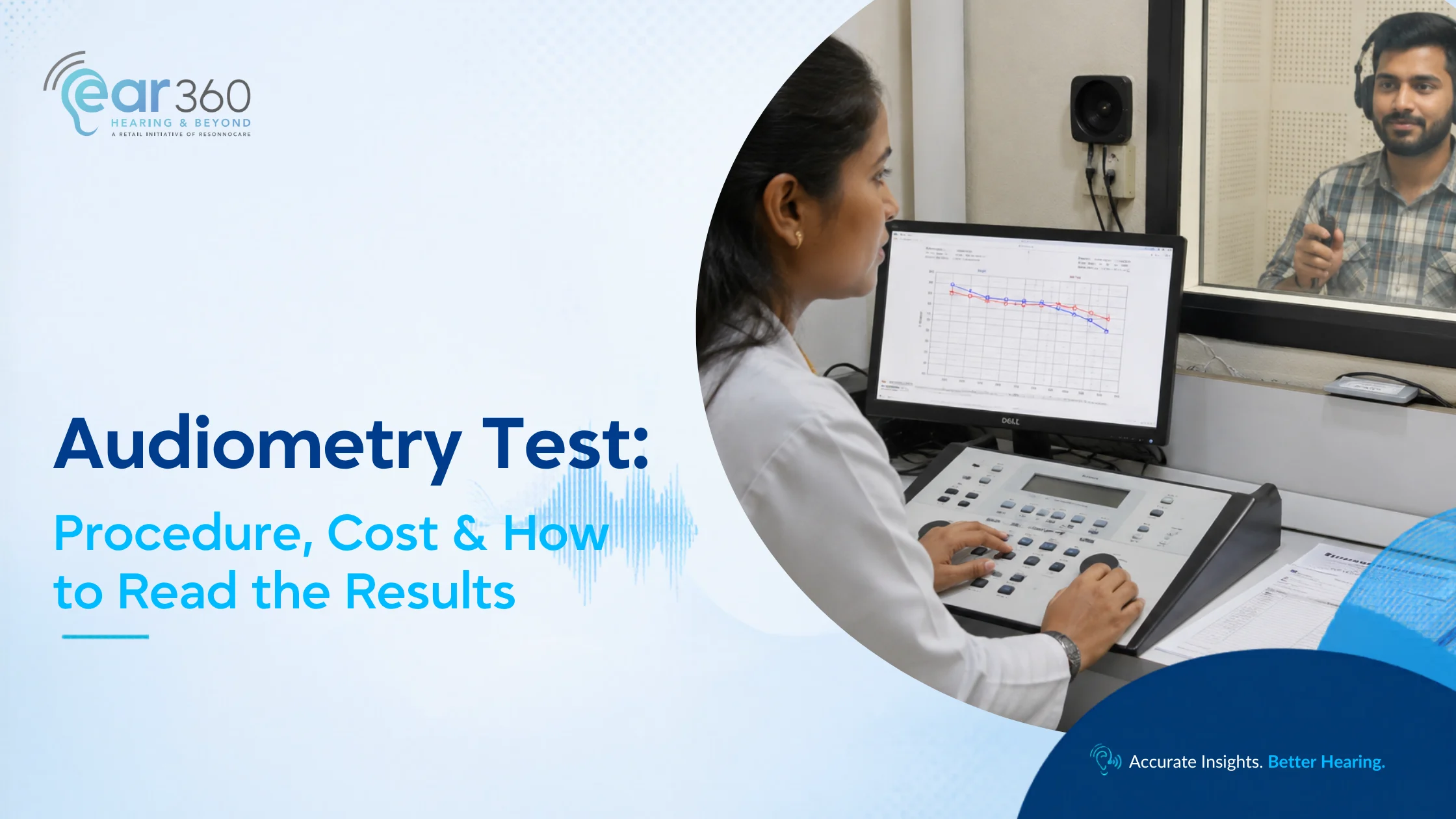
You will wear headphones and sit in a quiet room or sound-treated space. Different sounds will be played at different volumes and pitches. Each time you hear a sound, you may be asked to press a button or raise your hand.
This test is done separately for each ear and helps measure the softest sounds you can hear.
Step 4: Bone Conduction Test
A small vibrating device may be placed behind your ear. This test checks how well sound reaches the inner ear through vibration. It helps the audiologist determine whether the hearing problem is related to the outer or middle ear, or to the inner ear or hearing nerve.
Step 5: Speech Audiometry
You may be asked to listen to and repeat certain words. This helps check how clearly you can understand speech, not just sounds. It is especially useful for people who say they can hear voices but cannot clearly understand words.
Step 6: Tympanometry, If Required
In some cases, a tympanometry test may also be done. A soft probe is gently placed at the opening of the ear canal to check eardrum movement and middle ear pressure. It does not hurt and usually takes only a few seconds.
The full audiometry test usually takes around 30 to 60 minutes, depending on the symptoms and the tests required. After the test, the audiologist will explain your results in simple terms and guide you on the next steps.
Audiometry Test vs Audiogram: Know the Difference
An audiometry test is the hearing assessment itself, while an audiogram is the chart created from the hearing-threshold results. The test measures how softly you can hear different frequencies, and the audiogram displays those findings visually for each ear.
Term | What it means | Where to read more |
Audiometry test | The clinical hearing assessment used to measure hearing at different frequencies and intensities | |
Audiogram | The graph that displays hearing thresholds and helps the audiologist interpret the degree and pattern of hearing loss |
If your main question is what happens during the test or how much it costs, the audiometry hub is the more relevant resource. If you already have a hearing report and want to understand the chart, the audiogram guide is the more relevant resource.
How to Read Your Audiometry Test Results
After your audiometry test, your results are shown on a chart called an audiogram. At first, this chart may look confusing, but your audiologist will explain it in simple terms so you understand what it says about your hearing.
An audiogram shows the softest sounds you can hear at different pitches. The horizontal line on the chart shows sound frequency, or pitch. Low-pitched sounds are shown on the left side, and high-pitched sounds are shown on the right side. These are measured in Hertz, also written as Hz.
The vertical line shows loudness, measured in hearing level (dB HL). The lower a mark appears on the chart, the louder the sound had to be before you could hear it.
During the test, your audiologist checks each ear separately and marks your hearing levels at different frequencies. These marks indicate whether your hearing is within the normal range or shows hearing loss.
- Hearing levels are commonly understood as:
- Normal hearing: 0 to 25 dB
- Mild hearing loss: 26 to 40 dB
- Moderate hearing loss: 41 to 55 dB
- Moderately severe hearing loss: 56 to 70 dB
- Severe hearing loss: 71 to 90 dB
- Profound hearing loss: 91 dB and above
The shape of the audiogram is also important. For example, if the chart slopes downward in the higher frequencies, it may mean that high-pitched sounds are harder to hear. This pattern is often seen in age-related hearing loss or hearing loss caused by long-term noise exposure.
In some cases, the hearing loss may look similar across low and high frequencies. This can suggest a different type of hearing concern, which your audiologist will explain based on your symptoms and test findings.
At Resonnocare, your audiologist will review your audiogram with you after the test, explain what each result means, and guide you on the next steps. The goal is to ensure you leave with a clear understanding of your hearing health and how to support it.
What Does an Audiometry Test Cost in India?
Audiometry Tests in India may vary based on the type of test performed, the clinic, the city, and whether the audiometry test is part of a larger hearing test. Generally, the cost of a simple pure-tone audiometry test ranges from Rs. 300 to Rs. 1,200 at most clinics. The comprehensive hearing test (which entails speech audiometry and Tympanometry) can cost Rs. 800 to Rs. 3,000 or more.
We believe everyone deserves access to hearing health services and that they should be affordable. Our pricing will be clear and with no hidden fees, and our audiologists will take the time to explain all aspects to you.
If you are also considering hearing support, we offer a free hearing aid trial so you can experience the difference before making any decisions.
What Conditions Can an Audiometry Test Detect?
An audiometry test is not only used for measuring hearing thresholds, but can also be used to diagnose many conditions, such as:
- Conductive hearing loss (due to earwax, fluid, infection, or middle ear problems)
- Sensorineural hearing loss (damage to the inner ear or auditory nerve, usually due to aging or to loud noises)
- Mixed hearing loss, which is a combination of the above two hearing losses.
- Tinnitus assessment support
- Auditory processing difficulties
- Eustachian tube dysfunction
For a broader overview of ear-related conditions, visit our ear symptoms and conditions page, where we explain common hearing and ear health concerns in detail.

Why Choose Resonnocare for Hearing and Audiology Care
The right audiologist can make the difference between being accurately assessed and being well-treated. What makes Resonnocare different:
- Evidence-based and clinically guided care. All Resonnocare audiometry tests are performed in accordance with best practices in the clinic. Our evaluations are comprehensive and precise, conducted by trained audiologists and clinicians who have a holistic perspective on your hearing health.
- Experienced team. Our team of audiologists and specialists possesses extensive knowledge and experience in handling a wide range of cases, including pediatric hearing evaluations and complex adult cases.
- Personalized care plans. There are no uniform patients. Once the audiometry test is completed, our team develops a personalized care plan based on your type and level of hearing loss, lifestyle, and needs.
- Full range of hearing support. From hearing aid fittings to follow-up evaluations or support, we’re here for you.
For those who are unable to visit a clinic in person, Resonnocare also offers:
- Home visit services for patients who prefer care at home
- Video consultations for remote hearing advice and follow-ups
- Aftercare support to ensure your hearing care continues beyond the initial appointment
Find a Resonnocare Clinic Near You
Select your city to find the nearest Resonnocare clinic and book an appointment with our hearing care team.
Bangalore
Ear 360, Jayanagar
Ground Floor, Site No. 499, Municipal No. 499/97, East End Main Road, 9th Block, Jayanagar, Bangalore, Karnataka 560041
Timings: 10:00 AM to 7:00 PM
[Call] [Book an Appointment]
Ear 360, Spandana Sarjapura Hospital
239/205/34A, near Trinity Complex, Sompura Gate, Sarjapura Main Road, Bangalore, Karnataka 562125
Timings: 10:00 AM to 7:00 PM
[Call] [Book an Appointment]
Resonnocare, HSR Layout
150/5/72, 7th Cross, 24th Main, HSR Layout, Bangalore, Karnataka 560102
Timings: 10:00 AM to 7:00 PM
[Call] [Book an Appointment]
Resonnocare, Banashankari
272, 7th Cross Road, BSK 1st Stage, 2nd Block, Srinivasan Agra, 80 Feet Road, Bangalore, Karnataka 560050
Timings: 10:00 AM to 7:00 PM
[Call] [Book an Appointment]
Resonnocare, Indiranagar
34, Wind Tunnel Road, Murugeshpalya, Muniyappa Layout, Bangalore, Karnataka 560017
Timings: 10:00 AM to 7:00 PM
[Call] [Book an Appointment]
Delhi
Ear 360, Dr. Hans Anand Lok
46, Anand Lok Road, Anand Lok, Sadiq Nagar, New Delhi, Delhi 110049
Timings: 10:00 AM to 7:00 PM
[Call] [Book an Appointment]
Resonnocare, Dr. Hans Vasant Vihar
28, Basement, Paschimi Nagar, Vasant Vihar, New Delhi, Delhi 110057
Timings: 10:00 AM to 7:00 PM
[Call] [Book an Appointment]
Gurgaon
Resonnocare Head Office, M3M Urbana
Office 403, Office Block, 4th Floor, above Retail Blocks R1 and R5, M3M Urbana, Sector 67, Gurgaon, Haryana 122101
Timings: 10:00 AM to 7:00 PM
[Call] [Book an Appointment]
Resonnocare, Dr. Hans Sector 28
Plot No. 1SP, adjoining DLF Phase 1 Metro Station, Sector 28, Gurgaon, Haryana 122002
Timings: 10:00 AM to 7:00 PM
[Call] [Book an Appointment]
Ludhiana
Ear 360, BRS Nagar
963, Block B, BRS Nagar, Ludhiana, Punjab 141012
Timings: 10:00 AM to 7:00 PM
[Call] [Book an Appointment]
Resonnocare, Fawwara Chowk
565-A and 565-B, Upper Ground Floor, Cemetery Road, near Fawwara Chowk, West City, Ludhiana, Punjab 141001
Pune
Ear 360, Vighnaharta Healthcare Center
D-106-107, Choice Arcade, opposite Ruby Hall Hospital, Dhole Patil Road, Pune, Maharashtra 411001
Timings: 10:00 AM to 7:00 PM
[Call] [Book an Appointment]
Ear 360, Khan Parab ENT Hospital
Plot No. 102, Anand Nagar, Talegaon Dabhade, Taluka Maval, Pune, Maharashtra 410507
Timings: 10:00 AM to 7:00 PM
[Call] [Book an Appointment]
Tumkur
Resonnocare, Ashok Nagar
PID No. 3563, 8th Main, 8th Cross, Ashok Nagar, Tumkur, Karnataka 572103
Timings: 10:00 AM to 7:00 PM
[Call] [Book an Appointment]
Conclusion
Audiometry test is not a mere technical exercise. It is the cornerstone of good hearing health. It provides you and your audiologist with the data you need to make the right choice for your hearing care, whether that means reassurance, treatment, or long-term management.
In case you have been avoiding a hearing check-up, it is time to do so. With the help of an audiometry test, early detection is possible, the process of further worsening can be avoided, and the path to better communication, confidence, and a better quality of life opens.
To book your audiometry test or speak with one of our specialists, explore our services, or get in touch with the Resonnocare team today. We are here to help you hear better and live better.
FAQ’s
What is done during an audiometry test?
In an audiometry test, an audiologist will collect hearing data using special equipment and headphones to assess hearing in both ears. Sounds will be played at different pitches and volumes; you will indicate their pitch and volume. Other tests may include speech recognition tests and bone conduction tests, which can help determine the cause and severity of the hearing loss. This is a non-invasive procedure that takes about 20-30 minutes and is not painful.
What is a normal hearing test result?
The examination of hearing thresholds at important speech frequencies (0-25 dB) indicates normal hearing. This will allow for low levels of sound and conversation to be heard without stress. If the results are in this range, the audiogram is considered normal. However, all interpretations should be provided by an audiologist who will be able to explain the results to you and what they mean for your hearing health.
What is one of the first signs of hearing loss?
An early sign of hearing loss is difficulty hearing speech, especially in noisy situations such as social gatherings, meetings, and restaurants. Other people also report issues with their children’s speech or hearing, or that they frequently have to ask their children to repeat themselves. These symptoms can progress over time – it is best to schedule routine hearing checks to catch symptoms early and take steps to protect your hearing.
How to check an audiometry test?
To review the results of an audiometry test, an audiogram (a graph of a person’s hearing thresholds at different frequencies) is checked. The figures below represent better hearing, and the ones above represent hearing loss. Based on the results of the air conduction, bone conduction, and speech tests, the audiologist can determine the degree and type of hearing loss. Professional interpretation is crucial to receiving the right diagnosis and treatment plan.
What are three warning signs of hearing loss?
Symptoms of hearing loss include asking people to repeat themselves, having trouble hearing the television or phone, and not hearing people in noisy places. Some people may also have hearing problems or hear noises or ringing in the ears (tinnitus). A thorough hearing test is recommended if these symptoms continue.