

TL; DR:
This blog is aimed at existing hearing-aid users, especially people experiencing poor clarity, discomfort, excessive loudness, feedback, or changes in hearing-aid performance, as well as family members helping them decide when an audiologist review is needed.
- Several everyday problems can indicate that hearing-aid settings need adjustment. Common signs include speech being louder but still unclear, sounds feeling too sharp, background noise overpowering speech, frequent whistling, an unnatural-sounding own voice, repeated volume changes, discomfort, or reduced performance.
- Not every hearing-aid problem is caused by programming. Issues can also result from poor physical fit, blocked wax guards, worn domes or tubing, charging problems, moisture, damaged components, or changes in the user’s hearing.
- Users can perform a few basic checks before booking an appointment. The blog recommends checking battery or charging status, correct placement, visible wax, tubing or dome damage, basic cleaning, and Bluetooth connectivity while avoiding unsafe cleaning methods or sharp objects.
- An audiologist can determine whether the hearing aid needs adjustment, repair, or replacement. A professional review may include checking the device and fit, reviewing hearing-test results, assessing real-life listening problems, re-testing hearing if necessary, and fine-tuning the programming.
While a hearing aid should make it easier to hear every day, the initial settings are not necessarily the final settings. Listening environments, ear shape, and the fit of the device may change over time, as can your hearing needs. If you understand the symptoms of the hearing aid being in need of adjustment, you can get appropriate help before they get to the point of giving up on wearing it.
These are some changes that are normal adaptations, particularly for new users. Others recommend an audiologist to check the fitting, programming, condition of the device, and your hearing.
Quick Checklist: 11 Signs Hearing Aid Needs Adjustment
If you see or hear these repeatedly, book a review:
- Speech is louder but still not clear.
- Sounds are too loud or sharp for everyday use.
- Noise is too loud to hear the voice.
- The hearing aid beeps often.
- Your voice comes across as flat or boomy.
- You are continually adjusting the volume.
- The device is loose, tight, or uncomfortable.
- One hearing aid is different from the other one.
- It has not performed as well as before.
- The act of listening is still extremely fatiguing.
- Don’t wear it as it doesn’t sound or feel right.
The following signs do not necessarily indicate that the hearing aids are broken. It can be a problem with the programming, fit, maintenance, hearing changes, or just a technical issue.
Know More About
- Hearing Aid Price: What Affects the Cost of Hearing Aids?
- Digital Hearing Aids: Features, Benefits, Price & How They Work
- Hearing Aid Center Near Me: Checklist Before Booking an Appointment
Are These Signs Hearing Aid Needs Adjustment or Normal Adaptation?
New hearing-aid users may hear sounds, such as footsteps, running water, cutlery, traffic, or their own voice, that they may not have heard before. At first they may sound unfamiliar, but you will get used to them with regular use.
But if there is any painfully loud sound, discomfort that won’t go away, difficulty hearing what is being said, or a lot of feedback, this should not just be taken as “getting used to” hearing aids. These may be signs hearing aids need adjustment and should be discussed with your audiologist.
1. Speech Is Louder but Still Unclear
When individuals’ voices are heard more clearly but words are still hard to understand, an increase in volume may not help.
The program for the hearing aid is different at various frequencies, and fine-tuning may be necessary. Your audiologist also might look at how well you understand speech and determine if your hearing has changed since the last evaluation.
2. Everyday Sounds Feel Too Loud or Sharp
There might be sounds familiar to us that stand out more at first. However, sounds like food, traffic, children’s voices, or even kitchen noises should not be so loud as to be uncomfortable.
Make a note of the sounds that are difficult and provide any examples to your audiologist. Describing a hearing aid as “steel plates sound painfully sharp” is more helpful than just stating the hearing aid is “too loud”.
3. Background Noise Is Still Overwhelming
Listening in restaurants, at a market, at meetings, and at gatherings with family can be difficult.
Hearing aids can’t eliminate background noise. If noise always seems to be louder than speech, however, your audiologist will want to check programming, directional microphone settings, noise management settings, or your listening strategies.
The goal is toward realistic improvement in communication and not the elimination of all undesirable sounds.
4. Your Hearing Aid Keeps Whistling
Often, whistling or feedback is associated with:
- A device that is loose or has not fit well.
- Earwax blockage
- Tubing or domes that are worn out.
- The sound from the fitting leaks around the edge.
- Device-related problems
- Unsuitable settings
There are a number of causes of feedback, and reducing the volume by yourself might not be enough to remedy the situation.
5. Your Own Voice Sounds Hollow or Boomy
Some users find that their voice sounds abnormally deep, blocked, echoing, or boomy when they wear a hearing aid.
Sometimes this may be a reference to the method in which the hearing aid fits the ear canal, or to the dome or earmould. Adjustments to the physical fit, venting, dome/earmould and programming can be assessed by your audiologist to see if they can help.
6. You Keep Changing the Volume
It is normal to experience volume changes on occasion.
This is not the same as continually adjusting the hearing aid to a higher setting to hear speech and then back to a lower setting when regular sounds are too loud. This is one of the indications that the hearing aid’s settings need to be adjusted, as they may not be aligned with your typical listening situations.
Inform your audiologist of the location and time you are adjusting the volume. That information can be used to fine-tune more appropriately.
7. The Hearing Aid Feels Loose, Tight or Uncomfortable
Not all hearing aid issues can be solved by programming.
If the device slips out, pressure is being applied, it is rubbing against the ear, or the device is painful after several hours, it may need a physical fitting review.
Some domes, earmould or receiver length may be necessary to check. If there is persistent pain, skin irritation or soreness, it should not be ignored.
8. One Hearing Aid Sounds Different From the Other
If someone wears two hearing aids and one sounds softer, sounds distorted, sounds intermittent, or seems different, the cause should be investigated.
Possible reasons include:
- A blocked wax filter is a filter that is clogged by wax.
- A weak battery
- Charging problems
- Moisture
- A damaged component
- A change in hearing
An acute loss of hearing in one ear compared to the other ear, especially when it is coupled with ear symptoms like tinnitus or dizziness, is also worth a professional evaluation.
9. The Hearing Aid Isn’t Working as Well as Before
If your hearing aid is not as loud or clear as it once was, it does not necessarily require increased amplification.
Wax guards can plug up. Tubing or domes can become worn out. Issues with charging may arise. You might need to have the hearing aid serviced, or your hearing may have changed.
If basic care does not restore performance, book professional hearing-aid aftercare rather than repeatedly changing settings yourself.
Not Every Problem Is a Programming Problem
Some symptoms of hearing aid adjustment problems are actually maintenance problems, fit or hardware problems.
An audiologist will verify the fit, wax guards, domes, tubing, charging performance, and general condition prior to programming.
The more amplification a hearing aid receives, the more likely the hearing aid is to be blocked or damaged.
Resonnocare’s hearing-aid services include fitting, programming, and follow-up support based on hearing-test findings and real-life listening needs.
What Can You Check at Home Before Your Appointment?
There are a number of simple things you can do to exclude basic issues.
You can:
- Make sure the hearing aid is switched on.
- Ensure rechargeable devices are charged.
- If so, replace a weak disposable battery.
- Ensure that the hearing aid is in place.
- Gently clean with a dry, lint-free cloth.
- Look for obvious wax around the dome or wax guard.
- Inspect tubing and domes for damage.
- If there are only connection problems, restart your phone or Bluetooth connection.
Always follow the cleaning instructions provided for your particular device.
Avoid cleaning your hearing aid or ear with pins, needles, household chemicals, or other sharp objects.
When Should You Ask About Signs Hearing Aid Needs Adjustment?
Seek an audiologist assessment if the issue persists after using the device correctly and basic cleaning, or occurs often, negatively impacting comfort and communication.
If your speech is not clear, feedback is ongoing, loudness is excessive, or the fit is uncomfortable, you should not have to wait weeks for your teacher to assist you.
Prior to the appointment, record situations like:
- “Speech is garbled at family dinner.”
- “It sounds like traffic is cutting too sharply.”
- It is uncomfortable after 3 hours with the right hearing aid.
- Clear television, but conversations are not easy.
- “I have been decreasing the outdoor noise level.”
It may be beneficial to present some real-life examples to your audiologist so they can better understand the issue.
What Happens During a Hearing-Aid Adjustment Appointment?
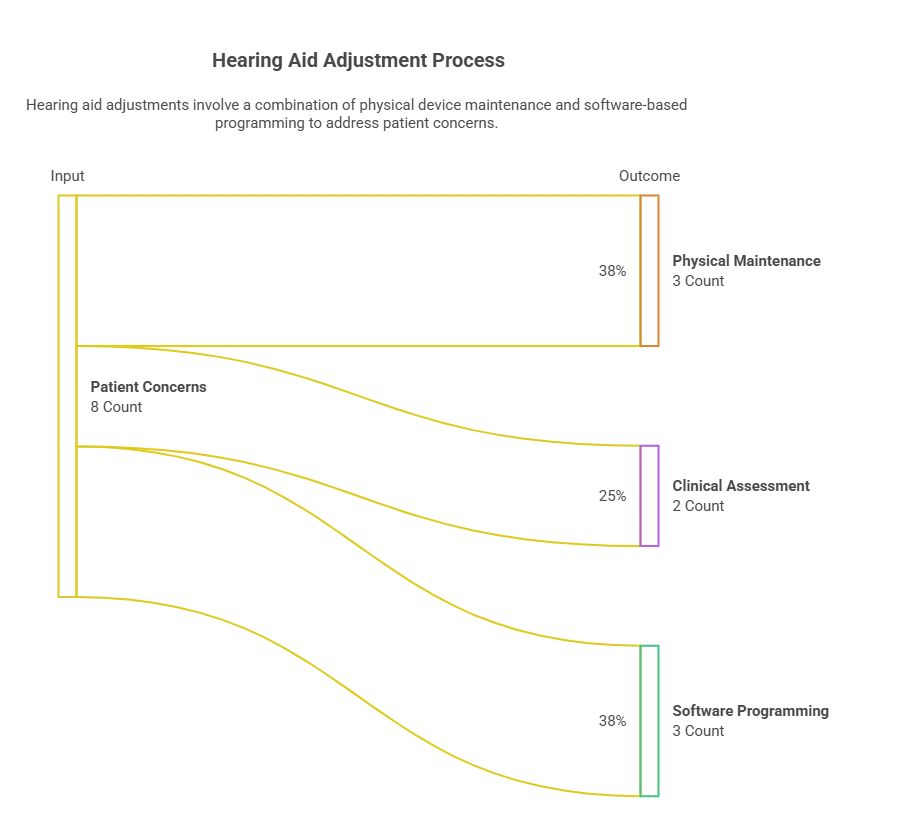
Most of the time, your audiologist will ask about the nature of your problem and where it’s happening.
The appointment may include, depending on the concern:
- Examination of the hearing aid.
- Checking its fit in or behind your ear.
- Checking domes, tubing, wax guards or earmoulds.
- Talking with yourself about your daily listening situations.
- Reviewing the results of the hearing tests.
- Re-testing if there is a suspicion that a change has occurred.
- Linking the hearing devices to programming software.
- Fine tuning the settings as needed.
If the problem presents itself as a technical solution, that may be the right way to go other than a change in programming.
Resonnocare provides hearing care for all ages with hearing assessment and ongoing clinical guidance when hearing needs change.
Do You Need Adjustment, Repair or Replacement?
An adjustment is the process of adjusting the programming or fit of the hearing aid.
A repair is meant for any fault or damaged component, charging problem, or any other technical issue.
Consider a replacement when the device is not working reliably, doesn’t meet the current hearing needs, or is not practical to service.
Older hearing aids don’t necessarily have to be replaced. Likewise, if your device no longer suits your hearing requirements, it may sometimes not be worth continually repairing.
An audiologist can evaluate the hearing aid to determine which one is clinically and practically appropriate for you.
When Hearing Changes Need Medical Attention
Not all hearing changes are necessarily treated with an adjustment to a hearing aid.
If you have any of these symptoms, see a professional immediately:
- Rapid onset of hearing loss, especially in one ear
- Severe ear pain
- Fluids draining from the ear(s) or bleeding from the ear(s)
- Dizziness or instability.
- New or troublesome tinnitus
- Sudden onset of hearing loss that doesn’t get better.
- Ongoing symptoms of the ears such as a feeling of fullness in the ears.
Do not just increase the volume on the hearing aid and wait if the hearing suddenly is worse. An audiologist, ear, nose, and throat (ENT) doctor, or other qualified healthcare provider should evaluate a patient who experiences a sudden hearing change.

Why Choose Resonnocare for Hearing and Audiology Care?
At Resonnocare, hearing-aid adjustment is not just a matter of turning up the volume; it is a clinically guided hearing care procedure.
Our approach includes:
- Clinically guided care: Before we suggest a change, we try to understand the issue with you.
- Hearing assessment, fitting, programming, troubleshooting, and follow-up by experienced audiologists and clinicians.
- Repeat hearing testing: This may be advised if your hearing seems to have changed.
- Your hearing profile, comfort, lifestyle and listening challenges in the real world are taken into account in the setting.
- Continuity of care: Support can include hearing aids, hearing tests, home visits, video consultation and aftercare depending on needs.
Our clinical excellence approach focuses on assessment-led recommendations and appropriate follow-up rather than treating every hearing-aid concern in the same way.
Find a Hearing Aid Clinic Near You
Select your city to find the nearest Resonnocare clinic and book an appointment with our hearing care team.
Bangalore
Ear 360, Jayanagar
Ground Floor, Site No. 499, Municipal No. 499/97, East End Main Road, 9th Block, Jayanagar, Bangalore, Karnataka 560041
Timings: 10:00 AM to 7:00 PM
[Call] [Book an Appointment]
Ear 360, Spandana Sarjapura Hospital
239/205/34A, near Trinity Complex, Sompura Gate, Sarjapura Main Road, Bangalore, Karnataka 562125
Timings: 10:00 AM to 7:00 PM
[Call] [Book an Appointment]
Resonnocare, HSR Layout
150/5/72, 7th Cross, 24th Main, HSR Layout, Bangalore, Karnataka 560102
Timings: 10:00 AM to 7:00 PM
[Call] [Book an Appointment]
Resonnocare, Banashankari
272, 7th Cross Road, BSK 1st Stage, 2nd Block, Srinivasan Agra, 80 Feet Road, Bangalore, Karnataka 560050
Timings: 10:00 AM to 7:00 PM
[Call] [Book an Appointment]
Resonnocare, Indiranagar
34, Wind Tunnel Road, Murugeshpalya, Muniyappa Layout, Bangalore, Karnataka 560017
Timings: 10:00 AM to 7:00 PM
[Call] [Book an Appointment]
Conclusion: Recognising Signs Hearing Aid Needs Adjustment
When hearing aids don’t sound the way they should, the most typical indications they require adjustment are: unclear speech, noises that sound too loud in everyday situations, too much background noise, whistling, discomfort and change of volume, or a decrease in performance.
In some cases, a program adjustment or fitting modification can help alleviate concerns. Some others could be due to wax, blocked components, charging problems, hearing loss, or device issues.
Don’t wait for persistent indicators that you need a hearing aid adjustment – schedule a hearing aid review with Resonnocare. Our audiology team can then check your device and your current hearing level, and the challenges you encounter in your daily listening life – before adjusting, servicing, further testing, or an alternative course of action.
Medical Note: This article is for general education purposes only and is not a substitute for an individual hearing assessment, diagnosis or treatment plan administered by an audiologist, ENT specialist or other qualified health care professional.
FAQ’s
Can I adjust my Signia hearing aid?
Yes, there are Signia hearing aids that offer volume, listening programs, and sound settings that can be adjusted using the hearing aids’ built-in controls or via the corresponding smartphone application. But changes in the level of amplification should be made by an audiologist to ensure that the hearing aid is programmed to suit your hearing loss and that it gives you the best possible listening experience.
What is the lifespan of a Signia hearing aid?
The lifespan of a Signia hearing aid is 5–7 years, depending on how it is used, maintained, and the environment. To observe a long lifespan, regular cleaning, proper storage, and routine servicing are needed. Many users upgrade earlier to take advantage of the latest technology and better hearing capabilities.
Is there a reset button on my hearing aid?
Unlike many Signia hearing aids, most hearing aids do not have a dedicated reset button. However, they typically will be reset by a power cycle, opening and closing the battery door, or through the charging case. Each model has a different method for resetting; check the user’s guide or consult with your hearing care professional for instructions.
Why is my Signia hearing aid playing a tune every 3 minutes?
If a hearing aid is playing the same tune over and over, it could indicate a low battery, a connection problem, a program switch, or a maintenance alert. The model and settings will determine this. Review the battery status, app notifications, and user manual. If it does not cease, seek help from your hearing care professional.
How do you reset a Signia hearing aid?
Resetting is simply a process of switching off the Signia hearing aid and on again, or for rechargeable models, briefly placing them in their charger before removing them. There are also some models that can be reset via Signia’s app. If issues continue following reset, please refer to the manual or your audiologist for model-specific instructions.