
TL; DR:
This blog is for people experiencing unusual ear sounds such as popping, clicking, fluttering, crackling, or pulsing, especially when the noise feels different from typical tinnitus.
- Not every ear noise is caused by conventional tinnitus. Earwax, Eustachian tube dysfunction, middle-ear fluid, infections, muscle contractions, jaw joint problems, and pressure changes can also create unusual sounds.
- The pattern of the sound helps guide evaluation. Important details include whether it affects one or both ears, follows the heartbeat, occurs while swallowing or chewing, or is accompanied by hearing loss, pain, pressure, discharge, or dizziness.
- Diagnosis may involve examining the ear canal and eardrum, conducting hearing and speech tests, and assessing middle-ear pressure or movement. Treatment depends on the underlying cause rather than the sound alone.
- Urgent medical assessment is needed when ear noise occurs with sudden hearing loss, severe pain, bleeding or discharge, major vertigo, difficulty walking, facial weakness, a recent injury, or a new pulse-synchronous sound.
A ringing, buzzing, clicking, or humming sound in the ear is often immediately labelled as tinnitus. However, not every unexplained ear noise follows the typical pattern of tinnitus.
You may notice a popping sound while swallowing, a pulse-like whooshing after a cold, or a brief fluttering sensation that appears and disappears. While some of these sounds may still be classified as tinnitus because they occur without an external sound source, others may be linked to earwax, fluid buildup, pressure changes, or movement in the middle ear or nearby jaw structures.
Understanding the sound alone is not enough. Its timing, frequency, triggers, and accompanying symptoms can provide important clues. An audiologist or ENT specialist can assess these patterns to identify whether the noise is tinnitus or a sign of another ear-related condition that requires further investigation.
What Does Noise in Ears Not Tinnitus Mean?
Tinnitus is the sensation of hearing sounds without an external sound source. It sounds like ringing, buzzing, or humming; it can sound like hissing, clicking, or whooshing and can be in one or both ears. Tinnitus is not a disease, but a symptom.
A sound doesn’t mean it has to be a high-pitched ring to be tinnitus. The word repeated can also be used to refer to a low rumble or a repeated click. Meanwhile, if there is a real mechanical change or movement in or around the ear, you will hear a real noise.
If the patient reports hearing sounds in their ears that are not tinnitus, our staff will ask what they sound like, when they occur, if they follow the pulse, and if they move when they swallow, chew, turn their head, or go high in the air. Often these details are more helpful than the label given to the symptom.
What Can Cause Noise in Ears Not Tinnitus?
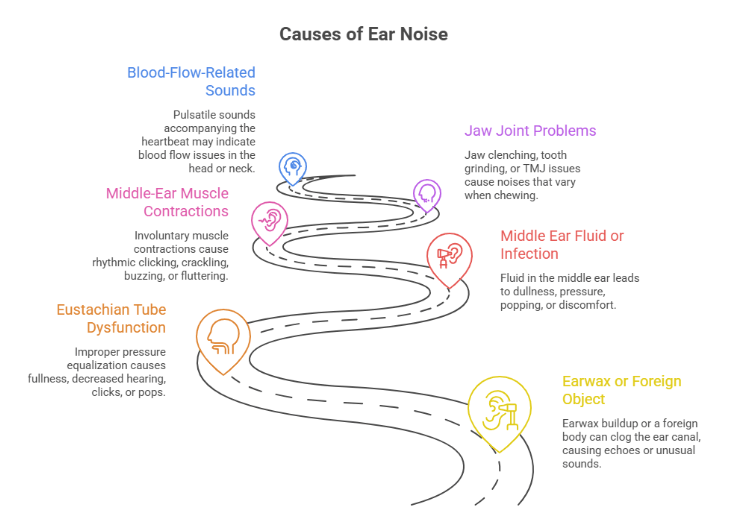
Several ear and nearby conditions can create unusual sounds. A symptom cannot be diagnosed from its sound alone, but certain patterns offer useful clues.
1. Earwax or a Foreign Object
Earwax can build up and clog the ear canal, making it harder to hear and may cause the ear to echo or other sounds within the ear. A foreign body can also cause irritation or blockage of the canal.
Never put anything into the ear with a cotton bud, pin or other object. It may force wax further into the ear canal or cause damage to the eardrum and canal.
2. Eustachian Tube Dysfunction
The Eustachian tube equalises the pressure between the middle ear and the back of the nose. If not functioning properly, you may experience fullness, decreased hearing, clicks or pops. Symptoms may occur following a cold, through allergy, or during flights or other changes of altitude.
This click is primarily swallowing related, and not necessarily a continuous tinnitus. If the symptoms persist or become painful or if there is some difficulty with hearing, this should be assessed.
3. Fluid or Infection in the Middle Ear
Ears may become dull, and pressure, popping, or discomfort in the middle ear can occur because of the middle-ear fluid. It is especially prevalent in children, who might not respond well or might increase the volume of the television or do the wrong thing instead of describing what it sounds like.
If the ear is painful, with a fever or ear discharge, it’s not a noise complaint. Watch for these symptoms, which need medical examination.
4. Middle-Ear Muscle Contractions
Sometimes small middle ear muscles can suddenly and involuntarily contract. This rare condition, known as middle-ear myoclonus, can cause a rhythmic clicking, crackling, buzzing, or fluttering.
Since there are many possible causes of clicking, repeated episodes should be considered for evaluation instead of diagnosis based on the description provided online.
5. Jaw Joint Problems
The jaw joint is located near the ear. Ear noises, discomfort, or symptoms that vary when chewing may be related to jaw clenching, tooth grinding, or temporomandibular joint (TMJ) problems.
A dental or jaw evaluation might be recommended by an audiologist or ENT doctor if there is a frequent change in sound with movement.
6. Blood-Flow-Related Sounds
Pulsatile tinnitus is a hissing or drumming sound that accompanies the heartbeat. It still counts as tinnitus, but it’s evaluated differently when there is a possibility of blood flow in the head or neck.
Don’t shrug off a pulse-synchronous sound, particularly if it is a new one, or if it doesn’t go away or it sounds only in one ear. The physician may need to examine the ear and check hearing and determine if other medical tests are necessary.
How Is Noise in Ears Not Tinnitus Diagnosed?
First, a thorough history is taken. Your clinician might also ask if the sound is in one or both ears, if it is continuous or intermittent, if it is rhythmic or if it is connected to the heartbeat. They will also request if it began after a cold, flight, loud noise, injury to the head or after a change in medication, and if hearing loss, pressure, pain, discharge or vertigo is present.
An examination of the ear canal and eardrum for wax, infection, fluid, injury, or visible cause. Hearing tests can measure hearing thresholds and speech understanding. May add middle ear testing if pressure or eardrum movement is to be evaluated.
Resonnocare’s ear symptoms and conditions pathway involves clinical exam and appropriate audiological procedures to determine the next step.
All ages have access to hearing services, so children, adults, and senior citizens can have a hearing evaluated to fit their age and communication style.
Can Noise in Ears Not Tinnitus Be Treated?
Management will vary depending on the cause. Safe removal of earwax may be necessary, medical treatment may be needed for an ear infection, and the nasal and/or middle ear problem may resolve over time, with the earwax pressure symptoms resolving as well. Dental or musculoskeletal interventions might be required for jaw-related symptoms.
If the tinnitus is related to hearing loss, there are hearing support, counselling, and sound strategies available. Hearing aids can help increase communication and may help reduce the tinnitus for some individuals who experience hearing loss. However, not everyone who experiences ear noise is a good candidate for a hearing aid.
Resonnocare’s hearing aid services are based on the findings of the hearing and the communication needs of the individual.
Do not give ear drops, supplements, or medicines to anyone without professional advice. What works for one cause might not work for another and may even be harmful.
When Does Noise in Ears Not Tinnitus Need Urgent Care?
Schedule immediate assessment for any new, persistent, one-sided,pulse-synchronous,s or sleep/attention impairments.
If ear noise happens in conjunction with:
- Abrupt or sudden and rapid loss of hearing
- Severe ear pain
- Often discharge or bleeding from the ears
- Major vertigo or trouble walking
- New neurological symptom, such as facial weakness
- New head or ear injury (last week)
Sudden sensorineural hearing loss may develop in a few hours or days and can be accompanied by a feeling of fullness in the ears, dizziness or tinnitus. It is a medical emergency and should not be delayed, as this may interfere with the effectiveness of treatment.
Persistent discharge, pain, hearing loss and dizziness are other symptoms that require examination, as these can be related to outer, middle and inner ear conditions.

Why Choose Resonnocare for Hearing and Audiology Care?
Resonnocare offers a clinically informed approach with experienced audiologists and clinicians. We start with a proper hearing test and thoroughly explore the timing, characteristics, and the presence of other symptoms.
Based on the results, your individualized care plan might include hearing testing, medical referral, hearing aids, counseling, and follow-up. Home visits could be considered for older adults or those with limited mobility, and a video consultation with an audiologist can be beneficial for initial counseling and review of reports, as well as for selected follow-up visits.
Each of our staff members does not assume that the same thing causes all ear sounds. We tell you what we found and what you might need to do next – such as getting an ENT evaluation if we suspect a medical condition.
Find a Resonnocare Clinic Near You
Select your city to find the nearest Resonnocare clinic and book an appointment with our hearing care team.
Bangalore
Ear 360, Jayanagar
Ground Floor, Site No. 499, Municipal No. 499/97, East End Main Road, 9th Block, Jayanagar, Bangalore, Karnataka 560041
Timings: 10:00 AM to 7:00 PM
[Call] [Book an Appointment]
Ear 360, Spandana Sarjapura Hospital
239/205/34A, near Trinity Complex, Sompura Gate, Sarjapura Main Road, Bangalore, Karnataka 562125
Timings: 10:00 AM to 7:00 PM
[Call] [Book an Appointment]
Resonnocare, HSR Layout
150/5/72, 7th Cross, 24th Main, HSR Layout, Bangalore, Karnataka 560102
Timings: 10:00 AM to 7:00 PM
[Call] [Book an Appointment]
Resonnocare, Banashankari
272, 7th Cross Road, BSK 1st Stage, 2nd Block, Srinivasan Agra, 80 Feet Road, Bangalore, Karnataka 560050
Timings: 10:00 AM to 7:00 PM
[Call] [Book an Appointment]
Resonnocare, Indiranagar
34, Wind Tunnel Road, Murugeshpalya, Muniyappa Layout, Bangalore, Karnataka 560017
Timings: 10:00 AM to 7:00 PM
[Call] [Book an Appointment]
Delhi
Ear 360, Dr. Hans Anand Lok
46, Anand Lok Road, Anand Lok, Sadiq Nagar, New Delhi, Delhi 110049
Timings: 10:00 AM to 7:00 PM
[Call] [Book an Appointment]
Resonnocare, Dr. Hans Vasant Vihar
28, Basement, Paschimi Nagar, Vasant Vihar, New Delhi, Delhi 110057
Timings: 10:00 AM to 7:00 PM
[Call] [Book an Appointment]
Gurgaon
Resonnocare Head Office, M3M Urbana
Office 403, Office Block, 4th Floor, above Retail Blocks R1 and R5, M3M Urbana, Sector 67, Gurgaon, Haryana 122101
Timings: 10:00 AM to 7:00 PM
[Call] [Book an Appointment]
Resonnocare, Dr. Hans Sector 28
Plot No. 1SP, adjoining DLF Phase 1 Metro Station, Sector 28, Gurgaon, Haryana 122002
Timings: 10:00 AM to 7:00 PM
[Call] [Book an Appointment]
Ludhiana
Ear 360, BRS Nagar
963, Block B, BRS Nagar, Ludhiana, Punjab 141012
Timings: 10:00 AM to 7:00 PM
[Call] [Book an Appointment]
Resonnocare, Fawwara Chowk
565-A and 565-B, Upper Ground Floor, Cemetery Road, near Fawwara Chowk, West City, Ludhiana, Punjab 141001
Pune
Ear 360, Vighnaharta Healthcare Center
D-106-107, Choice Arcade, opposite Ruby Hall Hospital, Dhole Patil Road, Pune, Maharashtra 411001
Timings: 10:00 AM to 7:00 PM
[Call] [Book an Appointment]
Ear 360, Khan Parab ENT Hospital
Plot No. 102, Anand Nagar, Talegaon Dabhade, Taluka Maval, Pune, Maharashtra 410507
Timings: 10:00 AM to 7:00 PM
[Call] [Book an Appointment]
Tumkur
Resonnocare, Ashok Nagar
PID No. 3563, 8th Main, 8th Cross, Ashok Nagar, Tumkur, Karnataka 572103
Timings: 10:00 AM to 7:00 PM
[Call] [Book an Appointment]
Conclusion: Should Noise in Ears Not Tinnitus Be Checked?
The phrase noise in ears not tinnitus refers to any noises that pop, click, flutter, crackle, or pulse, but seem different from the typical ringing sound. Some are mechanical or pressure related and some are forms of tinnitus that can be attributed to a contributing condition.
A brief, intermittent noise won’t necessarily be a problem, but if it’s a new noise, it’s one-sided or rhythmic, it shouldn’t be self-diagnosed. Make an appointment with Resonnocare for a hearing assessment or audiology consultation – particularly if the sound is present in conjunction with hearing loss, pain, discharge, dizziness or vertigo.
FAQ’s
How do I stop the noise in my inner ear?
Treatment for tinnitus depends on the cause and will include a range of interventions, such as emphasizing noise-canceling. If the sound is caused by tinnitus, stress management, avoiding exposure to loud sounds, addressing hearing loss, and sound therapy can help alleviate symptoms. If the noise suddenly occurs, persists over time, or is accompanied by hearing loss or dizziness, contact an ENT specialist for an appropriate assessment.
What can cause noise in the ears that is not tinnitus?
Not all ear noises are tinnitus. Earwax buildup, middle ear infection, dysfunction of the Eustachian tube, muscle spasms, jaw joint (TMJ) disorders, and blood flow changes near the ear can also cause sounds in the ear. It is important to find the root cause since the treatment depends on the cause of the noise.
When should I worry about noise in my ears?
If ear noise is sudden, heard only in one ear, or accompanied by hearing loss, dizziness, balance problems, facial weakness, or sounds that pulse with your heartbeat, medical attention should be sought. These symptoms may be the signs of an underlying condition that needs immediate assessment and management by an ENT specialist or neurotologist.
Why do I have a weird sound in my ear?
Tinnitus, ear wax blockage, ear infections, pressure changes, muscle contractions, and problems with the middle or inner ear can all cause a weird sound in the ear. Others have said the sound is like raspberries, buzzing, clicking, humming, or whooshing. A hearing exam can help to identify the exact cause and treatment possibilities.
How do I get rid of the weird noise in my ear?
Getting rid of ear noise depends on its cause. The treatment can be earwax removal, treatment of infection, ear allergy control, hearing loss treatment, or tinnitus treatments. Never put things in your ears and do not expose them to loud noise. If the noise continues for more than a few days or gets worse, seek help from a hearing specialist for diagnosis and treatment.