
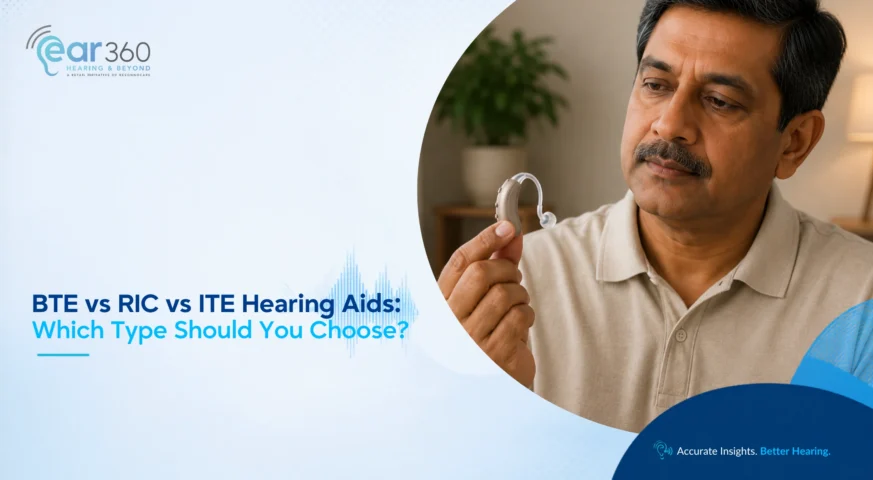
BTE vs RIC vs ITE Hearing Aids: Which Type Should You Choose?
TL; DR: The blog is aimed at people considering hearing aids for the first time, existing hearing-aid users exploring a different style, older adults and caregivers, and anyone comparing BTE, RIC, and ITE hearing aids before making a purchase decision. BTE, RIC, and ITE serve different needs: The blog explains how these hearing-aid styles differ in terms of placement, visibility, handling, amplification, custom fitting, rechargeable options, and maintenance, helping readers understand the practical differences. Hearing loss level alone should not determine the device: Choosing the right hearing aid should be based on the audiogram, speech understanding, affected frequencies, ear anatomy, previous ear problems, and everyday communication difficulties, rather than simply selecting a device based on its size or marketing claims. Lifestyle, comfort, and ease of handling matter: The blog highlights that factors such as dexterity, vision, wearing glasses, workplace/social environments, Bluetooth needs, rechargeable batteries, and ease of insertion and cleaning can significantly influence which hearing aid is most suitable. Professional assessment and a hearing-aid trial are important before choosing: Rather than assuming one style is universally best, the blog recommends a hearing assessment, professional fitting, trial, programming, and follow-up adjustments to identify the device that works best for the person’s hearing and daily life. With multiple hearing aid options available, selecting a hearing aid can be tricky when many of them provide similar options. You might have questioned whether a tiny device in the ear is more effective, whether a device behind the ear will be more effective, or even if a rechargeable device will be easier to handle. Various hearing aids are made to suit various levels of hearing, ear shape, lifestyle, and dexterity. At Resonnocare, we suggest that, instead of buying a device because it is smaller or has more features, you should first take your hearing assessment. Let’s take a closer look at the difference between BTE, RIC, and ITE hearing aids and what you should take into account before deciding. What Types of Hearing Aids Are Available? The microphone is used to capture sounds, the digital processor is used to manipulate that sound based on how well you hear it, and the receiver/speaker receives the sound and transmits it to your ear. There are several different types of hearing aids: Behind-the-Ear (BTE) Receiver-in-Canal (RIC) or Receiver in the Ear (RIE) In-the-Ear (ITE) In-the-Canal (ITC) Completely-in-Canal (CIC) Invisible-in-Canal (IIC) BTE, RIC, and ITE are the most frequently compared types of hearing aids for many patients who are considering a hearing aid for the first time. There are pros and cons to each, but there’s no one perfect design for all. You can explore Resonnocare’s range of hearing aid options to understand how devices are selected according to hearing needs. Know More About Mild Hearing Loss: Symptoms, Test Results & Do You Need Hearing Aids? Hearing Aid Trial: What to Expect Before Buying Hearing Aids Hearing Aids Near Me: How to Choose the Right Hearing Aid Center How Do the Main Types of Hearing Aids Differ? It’s easier to compare the devices when you know their location, and they’re all playing sound. BTE Hearing Aids A behind-the-ear hearing aid is an aid with a case behind the ear. The sound runs through a tube or wire to an earmold or earpiece in the ear. Depending on the model, BTE devices can offer a variety of amplification and can be used in varying degrees of hearing loss, from mild to more severe. BTE may be helpful to you if you: Need greater amplification Opt for bigger buttons that are simple to operate Want a long-lasting device Find it hard to manage very small hearing aids Need an earmould for a secure fit Due to the part of the device that lies behind the ear, some patients have a primary concern about visibility. Today’s BTE models, however, are much smaller and more inconspicuous than their predecessors. RIC Hearing Aids Receiver-in-Canal hearing aids also have a small, behind-the-ear piece, but the receiver is located in the ear canal and attached with a thin wire. The main reason for the wide use of RIC devices is that they are light, easy to wear, and flexible. They can be appropriate for individuals who have mild to severe hearing loss, although this will depend on the individual hearing loss pattern and the characteristics of the device. If you prefer, you may choose RIC if you want: An average amount of intruding design A sense of ‘lightness’ up the back of the ear Rechargeable options Smartphone or Bluetooth option Flexibility in the case of changing hearing requirements The receiver is placed in the ear canal so it can be affected by wax and/or moisture and requires routine cleaning and maintenance. ITE Hearing Aids In-the-Ear hearing aids are custom-made to fit in the outer part of your ear. Unlike BTE or RIC devices, there isn’t a separate piece behind the ear. They can also be easier to insert, remove, and operate in and out of the ear because they are larger in size than very small CIC or IIC devices. ITE devices could be suitable for patients who: Love things within the ear Give the tools for more user-friendly controls Wear glasses and prefer nothing behind the ear Wear a hearing aid, depending on the level of hearing loss (mild to severe) Need a custom-fitted device Comfort and fit should be assessed and fitted appropriately in the clinical setting since the shell is formed to fit the shape of the ear. Which Types of Hearing Aids May Suit Your Hearing Loss? One of the most significant elements in the selection of a hearing aid is your audiogram. For those who have mild hearing loss, there are a few discreet options available. If someone has greater hearing loss, they might require a device that provides more amplification but still has acceptable sound quality and comfort. This does not imply that BTE automatically goes to severe hearing loss and RIC automatically goes to mild hearing loss. There
Read More