
TL: DR;
This blog is primarily written for patients, caregivers, and families who are trying to understand hearing difficulties, pure tone audiometry test results, and what an audiogram means before seeking audiology care.
- Pure-tone audiometry tests hearing: by measuring how well you hear different pitches and volumes.
- Your audiogram shows results: It maps your hearing levels across low to high frequencies.
- Hearing thresholds matter: They show whether your hearing is normal, minimal, mild, moderate, severe, or profoundly reduced.
- It identifies hearing loss type: Results can suggest conductive, sensorineural, or mixed hearing loss.
- It guides treatment decisions: Your audiogram helps decide if you need medical care, hearing aids, or further evaluation.
- Get checked at Ear360 clinics: Visit Ear360 clinics if you notice tinnitus, muffled hearing, loud TV volume, or trouble hearing conversations.
It is not always obvious that someone is losing their hearing. These can sometimes start with little things, such as making people repeat themselves, turning up the television volume, difficulty understanding what people say in noisy environments, or feeling really tired after listening all day.
The changes can be baffling, particularly if you’re not sure whether they’re temporary, due to age, noise, or something that should be treated. This is where a pure tone audiometry test can come in handy. Helps to give a clear idea of how well you hear the various sounds and pitches, and the results are displayed on a chart called an audiogram.
We believe that when patients are informed, they make better choices about their health, and that is why we are ResonnoCare. This article covers what happens during a pure-tone audiology test, what the results might mean, and what to do next.
What Is Pure Tone Audiometry?
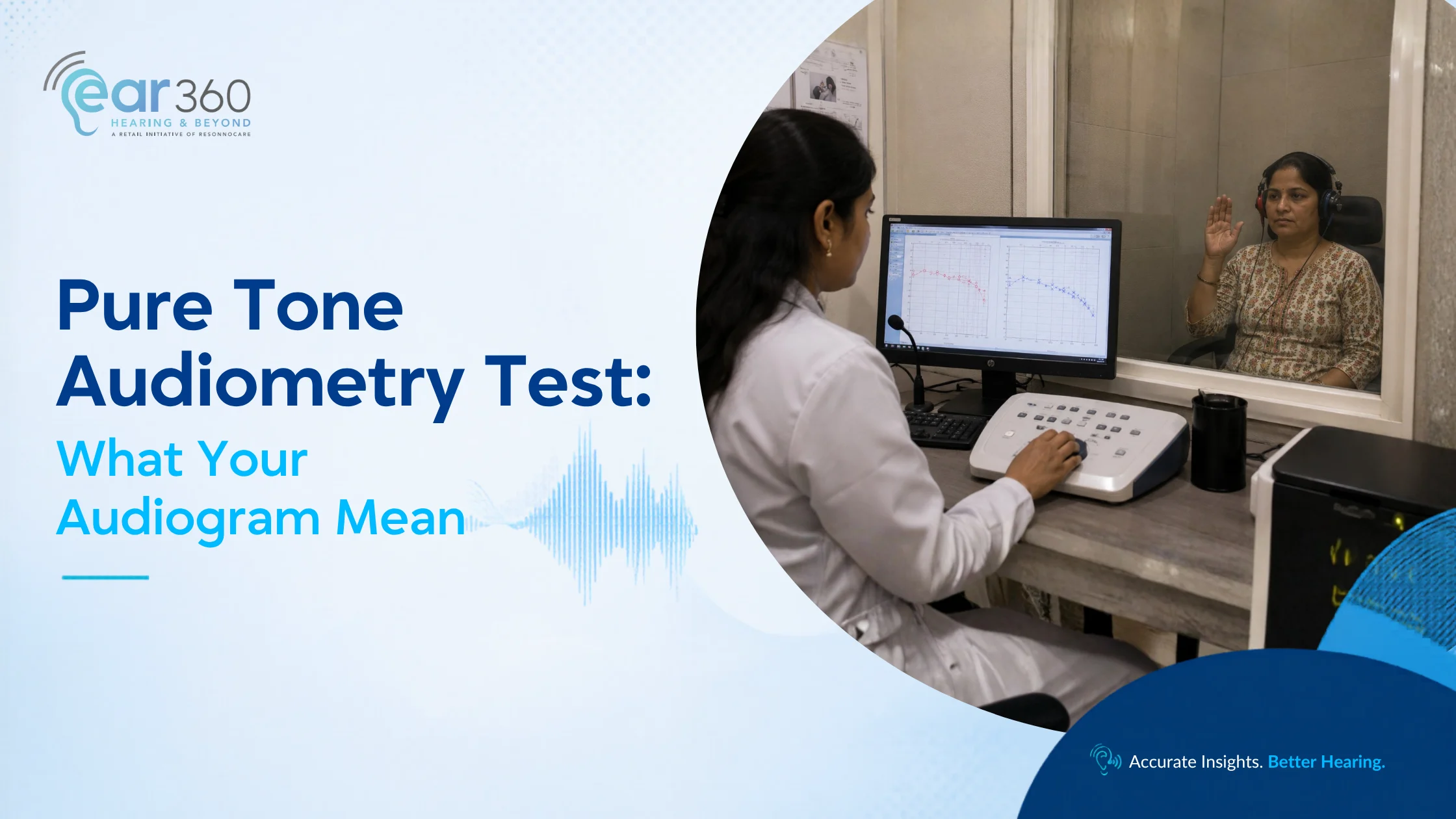
Pure tone audiometry quantifies auditory sensitivity to sound frequency in hearing assessments. For audiologists, this helps assess the presence, configuration, and severity of hearing loss. This also pinpoints frequency impact.
You are made to listen to tones of different frequencies and volumes through a bone vibrator. Tones are presented one at a time. You respond to each tone by pressing a button, and this is done for each tone at each frequency. Hearing threshold is defined as the softest tone that is detected 50% of the time.
The pure tone audiometry test is noninvasive and painless. The test takes 20 to 30 minutes. The assessment is conducted for individuals as young as 5 and serves as the basis for many other auditory assessments.
What Does an Audiogram Show?
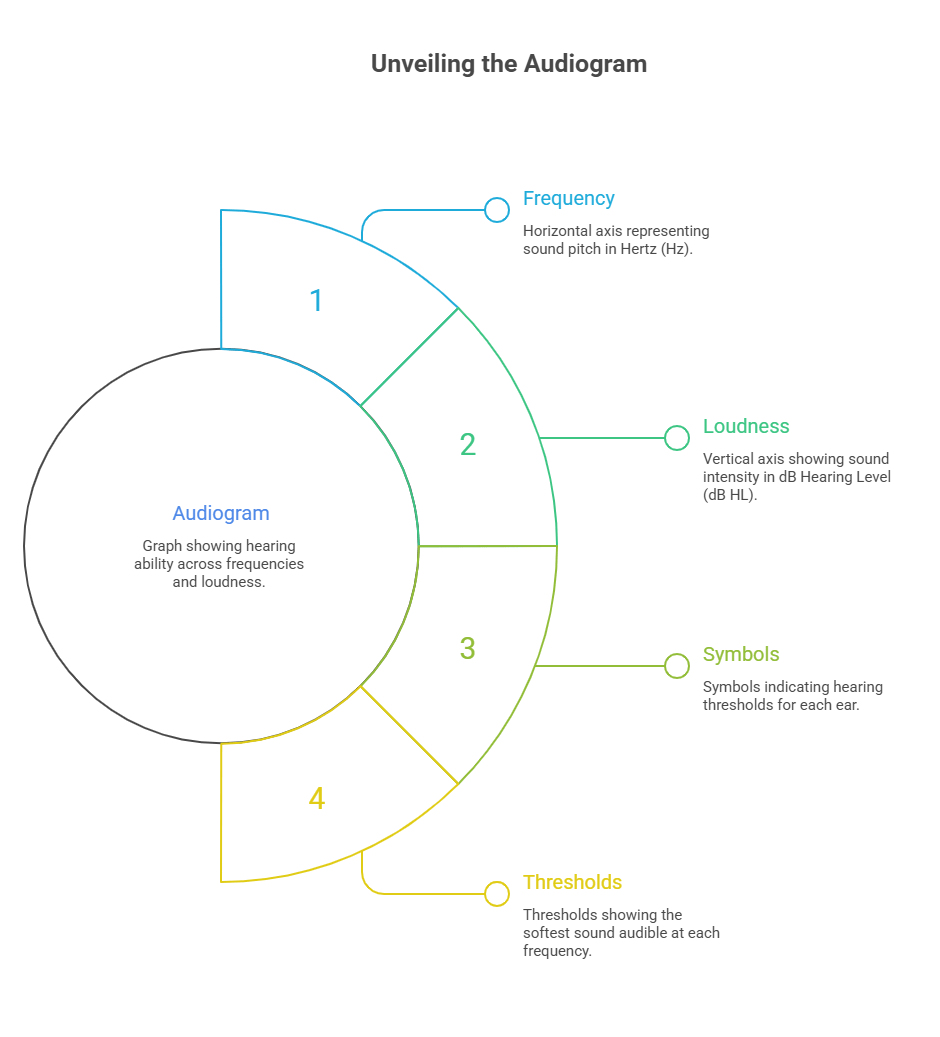
A pure-tone audiometry test produces a graph called an audiogram. At first, this chart may seem daunting, but it will be very easy to understand once you learn what you’re reading.
Frequency or pitch is plotted on the horizontal axis, in units of Hertz (Hz). The range of frequencies is from 250Hz (low-pitched sounds, such as a rumble) to 8000Hz (high-pitched sounds, such as a whistle or a bird call). This frequency range is of great importance clinically because human speech is in the range of 500Hz-4000Hz.
Loudness is shown on the vertical axis in dB Hearing Level (dB HL). Typically, it will range from 10 dB (very soft) at the top to 120 dB (extremely loud) at the bottom. The lower the mark on the audiogram, the louder a sound must be for you to hear it, and the greater the hearing loss.
The thresholds on the audiogram are indicated by symbols for each ear:
- O (red) = right ear thresholds
- X (blue) = left ear thresholds
- [ and ] = bone conduction thresholds (help determine type of hearing loss).
The thresholds for all frequencies tested on a normal audiogram are between 0 and 25 dB. Numbers higher than this indicate hearing loss of varying degrees.
How to Read the Main Symbols on Your Audiogram
The symbols on an audiogram help the audiologist separate the right ear from the left ear and compare different ways of presenting sound. Do not interpret one symbol in isolation; look at the complete pattern across frequencies.
Symbol or report feature | What it generally represents | Why it matters |
O | Right-ear air-conduction threshold | Shows the softest tones detected through the usual outer-, middle-, and inner-ear pathway in the right ear. |
X | Left-ear air-conduction threshold | Shows the corresponding hearing thresholds for the left ear. |
Bone-conduction symbols | Thresholds measured while bypassing much of the outer and middle ear | Help the audiologist determine whether a conductive component may be present. |
Connected threshold points | The hearing pattern across frequencies | Shows whether hearing is relatively flat, slopes toward poorer high-frequency hearing, or has another configuration. |
Different audiogram software or masking conditions may use additional symbols. If your report includes symbols you do not recognize, ask the audiologist to identify them rather than trying to diagnose the result from an online symbol chart alone.
Right Ear vs Left Ear: Why the Difference Matters
An audiogram displays each ear separately because hearing loss does not always affect both ears in the same way. One ear may have normal or near-normal thresholds while the other has reduced hearing, or both ears may have hearing loss of different degrees or patterns.
When reviewing your audiogram, ask:
- Are the right and left ears similar?
- Is one ear noticeably poorer than the other?
- Does one ear understand speech less clearly?
- Is the hearing loss present at the same frequencies in both ears?
- Is the difference between ears expected from my medical history?
- Does the asymmetry require additional medical or ENT assessment?
A significant or unexplained difference between ears should be interpreted by the audiologist together with your symptoms, speech-test findings, tinnitus, dizziness, ear history, and other clinical information.
What Do Frequency and Decibel Numbers Mean in Real Life?
The horizontal and vertical numbers answer two different questions. Frequency tells you which pitch is being tested, while dB HL tells you how loud that tone needed to be before you detected it.
Audiogram feature | Simple meaning | Possible real-life relevance |
Lower frequencies | Lower-pitched sounds | May contribute to the fullness and strength of speech and environmental sounds. |
Higher frequencies | Higher-pitched sounds | Often contain important speech detail, including softer consonant information. |
Threshold closer to the top of the chart | Softer sound can be detected | Better sensitivity at that tested frequency. |
Threshold farther down the chart | Sound must be louder before it is detected | Greater hearing reduction at that frequency. |
The audiogram therefore does not give one single “hearing number.” It gives a series of thresholds across frequencies for each ear.
How Is the Degree of Hearing Loss Classified?
One of the most significant things your pure tone audiometry results will show is how severe your hearing loss is. This is usually classified as:
- Minimal (16 to 25 dB HL): Difficulty hearing faint or distant speech, particularly in noisy environments.
- Mild (26 to 40 dB HL): Difficulty with everyday sounds that doesn’t interfere very much with everyday activities
- Moderate (41 to 55 dB HL): Needs to be heard by others at close range, such as when someone is talking quietly; difficulty hearing in noisy environments
- Moderate (41-55 dB HL): A hearing aid is required for normal conversation to be heard most of the time.
- Moderately Severe (56-70 dB HL): Needs to hear speech with loud volumes; group conversations are very difficult
- Severely hearing impaired (71-90 dB HL): Loud sounds and shouted speech may be heard, but not usual or conversational speech
- Low (91-100 dB HL): Not much ability to hear unaided or with minimal assistance (such as hearing aids or implants)
Understanding the extent of your loss helps our team at Resonnocare guide you toward the most appropriate intervention, whether that is monitoring, a hearing aid fitting, or a referral for further specialist care.
Degree of Hearing Loss vs Speech Understanding: They Are Not the Same Thing
The degree shown on an audiogram describes hearing sensitivity. It does not completely predict how clearly you will understand speech. Two people with similar pure-tone thresholds can experience very different levels of difficulty in conversation.
Speech understanding may also depend on:
- Which frequencies are affected
- How clearly each ear recognizes speech
- Background noise
- Distance from the speaker
- Whether visual cues are available
- The underlying type of hearing loss
- Listening fatigue
- The complexity of the listening environment
This is why someone with a relatively mild audiogram may still struggle considerably in restaurants or meetings, while another person with similar thresholds may cope better. Speech audiometry and real-life communication difficulties add information that pure-tone thresholds alone cannot provide.
Why Can Speech Be Difficult Even if Your Audiogram Looks “Good”?
A pure-tone audiogram measures detection of simple tones in controlled test conditions. Everyday conversation is more complex. Speech changes rapidly, speakers may be far away, several voices may compete at once, and background noise can mask important speech information.
You may therefore report:
- “I hear people talking, but I miss the words.”
- “I hear well at home but not in restaurants.”
- “The audiogram says my hearing is only mildly reduced, but meetings are exhausting.”
- “I can hear the television but dialogue is unclear.”
If these problems continue despite relatively good pure-tone thresholds, tell your audiologist. Speech testing, middle-ear assessment, additional hearing tests, or other clinical evaluation may be considered depending on the findings.
What Type of Hearing Loss Do You Have?
Pure-tone audiometry is more than a measurement of your hearing loss. It can also assist your doctor in determining the cause of your hearing loss and in choosing the appropriate intervention or support.
Conductive hearing loss is due to impaired transmission of sound through the outer or middle ear to the inner ear. This could be because of the earwax blockage, the accumulation of fluid behind the eardrum, a hole in the eardrum, or a problem with the small bones in the middle ear. Bone conduction is often normal, and air conduction is decreased on an audiogram. Medical or surgical therapies can improve conductive hearing loss in some instances.
Sensorineural hearing loss happens when there is damage to the hearing cells in the inner ear or to the hearing nerve. This is the most common type of hearing loss in adults. Can be associated with prolonged noise exposure or age. Air conduction and bone conduction are both decreased on an audiogram. This type of hearing loss is typically permanent; however, often be very well managed using hearing aids and/or hearing support.
Mixed hearing loss is when a person has both conductive and sensorineural hearing loss. A more detailed assessment is required for this type to make an appropriate treatment plan.
This is why it’s crucial to consider the entire audiogram as well as your symptoms when evaluating the test results.
Air Conduction vs Bone Conduction: What Is the Difference?
Air-conduction and bone-conduction results help the audiologist understand where the hearing problem may be occurring.
Air Conduction
Air-conduction testing sends sound through the normal hearing pathway: ear canal → eardrum → middle ear → inner ear. It therefore reflects the combined function of the outer, middle, and inner ear.
Bone Conduction
Bone-conduction testing uses vibration to stimulate the inner ear while bypassing much of the outer and middle ear. Comparing this result with air conduction helps determine whether reduced sound transmission through the outer or middle ear may be contributing to the hearing loss.
Pattern | Possible interpretation to discuss with the audiologist |
Air conduction reduced but bone conduction better | May suggest a conductive component. |
Air and bone conduction reduced by similar amounts | May suggest a sensorineural pattern. |
Air and bone conduction both reduced, with air conduction additionally poorer | May suggest a mixed pattern. |
These patterns should be interpreted together with ear examination, tympanometry, symptoms, speech testing, and other findings rather than used for self-diagnosis.
What Is an Air-Bone Gap on an Audiogram?
An air-bone gap is a difference between air-conduction and bone-conduction thresholds at the same or similar frequencies. In simple terms, the inner ear may respond better through bone conduction than sound is travelling through the usual outer- and middle-ear pathway.
An air-bone gap may prompt the audiologist to consider an outer- or middle-ear component and review findings such as:
- Earwax or ear-canal blockage
- Middle-ear fluid
- Eardrum problems
- Middle-ear pressure
- Movement of the middle-ear bones
- Other conductive conditions
The size, frequencies involved, reliability of the test, masking, tympanometry, and ear examination all matter. An air-bone gap should therefore be clinically interpreted rather than treated as a diagnosis by itself.
Sample Audiogram Patterns and What They May Suggest
These simplified examples are for understanding report terminology only. They are not substitutes for interpretation by an audiologist.
Example pattern | What the chart may look like | What may be discussed |
Relatively flat hearing loss | Thresholds are reduced by a similar amount across several frequencies | The audiologist considers the degree, type, symptoms, and cause rather than assuming one specific diagnosis. |
High-frequency sloping loss | Lower-frequency thresholds are better and hearing becomes poorer toward higher frequencies | May help explain difficulty with softer speech detail or speech in noise. |
Conductive pattern | Air-conduction thresholds are poorer than bone-conduction thresholds | Outer- or middle-ear involvement may need investigation. |
Sensorineural pattern | Air- and bone-conduction thresholds are both reduced without a meaningful conductive separation | Inner-ear or auditory-system hearing loss may be considered. |
Mixed pattern | Both air and bone thresholds are reduced, with an additional air-conduction difference | Both conductive and sensorineural components may be present. |
Asymmetric pattern | One ear is noticeably poorer than the other | The significance depends on the degree of difference, symptoms, speech results, and medical history. |
An audiogram pattern narrows the clinical question; it does not always identify the exact medical cause.
Does Mild Hearing Loss on an Audiogram Mean You Need Hearing Aids?
Not automatically. A mild hearing result is one part of the hearing-aid decision. The audiologist also considers how much the hearing difficulty affects your daily life, speech understanding, whether one or both ears are affected, the cause of hearing loss, and whether the hearing appears stable.
Monitoring may be considered when:
- Daily communication remains manageable
- The hearing appears stable
- There is no urgent medical concern
- The patient prefers to monitor after discussing the options
A hearing-aid trial may be useful when:
- Speech in noise is regularly difficult
- Work meetings or telephone calls are affected
- Listening is tiring
- Family conversations are frequently missed
- The patient wants to know whether amplification provides meaningful real-world benefit
Medical or ENT review may come first when the audiogram or symptoms suggest a treatable or medically concerning condition.
What Are the Common Signs That You May Need a Pure Tone Audiometry Test?
Slow, easy-to-ignore changes are why many people put off getting a hearing test. At Resonnocare, we regularly encounter patients who tell us they wish they had been here sooner. Some of the most common symptoms to watch for are:
- Frequently asking others to repeat themselves
- Trouble hearing when there is noise, such as at a restaurant or family reunion
- Loudening the TV or the phone tone, so it is much louder than the usual level it was set at.
- Persistent buzzing, ringing, or hissing noises in the ears (tinnitus)
- Not hearing what others are saying clearly, even though they are talking clearly. Mumbling even though talking normally
- Inability to hear high-pitched frequencies, such as a doorbell, a bird, or a child’s voice
If you or someone in your family is experiencing any of these, a pure tone audiometry test is the right starting point. Our hearing care for all ages service is designed precisely for this, from young children to older adults.
When Should You See an Audiologist Urgently?
Any changes in hearing should be checked by a professional as soon as possible, even if they occur slowly. Please seek an urgent evaluation if you notice any of the following:
- Sudden hearing loss in one or both ears: This means a major change in hearing that develops within 72 hours or less. It should be assessed urgently.
- Ear pain or a blocked feeling that does not go away: Pain, pressure, or fullness in the ear can sometimes be a sign of an infection or another ear-related problem that needs medical attention.
- Hearing loss with bleeding or discharge from the ear: Any fluid, pus, blood, or unusual discharge from the ear should be checked by a doctor or ENT specialist.
- Dizziness or vertigo along with hearing changes: If you feel dizzy, off balance, or have spinning sensations along with hearing loss or a change in hearing, you should seek medical advice promptly.
- Pulsatile tinnitus: This is a sound in the ear that beats in time with your heartbeat. It should be assessed by a healthcare professional.
These symptoms may point to conditions that need both ENT and audiology assessment. In many cases, getting help early can make a big difference in recovery and long-term hearing health.
Questions to Ask When Reviewing Your Audiogram
Instead of asking only “Is my hearing normal?”, use the report review to understand what the result means for your next decision.
Ask your audiologist:
- What do the X and O symbols on my report mean?
- Are my right and left ears similar?
- Which frequencies are most affected?
- What degree of hearing loss is present in each ear?
- Is the pattern conductive, sensorineural, or mixed?
- Is there an air-bone gap?
- What does the bone-conduction result tell us?
- How well do I understand speech compared with my pure-tone result?
- Why do I struggle in noise even if my audiogram looks relatively good?
- Does anything on the audiogram suggest that I should see an ENT?
- Is my hearing loss likely to be temporary, stable, or something that needs monitoring?
- Should I consider hearing aids now, monitor the hearing, or address a medical cause first?
- If hearing aids are being considered, should I try one or two?
- When should my hearing be retested?
- What symptoms should make me return earlier?
You should leave the appointment understanding both what the graph shows and what action if any the result calls for.
Audiogram Result to Next Decision: Quick Guide
Audiogram or symptom finding | Possible next discussion |
Thresholds within expected range and no significant symptoms | Routine monitoring may be sufficient according to the audiologist’s advice. |
Mild hearing loss with little daily impact | Discuss monitoring, communication strategies, hearing protection, and when to retest. |
Mild or moderate hearing loss affecting communication | Discuss whether a hearing-aid evaluation or trial is appropriate. |
Air-bone gap or conductive pattern | Review ear and middle-ear findings and whether medical/ENT assessment is required. |
Sensorineural pattern | Discuss cause, communication impact, hearing rehabilitation, and hearing-aid suitability where appropriate. |
Mixed hearing loss | The care plan may involve both medical evaluation and hearing rehabilitation. |
One ear significantly poorer than the other | Ask whether the asymmetry requires additional audiological or medical assessment. |
Pure-tone results look relatively good but speech remains difficult | Discuss speech audiometry and whether further assessment is appropriate. |
Sudden or rapidly worsening hearing | Seek urgent medical/ENT assessment rather than treating the audiogram as a routine hearing-aid decision. |
Existing hearing aid no longer provides expected benefit | Review current hearing thresholds, speech understanding, device function, physical fit, and programming. |
The audiogram should be used as a decision tool not as a self-diagnosis. The next step depends on the pattern, symptoms, speech understanding, medical history, and real-life communication needs.
Where to Go Next After Understanding Your Audiogram
Once you understand the report, the next page or appointment should match the question you are trying to answer:
- If you want to understand the broader PTA procedure and testing pathway: review the relevant Pure Tone Audiometry or hearing-test guide.
- If your report shows a mild loss and you are unsure whether to act: review guidance on mild hearing loss and whether monitoring or a hearing-aid trial may be appropriate.
- If you are considering amplification: discuss whether you need hearing aids based on your audiogram, speech understanding, and everyday communication difficulties.
- If the result is confusing or does not match what you experience: book an audiologist consultation and take the full hearing report with you.
- If there is a sudden, asymmetric, conductive, or medically concerning finding: ask whether ENT or further medical assessment is required.
The goal is not simply to understand the chart. It is to use the chart, your symptoms, and your daily communication difficulties together to make the correct next decision.

Why Choose Resonnocare for Hearing and Audiology Care?
At Resonnocare, we approach every patient’s hearing health with clinical seriousness and genuine care. Our team of experienced audiologists and clinicians understands that no two audiograms are alike, and neither are the people behind them.
Here is what you can expect when you come to us:
- Accurate, comprehensive hearing assessments: Our pure tone audiometry testing follows established clinical protocols. We take time to ensure results are reliable and properly interpreted, not just numbers on a page.
- Personalized care plans: Based on your audiogram, lifestyle, and communication needs, we build a plan that works for you. That may include clinical monitoring, hearing aid recommendations, or specialist referral.
- Access to leading hearing aids: If amplification is recommended, our team will guide you through the best options available. We also offer a free hearing aid trial so you can experience the difference before committing.
- Care at your convenience: Whether you prefer an in-clinic visit, a home visit, or a video consultation, Resonnocare is designed to make hearing care accessible, especially for those with mobility challenges or busy schedules.
- Ongoing aftercare: Our relationship with you does not end once you leave the clinic. Our aftercare services ensure your hearing aids and hearing health are continuously supported.
Conclusion
A pure-tone audiometry test is more than just a routine hearing test. It provides a clear understanding of your hearing system’s performance and offers insight into potential support needs.
Knowing what you hear and how it affects you can help you to ask the right questions and make the proper decisions in hearing care.
The Resonnocare team can help you if you’ve had a hearing test before but don’t know what your results mean, or if you’ve been avoiding one.
To learn more about the hearing evaluation, please schedule your appointment today. The first step in improving hearing is understanding hearing health.
FAQ’s
What is pure tone audiometry?
Pure-Tone Audiometry is a hearing test commonly used to assess a person’s ability to hear sounds at different frequencies and intensities. The test is conducted with headphones that allow the audiologist to hear tones and ascertain the type and severity of hearing loss.
What level of PTA is normal?
In Pure Tone Audiometry (PTA), adult hearing threshold (0-25 dBHL) is considered to be normal. If the results are high, the hearing loss might be mild, moderate, or more severe.
Is pure tone audiometry painful?
Pure Tone Audiometry is not painful or invasive. It is a relatively straightforward process – listening to sound, pressing a button, or signaling when hearing sound through headphones.
How is the PTA test done?
Pure Tone Audiometry is performed using an audiometer in a soundproof room, with the patient seated and wearing headphones. Different sounds are played to both ears, and the patient answers when he/she hears a sound. Then it is tested using the hearing test results, which are plotted on an audiogram.
What should you not do before a hearing test?
No loud noise, high-volume headphones, or anything that can temporarily impair hearing sensitivity before a hearing test. Prior to the hearing test, excessive earwax should be removed, as it can affect the test results.
This article is authored by:- Dr. Alok Lenka