
TL; DR:
The blog is aimed at people experiencing blocked ears, muffled hearing, tinnitus, or ear discomfort, hearing-aid users, older adults prone to wax buildup, and anyone considering earwax removal or an audiology/ENT consultation.
- Earwax is normal, but buildup can affect hearing: Earwax protects the ear canal, but when it becomes excessive or impacted, it can cause a blocked-ear sensation, reduced or muffled hearing, ringing, itching, pain, and difficulty following conversations.
- Impacted wax can cause conductive hearing loss: A large wax plug may block sound from travelling through the ear canal. If hearing does not improve after wax removal, a formal hearing test may be needed to identify another underlying cause.
- Safe removal starts with proper examination: Professional removal may involve wax-softening drops, irrigation, suction, or suitable instruments, depending on the condition of the ear. Cotton buds, hairpins, ear candles, and other objects should not be inserted into the ear canal.
- Persistent or serious symptoms require professional attention: A hearing or medical assessment is particularly important for sudden hearing loss, severe ear pain, discharge, dizziness/vertigo, sudden tinnitus, ear injury, or hearing loss that continues after the wax has been removed.
Is the world sounding like cotton to you? A blocked ear is not just a nuisance: whether it’s muffled hearing, a lingering sense of fullness, or that disorienting experience of hearing yourself sound different, a blocked ear is more than just a nuisance. It’s a break in your routine.
It is often assumed that it is only earwax; at times we even try to do it ourselves with cotton swabs. The truth is – it may be a misjudgement to take it for granted that it’s just wax. Your symptoms may be a sign of a larger problem than just hearing loss, such as underlying infections, and could actually exacerbate the problem.
We don’t like it when the answer to the question of hearing lies in the imagination. Don’t try a quick fix before getting clarity from the experts. The initial step is a professional ear and hearing assessment to discover the root cause and to help you with the path to a clearer way to hear again.
What Is Earwax and Why Does It Build Up?
Earwax is not dirt; it’s called cerumen. It is a normal substance that is used to protect the ear canal from trapping dust and debris. In most individuals, it slowly spreads out spontaneously.
Wax buildup occurs when too much wax is produced, the wax is hard and dry, or when the wax is pushed further into the canal. However, some people may notice an increased amount of dry wax, such as older adults or individuals who use earbuds, earplugs, and hearing aids regularly.
Cotton buds, hairpins, matchsticks, and other objects used to clean inside the ear can exacerbate the condition by pushing earwax in further.
Know More About
- Hearing Aid for Elderly People: Best Features to Look For
- Hearing Aid Trial: What to Expect Before Buying Hearing Aids
- Hearing Aid Price in India: Complete Cost Guide by Type & Features
When Is Ear Wax Removal Actually Needed?
Only visible sections of the wax require treatment. Earwax in most individuals does not lead to any symptoms, and treatment isn’t required.
Ear wax removal is not normally recommended unless the ear wax is blocking the eardrum from proper examination or is affecting hearing testing.
If you see any of these symptoms, you may need an examination:
- When it feels blocked or plugged.
- Limited hearing or hearing that is muffled or diminished.
- Ringing or buzzing
- Pain in the ears or itching of the ears
- Difficulty following conversations
- A hearing aid that suddenly sounds different or not as loud.A hearing aid that suddenly sounds fainter or less distinct.
These symptoms may be experienced during waxing, but they also may occur during infection, middle ear disease, and other diseases. Persistent ear symptoms should be properly assessed because they are explained in Resonnocare’s guide to ear symptoms and conditions.
How Can Earwax Buildup Affect Your Hearing?
When a large plug of wax forms, it can prevent sound from being transmitted through the ear canal. This can result in conductive hearing loss (in which sound is diminished before arriving at the inner ear).
The change can be abrupt after bathing or swimming, or hearing may be slowly affected. A hearing test may be required if hearing is still impaired following the removal of the blockage, to check for other causes.
Children, adults, and older people can experience hearing difficulty differently. Our hearing care for all ages approach focuses on age-appropriate assessment.
How Is Ear Wax Removal Safely Done?
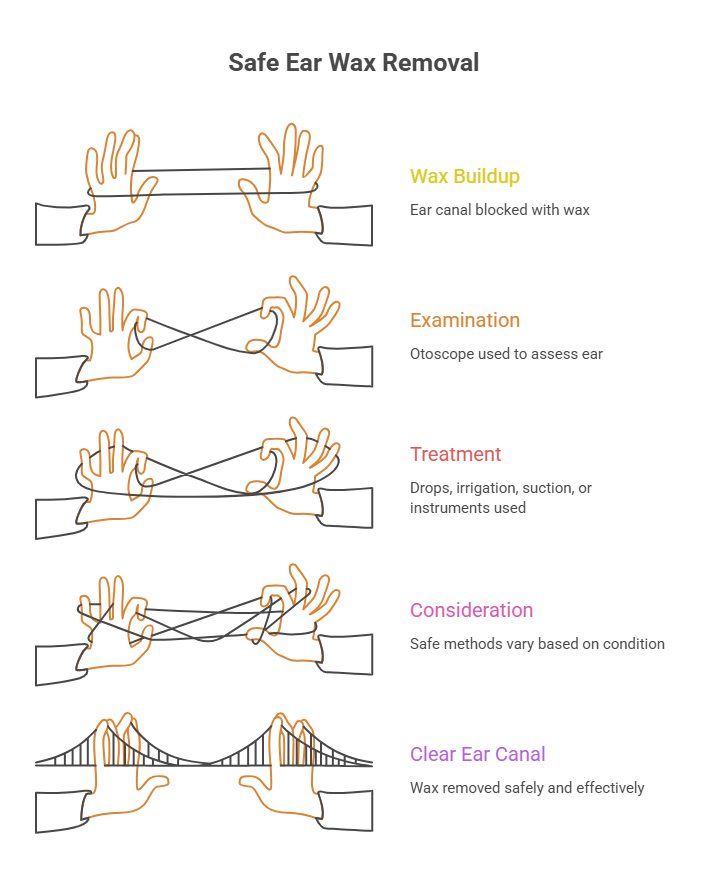
The first step to professional ear wax removal is the examination of the ear canal, typically done with an otoscope. The clinician should take the time to confirm the presence of wax and evaluate the ear canal and eardrum before determining the method to use.
Treatment with wax-softening drops, irrigation (when appropriate), suction, and gentle removal with suitable instruments are indicated, as appropriate, depending on the individual and condition of the ear.
Safe methods may vary if there has been previous ear surgery, any eardrum perforation, active infection, or significant pain or ear discharge. That’s why home treatment should not be undertaken without careful consideration.
Is It Safe to Remove Earwax at Home?
The usual limit of cleaning is the outside of the ear. A soft cloth can be placed around the ear opening, but objects should not be pushed into the ear canal.
Cotton buds can be used to take off a few of the visible waxes and push the remainder deeper into the ear canal. The canal may also be irritated by repeated cleaning. Ear candles are not a recommended treatment as they have not been proven to be a safe and effective way to remove impacted earwax and can be harmful.
Certain ear drops that soften the earwax might be appropriate, but consult with a healthcare professional before using them if you experience ear pain, ear discharge, previous ear surgery, potential ear perforation, or frequent ear problems.
When Should You Seek Professional Ear Wax Removal?
If earwax is suspected and a feeling of blockage, muffled hearing, or other symptoms are not relieved, consider professional ear wax removal.
If the primary issue is hearing problems, an audiologist may be a helpful referral. They can evaluate your symptoms, check your hearing, and recommend whether you need medical or ENT evaluation.
If you have: Get immediate medical attention for:
- Sudden or sudden progressive loss of hearing
- Severe ear pain
- A discharge of pus, fluid, or blood from the ear.
- Moderate dizziness/vertigo
- Tinnitus that suddenly or unexpectedly becomes loud or bothersome.
- An injury to the ear or a foreign object becomes lodged in the ear.
- Ongoing hearing loss following the removal of the wax.
Sudden hearing loss should never be ignored as it is thought to be wax.
Can Ear Wax Removal Improve Hearing?
If sound is not getting through the ear canal due to impacted wax, then its passage may improve once the impacted wax is removed. There is some variation in the level of improvement.
But an earwax removal doesn’t address age-related, noise exposure, inner ear damage, or other medical causes of hearing loss.
If the discussion is still somewhat muffled, or if one ear still sounds very little compared to the other after the blockage has been cleared, it’s wise to then have a formal hearing test.
What If You Wear Hearing Aids?
Wax may accumulate around the hearing aid(s) and can interfere with the receiver, vent, or domes. Increased volume is not the answer if a device suddenly feels weak or distorted; rather, check both the ear and the hearing aid.
Regular hearing-aid maintenance and appropriate aftercare can help identify cleaning, fitting, and device-performance issues.
How Can You Reduce Repeated Earwax Buildup?
The majority of people don’t require frequent cleaning of their ears. Helpful habits include:
- Do not insert anything into the ear canal, such as cotton buds.
- Maintain clean hearing aids, earbuds, and earplugs.
- Avoid the use of ear candles.
- If you have a history of ear problems, ask before using the wax softening drops.
- If blockages are recurring, ask for your ears to be monitored.
The objective is to maintain ear health, rather than to remove all earwax completely.

Why Choose Resonnocare for Hearing and Audiology Care?
We approach hearing problems in a clinically directed fashion at Resonnocare. Our trained audiologists and clinicians will conduct a hearing test to identify the causes of your symptoms, and then suggest the next steps.
Your personalized care plan may include hearing tests, hearing-aid guidance, home visits, video consultation, aftercare, or referral for medical or ENT evaluation when appropriate. Our clinical approach to hearing care focuses on assessment first and clear explanation of findings.
This is especially significant if the patient thinks that wax is the cause of their hearing problem. The testing result can either identify a blockage or indicate that additional hearing and medical evaluation is required.
Find a Resonnocare Clinic Near You
Select your city to find the nearest Resonnocare clinic and book an appointment with our hearing care team.
Bangalore
Ear 360, Jayanagar
Ground Floor, Site No. 499, Municipal No. 499/97, East End Main Road, 9th Block, Jayanagar, Bangalore, Karnataka 560041
Timings: 10:00 AM to 7:00 PM
[Call] [Book an Appointment]
Ear 360, Spandana Sarjapura Hospital
239/205/34A, near Trinity Complex, Sompura Gate, Sarjapura Main Road, Bangalore, Karnataka 562125
Timings: 10:00 AM to 7:00 PM
[Call] [Book an Appointment]
Resonnocare, HSR Layout
150/5/72, 7th Cross, 24th Main, HSR Layout, Bangalore, Karnataka 560102
Timings: 10:00 AM to 7:00 PM
[Call] [Book an Appointment]
Resonnocare, Banashankari
272, 7th Cross Road, BSK 1st Stage, 2nd Block, Srinivasan Agra, 80 Feet Road, Bangalore, Karnataka 560050
Timings: 10:00 AM to 7:00 PM
[Call] [Book an Appointment]
Resonnocare, Indiranagar
34, Wind Tunnel Road, Murugeshpalya, Muniyappa Layout, Bangalore, Karnataka 560017
Timings: 10:00 AM to 7:00 PM
[Call] [Book an Appointment]
Resonnocare, JC’s ENT Center, Nagarbhavi
57, 3rd Main Road, 2nd Block, Govindaraja Nagar Ward, Kalyan Nagar, Nagarbhavi, Bengaluru, Karnataka 560072
Timings: 10:00 AM to 7:00 PM
[Call] [Book an Appointment]
Resonnocare, Dr Bhattacharyya ENT Clinic
No. 14, 17th Cross Road, Sector 7, HSR Layout, Bangalore, Karnataka 560102
Timings: 10:00 AM to 7:00 PM
[Call] [Book an Appointment]
Delhi
Ear 360, Dr Hans Anand Lok
46, Anand Lok Road, Anand Lok, Sadiq Nagar, New Delhi, Delhi 110049
Timings: 10:00 AM to 7:00 PM
[Call] [Book an Appointment]
Resonnocare, Dr Hans Vasant Vihar
28, Basement, Paschimi Marg, Vasant Vihar, New Delhi, Delhi 110057
Timings: 10:00 AM to 7:00 PM
[Call] [Book an Appointment]
Resonnocare, Clarity ENT Clinic
Clarity, 2-10, Hauz Khas, New Delhi, Delhi 110016
Timings: 10:00 AM to 7:00 PM
[Call] [Book an Appointment]
Resonnocare, Dr Hans Center for ENT, Punjabi Bagh
2/5, West Avenue Road, West Punjabi Bagh, Punjabi Bagh, New Delhi, Delhi 110026
Timings: 10:00 AM to 7:00 PM
[Call] [Book an Appointment]
Gurgaon
Resonnocare Head Office, M3M Urbana
Office 403, Office Block, 4th Floor, above Retail Blocks R1 and R5, M3M Urbana, Sector 67, Gurgaon, Haryana 122101
Timings: 10:00 AM to 7:00 PM
[Call] [Book an Appointment]
Resonnocare, Dr Hans Sector 28 DLF Ph-1
Metro Station, Plot No. 1SP, adjoining DLF Phase 1, Sector 28, Gurgaon, Haryana 122002
Timings: 10:00 AM to 7:00 PM
[Call] [Book an Appointment]
Ludhiana
Ear 360, BRS Nagar
963, Block B, BRS Nagar, Ludhiana, Punjab 141012
Timings: 10:00 AM to 7:00 PM
[Call] [Book an Appointment]
Resonnocare, Fawwara Chowk
565-A and 565-B, Upper Ground Floor, Cemetery Road, near Fawwara Chowk, West City, Ludhiana, Punjab 141001
Timings: 10:00 AM to 7:00 PM
[Call] [Book an Appointment]
Pune
Ear 360, Vighnaharta Healthcare Center
D-106-107, Choice Arcade, opposite Ruby Hall Hospital, Dhole Patil Road, Pune, Maharashtra 411001
Timings: 10:00 AM to 7:00 PM
[Call] [Book an Appointment]
Ear 360, Khan Parab ENT Hospital
Plot No. 102, Anand Nagar, Talegaon Dabhade, Taluka Maval, Pune, Maharashtra 410507
Timings: 10:00 AM to 7:00 PM
[Call] [Book an Appointment]
Tumkur
Resonnocare, Ashok Nagar
PID No. 3563, 8th Main, 8th Cross, Ashok Nagar, Tumkur, Karnataka 572103
Timings: 10:00 AM to 7:00 PM
[Call] [Book an Appointment]
Resonnocare, Ganadhal ENT and Dental Hospital
3rd Cross, Somashekara Puram, Coffee Board Colony, Tumkur, Karnataka 572102
Timings: 10:00 AM to 7:00 PM
[Call] [Book an Appointment]
Mangalore
Ear 360, Bunts Hostel Circle
Shop No. 6 and 7, Basement Floor, Javed Plaza, Bunts Hostel Circle, Mangalore, Karnataka 575003
Timings: 10:00 AM to 7:00 PM
[Call] [Book an Appointment]
Resonnocare, Dr G K Hebbar ENT Clinic
M-2-153/6, K.S.R.M. Building, Lighthouse Hill Road, Mangaluru, Karnataka 575001
Timings: 10:00 AM to 7:00 PM
[Call] [Book an Appointment]
Resonnocare, Dr Navisha ENT Centre
3rd Floor, Falnir Health Center, Falnir Road, Falnir, Mangaluru, Karnataka 575002
Timings: 10:00 AM to 7:00 PM
[Call] [Book an Appointment]
Mysore
Ear 360, Ramaswamy Circle
371/A, Ramaswamy Circle, Mysore, Karnataka 570024
Timings: 10:00 AM to 7:00 PM
[Call] [Book an Appointment]
Hubli
Ear 360, Vidya Nagar
Srishti Elite, Shirur Park Road, Shirur Park, Vidya Nagar, Hubballi, Karnataka 580031
Timings: 10:00 AM to 7:00 PM
[Call] [Book an Appointment]
Davangere
Ear 360, P J Extension
Shop First Floor, 2nd Main, P J Extension, Davangere, Karnataka 577002
Timings: 10:00 AM to 7:00 PM
[Call] [Book an Appointment]
Indore
Resonnocare, Dr Navnit Jain ENT Hospital
Dr Navnit Jain ENT Hospital, C/o Unique Hospital, 335, Jawahar Marg, Opp. Nafees Bakery, Indore, Madhya Pradesh 452007
Timings: 10:00 AM to 7:00 PM
[Call] [Book an Appointment]
Resonnocare, Hearing Solutions Dr Agarwal
7, Gulmarg Complex, First Floor, near Sapna Sangeeta Lumiere, Indore, Madhya Pradesh 452001
Timings: 10:00 AM to 7:00 PM
[Call] [Book an Appointment]
Conclusion
Earwax, or cerumen, is a healthy ear substance, but when excessive, it may lead to a blockage, discomfort, tinnitus, or decreased hearing. If symptoms continue, earwax removal is safe. Still, first, it is important to determine that it is actually earwax causing the symptoms, and not doing so with cotton buds or home instruments.
If you experience persistent muffled hearing, a blocked ear feeling, or difficulty understanding speech, make an appointment to assess or consult with Resonnocare. Our staff will be able to assess your symptoms, provide information on whether additional testing is necessary, and help direct you towards the proper audiology or medical services. Book an Appointment.
FAQ’s
How can I remove my own earwax?
Earwax can be safely removed at home by softening it with ear drops, mineral oil, baby oil, or saline solution. Wax can be excreted after several days. Do not use cotton swabs, hairpins, or anything else, because it can drive the wax further into the ear and damage it.
Will an ENT remove ear wax?
Yes, earwax can be safely removed by an ENT doctor who is trained in these techniques. Dizziness, ear wax blockage, and pain are all signs that ear wax is interfering with your hearing and, in most cases, professional removal may be the safest and most effective solution.
How can I get rid of ear wax quickly?
Professional ear wax cleaning by an ENT specialist is often the fastest way to get rid of impacted ear wax. Many ear wax softening drops are available that can be purchased at the drugstore and can help soften the wax in a few days at home. Do not try to remove deep wax on your own, as you could make the blockage worse.
How can I remove ear wax?
Ear wax can be removed by softening it with ear drops, oil, or saline solution and draining it out naturally. If the symptoms last longer, or if the wax is significantly affected, medical treatment is required. Individuals who experience pain or loss of hearing in the ear or have had ear issues in the past need ear removal performed by a professional.
Can ear wax go away?
Yes, earwax will flow out of the ear canal naturally by moving your jaw through chewing and talking. People rarely need to clean their ears often. At times, however, there can be an excess of wax that can lead to symptoms, including hearing difficulty or discomfort, and these can be treated.