
TL; DR:
This blog is written for senior citizens, their family members, and caregivers who are noticing gradual hearing difficulty, repeated requests to increase volume, or trouble following conversations.
- Age-related hearing loss, also called presbycusis, usually develops slowly and affects both ears, which is why many people ignore it in the early stage.
- Common signs include difficulty hearing speech in groups, asking people to repeat themselves, increasing the volume on the phone or TV, feeling that others are mumbling, and sometimes ringing or buzzing in the ears.
- Diagnosis requires a proper hearing assessment by an audiologist, including otoscopy, pure-tone audiometry, speech audiometry, and tympanometry to understand the type and severity of hearing loss.
- Although age-related inner ear damage cannot be reversed, hearing aids, communication guidance, auditory rehabilitation, home visits, online consultations, and regular aftercare can significantly improve daily communication and quality of life.
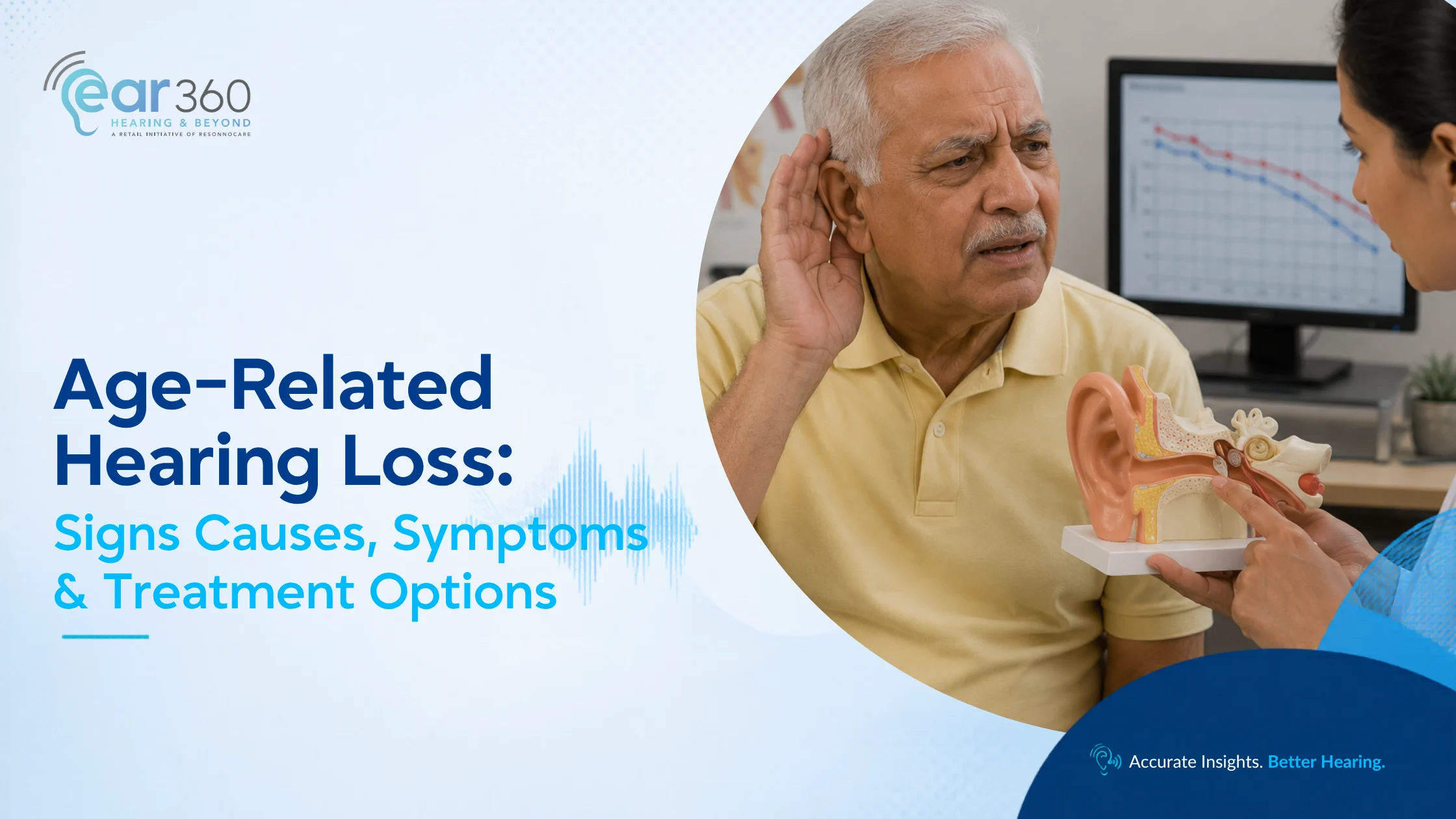
Presbycusis can begin gradually. The parent may request the television to be turned up. Grandparents are not required to attend group conversations. A senior might be able to hear a person talking, but it may be difficult to hear what the person is saying. These minor adjustments can begin to affect confidence, family communication, and comfort over time.
Medical professionals refer to this as “presbycusis” (age-related hearing loss). It typically develops slowly over time as the person ages and is often bilateral (both sides). This change is gradual, and many seniors and families think that it is a normal part of aging and put off seeking help.
What is important to know is that age-related hearing loss can be evaluated and managed. Many seniors can communicate more effectively and remain more connected with family and those around them with a proper hearing test, guidance from an audiologist, and appropriate hearing support, if necessary.
Our audiology team at Resonnocare provides regular services to older adults with hearing concerns, including advice on hearing aids, follow-up services, and family counseling. This guide discusses the causes of age-related hearing loss, how it can be diagnosed, and what can realistically be done to improve hearing and quality of life.
What Is Age-Related Hearing Loss?
Age-related hearing loss is the natural decline in hearing that occurs over time. It usually affects both ears and evolves gradually over many years, which is why it can go unnoticed or ignored in its early stages.
Age-related hearing loss typically affects high-frequency sounds first. As a result, speech may become difficult to understand, especially when background noise is present, or the speaker has a higher-pitched voice, or if the speaker’s voice is distorted by background noise. Low-pitched sounds, such as a truck on the street, can still be heard quite well, and this can give a false sense of good hearing.
Presbycusis is a form of sensorineural hearing loss caused by age-related damage to the sensory hair cells of the inner ear, which gradually lose their ability to convert sound into electrical signals. Sensorineural hearing loss (damage) is not reversible, whereas conductive hearing loss is hearing loss due to blockage or mechanical issues in the outer or middle ear. However, with proper management, its impact on communication and quality of life can often be significantly reduced.
What Does Age-Related Hearing Loss Usually Look Like on an Audiogram?
Age-related hearing loss commonly shows a gradual reduction in hearing sensitivity at the higher frequencies. On an audiogram, this may appear as a downward-sloping pattern, with better hearing at lower frequencies and greater hearing loss at higher frequencies.
This pattern helps explain why an older adult may still hear that someone is speaking but miss parts of the words. High-frequency speech sounds contribute important clarity, including sounds such as “s,” “f,” “th,” “sh,” and other consonants.
However, an audiogram pattern alone should not be used to diagnose age-related hearing loss. The audiologist also considers:
- Whether both ears show a similar pattern
- The degree of hearing loss at each frequency
- Speech-understanding results
- Middle-ear function
- Ear examination findings
- Medical and noise-exposure history
- Whether hearing changed gradually or suddenly
- Whether one ear is significantly different from the other
A hearing pattern that is strongly one-sided, suddenly changed, or inconsistent with typical age-related loss may require further medical evaluation.
What Causes Age-Related Hearing Loss?
Age-related hearing loss results from gradual changes in the structures of the inner ear over a person’s lifetime. If the hair cells in the cochlea that enable hearing are damaged, they cannot be repaired. As usual, these cells tend to decrease in number and activity as we grow older.
But it is not usually the only factor involved in aging. There are a number of conditions and exposures that can accelerate or worsen hearing loss in older adults.
The inner ear deteriorates much faster when an individual is exposed to loud noise over a long period, such as years spent working in a factory or on a construction site, or listening to loud music at concerts or through headphones. The cochlea depends on a healthy blood supply. Cardiovascular disease and poor circulation may reduce blood flow and impair its function. Damage to blood vessels and nerves throughout the body is another risk of diabetes and can result in hearing loss.
Certain medications can be ototoxic (toxic to hearing), and are administered over long periods of time, such as some diuretics, chemotherapy, or aspirin in high doses. Other factors are smoking, hypertension, and hearing loss in family members.
Knowing about them is important because, if you manage underlying health problems, you could slow the progression of age-related hearing loss, though it cannot be reversed.
What Are the Early Signs of Age-Related Hearing Loss?
Age-related hearing loss usually develops gradually, which is why many people do not notice it right away. In fact, family members often spot the signs before the individual does. What may seem like a minor hearing difficulty can slowly start affecting conversations, social interactions, and overall quality of life.
Some common early signs of age-related hearing loss include:
- Frequently asking people to repeat themselves
- Finding it difficult to follow conversations in groups
- Feeling that others are mumbling or not speaking clearly
- Turning up the TV, radio, or mobile phone volume more than before
- Struggling to hear conversations on the phone
- Missing parts of conversations, especially in noisy environments
- Finding restaurants, weddings, or family gatherings is more tiring because of the effort required to listen
- Responding incorrectly because certain words or phrases were not heard clearly
- Avoiding social situations due to difficulty hearing conversations
- Experiencing ringing, buzzing, hissing, or whistling sounds in the ears (tinnitus)
Many people with age-related hearing loss say, “I can hear people talking, but I can’t always understand what they are saying.” This happens because hearing loss often affects speech clarity before it affects overall loudness.
If any of these signs are familiar to you or someone in your family, a formal hearing assessment is the right next step. You can also review related ear symptoms and conditions to understand what else may be contributing to the changes you are noticing.
Real-Life Hearing Difficulties May Matter as Much as Volume
Age-related hearing loss is not always experienced as “everything sounds quiet.” Many older adults can hear environmental sounds reasonably well but have difficulty separating speech from background noise or distinguishing similar words.
Common real-life situations include:
Situation | What the person may experience |
One-to-one conversation in a quiet room | Speech may still be reasonably understandable, especially when the speaker is nearby and visible. |
Family gathering | Following several speakers may become difficult, particularly when people talk at the same time. |
Restaurant or wedding | Background conversation and room noise may make speech significantly harder to understand. |
Phone calls | Missing consonants or parts of words may make familiar voices sound unclear. |
Television | The person may increase volume but still miss dialogue. |
Higher-pitched voices | Women’s and children’s voices may seem less clear because high-frequency information is commonly affected. |
Conversation from another room | Words may be detected but not understood accurately without visual cues. |
These situations are useful to discuss during the hearing assessment because they help the audiologist understand the functional effect of the hearing loss, not only the hearing thresholds shown on the audiogram.
How Is Age-Related Hearing Loss Diagnosed?
Diagnosing age-related hearing loss requires a structured clinical assessment rather than self-evaluation alone. Our audiologists perform a comprehensive hearing evaluation with a few components at Resonnocare.
To rule out any conductive causes of hearing difficulty, the ear canal and eardrum are examined (otoscopy) to exclude earwax build-up or infection. Pure-tone audiometry then assesses the extent of your hearing at various frequencies, resulting in an audiogram. In most cases of age-related hearing loss, the hearing test will reveal a downward slope at the higher frequencies, and the audiogram often shows greater hearing loss at higher frequencies, which can make speech understanding more difficult.
Speech audiometry is used to help assess the patient’s hearing and repetition abilities to determine functional communication. Tympanometry is a test of the middle ear function. These tests together help our audiologists determine the nature and severity of the hearing loss, rule out other factors, and create a care plan tailored to your profile.
Resonnocare’s hearing care services for all ages include comprehensive assessments tailored to older adults’ needs, with care taken to ensure the process is comfortable, unhurried, and clearly explained at every stage.
Diagnostic Pathway for Suspected Age-Related Hearing Loss
A structured diagnostic pathway helps distinguish age-related sensorineural hearing loss from ear conditions that may require different management.
Step 1: Review the Hearing Difficulty
The audiologist asks when the hearing problem began, whether it developed gradually, which situations are difficult, whether one or both ears are affected, and whether tinnitus, dizziness, pain, discharge, or blockage is present.
Step 2: Examine the Ear
Otoscopy helps identify visible earwax, infection, discharge, or other outer-ear concerns that may affect hearing.
Step 3: Measure Hearing Thresholds
Pure-tone audiometry measures the softest sounds that can be heard at different frequencies and helps identify the degree and pattern of hearing loss.
Step 4: Assess Speech Understanding
Speech testing provides information about how well words can be recognized, which may influence expected hearing-aid benefit and communication planning.
Step 5: Review Middle-Ear Function
Tympanometry may be used to help identify middle-ear conditions that could contribute to hearing difficulty.
Step 6: Identify Medical Warning Signs
Sudden changes, significant differences between the ears, ear pain, discharge, neurological symptoms, or other concerning findings may require ENT or medical evaluation.
Step 7: Discuss the Appropriate Next Step
Depending on the findings, the recommendation may include monitoring, medical referral, communication strategies, hearing aids, assistive technology, rehabilitation, or a combination of approaches.
Why Speech Understanding Is Important in Age-Related Hearing Loss
The audiogram shows how softly a person can hear tones, but it does not fully describe how clearly they understand speech. Two older adults with similar hearing thresholds can have different speech-understanding abilities and therefore different experiences with hearing aids.
Speech testing can help the audiologist discuss:
- How clearly words are recognized under test conditions
- Whether speech becomes clearer when it is made louder
- How realistic hearing-aid expectations should be
- Whether additional communication strategies may be needed
- Whether unusually poor speech understanding requires further evaluation
A hearing aid can improve access to speech sounds, but it cannot guarantee perfect speech understanding if the auditory system has difficulty interpreting the information it receives.
What Are the Treatment Options for Age-Related Hearing Loss?
Unfortunately, the inner ear damage associated with age-related hearing loss can’t be fixed, but it can be controlled, and in many cases, there can be a significant improvement in the ability to communicate in day-to-day life.
Hearing aids are the most widely used and evidence-based treatment for age-related hearing loss. Contrary to what many believe, today’s hearing aids are anything but simple. They eliminate background noise and selectively amplify speech frequencies, making communication much easier in challenging environments. Many are small and compact, with wireless features that connect to phones, TVs, and more.
Hearing aids are best fit and programmed by a trained audiologist, not purchased off the counter, to receive the best benefits from wearing them. A hearing aid programmed to your individual audiogram is usually more effective than one using generic settings.
Resonnocare offers a wide range of hearing aids from leading manufacturers and provides a free hearing aid trial so you can experience how a device performs in your real daily environment before making any decision. This trial is particularly valuable for first-time users who are unsure whether amplification is right for them.
In addition to hearing aids, communication strategies and auditory rehabilitation can help older adults and their families adapt more effectively. These may include guidance on positioning during conversations, optimizing listening environments at home, and techniques to reduce listening fatigue.
Medical Treatment vs Hearing Amplification
The correct treatment depends on what is causing the hearing difficulty. Age-related sensorineural hearing loss itself usually cannot be reversed with medication or surgery because the underlying change involves the inner ear. Hearing aids and rehabilitation are therefore commonly used to improve access to sound and communication when amplification is appropriate.
However, not every hearing problem in an older adult should automatically be labelled age-related hearing loss.
Finding | Possible next step |
Earwax blocking the canal | Earwax management may be needed before deciding whether hearing aids are necessary. |
Middle-ear infection or fluid | Medical or ENT treatment may be required. |
Sudden hearing loss | Urgent medical assessment is required rather than routine hearing-aid selection. |
Gradual bilateral sensorineural loss | Hearing aids and communication rehabilitation may be considered depending on severity and daily impact. |
Significant difference between ears | Further medical evaluation may be needed to understand the reason for the asymmetry. |
Limited benefit from appropriately fitted hearing aids | Further audiological or specialist assessment may be appropriate depending on the degree and type of hearing loss. |
The hearing assessment helps determine whether the next step is medical treatment, amplification, monitoring, rehabilitation, or a combination of these.
Does Age-Related Hearing Loss Always Need Hearing Aids?
Not necessarily. The decision to use hearing aids depends on the degree of hearing loss, speech-understanding ability, communication difficulties, listening environments, personal preference, and how much the hearing change is affecting daily life.
For a person with mild hearing changes and limited communication difficulty, the immediate plan may include monitoring, communication strategies, hearing protection, and scheduled reassessment.
Hearing aids may become more appropriate when the person:
- Frequently misses parts of conversations
- Struggles in family or social situations
- Needs the television or phone significantly louder
- Finds listening increasingly tiring
- Withdraws from activities because hearing is difficult
- Has hearing-test results showing amplification is likely to provide useful access to sound
The audiologist should explain both the clinical findings and the expected practical benefit before the patient decides whether to proceed with amplification.
Will Hearing Aids Restore Normal Hearing?
No. Hearing aids do not reverse inner-ear damage or return hearing to exactly what it was before age-related hearing loss developed. Their role is to make important sounds more accessible and support communication by providing amplification appropriate to the hearing profile.
A well-fitted hearing aid may help with:
- Access to softer speech sounds
- Understanding conversations more comfortably
- Reducing the need for repeated requests
- Telephone or television listening
- Participation in family and social situations
- Reducing some of the listening effort required during daily communication
Results vary between people. Speech-understanding ability, duration of hearing loss, listening environment, hearing-aid fitting, consistent use, and follow-up adjustments all influence the experience.
Should Both Ears Be Treated When Age-Related Hearing Loss Affects Both Sides?
Age-related hearing loss often affects both ears, but whether one or two hearing aids are recommended should be decided from the hearing assessment rather than assumed automatically.
When both ears have aidable hearing loss, two hearing aids may help selected patients by supporting access to sound from both sides and improving everyday listening when compared with leaving one aidable ear unaided.
The audiologist considers:
- The degree of hearing loss in each ear
- Speech-understanding ability in each ear
- Whether both ears are medically suitable for amplification
- Differences between the ears
- The patient’s daily communication needs
- Dexterity and ability to manage devices
- Previous hearing-aid experience
- Budget and personal preference
If one ear is substantially different from the other, the reason for the asymmetry may need to be evaluated before deciding on the most appropriate hearing solution.
Monitoring and Follow-Up for Age-Related Hearing Loss
Age-related hearing loss can change gradually, so hearing care should not end after the initial test or hearing-aid fitting. Monitoring helps identify whether hearing thresholds, speech understanding, communication needs, or device requirements have changed.
Follow-up may include:
- Repeat hearing assessments when clinically appropriate
- Reviewing new communication difficulties
- Checking hearing-aid comfort and physical fit
- Reprogramming hearing aids when hearing or listening needs change
- Reviewing battery, charging, cleaning, and maintenance
- Checking whether the devices are being worn consistently
- Discussing difficulties in restaurants, family conversations, telephone calls, or television listening
- Considering additional assistive devices or communication strategies
- Referral for medical evaluation if new warning signs develop
Seek earlier review rather than waiting for a routine follow-up if hearing changes suddenly, one ear becomes noticeably worse, new persistent tinnitus develops, or hearing changes are accompanied by pain, discharge, dizziness, or other concerning symptoms.

Why Choose Resonnocare for Hearing and Audiology Care
At Resonnocare, we understand that age-related hearing loss is not simply a physical condition. It affects relationships, confidence, independence, and quality of life. Our approach is built around clinical accuracy and personalized care that respects the individual behind the audiogram.
Our audiologists conduct thorough hearing assessments using calibrated diagnostic equipment, and every result is explained in plain language so you know exactly what has been found and what the options are. No recommendation is made without the evidence to support it.
Our clinical excellence framework ensures that the audiologists across all Resonnocare and EAR360 clinics maintain high professional standards and stay current with developments in hearing care for older adults.
For patients who find traveling to a clinic difficult, whether due to mobility concerns, distance, or other health conditions, we offer both home visit audiology services and online video consultations, bringing expert hearing care directly to you. Once a hearing aid or care plan is in place, our aftercare programme provides the ongoing support, adjustments, and follow-up that make a genuine difference to long-term outcomes.
Find a Resonnocare Clinic Near You
Select your city to find the nearest Resonnocare clinic and book an appointment with our hearing care team.
Bangalore
Ear 360, Jayanagar
Ground Floor, Site No. 499, Municipal No. 499/97, East End Main Road, 9th Block, Jayanagar, Bangalore, Karnataka 560041
Timings: 10:00 AM to 7:00 PM
[Call] [Book an Appointment]
Ear 360, Spandana Sarjapura Hospital
239/205/34A, near Trinity Complex, Sompura Gate, Sarjapura Main Road, Bangalore, Karnataka 562125
Timings: 10:00 AM to 7:00 PM
[Call] [Book an Appointment]
Resonnocare, HSR Layout
150/5/72, 7th Cross, 24th Main, HSR Layout, Bangalore, Karnataka 560102
Timings: 10:00 AM to 7:00 PM
[Call] [Book an Appointment]
Resonnocare, Banashankari
272, 7th Cross Road, BSK 1st Stage, 2nd Block, Srinivasan Agra, 80 Feet Road, Bangalore, Karnataka 560050
Timings: 10:00 AM to 7:00 PM
[Call] [Book an Appointment]
Resonnocare, Indiranagar
34, Wind Tunnel Road, Murugeshpalya, Muniyappa Layout, Bangalore, Karnataka 560017
Timings: 10:00 AM to 7:00 PM
[Call] [Book an Appointment]
Delhi
Ear 360, Dr. Hans Anand Lok
46, Anand Lok Road, Anand Lok, Sadiq Nagar, New Delhi, Delhi 110049
Timings: 10:00 AM to 7:00 PM
[Call] [Book an Appointment]
Resonnocare, Dr. Hans Vasant Vihar
28, Basement, Paschimi Nagar, Vasant Vihar, New Delhi, Delhi 110057
Timings: 10:00 AM to 7:00 PM
[Call] [Book an Appointment]
Gurgaon
Resonnocare Head Office, M3M Urbana
Office 403, Office Block, 4th Floor, above Retail Blocks R1 and R5, M3M Urbana, Sector 67, Gurgaon, Haryana 122101
Timings: 10:00 AM to 7:00 PM
[Call] [Book an Appointment]
Resonnocare, Dr. Hans Sector 28
Plot No. 1SP, adjoining DLF Phase 1 Metro Station, Sector 28, Gurgaon, Haryana 122002
Timings: 10:00 AM to 7:00 PM
[Call] [Book an Appointment]
Ludhiana
Ear 360, BRS Nagar
963, Block B, BRS Nagar, Ludhiana, Punjab 141012
Timings: 10:00 AM to 7:00 PM
[Call] [Book an Appointment]
Resonnocare, Fawwara Chowk
565-A and 565-B, Upper Ground Floor, Cemetery Road, near Fawwara Chowk, West City, Ludhiana, Punjab 141001
Pune
Ear 360, Vighnaharta Healthcare Center
D-106-107, Choice Arcade, opposite Ruby Hall Hospital, Dhole Patil Road, Pune, Maharashtra 411001
Timings: 10:00 AM to 7:00 PM
[Call] [Book an Appointment]
Ear 360, Khan Parab ENT Hospital
Plot No. 102, Anand Nagar, Talegaon Dabhade, Taluka Maval, Pune, Maharashtra 410507
Timings: 10:00 AM to 7:00 PM
[Call] [Book an Appointment]
Tumkur
Resonnocare, Ashok Nagar
PID No. 3563, 8th Main, 8th Cross, Ashok Nagar, Tumkur, Karnataka 572103
Timings: 10:00 AM to 7:00 PM
[Call] [Book an Appointment]
Conclusion
Among adults, the prevalence of age-related hearing loss is high, and in India, it is a large proportion of adults are aged over 60 years. However, most don’t receive a diagnosis or any kind of intervention, as they either assume there is nothing to be done, or that going to get help is an admission that they don’t want to make.
In the world of hearing loss, there is a lot of room to improve – especially when it comes to participating in conversations, family life, and the world – with clinically guided treatment. Waiting is a waste of time, as it allows the condition to progress and the time of unnecessary suffering to increase.
Don’t wait to get hearing tests if you or your loved one is experiencing hearing loss. Make an appointment for a full hearing screening at your local EAR360 clinic or with a Resonnocare audiologist via our home visit or video consultation services. Help is just around the corner.
FAQ’s
What is the most common cause of age-related hearing loss?
The most common form of age-related hearing loss is presbycusis, which takes place when the tiny hairs in the inner ear age and become damaged. They are part of the normal aging process and transmit sound signals to the brain. Other causes of age-related hearing loss include long-term exposure to noise, genetics, and certain health conditions.
Is there a cure for age-related hearing loss?
At this time, there is no remedy for age-related hearing loss. However, there can be significant differences in how communication functions and in the quality of life when people use a hearing aid, an assistive listening device, and hearing rehabilitation. It is important that the condition is diagnosed early because today’s hearing solutions can help people hear better in conversations and participate in everyday activities.
What are the 4 types of presbycusis?
Presbycusis comes in four forms: sensory, neural, metabolic (strial), and mechanical (cochlear conductive). Each type damages different parts of the ear and can affect hearing in various ways. Most older people have a mix of these types, resulting in a gradual onset of hearing difficulties, especially in noisy settings, and difficulty hearing others’ speech.
How much hearing loss is normal with age?
As people age, there may be some loss of hearing, particularly at the higher frequencies. After age 60, many adults start to experience some hearing loss. The amount of loss may vary from person to person, depending on the individual’s genes, exposure to noise, and overall health. Frequent hearing tests can be used to monitor changes associated with aging.
At what age does your hearing start to deteriorate?
People usually start to notice hearing loss at 40 or 50, but some do not notice symptoms until later. Often, the first symptom of hearing loss goes unrecognized because it develops gradually and is associated with aging. The initial symptom of hearing loss may be difficulty hearing high-pitched sounds or hearing speech in noisy environments.