
TL; DR:
The blog is aimed at people considering hearing aids for the first time, existing hearing-aid users exploring a different style, older adults and caregivers, and anyone comparing BTE, RIC, and ITE hearing aids before making a purchase decision.
- BTE, RIC, and ITE serve different needs: The blog explains how these hearing-aid styles differ in terms of placement, visibility, handling, amplification, custom fitting, rechargeable options, and maintenance, helping readers understand the practical differences.
- Hearing loss level alone should not determine the device: Choosing the right hearing aid should be based on the audiogram, speech understanding, affected frequencies, ear anatomy, previous ear problems, and everyday communication difficulties, rather than simply selecting a device based on its size or marketing claims.
- Lifestyle, comfort, and ease of handling matter: The blog highlights that factors such as dexterity, vision, wearing glasses, workplace/social environments, Bluetooth needs, rechargeable batteries, and ease of insertion and cleaning can significantly influence which hearing aid is most suitable.
- Professional assessment and a hearing-aid trial are important before choosing: Rather than assuming one style is universally best, the blog recommends a hearing assessment, professional fitting, trial, programming, and follow-up adjustments to identify the device that works best for the person’s hearing and daily life.
With multiple hearing aid options available, selecting a hearing aid can be tricky when many of them provide similar options. You might have questioned whether a tiny device in the ear is more effective, whether a device behind the ear will be more effective, or even if a rechargeable device will be easier to handle.
Various hearing aids are made to suit various levels of hearing, ear shape, lifestyle, and dexterity. At Resonnocare, we suggest that, instead of buying a device because it is smaller or has more features, you should first take your hearing assessment.
Let’s take a closer look at the difference between BTE, RIC, and ITE hearing aids and what you should take into account before deciding.
What Types of Hearing Aids Are Available?
The microphone is used to capture sounds, the digital processor is used to manipulate that sound based on how well you hear it, and the receiver/speaker receives the sound and transmits it to your ear.
There are several different types of hearing aids:
- Behind-the-Ear (BTE)
- Receiver-in-Canal (RIC) or Receiver in the Ear (RIE)
- In-the-Ear (ITE)
- In-the-Canal (ITC)
- Completely-in-Canal (CIC)
- Invisible-in-Canal (IIC)
BTE, RIC, and ITE are the most frequently compared types of hearing aids for many patients who are considering a hearing aid for the first time. There are pros and cons to each, but there’s no one perfect design for all.
You can explore Resonnocare’s range of hearing aid options to understand how devices are selected according to hearing needs.
Know More About
- Mild Hearing Loss: Symptoms, Test Results & Do You Need Hearing Aids?
- Hearing Aid Trial: What to Expect Before Buying Hearing Aids
- Hearing Aids Near Me: How to Choose the Right Hearing Aid Center
How Do the Main Types of Hearing Aids Differ?

It’s easier to compare the devices when you know their location, and they’re all playing sound.
BTE Hearing Aids
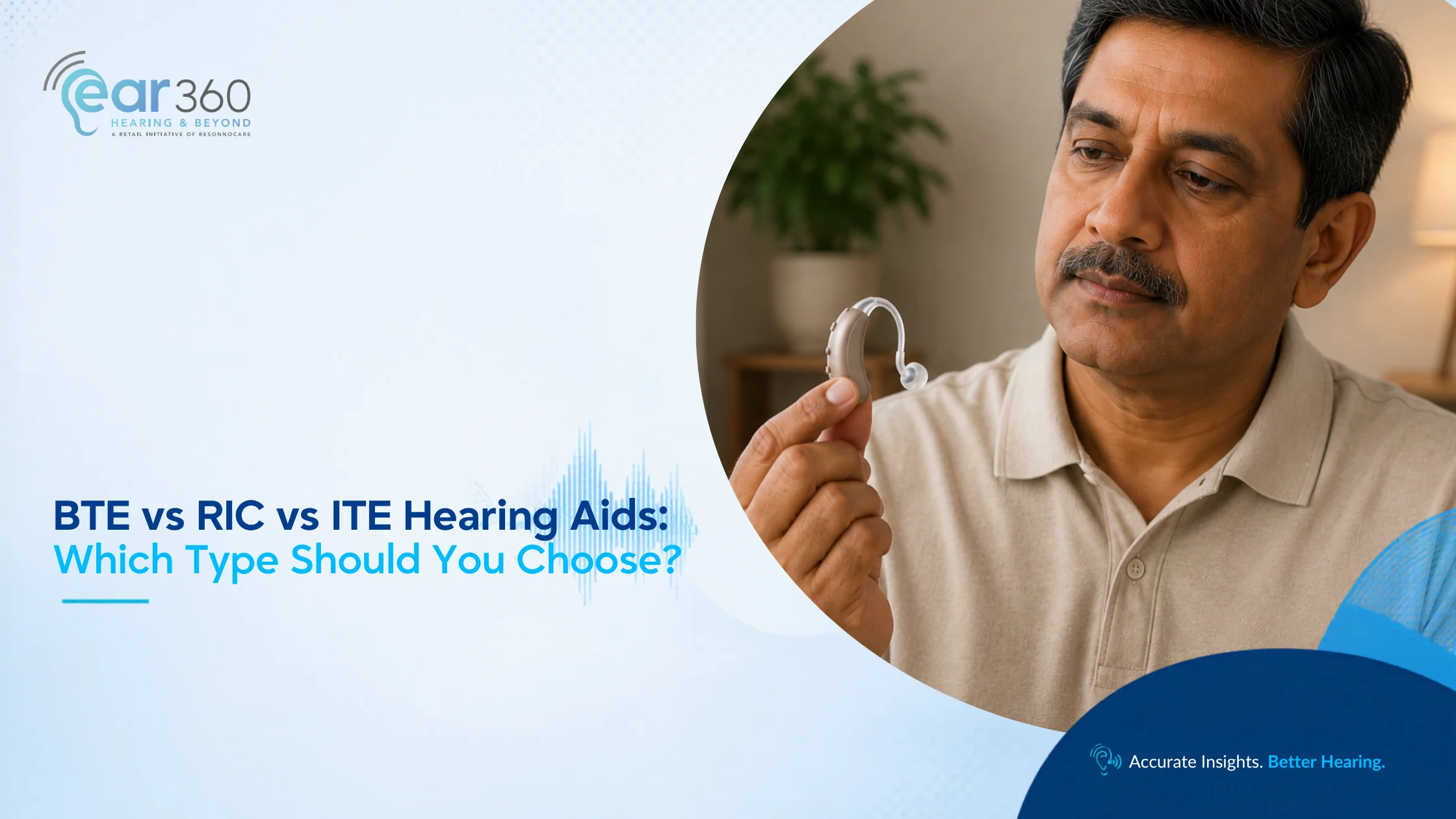
A behind-the-ear hearing aid is an aid with a case behind the ear. The sound runs through a tube or wire to an earmold or earpiece in the ear.
Depending on the model, BTE devices can offer a variety of amplification and can be used in varying degrees of hearing loss, from mild to more severe.
BTE may be helpful to you if you:
- Need greater amplification
- Opt for bigger buttons that are simple to operate
- Want a long-lasting device
- Find it hard to manage very small hearing aids
- Need an earmould for a secure fit
Due to the part of the device that lies behind the ear, some patients have a primary concern about visibility. Today’s BTE models, however, are much smaller and more inconspicuous than their predecessors.
RIC Hearing Aids
Receiver-in-Canal hearing aids also have a small, behind-the-ear piece, but the receiver is located in the ear canal and attached with a thin wire.
The main reason for the wide use of RIC devices is that they are light, easy to wear, and flexible. They can be appropriate for individuals who have mild to severe hearing loss, although this will depend on the individual hearing loss pattern and the characteristics of the device.
If you prefer, you may choose RIC if you want:
- An average amount of intruding design
- A sense of ‘lightness’ up the back of the ear
- Rechargeable options
- Smartphone or Bluetooth option
- Flexibility in the case of changing hearing requirements
The receiver is placed in the ear canal so it can be affected by wax and/or moisture and requires routine cleaning and maintenance.
ITE Hearing Aids
In-the-Ear hearing aids are custom-made to fit in the outer part of your ear. Unlike BTE or RIC devices, there isn’t a separate piece behind the ear.
They can also be easier to insert, remove, and operate in and out of the ear because they are larger in size than very small CIC or IIC devices.
ITE devices could be suitable for patients who:
- Love things within the ear
- Give the tools for more user-friendly controls
- Wear glasses and prefer nothing behind the ear
- Wear a hearing aid, depending on the level of hearing loss (mild to severe)
- Need a custom-fitted device
Comfort and fit should be assessed and fitted appropriately in the clinical setting since the shell is formed to fit the shape of the ear.
Which Types of Hearing Aids May Suit Your Hearing Loss?
One of the most significant elements in the selection of a hearing aid is your audiogram.
For those who have mild hearing loss, there are a few discreet options available. If someone has greater hearing loss, they might require a device that provides more amplification but still has acceptable sound quality and comfort.
This does not imply that BTE automatically goes to severe hearing loss and RIC automatically goes to mild hearing loss. There is a lot of overlap among modern devices in what they can handle.
Your audiologist will take the following into account:
- How severely a person is hearing impaired.
- Which frequencies are impacted
- Speech understanding
- Whether the ear(s) require an amplification device (hearing aid, bone conduction, etc.)
- Ear anatomy
- Previous ear problems
- Everyday communication difficulties
This is why it is important not to buy based on the advertisement or online specification alone.
BTE vs RIC vs ITE: A Simple Comparison
Feature | BTE | RIC | ITE |
Position | Behind ear | Behind-the-ear small case with receiver in canal | Inside the outer ear |
Visibility | Moderate to discreet | Usually discreet | Visible within ear |
Handling | Generally easy | Moderate | Generally easy |
Power options | Wide range | Wide range | Depends on model |
Custom fitting | Earmould may be custom. | Earpiece may vary. | Custom shell |
Rechargeable options | Available | Commonly available | Selected Models Available |
Good for glasses | Usually compatible | Usually compatible | Nothing behind the ear |
Maintenance | Tube/earmold care | Putting wax on receivers is a good idea. | Cleaning of the shell and microphone is required. |
These differences can help you limit your choices but should not be used for eliminating choices.
Which Types of Hearing Aids Are Easiest for Older Adults?
Handling should be given the same attention as sound quality for an elderly parent or a person with limited finger dexterity or arthritis or vision problems.
Small devices can be nice to look at but may be hard to insert, remove, clean, or charge. Sometimes a slightly bigger BTE or ITE device will be easier to use on their own.
Some individuals may have trouble changing small disposable batteries, so a rechargeable hearing aid can be useful for them, too.
For older adults, our team also considers communication needs, hearing levels, cognitive comfort, family support, and how easily the device can be used every day. Resonnocare’s hearing care for all ages is designed around these individual differences.
Should You Choose the Smallest Hearing Aid?
Not necessarily.
Patients may come to the clinic requesting the smallest device possible as they are concerned about its appearance. Discretion is an entirely permissible choice, but size should be considered in relation to hearing needs, comfort, and ease of use.
Some controls or features may be smaller in smaller devices. They can also be more difficult to handle if you are not very dexterous.
It’s more useful to have a slightly more visible hearing aid that you can wear all day long than a small hearing aid that you can’t handle.
So the best kind of hearing aid for you will be the one that you can hear with, use, and manage effectively.
What Features Should You Compare Along With Hearing Aid Style?
It is important to emphasize that the physical design is not the only factor to consider when deciding.
Today’s digital hearing aids can provide for you:
- Rechargeable batteries
- Bluetooth connectivity
- Smartphone control
- Directional microphones
- Background-noise management
- Automatic listening programs
- Feedback management
- Remote programming
- Television/phone streaming
Just because more technology is available doesn’t necessarily mean a device is better for you. A person who primarily has quiet discussions at home might have other needs than a professional who is constantly in meetings, traveling for business, and attending social functions.
The features that you value more are dependent on your lifestyle.
Can You Try Different Hearing Aid Types Before Choosing?
A trial of a hearing aid will be helpful for understanding more than reading the specs.
In the course of a trial, focus on:
- Speech clarity
- Ease after a few hours.
- Speaking in noise. Background noise conversation.
- Your own voice
- The ease of insertion and removal of the device.
- Spending too much time on the phone and TV.
- Charging or battery handling
- How comfortable you are wearing it
Resonnocare offers a free hearing aid trial for eligible patients and suitable devices, helping you assess the experience before making a final choice.
Remember that a hearing aid may require programming adjustments during the adaptation period. A first impression is useful, but appropriate fitting and fine-tuning also matter.
How Are Different Types of Hearing Aids Fitted?
The process should start with an evaluation of hearing.
Your audiologist discusses hearing aids and what may be appropriate based on your speech understanding and hearing loss. Your ear shape, comfort, lifestyle, handling, and preferences are also taken into consideration.
If you’ve chosen a device, then it must be programmed based on your hearing levels. This should then be followed by a check on fit, comfort, and sound.
Once the device is in use, you might discover that there are additional situations that require further adjustments. The conversation in the restaurant might seem different than listening at home, and if using the television or phone, you’ll need to fine-tune it a bit more.
This is normal. Fitting of hearing aids typically is a process and not a single appointment.
Ongoing hearing aid aftercare can support programming adjustments, fitting checks, cleaning, maintenance, and changes in your hearing needs.
If you experience sudden hearing loss, severe ear pain, ear discharge, significant vertigo, troublesome tinnitus, or a sudden change in your hearing, seek professional evaluation rather than simply changing hearing-aid settings.

Why Choose Resonnocare for Hearing and Audiology Care?
Unlike other hearing aids, Resonnocare hearing aid selection is not based on the brand, appearance, or price but is based only on a clinical approach.
Our experienced audiologists and clinicians begin with accurate hearing assessments and a discussion of the situations where you are having difficulty. This personalized care plan is influenced by your hearing outcomes, speech understanding, ear condition, lifestyle, comfort, and personal preference.
Our hearing and audiology service can consist of:
- Assessment of hearing and hearing tests
- Other hearing aids such as BTE, RIC, ITE, etc.
- Hearing-aid trials
- Fitting and programming devices
- Home visits were made available when appropriate.
- Video consultation
- Detailed tuning and continual support.
- Free hearing aid trial for eligible patients and suitable devices.
We’re not just here to help you figure out what to buy! The reason it is included is to help you realize the benefits of choosing that option for your hearing and living life.
Find a Resonnocare Clinic Near You
Select your city to find the nearest Resonnocare clinic and book an appointment with our hearing care team.
Bangalore
Ear 360, Jayanagar
Ground Floor, Site No. 499, Municipal No. 499/97, East End Main Road, 9th Block, Jayanagar, Bangalore, Karnataka 560041
Timings: 10:00 AM to 7:00 PM
[Call] [Book an Appointment]
Ear 360, Spandana Sarjapura Hospital
239/205/34A, near Trinity Complex, Sompura Gate, Sarjapura Main Road, Bangalore, Karnataka 562125
Timings: 10:00 AM to 7:00 PM
[Call] [Book an Appointment]
Resonnocare, HSR Layout
150/5/72, 7th Cross, 24th Main, HSR Layout, Bangalore, Karnataka 560102
Timings: 10:00 AM to 7:00 PM
[Call] [Book an Appointment]
Resonnocare, Banashankari
272, 7th Cross Road, BSK 1st Stage, 2nd Block, Srinivasan Agra, 80 Feet Road, Bangalore, Karnataka 560050
Timings: 10:00 AM to 7:00 PM
[Call] [Book an Appointment]
Resonnocare, Indiranagar
34, Wind Tunnel Road, Murugeshpalya, Muniyappa Layout, Bangalore, Karnataka 560017
Timings: 10:00 AM to 7:00 PM
[Call] [Book an Appointment]
Resonnocare, JC’s ENT Center, Nagarbhavi
57, 3rd Main Road, 2nd Block, Govindaraja Nagar Ward, Kalyan Nagar, Nagarbhavi, Bengaluru, Karnataka 560072
Timings: 10:00 AM to 7:00 PM
[Call] [Book an Appointment]
Resonnocare, Dr Bhattacharyya ENT Clinic
No. 14, 17th Cross Road, Sector 7, HSR Layout, Bangalore, Karnataka 560102
Timings: 10:00 AM to 7:00 PM
[Call] [Book an Appointment]
Delhi
Ear 360, Dr Hans Anand Lok
46, Anand Lok Road, Anand Lok, Sadiq Nagar, New Delhi, Delhi 110049
Timings: 10:00 AM to 7:00 PM
[Call] [Book an Appointment]
Resonnocare, Dr Hans Vasant Vihar
28, Basement, Paschimi Marg, Vasant Vihar, New Delhi, Delhi 110057
Timings: 10:00 AM to 7:00 PM
[Call] [Book an Appointment]
Resonnocare, Clarity ENT Clinic
Clarity, 2-10, Hauz Khas, New Delhi, Delhi 110016
Timings: 10:00 AM to 7:00 PM
[Call] [Book an Appointment]
Resonnocare, Dr Hans Center for ENT, Punjabi Bagh
2/5, West Avenue Road, West Punjabi Bagh, Punjabi Bagh, New Delhi, Delhi 110026
Timings: 10:00 AM to 7:00 PM
[Call] [Book an Appointment]
Gurgaon
Resonnocare Head Office, M3M Urbana
Office 403, Office Block, 4th Floor, above Retail Blocks R1 and R5, M3M Urbana, Sector 67, Gurgaon, Haryana 122101
Timings: 10:00 AM to 7:00 PM
[Call] [Book an Appointment]
Resonnocare, Dr Hans Sector 28 DLF Ph-1
Metro Station, Plot No. 1SP, adjoining DLF Phase 1, Sector 28, Gurgaon, Haryana 122002
Timings: 10:00 AM to 7:00 PM
[Call] [Book an Appointment]
Ludhiana
Ear 360, BRS Nagar
963, Block B, BRS Nagar, Ludhiana, Punjab 141012
Timings: 10:00 AM to 7:00 PM
[Call] [Book an Appointment]
Resonnocare, Fawwara Chowk
565-A and 565-B, Upper Ground Floor, Cemetery Road, near Fawwara Chowk, West City, Ludhiana, Punjab 141001
Timings: 10:00 AM to 7:00 PM
[Call] [Book an Appointment]
Pune
Ear 360, Vighnaharta Healthcare Center
D-106-107, Choice Arcade, opposite Ruby Hall Hospital, Dhole Patil Road, Pune, Maharashtra 411001
Timings: 10:00 AM to 7:00 PM
[Call] [Book an Appointment]
Ear 360, Khan Parab ENT Hospital
Plot No. 102, Anand Nagar, Talegaon Dabhade, Taluka Maval, Pune, Maharashtra 410507
Timings: 10:00 AM to 7:00 PM
[Call] [Book an Appointment]
Tumkur
Resonnocare, Ashok Nagar
PID No. 3563, 8th Main, 8th Cross, Ashok Nagar, Tumkur, Karnataka 572103
Timings: 10:00 AM to 7:00 PM
[Call] [Book an Appointment]
Resonnocare, Ganadhal ENT and Dental Hospital
3rd Cross, Somashekara Puram, Coffee Board Colony, Tumkur, Karnataka 572102
Timings: 10:00 AM to 7:00 PM
[Call] [Book an Appointment]
Mangalore
Ear 360, Bunts Hostel Circle
Shop No. 6 and 7, Basement Floor, Javed Plaza, Bunts Hostel Circle, Mangalore, Karnataka 575003
Timings: 10:00 AM to 7:00 PM
[Call] [Book an Appointment]
Resonnocare, Dr G K Hebbar ENT Clinic
M-2-153/6, K.S.R.M. Building, Lighthouse Hill Road, Mangaluru, Karnataka 575001
Timings: 10:00 AM to 7:00 PM
[Call] [Book an Appointment]
Resonnocare, Dr Navisha ENT Centre
3rd Floor, Falnir Health Center, Falnir Road, Falnir, Mangaluru, Karnataka 575002
Timings: 10:00 AM to 7:00 PM
[Call] [Book an Appointment]
Mysore
Ear 360, Ramaswamy Circle
371/A, Ramaswamy Circle, Mysore, Karnataka 570024
Timings: 10:00 AM to 7:00 PM
[Call] [Book an Appointment]
Hubli
Ear 360, Vidya Nagar
Srishti Elite, Shirur Park Road, Shirur Park, Vidya Nagar, Hubballi, Karnataka 580031
Timings: 10:00 AM to 7:00 PM
[Call] [Book an Appointment]
Davangere
Ear 360, P J Extension
Shop First Floor, 2nd Main, P J Extension, Davangere, Karnataka 577002
Timings: 10:00 AM to 7:00 PM
[Call] [Book an Appointment]
Indore
Resonnocare, Dr Navnit Jain ENT Hospital
Dr Navnit Jain ENT Hospital, C/o Unique Hospital, 335, Jawahar Marg, Opp. Nafees Bakery, Indore, Madhya Pradesh 452007
Timings: 10:00 AM to 7:00 PM
[Call] [Book an Appointment]
Resonnocare, Hearing Solutions Dr Agarwal
7, Gulmarg Complex, First Floor, near Sapna Sangeeta Lumiere, Indore, Madhya Pradesh 452001
Timings: 10:00 AM to 7:00 PM
[Call] [Book an Appointment]
Conclusion
It can help you compare the BTE, RIC, and ITE devices and help you make the hearing-aid decision, but there isn’t a single best style. The kind of hearing aid required is determined by your hearing test, extent of hearing loss, ability to understand speech, ear shape, lifestyle, comfort, and your personal taste.
If you are not sure which of the two types of hearing aids, BTE or RIC, is suitable for you, schedule a hearing assessment or hearing-aid consultation at Resonnocare. Our audiologists can assess your hearing, discuss your options in a manner that is easy for you to understand, and help you decide which options are best for you based on how you live and communicate.
FAQ’s
What are the three main types of hearing aids?
There are three major categories of hearing aids: Behind-the-Ear (BTE), In-the-Ear (ITE), and Receiver-in-Canal (RIC). There are specific hearing loss types that each type is designed to fit. BTE aids are strong and easy to use; ITE aids fit into the external ear, and RIC aids are comfortable, have good sound quality, and are discreet.
What are the five types of hearing aids?
There are five different types of hearing aids that are common: behind-the-ear (BTE), receiver-in-canal (RIC), in-the-ear (ITE), in-the-canal (ITC), and completely-in-canal (CIC). Every style comes in different sizes, levels of visibility, levels of power, and has different features. Depending on your hearing loss, dexterity, and lifestyle needs, an audiologist can recommend the best option for you.
What are the top five hearing aids?
Some of the most popular brands of hearing aids include Phonak, Signia, Oticon, Widex, and Starkey. These manufacturers can boast of advanced features like AI-powered sound processing, noise reduction, Bluetooth connectivity, etc., and rechargeable batteries. It is not the brand of hearing aid that matters but your hearing needs, budget, and personal preference.
What is a level 4 hearing aid?
Generally, a level 4 hearing aid is a high-quality hearing aid that is provided by certain manufacturers. They typically have features such as sophisticated noise reduction, speech enhancement, auto-adjustment capabilities, and wireless connectivity. Note that the level of technology will differ depending on the brand and hence the specific features of the models provided at Level 4 may be different.
Which hearing aid is the most powerful?
Behind-the-Ear (BTE) hearing aids, especially super-power and ultra-power, are regarded as the most powerful hearing aids on the market. They’re made for individuals with profound or severe hearing loss and offer more power than smaller hearing aid types, with excellent sound quality and durability.