
TL: DR;
- Hearing tests: They check how well you hear different sounds, pitches, and volumes.
- Different tests check different needs: PTA, speech audiometry, tympanometry, OAE, and ABR assess different parts of hearing.
- The procedure is simple: Most hearing tests are painless, non-invasive, and guided by an audiologist.
- Results are clearly shown: Audiograms help classify hearing loss as normal, mild, moderate, severe, or profound.
- Costs vary by test type: Hearing test cost in India depends on the assessment needed and the clinic location.
- Get checked at Ear360 clinics: Visit Ear360 clinics for guided testing, clear results, and personalized hearing care.
In most cases, people only call in for a hearing test when hearing issues have become a problem. But most often, hearing loss is a gradual process. It may become difficult to hear people when they are talking; you may find yourself repeating what you hear, turning the TV up to a higher volume, or becoming more fatigued after longer listening sessions.
These signs may occur gradually, and some individuals adapt without noticing any changes in their hearing. A hearing test can eliminate the uncertainty. It is a non-invasive, easy-to-use method to determine the degree of hearing loss and its type, if any, and determine if any further intervention is required.
We at ResonnoCare offer correct and clinically relevant hearing testing for all ages. Whether it’s a routine checkup or your child’s hearing problem, age-related or new symptoms, this guide will help you prepare for your initial appointment.
Do You Need a Hearing Test?
You should consider a professional hearing test if you are finding speech unclear, asking people to repeat themselves, increasing the television or phone volume, struggling in background noise, experiencing tinnitus, noticing a difference between your ears, or having concerns about a child’s response to sound or speech development.
A hearing test does more than tell you whether hearing is reduced. Depending on the assessments performed, it can help show which ear is affected, the degree and pattern of hearing difficulty, whether the problem may involve the outer, middle, or inner ear, and what the appropriate next step may be.
This page is particularly useful if you are:
- Not sure whether your symptoms justify a hearing test
- Trying to understand which type of hearing test may be needed
- Booking a first audiology appointment
- Comparing PTA, speech testing, tympanometry, OAE, or ABR
- Concerned about whether the procedure is uncomfortable
- Trying to understand your audiogram
- Comparing hearing-test costs
- Deciding what to do after receiving a hearing-test result
What Is a Hearing Test?
A hearing test measures the ability to hear various sounds, including loudness and pitch. It is performed by a trained audiologist and typically lasts about 30 to 60 minutes, depending on the tests required.
This is not simply to determine if there is a hearing loss. An appropriate hearing test can also indicate if you have a hearing loss, the nature of the hearing loss, the affected ear(s), and what may be causing it.
Your audiologist uses this information as a guide to the next steps. This can be hearing monitoring, additional medical testing, hearing aids, or other hearing support, depending on your results.
Hearing tests are appropriate for everyone, from newborns to older adults. Our hearing care for all ages service at Resonnocare is built around exactly this understanding.
Which Hearing Test Might You Need?
You usually do not need to choose the test yourself. The audiologist selects the appropriate assessment according to your age, symptoms, ability to respond, ear condition, and the clinical question that needs to be answered.
Your situation | Test that may form part of the assessment | What it helps assess |
Adult noticing gradual hearing difficulty | Pure Tone Audiometry, with other tests where required | Hearing thresholds across different pitches and the pattern of hearing loss |
“I can hear people but cannot understand the words” | Speech Audiometry along with the hearing assessment | Speech detection and understanding |
Blocked ear, pressure, suspected middle-ear fluid, or eardrum concern | Tympanometry | Middle-ear and eardrum function |
Newborn or patient unable to give reliable behavioural responses | OAE and/or objective testing depending on the clinical need | Objective information about auditory function |
Additional auditory nerve or brainstem assessment required | ABR | Response of the auditory nerve and brainstem to sound |
Previous test results do not explain the symptoms | A combination of tests may be required | Helps build a more complete hearing profile |
One test does not necessarily replace another. For example, a pure-tone test measures hearing thresholds, while tympanometry answers a different question about middle-ear function.
What Are the Different Types of Hearing Tests?
There is no one test that fits all. An effective audiological assessment is a sequence of assessments, each addressing a different aspect.
- The most common hearing test performed in clinics is known as Pure Tone Audiometry (PTA). Sounds can be heard at different pitch and volume levels through headphones, and the event of the sound can be perceived. These will be reported on an audiogram, which will show your speech range and hearing thresholds.
- Speech Audiometry: This test assesses not only tones but also speech. Words or phrases repeated are uttered at varying volumes. This is particularly beneficial for appreciating the effects of hearing loss on communication in everyday life.
- Tympanometry: This test determines the health and mobility of your eardrum and middle ear. The air pressure is slowly changed as a small probe is inserted into the ear canal. It is not a hearing test but a method of detecting underlying conditions such as fluid behind the eardrum, a perforated eardrum, or Eustachian tube problems.
- Otoacoustic Emissions (OAE): OAE tests measure the sounds produced by the inner ear (cochlea) when a sound is played in the ear. It lends itself especially well to newborn hearing screening and can be applied to persons who are unable to communicate verbally.
- Auditory Brainstem Response (ABR): A test used to evaluate the response of the auditory nerve and brainstem to sound. Electrodes are put on the scalp, and reactions are measured. May be done if an additional auditory pathway assessment is required or if standard tests are not possible.
Hearing Test Decision Table: Screening, PTA, Speech, Tympanometry, OAE or ABR?
Test | Requires you to respond? | Main question it helps answer | Common practical use |
Pure Tone Audiometry | Yes | What are the softest tones you can hear at different frequencies? | Assessing hearing thresholds in cooperative children and adults |
Speech Audiometry | Yes | How well can you detect and understand speech? | Understanding functional communication difficulty |
Tympanometry | No behavioural response required | How is the middle ear functioning? | Investigating middle-ear fluid, pressure, or eardrum-related concerns |
OAE | No behavioural response required | How is the cochlea responding to sound? | Newborn screening and selected objective hearing assessments |
ABR | No active behavioural response required | How does the auditory nerve and brainstem respond to sound? | Infants, difficult-to-test patients, or selected auditory-pathway investigations |
Your symptoms determine the question that needs answering; the clinical question determines the test. This is why asking an audiologist “Which hearing test do I need?” is usually more useful than booking a particular test based only on its name or price.
How Is a Hearing Test Performed? A Step-by-Step Overview
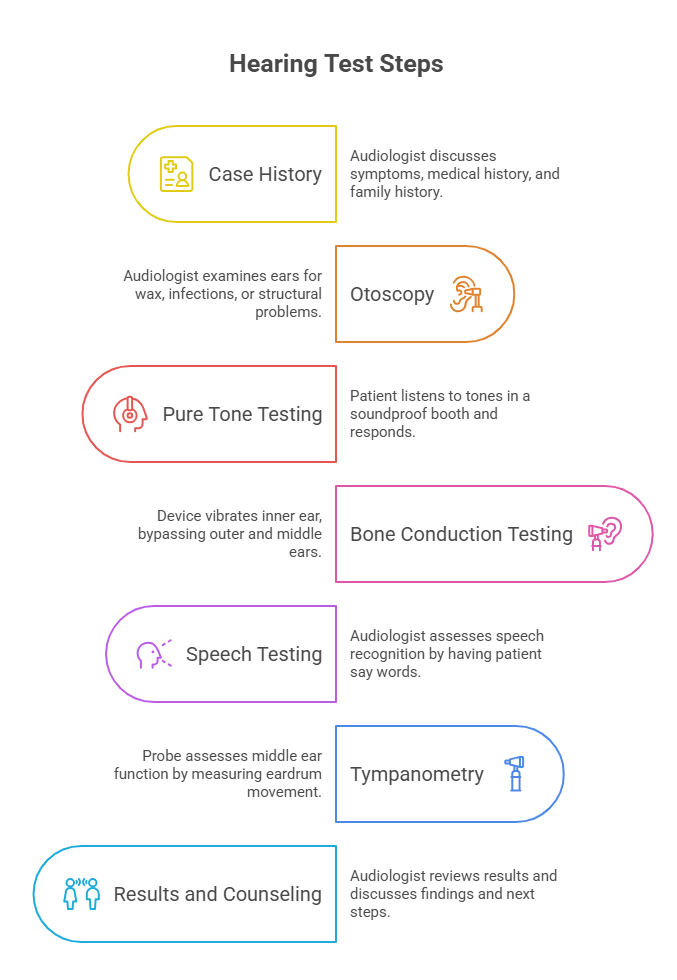
Patients will feel more comfortable and know what to expect before their appointment. The following is a typical hearing test routine for an adult performed in a clinic such as Resonnocare:
Step 1: Case History. Your audiologist will begin by discussing your symptoms, medical history, noise exposure history, and family history of hearing problems. This context should help to guide the testing approach.
Step 2: Otoscopy. Your audiologist will use an otoscope to examine your ears prior to any electronic testing. This eliminates earwax plugging, infections, or structural problems that could impact the results.
Step 3: Pure Tone Testing, you will be seated in a soundproof booth or quiet room with headphones. Various tones will be sounded, each rising or falling in pitch and volume, one ear at a time. On each occurrence of sound, whether weak or strong, you press a button or raise your hand.
Bone Conduction Testing (Step 4). A bone conduction vibrator behind the ear and mastoid bone vibrates directly into the inner ear, bypassing the outer and middle ears. This helps differentiate between sensorineural and conductive hearing loss.
Step 5: Speech Testing. Your audiologist will then have you say words at various levels to assess speech recognition.
Step 6: Tympanometry. A probe is inserted into your ear canal. This only takes a minute and assesses the function of the middle ear.
Step 7: Results and Counseling. After your tests, your audiologist will review your results and discuss the findings with you, including any further steps (if any) that are advisable.
Is a Hearing Test Painful or Difficult?
Most routine hearing tests are non-invasive and should not be painful. The experience varies slightly according to the test being performed.
Part of assessment | What you may experience |
Otoscopy | The audiologist looks into the ear using an otoscope. |
Pure-tone testing | You wear headphones or insert earphones and respond when you hear a tone. |
Bone conduction | A small vibrator is placed behind the ear. |
Speech testing | You listen to and repeat speech material. |
Tympanometry | A probe is placed at the ear canal opening and you may briefly notice pressure changing. |
OAE | A small probe presents sounds and records the cochlear response. |
ABR | Electrodes record responses while sounds are presented through earphones. |
If you have severe ear pain, discharge, recent ear surgery, significant dizziness, or another active ear problem, tell the clinic before testing so the appropriate assessment pathway can be decided.
Do You Need to Prepare Before a Hearing Test?
Routine hearing testing usually requires little preparation, but bringing the right information can make the appointment more useful.
Consider bringing:
- Previous audiograms or hearing-test reports
- ENT or other medical reports related to your ears
- A list of medicines you take
- Details of previous ear infections or ear surgery
- Your current hearing aids if you use them
- Hearing-aid charger, batteries, or accessories if the appointment includes device review
- A list of situations in which you struggle to hear
- A family member or caregiver if they regularly notice your hearing difficulties
Tell the audiologist if the hearing problem began suddenly, affects one ear much more than the other, or occurs with tinnitus, dizziness, pain, discharge, or bleeding. These details may change the urgency or type of assessment required.
How Do You Read Hearing Test Results?
The results are displayed on an audiogram, which is a chart that shows how well you hear sounds at various frequencies. On the X-axis, from left to right, are different frequencies (pitch), from low (250 Hz) to high (8000 Hz). Loudness is on the vertical axis from very soft at the top to very loud at the bottom.
Normal hearing is defined as 0-15 dB. If the numbers are lower, it means that you need sounds to be louder to hear them, which indicates some level of hearing loss:
- Minimal: 16-25dB
- Mild: 26 to 40 dB
- Moderate: 41 to 55 dB
- Moderately Severe: 56-70 dB
- Severe: 71 to 90 dB
- Profound: 91 dB and above
The shape of the audiogram also plays a role. An increasing loss of hearing at higher frequencies is common for hearing loss due to age or exposure to loud noises. If there is a flat loss at all frequencies, it could indicate a different cause. Your audiologist will explain the significance of the pattern of your results for you personally.
Our clinical team is always willing to review a previous hearing test result and seek second opinions when any questions or concerns remain unaddressed at the hearing.
What Should Your Hearing-Test Result Tell You?
After testing, you should leave with more than an audiogram. The result should help answer practical questions about your hearing and the next step.
Ask the audiologist to explain:
- Is hearing reduced or within the expected range?
- Is one ear different from the other?
- Which pitches are affected?
- What degree of hearing loss is present?
- Does the pattern suggest conductive, sensorineural, or another hearing concern?
- How clearly do I understand speech?
- Do I need another hearing test?
- Is an ENT or medical review required?
- Do I need monitoring rather than treatment?
- Should hearing aids or another hearing solution be considered?
The purpose of the result is to move from “Do I have a hearing problem?” to “What should I do next?”
What Does a Hearing Test Cost in India?
The fee for a hearing test in India depends on the type of test, the clinic, and the location.
The basic pure-tone audiometry test typically costs Rs. 500 to Rs 800 at most audiology clinics. A detailed hearing evaluation, including tympanometry, speech tests, and an audiologist consultation, will cost approximately Rs. 800 to Rs. 2,000.
Some specialized tests, such as ABR or OAE, may cost more. These tests are typically ordered when a regular hearing test does not yield clear results or when testing young children.
At Resonnocare, we want to simplify, clarify, and make hearing care easy to understand. Our team will first inform you of the recommended tests and why they are necessary prior to the tests.
Eligible patients can avail themselves of services under CGHS and ECHS as well. Contact us, and we will be happy to explain the options and necessary paperwork.
What Should You Confirm About Hearing-Test Cost Before Booking?
The lowest advertised hearing-test fee may not represent the complete assessment you need. Before booking, ask what is included in the quoted amount.
Confirm:
- Which hearing test is included
- Whether the price is for PTA only or a broader hearing evaluation
- Whether both ears are tested
- Whether speech audiometry is included
- Whether tympanometry is included if clinically required
- Whether the audiologist consultation is included
- Whether interpretation and result explanation are included
- Whether a written report is provided
- Whether OAE, ABR, or another specialized test would be separately charged
- Whether follow-up or report review costs extra
- Whether applicable CGHS or ECHS documentation needs to be arranged before the appointment
Compare the clinically recommended assessment rather than choosing a test only because its starting price is lower.
When Should You Get a Hearing Test?
A hearing test isn’t just for those who are already aware of a problem. There are several clinical circumstances where it is very sensible to be assessed proactively:
- Over 50 (routine annual checks are recommended)
- Your workplace is loud (e.g., construction, manufacturing, entertainment)
- Is there a difference in the clarity with which you hear speech?
- Often, family or friends will remind you that you didn’t hear what was said.
- Have a ringing or buzzing in the ears (tinnitus)
- Ear infections have occurred more than once, or ear disease is present.
- A child is not responding to sounds or is delayed in speech, usually
Please seek urgent evaluation if you experience sudden hearing loss in one or both ears, ear discharge, significant ear pain, or dizziness alongside hearing changes. These symptoms may indicate conditions that require prompt medical attention. You can learn more about specific ear symptoms and conditions on our website.
Hearing-Test Next-Step Selector
Use your symptoms and result not guesswork to decide what happens next.
Situation | Likely next step to discuss |
You notice gradual difficulty hearing speech | Book a hearing assessment with an audiologist. |
You hear sounds but words remain unclear | Ask whether speech audiometry should form part of the assessment. |
You feel blocked or have middle-ear symptoms | The audiologist may assess the ear and middle-ear function and advise whether medical review is needed. |
Hearing changed suddenly | Seek urgent medical/ENT assessment rather than waiting for a routine hearing appointment. |
The audiogram shows hearing loss | Discuss the type, degree, likely cause, and whether monitoring, medical referral, hearing aids, or another option is appropriate. |
The hearing test is within the expected range but communication difficulty continues | Discuss whether additional assessment is appropriate rather than assuming there is no hearing-related concern. |
You already use hearing aids and benefit has reduced | Arrange a hearing and device review so changes in hearing, programming, fit, or device function can be assessed. |
A child has speech delay or inconsistent responses to sound | Arrange an age-appropriate pediatric hearing assessment. |
The result should always lead to a defined next step even when that next step is simply monitoring rather than immediate treatment.
What Makes a Hearing Test Reliable?
A hearing test is more useful when the testing process, equipment, professional interpretation, and clinical context are considered together.
Important trust factors include:
- Testing conducted by an appropriately trained audiologist
- Use of calibrated equipment
- A suitable testing environment
- Case history taken before interpreting results
- Ear examination where appropriate
- Tests selected according to the patient’s symptoms and age
- Results explained in understandable language
- Medical warning signs identified rather than ignored
- A clear recommendation for the next step
The result should not be interpreted as an isolated number. The audiologist should connect the test findings with your symptoms and communication difficulties.
What If You Already Have a Hearing-Test Report?
You may not always need to repeat every test immediately simply because you are visiting another hearing-care provider. Bring the existing report so the audiologist can review what was tested, when it was performed, whether the results answer the current clinical question, and whether your hearing or symptoms have changed since then.
A repeat or additional assessment may be considered when:
- The existing report is old and hearing appears to have changed
- Only a screening rather than a diagnostic assessment was completed
- Speech understanding was not assessed despite relevant symptoms
- There is a new difference between the ears
- New tinnitus, dizziness, pain, discharge, or other symptoms have appeared
- Hearing-aid benefit has changed
- The earlier results were incomplete or unclear
A previous report can therefore be a useful starting point rather than something to leave at home.

Why Choose Resonnocare for Hearing and Audiology Care
At Resonnocare, a hearing test is never just a tick-box exercise. Every assessment is conducted by experienced audiologists who take the time to understand your individual situation before drawing any conclusions.
- Clinically guided care: Our assessments follow evidence-based protocols. We use calibrated equipment and work in environments designed to ensure accurate results every time.
- Personalized care plans: After your test, you will not be handed a leaflet and sent on your way. Our team builds a clear plan around your results, lifestyle, and communication needs, whether that means monitoring over time, exploring hearing aids, or referring you to an ENT specialist.
- Flexible access: We understand that getting to a clinic is not always straightforward. That is why we offer home visits and video consultations for patients who need a more convenient option.
- Ongoing support: Our care does not end after the appointment. From fitting to follow-up, our aftercare services are designed to make sure you continue to hear well long after your initial visit.
Conclusion
A hearing test takes less than an hour, but the clarity it provides can make an enormous difference to how you communicate, connect, and experience the world around you. Whether you have been putting it off for years or have just started noticing changes, there is no better time to get properly assessed.
Book your hearing test with Resonnocare today and take the first step toward hearing health that is built on real answers, not assumptions.
FAQ’s
Can I self-test my hearing?
Yes, you can perform simple “self” hearing tests online through screening tests or by using an app on your smartphone, but they are not as accurate as hearing exams performed by a professional audiologist. Formal hearing testing, including Pure Tone Audiometry, is advised if there are any signs of hearing loss, such as tinnitus, difficulty hearing speech, or needing to increase the volume.
What hearing aid is best for people with tinnitus?
A person with tinnitus can substantially benefit from hearing aids with sound therapy or masking options. When tinnitus is associated with hearing loss, modern hearing aids can amplify background noise and minimize the perception of tinnitus.
Which fruit is best for hearing?
Citrus fruits, including oranges, berries, bananas, and pomegranates, which are high in antioxidants and vitamin C, can improve circulation and reduce oxidative stress, which may help to keep your hearing in good health. Eating the right foods to nourish the ears and blood vessels can contribute to healthy hearing in the long run.
Is Whoopi Goldberg deaf?
Whoopi Goldberg also has an open discussion about hearing loss, attributing part of it to years of exposure to loud noise and high headphone volume. She has been vocal about her work in hearing protection awareness.
Does Jodie Foster have hearing loss?
In the past, hearing problems have been discussed in the public eye, but nothing specific has been widely confirmed regarding the nature of Jodie Foster’s hearing issues.
This Article is Authored by:- Dr. Anant Arun