
TL;DR:
This blog is aimed for Parents of newborns and infants, especially those whose babies have not yet undergone hearing screening, received a “refer” or inconclusive screening result, have birth-related hearing risk factors, or whose parents are concerned about hearing and speech development.
- Newborn hearing screening helps identify concerns early: The blog explains why babies should ideally be screened soon after birth, before hearing difficulties become noticeable through delayed responses, speech, or developmental milestones.
- The screening is quick, painless, and non-invasive: Newborn hearing tests can usually be performed while the baby is sleeping or resting and are designed to check whether the baby’s auditory system is responding appropriately to sound.
- A failed initial screening does not necessarily mean hearing loss: Temporary factors such as fluid, vernix, movement, or background noise can affect results. Babies receiving a “refer” result may require repeat screening or further diagnostic testing such as BERA.
- Early diagnosis enables timely support and intervention: The blog covers when parents should consult an audiologist, possible follow-up tests and management options, and how Resonnocare supports families through screening, diagnosis, hearing aids, home visits, consultations, and continued hearing care.
Once you bring your newborn home, there are numerous areas to consider, including feeding, sleeping, immunizations, and check-ups. Even though it might not be something parents can easily assess in the first few days of their baby’s life, hearing is equally important.
A baby may seem to be hearing normally, but may have a hearing problem that is not detected without testing. This is why it’s recommended to screen infants right after birth. It is painless and easy to perform a test to help check early how your baby is reacting to sound.
Here we will discuss the significance of newborn screening, the timing of newborn screening, what happens to your baby during the screening, and what to do if your baby is offered a second screening.
What Is Newborn Hearing Screening?
Newborn hearing screening is a straightforward, non-invasive test that is typically conducted in the first 24-48 hours after birth, either in the hospital or at a very early paediatric visit. Determines if your baby’s ears and ear bones are reacting to sound properly. The test is harmless to your baby, and it is usually performed during a sleep or still time in your arms.
This is now a common part of newborn care in the majority of hospitals in India; however, not all do so automatically. If your baby was born at home or at a smaller clinic, it is important to make a specific enquiry with your paediatrician before you leave the hospital or at the first follow-up visit about the screening for hearing loss.
Know More About Hearing Tests and Hearing Aids
- Hearing Aid Price: What Affects the Cost of Hearing Aids?
- Hearing Aid Price in India: Complete Cost Guide by Type & Features
- Hearing Aids Near Me: How to Choose the Right Hearing Aid Center
Why Does Newborn Hearing Screening Matter So Early?
Hearing plays an important role in how your baby begins to recognise voices, respond to sounds, and eventually develop speech and language. These skills start developing from the very first months of life, which is why checking hearing early is so important.
A hearing concern in a newborn may not always be easy for parents to notice at home. Your baby may still react to certain sounds, even if they are not hearing clearly in one or both ears. Newborn hearing screening helps identify possible concerns before they begin to affect important speech and language milestones.
If a concern is found early, your family has more time to understand what it means, complete any further testing that may be needed, and get the right support for your baby. The goal is not to create worry, but to make sure your baby’s hearing development is being followed from the start.
What Can Cause Hearing Concerns in Newborns?
Hearing concerns in newborns can happen for several reasons, and sometimes there may be no clear cause at all. It is also important to remember that having a risk factor does not mean that your baby will definitely have hearing loss.
Some babies may need closer hearing monitoring if there is a family history of childhood hearing loss, if they were born prematurely or with a low birth weight, or if they needed a longer stay in the NICU. Certain infections during pregnancy, complications around birth, severe jaundice requiring treatment, or exposure to particular medications may also increase the risk of hearing difficulties.
However, hearing loss can also occur in babies who have none of these risk factors. This is why newborn hearing screening is recommended for all babies, rather than only for those considered at higher risk.
What Are the Early Signs Parents Should Watch For?
Newborn screening is intended to detect issues before symptoms present, but it is useful to be aware of what normal hearing development might be like as your baby grows. If your baby doesn’t react to loud noises, doesn’t turn toward familiar voices by 4-6 months, babbling is scarce or none by about 9 months, or doesn’t seem to be consoled by your voice during fussy periods, you might want to discuss it with your child’s paediatrician or audiologist. While not an indicator of a hearing loss, these observations should be discussed, particularly if your baby did not have a hearing screening at birth. More on related symptoms is available on our ear symptoms and conditions page.
When Should You See an Audiologist for Your Baby?
It is important to arrange a formal hearing evaluation if your baby fails the initial screening, if screening fails, or if you notice any of the above hearing loss signs as your baby grows. It’s also logical to ask to have an evaluation if there’s a family history of hearing loss or complications around birth time. If your baby’s hearing screening results are a “miss” or a “refer,” it does not mean that your baby has permanent hearing loss; it just means that the test needs to be repeated to get a better picture. When travelling with a newborn seems like too much work, our home visit option allows an audiologist to conduct assessments in the comfort of your home.
How Is Hearing Loss Diagnosed After Initial Screening?
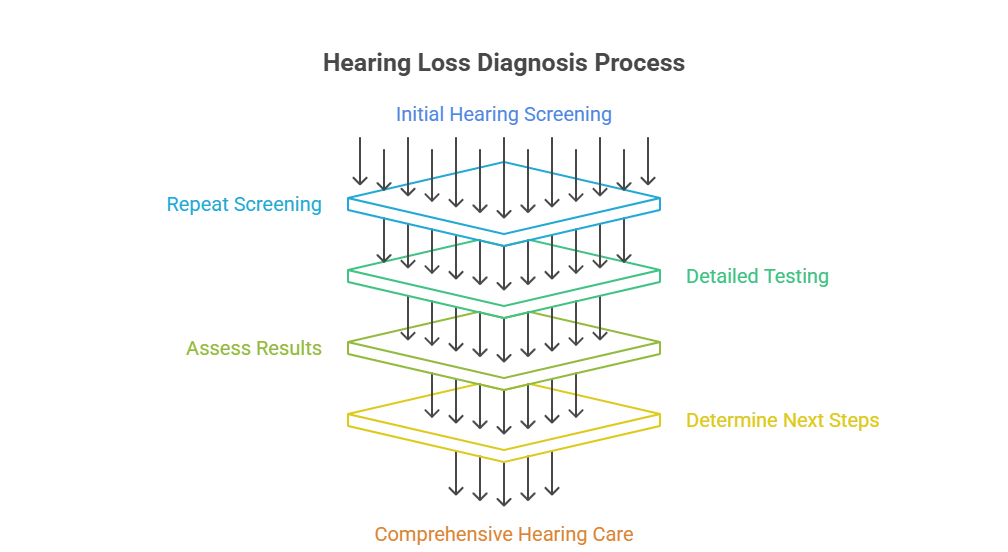
If your baby does not pass the first newborn hearing screening, it does not automatically mean that they have hearing loss. Sometimes, the result may be affected by temporary factors such as fluid in the ear, movement during the test, or background noise.
Depending on the screening result, your audiologist may recommend repeating the screening or carrying out a more detailed test such as Brainstem Evoked Response Audiometry (BERA). BERA helps check how sound signals travel from your baby’s ear through the hearing nerve towards the brainstem.
The follow-up assessment may help the audiologist understand whether:
- The first screening result was temporary or unclear
- Fluid or another middle-ear issue may be affecting hearing
- Your baby’s hearing needs to be monitored over time
- A more permanent hearing difficulty may be present
- Further support or early intervention may be helpful
These tests are carried out gently and are usually performed while your baby is calm or asleep. The aim is to understand your baby’s hearing as clearly as possible before deciding what, if anything, needs to happen next.
What Should Parents Do After a “Refer” Result?
A “refer” result can understandably worry parents, but it is not a diagnosis of hearing loss. The most useful response is to complete the recommended follow-up rather than trying to judge your baby’s hearing from behaviour at home.
- Ask the audiologist what the result means and whether a repeat screening is recommended.
- Attend the follow-up within the advised timeframe.
- If further diagnostic testing such as BERA is recommended, ask what information the test will provide.
- Tell the audiologist about any family history, NICU stay, birth complications, infections, or other relevant medical history.
- Continue observing your baby’s responses to voices and sounds, but remember that home observations cannot replace a formal hearing assessment.
- The goal of follow-up is clarity, not alarm: first understand the result, then decide what—if anything needs to happen next.
These tests are carried out gently and are usually performed while your baby is calm or asleep. The aim is to understand your baby’s hearing as clearly as possible before deciding what, if anything, needs to happen next. A screening result is not the same as a final diagnosis, so the follow-up pathway matters.
Our hearing care for all ages programme helps families understand each stage of the hearing assessment process and what the results mean for their baby.
What Treatment or Management Options Are Available?
The next step depends entirely on what your baby’s hearing assessment shows. Not every baby who needs follow-up testing will need treatment. Many babies who are referred after their first screening are later found to have normal hearing.
Depending on the results, the next step may include:
- No further treatment: If hearing is found to be normal, your baby may simply continue with routine developmental monitoring.
- Repeat hearing testing: If fluid or another temporary issue may have affected the result, the audiologist may recommend testing again after an appropriate interval.
- Regular hearing monitoring: Some babies may need periodic hearing checks, particularly if they have certain risk factors.
- Hearing support: If hearing loss is confirmed, your audiologist will explain the type and level of hearing loss and discuss suitable options with you.
- Hearing aids: For some babies, hearing aids may be recommended to provide earlier access to sound.
- Speech and language support: Depending on your baby’s hearing needs, early communication and speech and language support may also form part of the care plan.
If hearing aids are recommended, parents may also want to understand how the devices work and what to expect before making a longer-term decision. Resonnocare’s free hearing aid trial can help families become more familiar with the recommended hearing solution and discuss any questions with the audiology team.
The most important thing is that parents are involved throughout the process. Each recommendation should be explained clearly so you understand what has been found, why a particular next step is being advised, and how it can support your baby’s hearing and communication development.

Why Choose Resonnocare for Hearing and Audiology Care?
Resonnocare’s approach to infant hearing care is as clinical and compassionate as we like our families to be. We have qualified and expert audiologists and clinicians who specialise in accurate and clinically guided hearing assessments for babies and young children. All recommendations are tailored to your baby’s results, not a one-size-fits-all solution, and personalised care plans are created with you at every stage. Depending on your baby’s needs, this might involve follow-up to the newborn hearing screening, diagnostic testing, the provision of hearing aids, visiting your baby at home to help keep them comfortable, video consultation to provide early guidance, and structured aftercare to monitor your baby’s progress as they get bigger. To understand the clinical standards behind our approach, visit our clinical excellence page.
Find a Resonnocare Clinic Near You
Select your city to find the nearest Resonnocare clinic and book an appointment with our hearing care team.
Bangalore
Ear 360, Jayanagar
Ground Floor, Site No. 499, Municipal No. 499/97, East End Main Road, 9th Block, Jayanagar, Bangalore, Karnataka 560041
Timings: 10:00 AM to 7:00 PM
[Call] [Book an Appointment]
Ear 360, Spandana Sarjapura Hospital
239/205/34A, near Trinity Complex, Sompura Gate, Sarjapura Main Road, Bangalore, Karnataka 562125
Timings: 10:00 AM to 7:00 PM
[Call] [Book an Appointment]
Resonnocare, HSR Layout
150/5/72, 7th Cross, 24th Main, HSR Layout, Bangalore, Karnataka 560102
Timings: 10:00 AM to 7:00 PM
[Call] [Book an Appointment]
Resonnocare, Banashankari
272, 7th Cross Road, BSK 1st Stage, 2nd Block, Srinivasan Agra, 80 Feet Road, Bangalore, Karnataka 560050
Timings: 10:00 AM to 7:00 PM
[Call] [Book an Appointment]
Resonnocare, Indiranagar
34, Wind Tunnel Road, Murugeshpalya, Muniyappa Layout, Bangalore, Karnataka 560017
Timings: 10:00 AM to 7:00 PM
[Call] [Book an Appointment]
Resonnocare, JC’s ENT Center Nagarbhavi
57, 3rd Main Road, 2nd Block, Govindaraja Nagar Ward, Kalyan Nagar, Nagarbhavi, Bengaluru, Karnataka 560072
Timings: 10:00 AM to 7:00 PM
[Call] [Book an Appointment]
Resonnocare, Dr Bhattacharyya ENT Clinic
No. 14, 17th Cross Road, Sector 7, HSR Layout, Bangalore, Karnataka 560102
Timings: 10:00 AM to 7:00 PM
[Call] [Book an Appointment]
Delhi
Ear 360, Dr Hans Anand Lok
46, Anand Lok Road, Anand Lok, Sadiq Nagar, New Delhi, Delhi 110049
Timings: 10:00 AM to 7:00 PM
[Call] [Book an Appointment]
Resonnocare, Dr Hans Vasant Vihar
28, Basement, Paschimi Marg, Vasant Vihar, New Delhi, Delhi 110057
Timings: 10:00 AM to 7:00 PM
[Call] [Book an Appointment]
Resonnocare, Clarity ENT Clinic
Clarity, 2-10, Hauz Khas, New Delhi, Delhi 110016
Timings: 10:00 AM to 7:00 PM
[Call] [Book an Appointment]
Resonnocare, Dr Hans Center for ENT Punjabi Bagh
2/5, West Avenue Road, West Punjabi Bagh, Punjabi Bagh, New Delhi, Delhi 110026
Timings: 10:00 AM to 7:00 PM
[Call] [Book an Appointment]
Gurgaon
Resonnocare Head Office, M3M Urbana
Office 403, Office Block, 4th Floor, above Retail Blocks R1 and R5, M3M Urbana, Sector 67, Gurgaon, Haryana 122101
Timings: 10:00 AM to 7:00 PM
[Call] [Book an Appointment]
Resonnocare, Dr Hans Sector 28 DLF Ph-1
Metro Station, Plot No. 1SP, adjoining DLF Phase 1, Sector 28, Gurgaon, Haryana 122002
Timings: 10:00 AM to 7:00 PM
[Call] [Book an Appointment]
Ludhiana
Ear 360, BRS Nagar
963, Block B, BRS Nagar, Ludhiana, Punjab 141012
Timings: 10:00 AM to 7:00 PM
[Call] [Book an Appointment]
Resonnocare, Fawwara Chowk
565-A and 565-B, Upper Ground Floor, Cemetery Road, near Fawwara Chowk, West City, Ludhiana, Punjab 141001
Timings: 10:00 AM to 7:00 PM
[Call] [Book an Appointment]
Pune
Ear 360, Vighnaharta Healthcare Center
D-106-107, Choice Arcade, opposite Ruby Hall Hospital, Dhole Patil Road, Pune, Maharashtra 411001
Timings: 10:00 AM to 7:00 PM
[Call] [Book an Appointment]
Ear 360, Khan Parab ENT Hospital
Plot No. 102, Anand Nagar, Talegaon Dabhade, Taluka Maval, Pune, Maharashtra 410507
Timings: 10:00 AM to 7:00 PM
[Call] [Book an Appointment]
Tumkur
Resonnocare, Ashok Nagar
PID No. 3563, 8th Main, 8th Cross, Ashok Nagar, Tumkur, Karnataka 572103
Timings: 10:00 AM to 7:00 PM
[Call] [Book an Appointment]
Resonnocare, Ganadhal ENT and Dental Hospital
3rd Cross, Somashekara Puram, Coffee Board Colony, Tumkur, Karnataka 572102
Timings: 10:00 AM to 7:00 PM
[Call] [Book an Appointment]
Mangalore
Ear 360, Bunts Hostel Circle
Shop No. 6 and 7, Basement Floor, Javed Plaza, Bunts Hostel Circle, Mangalore, Karnataka 575003
Timings: 10:00 AM to 7:00 PM
[Call] [Book an Appointment]
Resonnocare, Dr G K Hebbar ENT Clinic
M-2-153/6, K.S.R.M. Building, Lighthouse Hill Road, Mangaluru, Karnataka 575001
Timings: 10:00 AM to 7:00 PM
[Call] [Book an Appointment]
Resonnocare, Dr Navisha ENT Centre
3rd Floor, Falnir Health Center, Falnir Road, Falnir, Mangaluru, Karnataka 575002
Timings: 10:00 AM to 7:00 PM
[Call] [Book an Appointment]
Mysore
Ear 360, Ramaswamy Circle
371/A, Ramaswamy Circle, Mysore, Karnataka 570024
Timings: 10:00 AM to 7:00 PM
[Call] [Book an Appointment]
Hubli
Ear 360, Vidya Nagar
Srishti Elite, Shirur Park Road, Shirur Park, Vidya Nagar, Hubballi, Karnataka 580031
Timings: 10:00 AM to 7:00 PM
[Call] [Book an Appointment]
Davangere
Ear 360, P J Extension
Shop First Floor, 2nd Main, P J Extension, Davangere, Karnataka 577002
Timings: 10:00 AM to 7:00 PM
[Call] [Book an Appointment]
Indore
Resonnocare, Dr Navnit Jain ENT Hospital
Dr Navnit Jain ENT Hospital, C/o Unique Hospital, 335, Jawahar Marg, Opp. Nafees Bakery, Indore, Madhya Pradesh 452007
Timings: 10:00 AM to 7:00 PM
[Call] [Book an Appointment]
Resonnocare, Hearing Solutions Dr Agarwal
7, Gulmarg Complex, First Floor, near Sapna Sangeeta Lumiere, Indore, Madhya Pradesh 452001
Timings: 10:00 AM to 7:00 PM
[Call] [Book an Appointment]
Conclusion
One of the easiest, yet most beneficial steps you can take for early childhood development is newborn hearing screening. It is fast, painless, and has the ability to identify issues that could otherwise go unnoticed and go untreated. If your baby has not been screened, or a screening test indicated that more testing was necessary, don’t delay seeking advice. Contact Resonnocare to arrange a hearing evaluation and discuss the newborn hearing screening process with a qualified audiologist who will be patient, clear, and compassionate with you and your family.
FAQ’s
Is it common for a newborn to fail a hearing test?
Yes, it is not uncommon for newborns to not pass the initial hearing screening. Results may be affected by temporary conditions, including fluid in the ear, vernix in the ear canal, movement, or background noise. In most cases, babies who fail the initial screening do not go on to have permanent hearing loss. However, it is important to have them retested to confirm that their hearing is normal.
What are the causes of hearing loss at birth?
In some cases, hearing loss may be present at birth due to genetic causes, in-utero infections, low birth weight, or other birth complications or medications. In some cases, babies are born with a hearing loss without any family history. Early diagnosis and intervention are critical to support speech, language, and developmental milestones.
Can deafness be detected during pregnancy?
There are a few accurate ways to identify hearing loss in pregnant women. Some genetic conditions that can cause hearing loss can be detected during pregnancy, however. Usually, a hearing assessment is carried out after birth via neonatal hearing screening tests like OAE and BERA designed to detect hearing loss at an early stage.
What happens if my baby is born deaf?
An early intervention program can make a huge difference in communication and developmental outcomes for a baby born with a hearing loss. Treatment can include a cochlear implant, hearing aids, speech therapy, and special education services. Early diagnosis and timely intervention allow many children with hearing loss to have good language and communication skills.
Can a born deaf person hear again?
The outcome of whether hearing can be restored or not will depend on the cause and severity of the hearing loss. Children with severe or profound deafness may be able to use hearing aids or a cochlear implant, which can help them access sound. These treatments can help to enhance communication and quality of life, though they cannot restore natural hearing.