
TL; DR:
This blog is aimed at parents and caregivers of children with delayed speech, unclear speech, or difficulty understanding instructions, especially when the child appears to hear everyday sounds normally.
- The blog explains the connection between speech delay and hearing loss, including how even partial difficulty hearing certain speech sounds or frequencies can affect vocabulary, pronunciation, sentence formation, and understanding.
- It highlights why responding to sounds does not automatically mean a child’s hearing is completely normal, as children may hear louder sounds while missing softer sounds or specific speech-related frequencies.
- The article covers the hearing tests that may be used for children, including OAE, BERA/ABR, tympanometry, and age-appropriate behavioural hearing tests, with test selection depending on the child’s age and developmental ability.
- It also explains that not every child with speech delay has hearing loss, but checking hearing helps rule out an important factor and supports more informed decisions about audiology, medical care, speech assessment, or therapy.
Your child is able to hear your voice when you call them from a distance. They sit up and look at the TV, identify familiar voices, and respond to a closed door. However, they may still be using fewer words than expected, speaking unclearly, or not following simple instructions.
This may cause many parents to ask themselves the question: why should the hearing be tested if the child hears sound?
There is not always a clear link between speech delay and hearing loss. It is important to realize that a child doesn’t have to be completely deaf to have problems learning to speak and understand. Limited access to some sounds can impact a child’s ability to understand words.
There is a tendency to consider hearing as the only part of the evaluation when speech development is a concern, but at Resonnocare we suggest the evaluation include hearing.
What Is the Connection Between Speech Delay and Hearing Loss?
Children hear others talking and acquire speech through exposure to the speech of others.
In the first few months, children listen and identify voices, familiarize themselves with speech patterns, and begin to master the sounds of language before they say words like “mama”, “water,” or “ball”.
Some parts of speech may not be heard clearly if there is a reduction in hearing, even if it is only at certain frequencies.
A child may hear people talking but not hear lower-level sounds. The sentence might then seem to be unfinished or ambiguous.
This decreased access to speech can impact over time:
- Development of new words
- Pronunciation
- Understanding instructions
- Sentence formation
- Communication with parents and other children
But speech delay is not a hearing loss. Several reasons can cause speech delay, and many children with delayed speech will have normal hearing. This is why it is better to have an accurate diagnosis of what is going on with your hearing than to assume it is normal or that it is the problem.
Know More About
- BERA Test: Procedure, Uses, Results & When It Is Needed
- Audiometry Test: Procedure, Cost & How to Read the Results
- BERA Test Price in India: Cost, Procedure & Where to Get Tested
Why Check Hearing If Your Child Responds to Sounds?
One of the top concerns parents have is this.
Your child might hear their name, hear music, hear a whistle (used for pressure cooking or something they like), or hear his favourite cartoon. That is only information about whether they can hear something, but not what they can hear at the various speech-related frequencies.
The term hearing is not just “present” or “absent”.
A child can hear louder or higher-pitched sounds, and have more difficulty hearing softer sounds or specific pitches. They can generally be more responsive when in proximity than when in another room.
This does not imply that hearing ability can always be excluded based on the day-to-day observations.
A hearing evaluation for children and adults can be conducted in an age-appropriate way to get more objective information on your child’s hearing.
What Signs of Speech Delay and Hearing Loss Should Parents Notice?
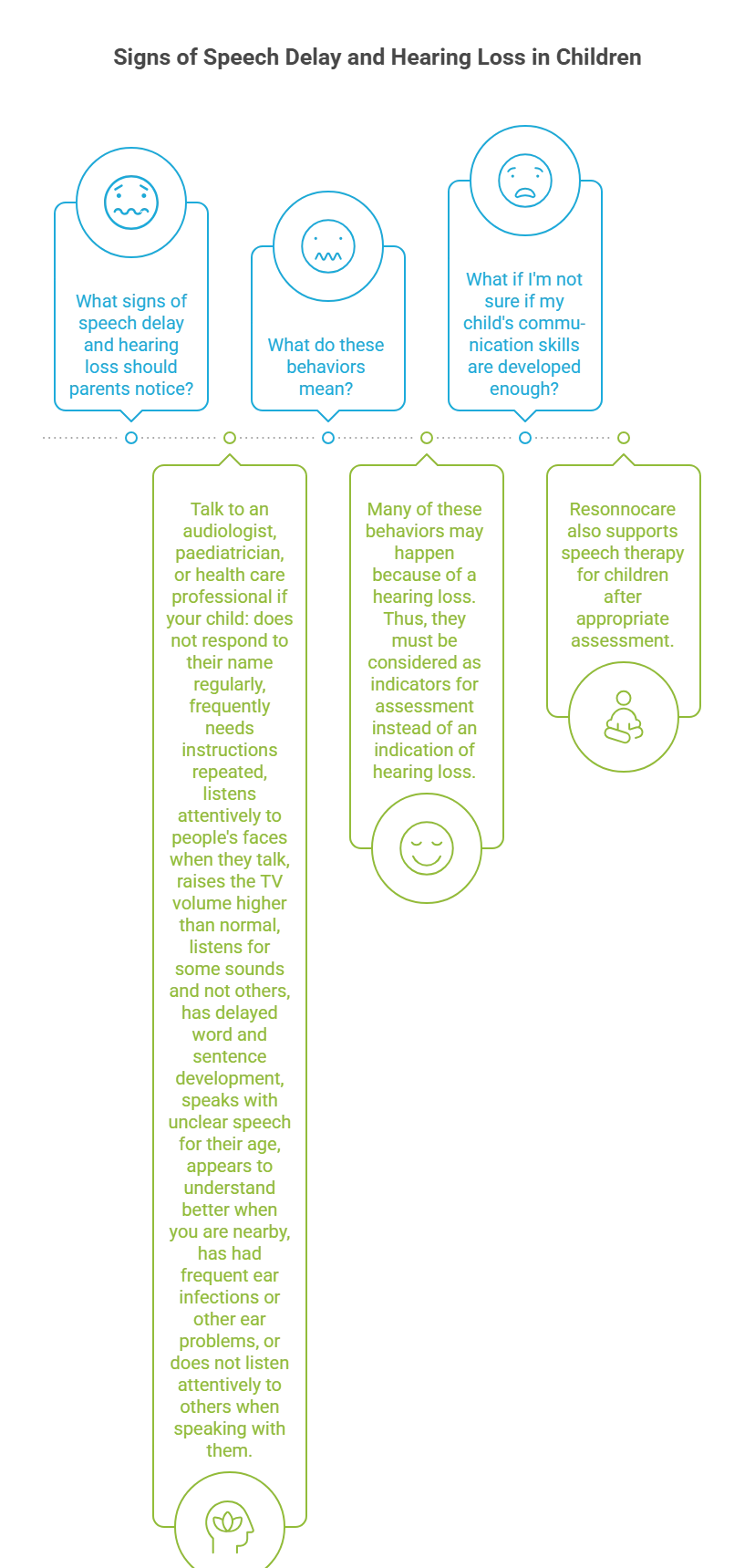
Children do not necessarily show one obvious sign of hearing loss. But certain behaviors might be particularly well suited to a hearing assessment.
Talk to an audiologist, paediatrician or health care professional if your child:
- Does not respond to their name regularly
- Frequently needs instructions repeated
- Listens attentively to people’s faces when they talk
- Raises the TV volume higher than normal
- Listens for some sounds and not others
- Delayed word and sentence development
- Speaks with unclear speech for their age
- Appears to understand better when you are nearby
- Has had frequent ear infections or other ear problems
- Does not listen attentively to others when speaking with them.
Many of these behaviors may happen because of a hearing loss. Thus, they must be considered as indicators for assessment instead of an indication of hearing loss.
Resonnocare also supports speech therapy for children after appropriate assessment in case you are not sure if your child’s communication skills are developed enough.
Can Mild Hearing Loss Cause Speech Delay?
Hearing loss doesn’t always have to be a significant problem.
There are lots of different sounds in speech. Some are louder than others and easier to hear, and some are softer.
If your child has limited access to some speech sounds, they might not hear the noise of other sounds during the day. But they don’t always hear every word of a spoken word.
For instance, if you hear a word only part of the time, this may make it more difficult to master the correct pronunciation of the word.
This is why one needs to take the hearing loss and speech delay relationship into consideration. Whether your child responds to sound is not important. It is important to determine if they can access the speech information necessary for the development of communication.
What Can Cause Hearing Problems in Children?
There are various causes for changes in hearing in children.
Hearing loss may be congenital (present at birth). Others might have a temporary or permanent hearing loss later.
This may be due to:
- Middle-ear fluid
- Ear infections
- Earwax blockage
- Middle or inner ear disorders
- An inborn or inherited hearing loss
- Some diseases or illnesses may cause the blood vessels to become blocked.
- Medicines that can affect hearing at certain times
In some cases, there are no signs or symptoms of an ear problem that are apparent to the parents.
This is why it is crucial that a professional evaluation is done if there are any concerns regarding speech delay and hearing loss. The audiologist will be able to see what tests are suitable and whether more medical assessment is required.
How Is Hearing Checked in a Child With Speech Delay?
Hearing assessment of children is adjusted to the child’s age and developmental capacity.
Not all children will be able to be “toned” every time they hear a tone. Therefore, audiologists employ various strategies based upon the child’s ability to take part in the testing session.
OAE
OAE is an objective test that offers information on cochlear (outer hair cell) function.
The child does not have to say each time they hear the sound during the test.
BERA or ABR
BERA (also known as ABR) measures electrical responses in the auditory pathway in response to sounds presented.
It may be beneficial for infants and children who are not able to reliably perform traditional behavioural hearing tests.
For more information on the BERA test and when it might be advisable.
Tympanometry
Tympanometry gives information about the function of the middle ear.
It may be helpful if the audiologist wants to explore issues like middle-ear fluid or changes in middle-ear pressure.
Behavioural hearing tests
Additionally, behavioural hearing assessments can be conducted as children age and develop the ability to respond consistently.
The tests chosen depend on the age, developmental level, symptoms, medical history, and question being asked by your audiologist.
There is no universal test which is suitable for all children.
Does Every Child With Speech Delay Have Hearing Loss?
No.
For parents, this is a key factor to keep in mind.
Speech delay and hearing loss may co-occur; hearing loss is just one factor that can be associated with delayed speech or language development.
There are many factors that can affect the development of a child’s communication skills, and some children with speech delay may have normal hearing.
Checking the hearing eliminates one of the key uncertainties.
When there is no hearing loss, the care team can have more confidence in developing other areas of speech and language development. If a hearing concern is identified, then next steps will be discussed.
Therefore, an integrated approach can be implemented with both audiology and speech and language assessment or therapy, depending on your child’s needs.
What Happens If a Hearing Problem Is Found?
The next step will be dependent upon the outcome of the assessment.
For instance, if a child has a middle ear problem, they may require medical evaluation. Additional audiological testing may be necessary with another child. If your child has a known hearing loss, they might require an individual hearing and communication plan.
Treatment will vary according to the type and severity of the hearing loss and may include medical treatment, hearing technology, monitoring, or appropriate intervention such as communication support.
Where hearing aids are recommended, these should be chosen and programmed to the child’s individual hearing needs and not just purchased by age.
The most important is that if a parent or clinician identifies a hearing concern, they can make decisions that are based on the evidence and not assumptions.
When Should You See an Audiologist or Doctor?
If there are concerns about your child’s speech development or listening and responding to speech, consider an assessment.
If your child has ongoing ear issues, frequent ear discharge, severe discomfort in the ear, tinnitus, vertigo, or a hearing loss, they should also be evaluated professionally.
It is important to assess a sudden hearing loss as soon as possible.
Don’t wait for a child to be old enough to clearly state the problem. Even if a young child cannot tell you what they are hearing, objective and age-appropriate hearing tests can supply valuable information.

Why Choose Resonnocare for Hearing and Audiology Care?
Here at Resonnocare, we feel that every case involving speech delay or hearing loss must be handled on a case-by-case basis.
Our approach includes:
- Treatment based on your child’s symptoms and developmental needs
- Audiologists and clinicians with knowledge and expertise in age-appropriate tests
- Correct hearing testing with correct diagnostic techniques.
- Individual care plans, not assumptions, based on test results.
- The right to receive hearing tests and hearing aids where clinically appropriate
- Home visits and video consultation (as appropriate)
- Follow-up aftercare for hearing devices and ongoing audiology support as needed
We take a clinical approach to hearing care that ensures proper evaluation, individual care planning, and continuity of care.
If a child has communication issues, their hearing evaluation may also be part of a more comprehensive pathway of care with speech and language therapists if necessary.
Find a Resonnocare Clinic Near You
Select your city to find the nearest Resonnocare clinic and book an appointment with our hearing care team.
Bangalore
Ear 360, Jayanagar
Ground Floor, Site No. 499, Municipal No. 499/97, East End Main Road, 9th Block, Jayanagar, Bangalore, Karnataka 560041
Timings: 10:00 AM to 7:00 PM
[Call] [Book an Appointment]
Ear 360, Spandana Sarjapura Hospital
239/205/34A, near Trinity Complex, Sompura Gate, Sarjapura Main Road, Bangalore, Karnataka 562125
Timings: 10:00 AM to 7:00 PM
[Call] [Book an Appointment]
Resonnocare, HSR Layout
150/5/72, 7th Cross, 24th Main, HSR Layout, Bangalore, Karnataka 560102
Timings: 10:00 AM to 7:00 PM
[Call] [Book an Appointment]
Resonnocare, Banashankari
272, 7th Cross Road, BSK 1st Stage, 2nd Block, Srinivasan Agra, 80 Feet Road, Bangalore, Karnataka 560050
Timings: 10:00 AM to 7:00 PM
[Call] [Book an Appointment]
Resonnocare, Indiranagar
34, Wind Tunnel Road, Murugeshpalya, Muniyappa Layout, Bangalore, Karnataka 560017
Timings: 10:00 AM to 7:00 PM
[Call] [Book an Appointment]
Delhi
Ear 360, Dr. Hans Anand Lok
46, Anand Lok Road, Anand Lok, Sadiq Nagar, New Delhi, Delhi 110049
Timings: 10:00 AM to 7:00 PM
[Call] [Book an Appointment]
Resonnocare, Dr. Hans Vasant Vihar
28, Basement, Paschimi Nagar, Vasant Vihar, New Delhi, Delhi 110057
Timings: 10:00 AM to 7:00 PM
[Call] [Book an Appointment]
Gurgaon
Resonnocare Head Office, M3M Urbana
Office 403, Office Block, 4th Floor, above Retail Blocks R1 and R5, M3M Urbana, Sector 67, Gurgaon, Haryana 122101
Timings: 10:00 AM to 7:00 PM
[Call] [Book an Appointment]
Resonnocare, Dr. Hans, Sector 28
Plot No. 1SP, adjoining DLF Phase 1 Metro Station, Sector 28, Gurgaon, Haryana 122002
Timings: 10:00 AM to 7:00 PM
[Call] [Book an Appointment]
Ludhiana
Ear 360, BRS Nagar
963, Block B, BRS Nagar, Ludhiana, Punjab 141012
Timings: 10:00 AM to 7:00 PM
[Call] [Book an Appointment]
Resonnocare, Fawwara Chowk
565-A and 565-B, Upper Ground Floor, Cemetery Road, near Fawwara Chowk, West City, Ludhiana, Punjab 141001
Pune
Ear 360, Vighnaharta Healthcare Center
D-106-107, Choice Arcade, opposite Ruby Hall Hospital, Dhole Patil Road, Pune, Maharashtra 411001
Timings: 10:00 AM to 7:00 PM
[Call] [Book an Appointment]
Ear 360, Khan Parab ENT Hospital
Plot No. 102, Anand Nagar, Talegaon Dabhade, Taluka Maval, Pune, Maharashtra 410507
Timings: 10:00 AM to 7:00 PM
[Call] [Book an Appointment]
Tumkur
Resonnocare, Ashok Nagar
PID No. 3563, 8th Main, 8th Cross, Ashok Nagar, Tumkur, Karnataka 572103
Timings: 10:00 AM to 7:00 PM
[Call] [Book an Appointment]
Conclusion: Why Speech Delay and Hearing Loss Should Be Assessed Together
It’s only natural that, when your child is late in talking or having trouble speaking clearly, you’ll think of speech therapy first.
However, the ability to hear should come into the picture as well.
A child can hear sounds around him in everyday settings and yet not hear individual words, such as parts of speech, clearly. Many children who have speech delay are also normal hearing children. Testing can be the difference between one and the other.
Knowing the possible connection between speech delay and hearing loss provides a better place to begin a discussion with parents and clinicians about what support a child may require.
FAQ’s
Can hearing loss cause speech delay in children?
Yes, hearing loss can make it harder for children to learn to speak as they hear sounds, words, and conversations around them. Some sounds may not be heard, and this can impact pronunciation, words, and language development.
Can a child hear sounds but still have hearing loss?
Yes. Sometimes a child may hear loud sounds, music, or familiar voices but not hear softer speech sounds or some frequencies. This is why children may be referred for a specialist hearing assessment if they are having difficulty with their speech development.
Should hearing be checked if a child has speech delay?
Yes. If speech delay and hearing loss are concerns, it is important to perform a hearing check. It can help identify if hearing impairment is a factor in the child’s communication problem.
Which hearing tests are used for children with speech delay?
The tests will vary based on the child’s age and ability to provide responses. OAE or BERA / ABR, tympanometry, and age-appropriate behavioral hearing tests may be recommended by Audiologists. Multiple tests may be required to evaluate patients fully.
At what age can a child’s hearing be tested?
Testing to ascertain if a child has a hearing loss can begin from infancy. Objective tests (OAE, BERA/ABR) can be used when clinically appropriate, and babies and young children do not need to be able to respond verbally.