
TL; DR:
The blog is aimed at adults experiencing moderate to severe hearing difficulty, older adults, family members or caregivers noticing hearing changes, and people considering hearing tests, hearing aids, or professional audiology support.
- Moderate hearing loss affects clarity, not just volume: People may hear someone speaking but miss words, struggle in restaurants or meetings, frequently ask others to repeat themselves, and increase TV or phone volume.
- There can be several underlying causes: Moderate to severe hearing loss may result from age-related changes, prolonged noise exposure, ear infections, middle-ear fluid, earwax, eardrum problems, certain medications, or sensorineural damage.
- Diagnosis requires more than identifying a hearing-loss level: The blog explains the role of hearing history, pure tone audiometry, audiograms, speech testing, ear examination, and additional tests in understanding the type and impact of hearing loss.
- Treatment depends on the cause and individual hearing needs: Management may include treating reversible ear conditions, professionally fitted hearing aids, communication strategies, assistive listening support, programming adjustments, and ongoing aftercare.
First signs of hearing loss may be obvious in daily activities. You may turn up the volume when you’re talking to your family member, or you might find it difficult to understand what they’re saying. It can be easy to overlook these changes, particularly if you can still hear some sounds at this point.
Moderate hearing loss means that hearing normal speech may become more difficult over time, especially in noisy areas, in group conversations, or when they are not able to see the person speaking. As hearing loss gets worse, familiar everyday sounds and speech may not be so easy to hear, even if the speaker is talking loudly.
Many people make the transition over time and don’t notice how much their hearing has deteriorated. An evaluation from Resonnocare can help determine the extent of hearing loss, the potential causes, and the best next steps for individuals with hearing loss.
What Is Moderate Hearing Loss?
Hearing loss is a measurement of how quiet sounds you can hear are, in decibels hearing level (dB HL), based on your hearing test results. The ranges for professional classification systems are slightly different, and your audiologist should always interpret the range of your audiogram in conjunction with your speech understanding and daily challenges.
Moderate hearing loss – in a real-life scenario, this translates to the inability to hear sounds and language as clearly as before, with a tendency towards using less volume with speech. Sometimes you may hear someone talking, and miss words or parts of sentences. Discussions in a quiet room can still be acceptable, but eating out at restaurants, attending meetings, traffic, or family gatherings become difficult.
When the degree of hearing loss is in the moderately severe to severe range, it may be hard to hear normal conversation without the use of amplification.
Know More About Hearing Loss
- At What Level of Hearing Loss Are Hearing Aids Recommended?
- Conductive Hearing Loss: Causes, Symptoms, Diagnosis & Treatment
- Sensorineural Hearing Loss: Causes, Symptoms & Treatment Options
What Does Moderate Hearing Loss Feel Like in Everyday Life?
Hearing loss is more than just loudness. Patients often refer to it as a loss of clarity.
You may:
- Have people repeat themselves frequently
- Hear speech and omit words
- Have trouble understanding when multiple people talk simultaneously
- Lack of energy in conversations by phone
- Make the TV or mobile louder. Turn up the TV or mobile’s volume.
- Don’t hear doorbells, alarms, traffic, or someone calling from another room.
- Use more expression and lip movements.
- Others start to steer clear of get-togethers due to the strain on listening. When things change over time, it is easier to get used to than immediate changes.
What Causes Moderate to Severe Hearing Loss?
It’s not a single cause. Hearing loss can range from the outer or middle ear to the inner ear or to the hearing nerve.
It can be due to changes as you get older, to being exposed to loud noises for a long time, or to ear infections, middle ear fluid, eardrum problems, impacted earwax, some medicines that can affect hearing, or certain inherited or medical issues.
Sometimes, conductive hearing loss can be improved by treating the underlying ear condition. Sensorineural refers to damage to the inner ear or the auditory pathway and is frequently permanent, but can be managed.
If you have fullness, ringing, pain, discharge, or other concerns alongside hearing difficulty, you can also read about common ear symptoms and conditions.
What Are the Signs That Moderate Hearing Loss Is Becoming More Severe?
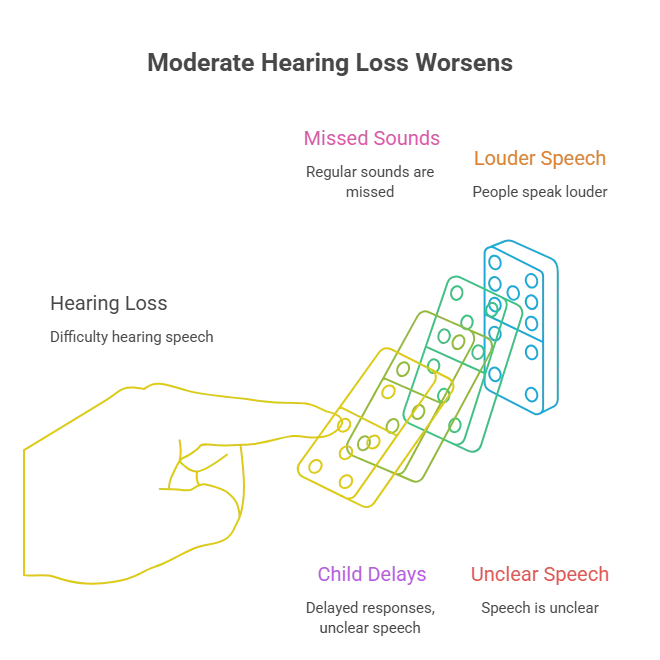
Any change in listening ability should be taken seriously, particularly one in which it was once easy to listen during quiet activities but not so easy in conversational situations.
People might need to say things louder; they might be unable to hear speech even when it is loud, or it may be unclear even when it is loud. Some sounds they hear regularly, like a phone ringing, a pressure cooker whistle, cars passing by, or a reminder in the home, might also be more difficult to hear.
In children, hearing difficulty may appear as delayed responses, unclear speech, reduced classroom participation, or trouble following instructions. Resonnocare provides hearing care for all ages because hearing loss affects children, adults, and older people differently.
When Should You See an Audiologist or ENT Doctor?
If you have trouble reading a book, if this makes it difficult to talk, or if you have trouble at work, in relationships, school, or with safety, make an appointment for a hearing test.
If you have a sudden decrease in hearing, especially in one ear, get immediate medical attention. Sudden hearing loss may be a medical emergency and shouldn’t be addressed as a regular hearing-aid problem.
Additionally, if ear pain is severe, there is ear discharge, severe dizziness, excessive tinnitus, or hearing loss following head trauma, medical attention is required.
Do not dismiss slow onset of symptoms as the normal consequences of ageing. A hearing test can be used as an aid to assess the severity and the type of hearing loss, and whether it requires ENT review or not. If you or a loved one has similar symptoms, book an appointment here.
How Is Moderate Hearing Loss Diagnosed?
The first place to start in assessment is your history. Your audiologist might ask how long the problem has been present, if one or both ears are involved, what your exposure to noise has been like, if you experience tinnitus or dizziness, and what the situations you find challenging are.
Pure tone audiometry tests the quietest sounds a person can hear at various frequencies, and puts the results on an audiogram. Speech testing may also be performed, as two individuals with the same hearing thresholds can have different speech clarity.
The clinician will examine the ear and may suggest middle-ear or other special tests based on your symptoms. What matters isn’t so much the label on the report, but the implications for your day-to-day communications.
What Treatment Is Available for Moderate Hearing Loss?
Treatment will be based on the cause, type, severity, and impact on daily life.
Medical management may be necessary if there is earwax, an ear infection, or middle ear fluid that is adding to the problem. If hearing loss is sensorineural and permanent, the emphasis is on making speech more accessible and decreasing communication barriers.
For many people, professionally fitted hearing aids are an important part of management. A device should be selected according to your audiogram, speech understanding, lifestyle, comfort, ear anatomy, dexterity, and listening needs.
Hearing aids can help people hear speech better and listen during various listening situations, but they cannot replace biological hearing. Speaker facing, noise reduction, and subtitles/assistive listening devices can also be helpful.
Do Hearing Aids Help with Moderate to Severe Hearing Loss?
Yes, but benefits are not the same for all patients.
Moderate hearing loss (26-40 dB) can be made easier to hear with appropriate hearing aids, making speech and environmental sounds more accessible. Stronger amplification or certain types of hearing aids may be necessary for more serious losses.
The comprehensibility of speech also plays a role, as simply increasing the volume of a sound does not ensure that all speech will be comprehensible. Speech recognition, the context of listening, and other factors can mean that two individuals with comparable audiograms can derive very different benefits.
Hearing aids should therefore be programmed according to your hearing results and adjusted after real-world use. Ongoing hearing aid aftercare can help with comfort, programming, cleaning, device care, and changing listening needs.
If severe or profound hearing loss receives limited benefit from hearing aids, an ENT or specialist hearing team may discuss whether further evaluation for other hearing technologies is appropriate.
Can Moderate Hearing Loss Affect Your Daily Life More Than You Realise?
The most powerful impact can be less than what you can’t hear; it can be the effort you put into hearing it.
You can start to watch other people’s faces, sit in the right place at meetings, not go to loud restaurants, or rely on family to repeat things. The conversation may be long, and you might feel very tired due to your brain working harder to fill in missing parts of speech.
Receiving instructions or failing to grasp the information given in a phone call at work can cause unnecessary stress. It can become a problem at home to repeatedly ask family members to repeat themselves.
These challenges can be discussed with an Audiologist. Hearing care is more than just an audiogram. It’s also about making you feel more comfortable communicating in situations that are important to you.

Why Choose Resonnocare for Hearing and Audiology Care?
The device-first approach is not the Resonnocare way of hearing care. We ask our patients if they have symptoms, hearing history, communication issues, and/or daily listening needs before we start working with them.
Hearing assessments are performed accurately and can give us a good idea of the extent and the type of hearing loss, and we can give you a simple explanation of your results. From there, we can develop an individual care plan for you that is clinically appropriate.
Care can consist of:
- Hearing tests and hearing assessments
- Assessment/Recommendation, fitting, and programming for hearing aids.
- Guidance to assist with communication and listening.
- Visits to home where appropriate and possible
- Video consultation, as appropriate.
- Adjusting and aftercare for hearing aids
For those who have difficulty getting to a clinic, it can be asked if a home hearing assessment or consultation can be arranged at their location.
Our goal is to provide you with a thorough understanding of your hearing so you and your family can have options and make informed decisions about moving forward.
Find a Resonnocare Clinic Near You
Select your city to find the nearest Resonnocare clinic and book an appointment with our hearing care team.
Bangalore
Ear 360, Jayanagar
Ground Floor, Site No. 499, Municipal No. 499/97, East End Main Road, 9th Block, Jayanagar, Bangalore, Karnataka 560041
Timings: 10:00 AM to 7:00 PM
[Call] [Book an Appointment]
Ear 360, Spandana Sarjapura Hospital
239/205/34A, near Trinity Complex, Sompura Gate, Sarjapura Main Road, Bangalore, Karnataka 562125
Timings: 10:00 AM to 7:00 PM
[Call] [Book an Appointment]
Resonnocare, HSR Layout
150/5/72, 7th Cross, 24th Main, HSR Layout, Bangalore, Karnataka 560102
Timings: 10:00 AM to 7:00 PM
[Call] [Book an Appointment]
Resonnocare, Banashankari
272, 7th Cross Road, BSK 1st Stage, 2nd Block, Srinivasan Agra, 80 Feet Road, Bangalore, Karnataka 560050
Timings: 10:00 AM to 7:00 PM
[Call] [Book an Appointment]
Resonnocare, Indiranagar
34, Wind Tunnel Road, Murugeshpalya, Muniyappa Layout, Bangalore, Karnataka 560017
Timings: 10:00 AM to 7:00 PM
[Call] [Book an Appointment]
Resonnocare, JC’s ENT Center, Nagarbhavi
57, 3rd Main Road, 2nd Block, Govindaraja Nagar Ward, Kalyan Nagar, Nagarbhavi, Bengaluru, Karnataka 560072
Timings: 10:00 AM to 7:00 PM
[Call] [Book an Appointment]
Resonnocare, Dr Bhattacharyya ENT Clinic
No. 14, 17th Cross Road, Sector 7, HSR Layout, Bangalore, Karnataka 560102
Timings: 10:00 AM to 7:00 PM
[Call] [Book an Appointment]
Delhi
Ear 360, Dr Hans Anand Lok
46, Anand Lok Road, Anand Lok, Sadiq Nagar, New Delhi, Delhi 110049
Timings: 10:00 AM to 7:00 PM
[Call] [Book an Appointment]
Resonnocare, Dr Hans Vasant Vihar
28, Basement, Paschimi Marg, Vasant Vihar, New Delhi, Delhi 110057
Timings: 10:00 AM to 7:00 PM
[Call] [Book an Appointment]
Resonnocare, Clarity ENT Clinic
Clarity, 2-10, Hauz Khas, New Delhi, Delhi 110016
Timings: 10:00 AM to 7:00 PM
[Call] [Book an Appointment]
Resonnocare, Dr Hans Center for ENT, Punjabi Bagh
2/5, West Avenue Road, West Punjabi Bagh, Punjabi Bagh, New Delhi, Delhi 110026
Timings: 10:00 AM to 7:00 PM
[Call] [Book an Appointment]
Gurgaon
Resonnocare Head Office, M3M Urbana
Office 403, Office Block, 4th Floor, above Retail Blocks R1 and R5, M3M Urbana, Sector 67, Gurgaon, Haryana 122101
Timings: 10:00 AM to 7:00 PM
[Call] [Book an Appointment]
Resonnocare, Dr Hans Sector 28 DLF Ph-1
Metro Station, Plot No. 1SP, adjoining DLF Phase 1, Sector 28, Gurgaon, Haryana 122002
Timings: 10:00 AM to 7:00 PM
[Call] [Book an Appointment]
Ludhiana
Ear 360, BRS Nagar
963, Block B, BRS Nagar, Ludhiana, Punjab 141012
Timings: 10:00 AM to 7:00 PM
[Call] [Book an Appointment]
Resonnocare, Fawwara Chowk
565-A and 565-B, Upper Ground Floor, Cemetery Road, near Fawwara Chowk, West City, Ludhiana, Punjab 141001
Timings: 10:00 AM to 7:00 PM
[Call] [Book an Appointment]
Pune
Ear 360, Vighnaharta Healthcare Center
D-106-107, Choice Arcade, opposite Ruby Hall Hospital, Dhole Patil Road, Pune, Maharashtra 411001
Timings: 10:00 AM to 7:00 PM
[Call] [Book an Appointment]
Ear 360, Khan Parab ENT Hospital
Plot No. 102, Anand Nagar, Talegaon Dabhade, Taluka Maval, Pune, Maharashtra 410507
Timings: 10:00 AM to 7:00 PM
[Call] [Book an Appointment]
Tumkur
Resonnocare, Ashok Nagar
PID No. 3563, 8th Main, 8th Cross, Ashok Nagar, Tumkur, Karnataka 572103
Timings: 10:00 AM to 7:00 PM
[Call] [Book an Appointment]
Resonnocare, Ganadhal ENT and Dental Hospital
3rd Cross, Somashekara Puram, Coffee Board Colony, Tumkur, Karnataka 572102
Timings: 10:00 AM to 7:00 PM
[Call] [Book an Appointment]
Mangalore
Ear 360, Bunts Hostel Circle
Shop No. 6 and 7, Basement Floor, Javed Plaza, Bunts Hostel Circle, Mangalore, Karnataka 575003
Timings: 10:00 AM to 7:00 PM
[Call] [Book an Appointment]
Resonnocare, Dr G K Hebbar ENT Clinic
M-2-153/6, K.S.R.M. Building, Lighthouse Hill Road, Mangaluru, Karnataka 575001
Timings: 10:00 AM to 7:00 PM
[Call] [Book an Appointment]
Resonnocare, Dr Navisha ENT Centre
3rd Floor, Falnir Health Center, Falnir Road, Falnir, Mangaluru, Karnataka 575002
Timings: 10:00 AM to 7:00 PM
[Call] [Book an Appointment]
Mysore
Ear 360, Ramaswamy Circle
371/A, Ramaswamy Circle, Mysore, Karnataka 570024
Timings: 10:00 AM to 7:00 PM
[Call] [Book an Appointment]
Hubli
Ear 360, Vidya Nagar
Srishti Elite, Shirur Park Road, Shirur Park, Vidya Nagar, Hubballi, Karnataka 580031
Timings: 10:00 AM to 7:00 PM
[Call] [Book an Appointment]
Davangere
Ear 360, P J Extension
Shop First Floor, 2nd Main, P J Extension, Davangere, Karnataka 577002
Timings: 10:00 AM to 7:00 PM
[Call] [Book an Appointment]
Indore
Resonnocare, Dr Navnit Jain ENT Hospital
Dr Navnit Jain ENT Hospital, C/o Unique Hospital, 335, Jawahar Marg, Opp. Nafees Bakery, Indore, Madhya Pradesh 452007
Timings: 10:00 AM to 7:00 PM
[Call] [Book an Appointment]
Resonnocare, Hearing Solutions Dr Agarwal
7, Gulmarg Complex, First Floor, near Sapna Sangeeta Lumiere, Indore, Madhya Pradesh 452001
Timings: 10:00 AM to 7:00 PM
[Call] [Book an Appointment]
Conclusion
For people who have moderate hearing loss, conversations, work, relating with family, phone calls, and social interactions can be more challenging. Hearing changes can be very gradual, and it is easy to compensate without realising how much communication has been impacted.
If you or a family member has been having difficulty hearing speech, if you are always having to increase the volume, repeat everything you hear often, or if you are avoiding conversations, book an appointment for a professional hearing assessment.
Seek immediate medical attention if you experience sudden hearing loss, severe ear pain, ear discharge, severe dizziness, or acute or persistent tinnitus.
FAQ’s
Can moderate hearing loss be corrected?
While the prognosis for moderate hearing loss can be promising, it will depend upon the cause. Treatment can restore hearing if the hearing loss is caused by earwax build-up, infection, or middle ear issues. If hearing loss is permanent, the most often used remedy is hearing aids that can greatly enhance your speech understanding and communication and improve your quality of life.
What are the daily effects of hearing loss?
People with hearing loss may find it harder to hear what others are saying, particularly in loud settings. We often hear people asking for things to be repeated, misunderstanding, turning up the volume on a device, or avoiding social interactions. Untreated hearing loss can have a negative impact on communication, relationships, work performance, and emotional well-being over time.
Can hearing loss be temporary?
Yes, there are types of hearing loss that are temporary. This is often caused by wax buildup in the ear, ear infections, middle ear effusion, or temporary damage from overexposure to loud noises. After the cause of the hearing loss is cured or normalizes, the hearing may improve. If the hearing loss continues, then it should be assessed by a hearing specialist.
Is hearing loss painful?
Loss of hearing is rarely painful. If ear infections, ear injuries, or ear inflammation cause hearing loss, however, ear pain, ear pressure, or ear discomfort will result. Sudden onset of hearing loss, or onset of hearing loss with associated pain, dizziness, or tinnitus should be treated with medical intervention.
Can I live a normal life with moderate hearing loss?
Yes, those with moderate hearing loss can live a full and active life. Once treated – such as with hearing aids, communication strategies, and regular hearing care – it is possible for individuals to continue working, socializing, and enjoying daily activities. Hearing will often be better if early intervention is provided, and it will help to keep quality of life high.