
TL: DR;
This blog is designed for parents of newborns and children with hearing or speech concerns, adults experiencing hearing-related symptoms, and anyone advised by an ENT specialist or audiologist to undergo a BERA test.
- Explains the purpose and procedure of the BERA test: The blog clearly describes BERA (Brainstem Evoked Response Audiometry) as a safe, painless, non-invasive hearing test that evaluates how the auditory nerve and brainstem respond to sound.
- Highlights when the BERA test is recommended: It outlines common situations in which the test is needed, including a failed newborn hearing screening, delayed speech development, unexplained hearing loss, tinnitus, vertigo, and suspected auditory nerve disorders.
- Simplifies understanding of BERA test results: The article explains how audiologists interpret brainstem waveforms, what normal and abnormal results may indicate, and why BERA findings are combined with other clinical assessments for accurate diagnosis.
- Builds trust in Resonnocare’s hearing care services: The blog emphasizes Resonnocare’s experienced audiologists, advanced diagnostic equipment, personalized care plans, home visits, video consultations, hearing aid guidance, and long-term aftercare support.
Hearing loss tends to happen gradually and be overlooked. However, if your doctor recommends a BERA test, you may have many questions to answer. What is the test? Why is it needed? Is it painful? What is the meaning of the results?
When you don’t know what to expect, uncertainty can only make it feel more stressful than it’s supposed to be.
At Resonnocare, we help make hearing care accessible. This guide offers an overview of the BERA test, how it is administered, why you may be recommended to have it, and what happens after.
What Is a BERA Test?
BERA assesses the brainstem’s reaction to sound. It is also referred to as the Auditory Brainstem Response (ABR) and is one of the most sensitive non-invasive hearing tests used in modern audiology.
BERA is a test that examines the function of your auditory nerve and brainstem. Once sound is detected, it is transmitted along the auditory nerve to the brainstem. These responses are assessed using tiny electrodes placed on the forehead and the backs of the ears during the BERA. What emerges is a series of waveforms that reflect the brain’s response to sound at specific locations along the auditory pathway.
A key benefit of the BERA test is that it is non-invasive and does not require the patient’s active cooperation. Since the test is performed while the patient is in deep sleep, it is especially useful for infants, children, or individuals who may not be able to participate in regular hearing tests.
BERA Test for Babies: Why Is It Commonly Recommended?
A BERA test is especially useful for babies because it does not depend on the child raising a hand, pressing a button, or giving a verbal response. The test records the auditory pathway’s electrical response to sound while the baby is asleep or sufficiently still.
It may be recommended when a newborn does not pass an initial hearing screening, when there are risk factors for hearing loss, or when parents and doctors have concerns about hearing or later speech and language development.
Parents searching for a BERA test for baby near me should look for a centre experienced in infant hearing assessment and able to explain whether natural-sleep testing, additional tests, or medical supervision may be required.
Which Age Groups Can Have a BERA Test?
BERA can be used across different age groups because the patient does not need to press a button, raise a hand, or verbally respond to each sound. The clinical reason for ordering the test, however, can differ considerably between a newborn, child, and adult.
Age group | Why BERA may be considered |
Newborns and infants | To objectively assess hearing when a baby cannot participate in behavioural hearing testing, particularly after a hearing-screening concern. |
Toddlers and young children | To investigate suspected hearing loss when reliable behavioural responses are difficult to obtain or when speech and language development raises a hearing concern. |
Older children | To provide objective information when conventional test results are inconsistent, incomplete, or when an auditory nerve concern needs investigation. |
Adults | To investigate selected cases of unexplained hearing loss, tinnitus, vertigo, differences between the two ears, or suspected auditory nerve or brainstem involvement. |
Patients unable to complete conventional testing | BERA can provide objective information when physical, developmental, neurological, or communication limitations make standard behavioural hearing testing difficult. |
Age alone does not determine whether BERA is required. The audiologist or referring doctor chooses the test according to the patient’s symptoms, age, ability to complete other hearing tests, and the clinical question that needs to be answered.
Why Is the BERA Test Done?
The BERA test has a number of clinical uses. In these situations, our audiologists at Resonnocare may recommend it:
- Newborn and infant hearing screening: The BERA test is used regularly for infant hearing loss screening in the first few days after birth. The key to early intervention is early detection of hearing loss.
- The BERA test, an objective hearing function test that does not rely on the child’s ability to follow instructions, is used to diagnose hearing loss in noncooperative children.
- Diagnosis of hearing loss: The test can identify the type and location of hearing loss within the auditory system.
- Aid in diagnosis of unexplained tinnitus or vertigo: BERA can be used to rule out nerve involvement when a patient has an unexplained tinnitus or vertigo.
- Acoustic Neuroma: It is a non-cancerous tumor that forms on the auditory nerve. If a BERA test is abnormal, meaning there is an abnormal nerve conduction, it can be an indicator of issues that need to be further investigated.
- Monitoring auditory function: The BERA test can be used to monitor auditory function in patients receiving drugs that may affect hearing and/or undergoing surgery that can affect hearing.
When Is BERA Recommended After a Baby Does Not Pass Hearing Screening?
A baby who does not pass a newborn hearing screening does not automatically have permanent hearing loss. Screening is designed to identify babies who need a more complete hearing assessment. Fluid in the ear, movement, background noise, or other factors can sometimes affect the initial screen.
When follow-up is advised, the audiologist may recommend BERA or other age-appropriate tests to obtain more detailed information about the baby’s hearing. Parents should follow the recommended assessment timeline rather than waiting for visible signs of hearing difficulty.
Can Adults Take a BERA Test?
Yes. BERA is not limited to babies and children. Adults may also be advised to undergo BERA when the clinician needs objective information about how sound signals travel through the auditory nerve and brainstem.
An adult may be referred for BERA when there is:
- Unexplained hearing loss
- A significant difference between the two ears
- Persistent tinnitus with other hearing concerns
- Vertigo or dizziness associated with hearing symptoms
- Concern about auditory nerve involvement
- Difficulty obtaining reliable results from conventional hearing tests
- A need to objectively assess auditory pathway function
Most cooperative adults can complete pure-tone and speech audiometry, so BERA is generally selected when it provides additional information that conventional behavioural testing cannot provide on its own.
How Is the BERA Test Performed?
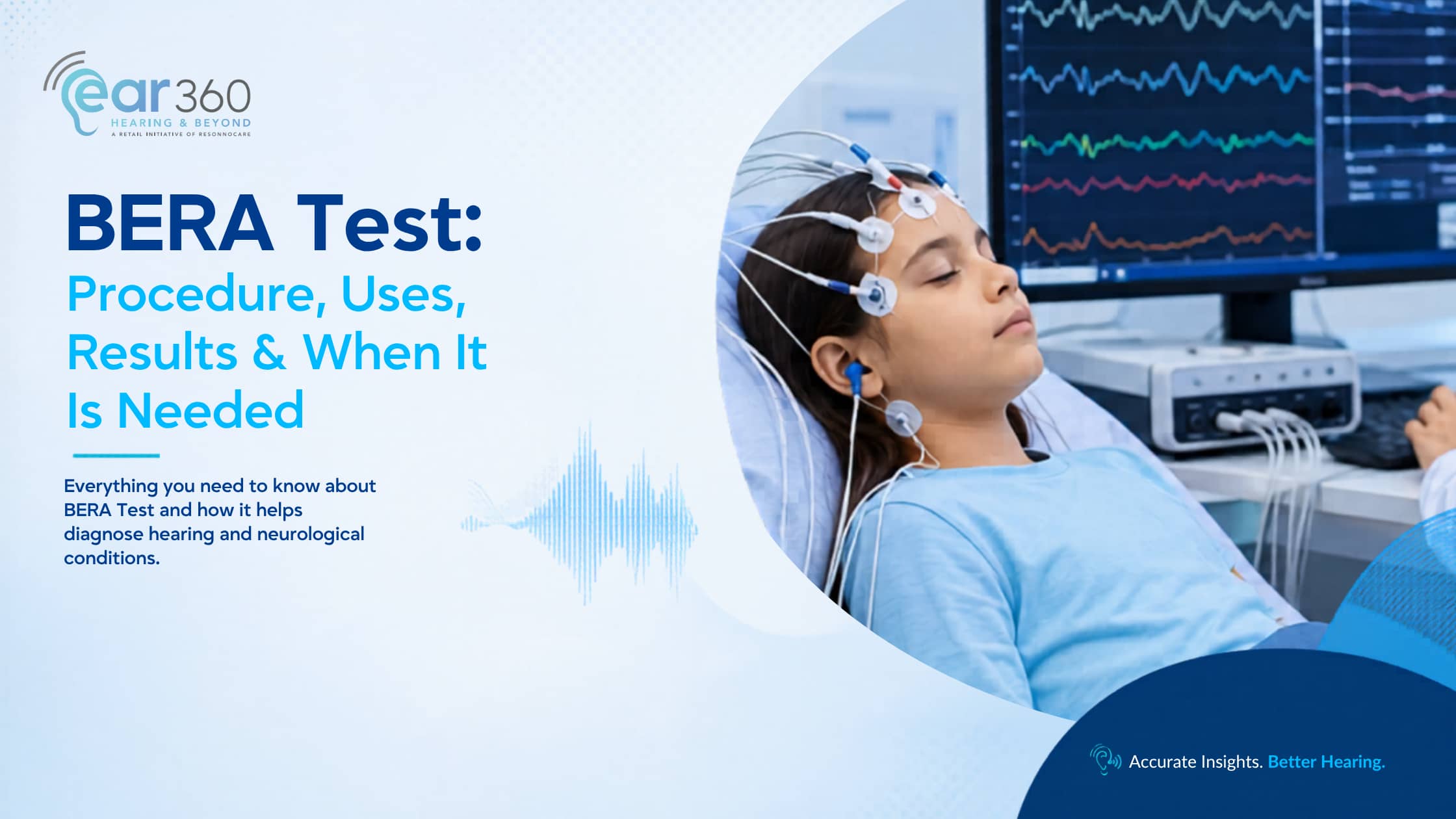
Knowing what to expect can help reduce anxiety before the test. The BERA test is painless and non-invasive, and is usually performed while the patient is in deep sleep or fully relaxed.
- Patient preparation and relaxation: Adults are asked to lie comfortably on a test bed and relax deeply. For infants and toddlers, parents may be advised to keep the child awake and active before the appointment, then feed them just before the test so they fall into a deep, natural sleep. In rare cases, if a child cannot sleep, a mild sedative may be given under medical supervision.
- Skin cleaning and electrode placement: The audiologist gently cleans specific areas of the skin, usually the forehead, the area behind each ear, or the earlobes, using a mild exfoliating gel. This helps the electrodes make proper contact. Small sensor stickers called electrodes are then placed on these areas to record natural brain activity.
- Connecting earphones: Special insert earphones or headphones are gently placed in or over the patient’s ears. These deliver precise clicking sounds or tone bursts needed to stimulate the hearing pathway.
- Sound stimulus and recording: As the sounds are played, the electrodes detect tiny electrical signals produced by the auditory nerve and brainstem in response. The BERA machine filters, amplifies, and records these signals as wave patterns on a monitor.
- Waveform analysis and electrode removal: Once clear and repeatable waveforms are recorded for both ears, the test is stopped. The audiologist removes the earphones and electrode stickers, cleans off any remaining gel, and studies the timing and size of the recorded waves to assess hearing levels or nerve function.
- No pain or side effects: The BERA test does not involve injections, electric shocks, or pain. The electrodes only record responses; they do not send any electrical current into the body.
How Long Does a BERA Test Take?
The time required for BERA can vary because the audiologist needs clear and repeatable responses. A straightforward recording may take less time, while testing an infant, assessing multiple sound levels, repeating unclear responses, or allowing time for the child to fall asleep can make the appointment longer.
Parents should therefore allow enough time for preparation, settling the baby, electrode placement, testing, and discussion of the results rather than expecting every BERA appointment to take exactly the same amount of time.
Does a BERA Test Always Require Sleep or Sedation?
No. What is important during BERA is that the patient remains sufficiently quiet and relaxed so that muscle movement and other electrical activity do not interfere with the very small responses being recorded.
The approach can therefore differ by patient:
Patient situation | What may be required |
Relaxed adult | An adult may be able to complete the test while resting quietly without sleeping. |
Young infant | Natural sleep is often useful because the baby can remain still without actively cooperating. |
Toddler or young child | The appointment may be planned around natural sleep when possible. |
Child unable to remain sufficiently still | Sedation may sometimes be considered under appropriate medical supervision when clinically required. |
Patient who can remain relaxed and motionless | Sedation may not be necessary if a reliable recording can be obtained. |
Sedation should not be assumed to be part of every BERA test. Parents should follow the individual preparation instructions provided by the testing team and should not give a child sleep medication unless specifically instructed by the responsible medical professional.
How Can Parents Prepare a Baby for a Natural-Sleep BERA Test?
Preparation depends on the baby’s age and the testing centre’s protocol, so parents should follow the specific instructions given by the audiologist. When natural-sleep testing is planned, the appointment may sometimes be timed around the baby’s usual sleep or feeding schedule.
Parents may be asked to keep the baby awake for a period before the appointment or feed the baby shortly before testing so that natural sleep is easier to achieve. These instructions should only be followed when provided by the testing team.
Do not give a baby any sleep medicine or sedative unless it has been specifically prescribed or instructed by the responsible medical team.
What Can Affect the Accuracy of a BERA Recording?
BERA measures very small electrical responses, so recording conditions matter. Excessive movement or poor recording conditions can make waveforms difficult to interpret and may sometimes require part of the test to be repeated.
Factors that may interfere with the recording include:
- Movement during testing
- Crying or significant muscle tension
- Poor electrode contact
- Earphone movement or displacement
- Difficulty remaining relaxed
- Electrical interference in the testing environment
- An incomplete recording
- Middle-ear problems that influence how sound reaches the inner ear
This is why preparation, suitable electrode placement, a controlled testing environment, and professional interpretation are important parts of the BERA procedure.
Understanding Your BERA Test Results
The BERA test result appears as a series of wave patterns, usually labeled Waves I to V. Each wave reflects electrical activity at a different point along the hearing pathway:
- Waves I and II: Activity from the auditory nerve.
- Wave III: Electrical activity within the lower brainstem, specifically the cochlear nucleus and superior olivary complex.
- Wave V: Activity moving through the upper brainstem and midbrain, including the lateral lemniscus and inferior colliculus.
The audiologist will look at these waveforms and take into account latency (the delay, or the time it took for the first wave to arrive) and amplitude (how strong the signal was).
Normal result: Show waveforms within the time range and normal amplitude range. This usually means that the pathway that carries sounds from the ear to the brainstem is functioning normally.
Unusual findings: These can be delayed latency, no waveforms, or an unequal ear response. The results can be due to sensorineural hearing loss, auditory nerve dysfunction, or a central auditory processing disorder, but will always need further clinical evaluation for diagnosis.
It’s worth noting that a BERA result is only a part of the diagnostic picture. The hearing test results are always interpreted in the context of your clinical history, symptoms, and other hearing tests.
Can a Normal BERA Result Rule Out Every Hearing Problem?
No. BERA provides objective information about auditory pathway responses, but it does not assess every part of hearing or communication. A person may still need other tests depending on age, symptoms, middle-ear status, speech understanding, or real-world listening difficulties.
This is why audiologists may combine BERA with OAE, tympanometry, pure tone audiometry, speech audiometry, behavioural testing, or other assessments when clinically appropriate.
Common BERA Result Categories and What Happens Next
A BERA report should not be interpreted simply as “pass” or “fail.” The meaning depends on the responses recorded, the purpose of testing, the patient’s age, and findings from other hearing and medical assessments.
Possible result | What it may mean for the next step |
Responses within the expected range | The recorded auditory pathway responses appear within the expected pattern, although further testing may still be needed if hearing concerns continue. |
Elevated estimated hearing threshold | Further assessment may be needed to understand the degree and type of possible hearing loss. |
Delayed waveform timing | The audiologist may compare the finding with the opposite ear and other tests and may recommend further investigation. |
Different responses between the ears | A significant unexplained difference may require additional audiological or medical assessment. |
No repeatable response at a tested level | This does not by itself explain the cause. Additional testing may be required to understand whether hearing loss, recording conditions, middle-ear status, or another factor contributed. |
Inconclusive recording | Part or all of the test may need to be repeated if reliable waveforms could not be obtained. |
The audiologist should interpret BERA alongside the patient’s symptoms, hearing history, ear examination, and other appropriate tests rather than using the waveform alone as a final diagnosis.
What Are the Limitations of a BERA Test?
BERA provides valuable objective information, but it does not answer every question about hearing. It primarily evaluates the electrical response of the auditory pathway to sound and should be interpreted as one part of a broader hearing assessment.
BERA alone may not fully explain:
- Every possible cause of hearing loss
- Middle-ear function
- How clearly a person understands everyday speech
- Real-world listening ability in background noise
- All aspects of auditory processing
- Whether a child’s speech or language delay is caused by hearing loss
- Whether an abnormal waveform represents one specific medical diagnosis
Depending on the clinical question, the audiologist may therefore combine BERA with OAE, tympanometry, pure-tone audiometry, speech testing, ASSR, behavioural hearing assessment, or medical evaluation.
When Should You or Your Child Have a BERA Test?
If you or your child is suspected of having hearing loss issues, or your doctor wants to evaluate the ability of the hearing nerve to react to sound, then a BERA test may be suggested.
If your child’s pediatrician, ear, nose, or throat specialist (ENT), or audiologist recommends a BERA test, it is likely because they are concerned about:
- A baby may not pass the first test for hearing loss.
- A young child with a delay in speech or language development.
- There is a family history of childhood hearing loss
- Hearing loss can start suddenly or over time, for no obvious reason.
- You have long-lasting tinnitus or ringing in the ears
- You feel dizzy, have vertigo, or have sound sensitivity
- Your doctor thinks you may have an acoustic neuroma or a hearing problem from a nerve problem
- If your child needs auditory nerve monitoring during an operation.
If you’re not sure if a BERA is appropriate for yourself or your child, please consult with a skilled audiologist. You’ll be taken through the assessment process at Resonnocare and be helped to select the tests that are suitable for you.
BERA Test for Baby Near Me: What Should Parents Check Before Booking?
When searching for a BERA test for baby near me, location is important, but infant-testing experience is equally important. Parents can ask the centre:
- Whether BERA or ABR testing is routinely performed for infants
- Whether natural-sleep testing is available
- What preparation instructions should be followed
- Whether sedation is ever used and, if so, under whose medical supervision
- Whether OAE or tympanometry can also be performed if needed
- Who will interpret and explain the results
- Whether a written report will be provided
- What follow-up pathway is available if hearing loss is identified
This helps parents compare centres on clinical support, not only distance or BERA test price
BERA vs OAE vs ASSR vs Pure Tone Audiometry
BERA is not automatically a replacement for other hearing tests. Each test answers a different clinical question, and more than one may be required to build a complete hearing profile.
Test | What it mainly evaluates | Active patient response needed? | When it may be useful |
BERA / ABR | Electrical responses of the auditory nerve and brainstem to sound | No | Infants, patients who cannot complete behavioural testing, or investigation of auditory-pathway concerns |
OAE | Responses generated by the cochlea | No | Newborn hearing screening and assessment of cochlear function |
ASSR | Objective auditory responses to frequency-specific sound stimulation | No active behavioural response | When objective frequency-specific hearing information is needed in selected patients |
Pure Tone Audiometry (PTA) | Softest tones a person can consciously hear across different frequencies | Yes | Cooperative older children and adults |
A patient may need more than one of these tests. For example, a clinician may compare BERA findings with OAE or tympanometry in a baby, while an adult may also undergo pure-tone and speech audiometry.
BERA Test in Children: What Parents Should Know
Parents are not at ease if their child is tested for anything. Thankfully, the BERA test is very safe and well-tolerated by children, including newborns.
Sometimes the test is performed in very young babies while they are sleeping. If the young child is having difficulty staying quiet, a light sedative may be necessary under medical supervision to obtain accurate results. We have experience and have a care plan for young children and families, and we try to make the process as relaxed and comfortable as possible.
Early hearing assessment is one of the most important things a parent can do for their child’s development. Hearing care tailored to all ages is something our team is deeply committed to at every stage of life.
What Should Parents Bring for a Child’s BERA Appointment?
Preparation instructions vary depending on the child’s age and whether testing is planned while awake, during natural sleep, or with medical support. Follow the instructions given by the testing center rather than using a general sleep or fasting routine.
Useful information to bring may include:
- Newborn hearing-screening results
- Previous OAE, BERA, tympanometry, or behavioural hearing reports
- ENT or pediatric referral, if available
- Information about speech or language delay
- Relevant medical and developmental history
- A list of current medicines
- Details of previous ear infections or other hearing concerns
- Comfort items for a young child if advised by the clinic
If sedation is being considered, parents should confirm preparation, fasting, medicine, arrival, and recovery instructions directly with the responsible medical team.
What Should You Ask Before Comparing BERA Test Prices?
BERA test price should not be compared using the final number alone because the quoted amount may include different services at different centres. Before comparing prices, ask whether the quote includes:
- The BERA test itself
- Testing of one or both ears
- Audiologist interpretation
- A written report
- OAE, tympanometry, or other additional tests
- Natural-sleep or sedation-related arrangements, where applicable
- Medical supervision if sedation is required
- Follow-up consultation
- Taxes or additional facility charges
A lower BERA test price may not represent a lower total cost if important assessments or reporting charges are billed separately.
What Happens After a BERA Test?
Once your BERA test results are ready, your audiologist or referring doctor will explain the findings and guide you through the next steps.
Depending on the results, they may recommend:
- Further hearing tests, such as pure tone audiometry, tympanometry, or OAE testing
- An ENT or neurology referral is required if a structural or nerve-related concern is suspected
- Hearing aid recommendations and fitting if hearing loss is identified
- Monitoring and follow-up if the results are borderline or need to be reviewed over time
If the BERA test confirms hearing loss, early support can make a meaningful difference. Modern hearing aids are highly advanced and can improve communication, confidence, and quality of life. At Resonnocare, our team will help you explore the right options, including a free hearing aid trial, so you can experience the benefits before making a decision.
What If the BERA Result Is Abnormal?
An abnormal BERA result does not automatically identify one specific condition. It means that the recorded responses need to be interpreted in the context of the patient’s age, symptoms, hearing history, other test findings, and the quality of the recording.
Depending on the finding, the next step may include:
- Reviewing the BERA recording and comparing the two ears
- Checking middle-ear function with tympanometry
- Using OAE to obtain additional information about cochlear function
- Completing behavioural or pure-tone audiometry when the patient can participate
- Considering additional objective testing such as ASSR where clinically appropriate
- Repeating BERA if the original recording was incomplete or unreliable
- Referral to an ENT specialist if a medical or structural cause needs evaluation
- Neurological assessment when auditory nerve or brainstem involvement is suspected
- Hearing-aid evaluation or other rehabilitation planning when hearing loss is confirmed
For children, the care pathway may also include speech, language, developmental, and ongoing hearing monitoring according to the overall assessment.
Does an Abnormal BERA Result Mean a Baby Will Need a Hearing Aid?
Not necessarily. An abnormal or unclear BERA result needs to be interpreted together with the baby’s age, middle-ear status, other hearing tests, and the reliability of the recording. Additional testing may be needed before the type and degree of hearing loss can be confirmed.
If permanent hearing loss is identified, the audiologist and medical team can then discuss appropriate intervention, which may include monitoring, hearing devices, additional medical evaluation, or communication and developmental support depending on the individual findings.
Where Should You Check BERA Test Cost?
This page focuses on when BERA is needed, how the test is performed, preparation, and interpretation. Because BERA pricing varies according to test type, patient age, facility, natural-sleep or sedation requirements, additional tests, and reporting, detailed cost information is covered separately.
For pricing, inclusions, sedation-related charges, insurance considerations, and provider selection, see BERA Test Price in India: Cost, Procedure & Where to Get Tested.
Why Can the BERA Test Price Vary?
BERA test price can vary based on the patient’s age, testing protocol, number of ears tested, whether additional hearing assessments are required, reporting, facility charges, and whether natural sleep or medically supervised sedation is used.
For babies and young children, appointment length and preparation requirements may also differ from a routine adult test. Ask for an itemized quotation so that you understand what is included before comparing BERA test prices between providers.
Why Choose Resonnocare for Hearing and Audiology Care
We feel it’s important to provide accurate information and compassionate direction at Resonnocare to ensure that good hearing care starts here. Patients and families in India trust us with their hearing health for these reasons:
- Skilled audiologists and clinicians: Our staff has a broad range of clinical expertise in hearing disorders and audiology evaluations, including BERA testing and more.
- Evidence-based care with clinical guidance: All our suggestions are grounded in clinical evidence and tailored to you. We are not a one-size-fits-all organization.
- Accurate hearing assessments: We use advanced diagnostic equipment to ensure your results are precise and meaningful.
- Personalized care plans: Your hearing test, hearing aid fitting, and management plan are tailored to your lifestyle, preferences, and hearing goals.
- Flexible access to care: We understand that visiting a clinic is not always convenient. That is why we offer home visits and video consultations for those who need care in the comfort of their own homes.
- Long-term aftercare: Our relationship with you does not end after the test or the fitting. We provide structured aftercare support to help you get the most out of your hearing care journey.
Conclusion
The BERA test is a safe, painless, and highly informative diagnostic tool that plays a key role in the audiologist/clinician’s evaluation of how well the auditory nerve and brainstem are functioning. The BERA test is suitable for screening a newborn’s hearing, investigating unexplained tinnitus in an adult, assessing a child who is unable to take standard tests, and providing objective, reliable information to inform clinical decisions.
If you have been referred for BERA testing or have concerns about your or your child’s hearing, it is best not to delay evaluation. Identifying a hearing problem early means there are more options for handling it effectively. Contact the Resonnocare team today to schedule a hearing assessment or to speak with one of our audiologists with extensive experience. We are here to listen, guide, and support you throughout the process.
FAQ’s
What is the BERA test for?
Brainstem Evoked Response Audiometry (BERA) is a hearing and brainstem exam that tests the passage of sound from the ear to the brainstem. It is useful for diagnosing hearing loss, auditory nerve disorders, delayed speech development in children, and certain neurological disorders of the auditory pathways.
What if the BERA test fails?
When BEARS is abnormal, it can indicate hearing loss, auditory nerve dysfunction, or a delay in the transmission of sound to the brain. If the condition is severe and/or caused by an underlying issue, an extra hearing test or treatment planning is generally recommended.
Is the BERA test painful?
No, B.E.R.A. is neither painful nor invasive. Electrodes are attached to the scalp and ears to measure electrical reactions when sounds are played via earphones. The test is well-tolerated even by babies.
How much does the BERA test cost?
The cost of BEA varies across hospitals and cities, ranging from a few thousand rupees, and may also include additional hearing tests.
When is a BERA test recommended?
A BERA test, also called Brainstem Evoked Response Audiometry, may be recommended when a reliable behavioural hearing test is difficult to perform or when the clinician needs information about how sound signals travel through the auditory nerve and brainstem. It is commonly used for infants, young children, and some adults who need further diagnostic assessment.
Is BERA used for babies?
Yes. BERA is commonly used for babies because it does not require them to raise a hand, press a button, or verbally respond to sounds. It can help estimate hearing sensitivity and assess the auditory pathway at an age when standard behavioural hearing tests may not be reliable.
Does a child need to sleep during BERA?
Young children and babies usually need to be asleep or very still during BERA because movement can interfere with the recordings. Some babies can be tested during natural sleep, while in certain situations a clinician may discuss other options if the child cannot remain still enough for accurate testing.
How long does BERA take?
A BERA test may take around 30 to 90 minutes, depending on the child’s age, how easily they remain asleep or still, and how detailed the assessment needs to be. The appointment may take longer if preparation or additional testing is required.
What does a BERA result show?
BERA measures the brainstem’s electrical responses to sound. The results help clinicians assess whether sound signals are travelling appropriately through the auditory nerve and brainstem and can provide an estimate of hearing sensitivity.
Is BERA the same as a normal hearing test?
No. A standard hearing test such as Pure Tone Audiometry depends on a person actively responding when they hear a sound. BERA is an objective test, meaning the response is recorded automatically from the auditory pathway without requiring the patient to respond.
Can BERA identify the degree of hearing loss?
BERA can help estimate hearing thresholds and provide information about the possible degree of hearing loss. However, results are usually interpreted alongside other tests such as OAE, tympanometry, and behavioural hearing assessments to build a more complete picture.
What happens after an abnormal BERA result?
If the BERA result suggests hearing loss or an abnormal auditory response, your audiologist or ENT specialist may recommend additional tests to confirm the findings and determine the cause. Depending on the results, next steps may include ongoing monitoring, medical evaluation, repeat testing, or discussion of hearing support such as hearing aids and early intervention for children.
What is the success rate of the BERA test?
BEA is considered highly reliable for diagnosing hearing and auditory nerve anomalies and is indicated for patients who are unable to perform standard hearing tests, as well as for newborns. It is highly accurate as long as it is tested under proper conditions.