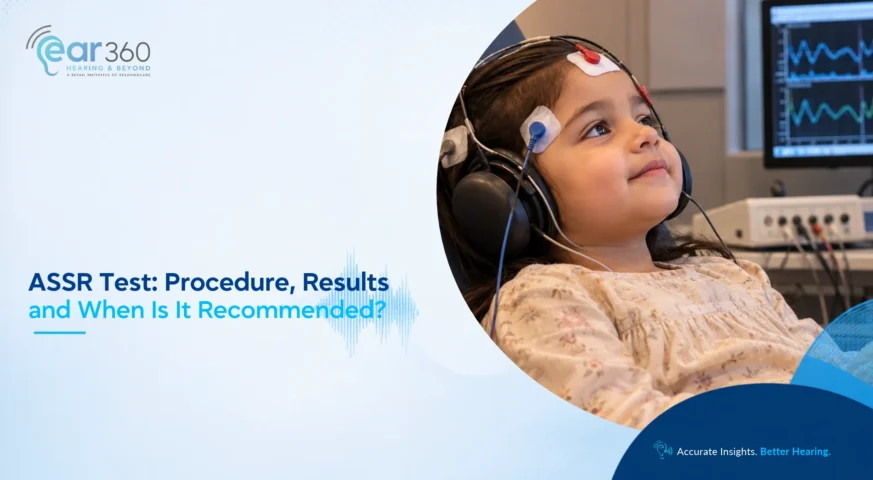
ASSR Test: Procedure, Results, and When Is It Recommended?
ASSR Test: Procedure, Results, and When Is It Recommended? This blog is aimed at parents of babies and young children, as well as older children or adults who may not be able to give reliable responses during a standard behavioural hearing test and have been advised to undergo an ASSR test. The blog explains what an ASSR test is and how it works, including how electrodes record the auditory system’s electrical response to sounds to estimate hearing sensitivity at different frequencies. It covers when an ASSR test may be recommended, particularly for babies, young children, patients with developmental or communication difficulties, inconclusive previous results, or suspected significant hearing loss. The article walks readers through the ASSR test procedure and interpretation of results, including electrode placement, presentation of sounds, recording responses, and how audiologists use the findings alongside other hearing assessments. It also explains the difference between ASSR and BERA/ABR, why these tests may complement each other, and how ASSR results can guide next steps such as further testing, monitoring, medical evaluation, hearing aids, or rehabilitation support. If the audiologist recommended an ASSR test for you or your child, you might be asking yourself why another hearing test is necessary when there were already OAE, BERA/ABR, and other tests conducted. ASSR is an Auditory Steady-State Response. It’s an objective hearing test that measures an electrical response of the auditory system to sound. The test person is not required to press a button, raise a hand, or say the word “hear” when a sound is heard, as would be required with a normal behavioural hearing test. ASSR is very useful, especially when reliable behavioural responses are not available, such as in babies and young children. Each hearing test at Resonnocare is chosen based on the patient’s age, symptoms, and clinical needs, and is not the same test for everyone. What Is an ASSR Test? ASSR tests are an electrophysiological hearing test that can be used to estimate hearing sensitivity at various frequencies of sound. Sounds are played during the assessment using earphones or small insert earphones. These sounds create an electrical response in the auditory system, which is recorded by electrodes attached to the head. A computer analyzes the response and facilitates the audiologist’s estimation of hearing levels at various frequencies. This is helpful because the hearing loss does not occur in every frequency range. Different frequencies may be audible to different people. Information available in the frequency domain can then be used to aid in the understanding of the hearing profile. ASSR is an objective test. This is because the result is not based on the patient knowing when a sound is heard, which is a conscious action. For more information on Resonnocare’s approach to audiology-led hearing assessments, contact them. Know More About BERA Test: Procedure, Uses, Results & When It Is Needed OAE vs BERA Test for Babies: What’s the Difference and When Is Each Needed? BERA Test Price in India: Cost, Procedure & Test Details When Is an ASSR Test Recommended? If detailed objective information regarding hearing levels is required but reliable behaviour tests cannot be obtained, an ASSR test may be recommended by the audiologist. Situations may include: Babies and young children unable to respond reliably in a traditional hearing test Children with developmental or communication problems where behavioural testing is difficult. Those patients with missing or inconclusive hearing-test results Evaluation of a possible significant hearing loss. Situations where there is a need for more objective hearing information in specific areas/frequencies. Situations where ASSR can be used in conjunction with BERA/ABR and other tests Not all people with a hearing loss need the test. Your audiologist will decide whether it is appropriate to use ASSR based on your age, symptoms, medical and hearing histories, and previous testing and participation in other testing. How Is the ASSR Test Procedure Performed? ASSR is not painful and should not involve an invasive procedure. This is the process that usually takes place, but it may differ slightly depending on age and clinical situation. 1. Preparing the skin The audiologist cleans small areas of skin where the electrodes will be placed. This allows the equipment to get a good record of the electrical responses. 2. Placing the electrodes Small electrodes are placed on the forehead, around the ears, and on the head. These electrodes are not designed to conduct electricity into the body. They only pick up the extremely faint electrical reactions from the auditory system. 3. Presenting sounds Earphones or suitable earphones are inserted or placed around the ears. Then, special test sounds are presented at various frequencies and intensities. 4. Recording the response The equipment measures the electrical signals produced by the auditory system when listening to the sounds. No buttons to press when listening to sounds, as you do in Pure Tone Audiometry. 5. Analysing the results The answers are fed into a computer, which provides a reading of the responses, and the audiologist reads the responses with the other results of the hearing test. The duration will depend on the number of frequencies being tested, the degree of hearing loss of the patient, the level of patient stability, and the quality of the recording. Does a Child Need to Sleep During an ASSR Test? During electrophysiological hearing testing, the child mustn’t be moving or tense during the testing. Movement and muscle activity can interfere with the electrical recording. Sometimes babies are tested when they are sleeping naturally. Therefore, parents may be provided with instructions regarding feeding or sleep schedule prior to the appointment based on the age of the child and the testing protocol. Sometimes, under special circumstances such as when a child cannot maintain adequate stillness and sleep for testing, a clinician may discuss whether another method is required. However, sedation is not a standard requirement for all ASSR assessments, and if used, should be handled under the guidelines of appropriate medical procedure and supervision. Do not change your child’s sleep or feeding pattern without your
Read More