
TL; DR:
This blog is aimed at people with conductive or mixed hearing loss, individuals with chronic outer or middle ear problems, people with single-sided hearing loss, parents of children with congenital ear conditions, and families exploring alternatives when conventional hearing aids are not suitable.
- Bone Conduction Hearing Aids Work by Bypassing the Outer and Middle Ear: Instead of sending amplified sound through the ear canal, a bone conduction hearing aid converts sound into vibrations that travel through the skull directly to the cochlea, making it useful when the normal sound pathway is impaired.
- BAHA and Non-Surgical Bone Conduction Are Not the Same: Bone conduction can be delivered through non-surgical options such as softbands or headbands, while BAHA-type systems use an implanted component to transmit vibrations through bone. A BAHA is also different from a cochlear implant.
- Suitability Depends on the Type of Hearing Loss and Clinical Assessment: Bone conduction may be considered for conductive hearing loss, mixed hearing loss, congenital ear-canal abnormalities, chronic ear conditions, and selected cases of single-sided deafness. Audiometry, speech testing, ENT evaluation, and sometimes imaging may be needed before deciding on a device.
- Cost and Treatment Pathway Vary Considerably: The total cost may include the sound processor, implant where required, softband or headband, ENT and hospital charges, hearing tests, imaging, fitting, programming, follow-ups, batteries, accessories, and servicing. The blog also explains that some patients may be able to try a non-surgical bone conduction processor before considering implantation.
You might have heard about a bone conduction hearing aid if an ordinary hearing aid has not been appropriate due to a blocked, malformed, or chronically problematic ear canal. This technology stimulates the inner ear by vibrating through the skull rather than sending amplified sound through the ear canal, as is the normal method.
This may be a significant choice for individuals who have conductive or mixed hearing loss and for certain individuals with unilateral (one-sided) hearing loss. Not all hearing difficulties can be treated with it. The first step at Resonnocare is to do a full hearing evaluation to understand the nature and course of your hearing loss prior to discussing a device.
What Is a Bone Conduction Hearing Aid and How Does It Work?
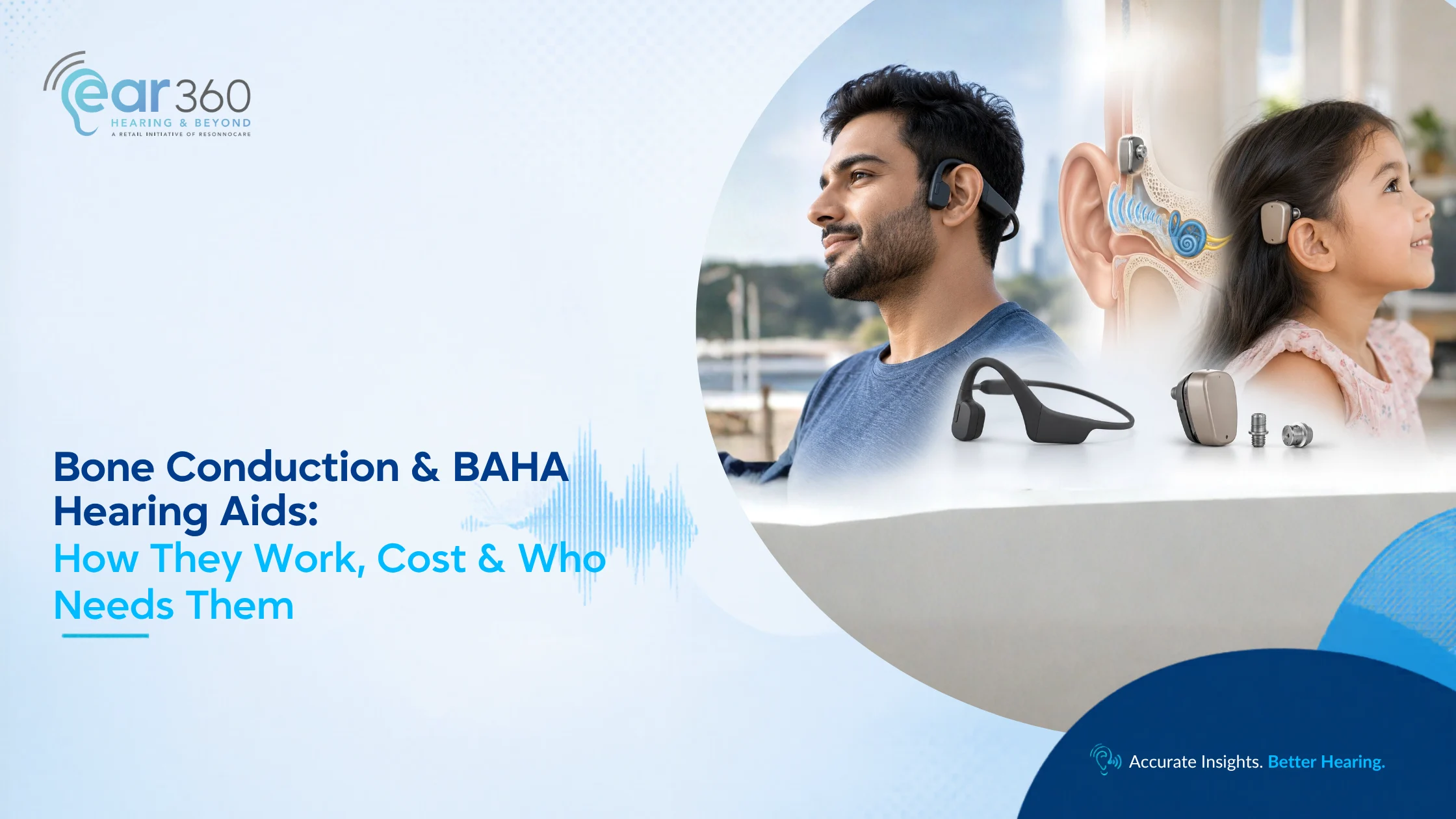
Typically, sound passes from the outer ear, through the ear canal, and then through the middle ear to the cochlea. The bone conduction hearing aid does not. A sound processor transforms sound into vibrations that pass through the bone in the skull to the cochlea.
This will avoid some of the outer or middle ear that are not transmitting sound well. Useful if the inner ear is able to hear sound and there is a problem with how it is being heard by the regular route.
These include some congenital ear-canal atresia and chronic middle-ear disease and other conductive hearing losses. The amount of benefit you can expect will depend on your hearing levels, the function of your inner ears, and underlying diagnosis.
Know More About
- Hearing Aid for Elderly People: Best Features to Look For
- Hearing Aid Trial: What to Expect Before Buying Hearing Aids
- Hearing Aid Center Near Me: Checklist Before Booking an Appointment
Bone Conduction Hearing Aid vs BAHA: What Is the Difference?
The transmission of sound by skull vibration is referred to as bone conduction. Some can accomplish this vibration without surgery with a softband or other methods like a headband.
BAHA stands for bone-anchored hearing system, which means a system in which sound vibration is conducted through the bone with the aid of an implant. For each system, the external processor may be connected with an abutment or magnetically under intact skin with the implant. There are several other varieties of active bone conduction devices.
A BAHA is not a cochlear implant. Cochlear implants work by stimulating the auditory nerve. Bone-anchored systems transmit sound to the working cochlea via vibration.
The key message from the patient’s point of view is that surgery is not a prerequisite for bone conduction, so don’t be afraid to opt for it!
Who May Need a Bone Conduction Hearing Aid?
The bone conduction hearing aid may be suggested when a traditional hearing aid is not appropriate due to the nature of the hearing loss or outer or middle ear conditions.
Your audiologist or ENT specialist might discuss bone conduction in situations such as:
- Conductive hearing loss
- Mixed hearing loss
- Either a complete or partial lack of the ear canal.
- Persistent ear issues that cause the earmould or in-ear device to be difficult to use.
- A few cases of single-sided deafness were selected.
A BAHA implant is not always necessary if you have one of these conditions. All your hearing-test results, your age, ear anatomy, medical history, previous treatment, and your daily communication needs are important.
A non-surgical processor may be employed with a softband for some children prior to considering an implant. Audiology and ENT assessment should be co-ordinated in paediatric cases.
What Tests Are Needed Before Choosing Bone Conduction or BAHA?
It’s not whether the device options should be purchased. It’s the nature of the hearing loss.
Typically, pure-tone audiometry is used to record air-conduction and bone conduction hearing thresholds. Your audiologist will be able to tell if the problem is in the outer or middle ear by comparing these results.
Speech testing can also be used to find out how well you can recognise words.
ENT exam might be required to evaluate the ear canal, eardrum, and middle ear. Depending on your anatomy and the system being evaluated, further medical evaluation and/or imaging may be needed if you are considering implantation.
A processor can also be used in some patients prior to discussing surgery.
Resonnocare’s hearing care for all ages starts with assessment and clinically guided recommendations rather than choosing a device based only on symptoms.
How Much Does a Bone Conduction Hearing Aid Cost in India?
The price of a bone conduction hearing aid in India cannot be fixed, as the term may be used for a non-surgical solution, a sound processor, or a full-fledged hearing implant system.
There are wide variations among public Indian estimates. In some procedures, it is estimated that you are looking at around ₹45,000 for the initial procedure; in some cases, the full procedure (Bone Anchored Surgical Package) might cost you several lakhs. These prices are not directly comparable to Resonnocare prices, nor do they constitute a treatment quote.
The total price can contain the following:
- Sound processor
- Where necessary, use implantable devices;
- Softband (non-surgical) or Headband
- ENT specialist and hospital charges
- Pre-operative hearing tests
- Use of imaging as needed for clinical purposes.Imaging for medical need.
- Fitting and programming processors.
- Follow-up appointments
- Batteries and accessories and future servicing.
That’s why it’s important to compare only one online price. A lower number might indicate just the processor or a single treatment step in the treatment route.
Ask for an itemised estimate before making a decision. If using health insurance or other health care scheme, check eligibility and inclusions with the health care provider.
Can You Try Bone Conduction Before Surgery?
A non-surgical trial may be a component of the evaluation for many patients. The sound processor can be placed on the skull surface with a softband or test setup without the need for an implanted component, which allows you to hear bone-conducted sound.
It can’t duplicate all the components of an implant system, but it can serve as a resource to talk with your audiologist about sound quality and realistic expectations.
A conventional hearing aid may still be appropriate for some patients. Resonnocare provides professional hearing aid assessment and fitting and a free hearing aid trial where applicable.
The purpose is to determine if the deafness is suited to any particular hearing pathway/device type before making an irreversible long-term commitment.
What Are the Benefits and Limitations of BAHA-Type Systems?
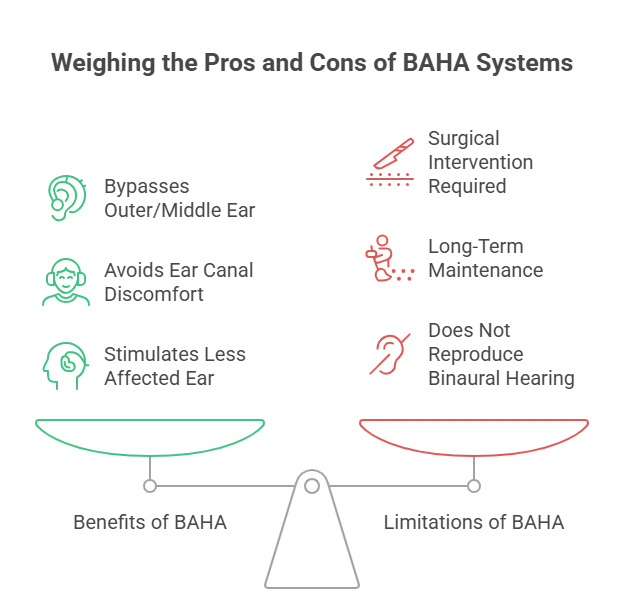
A good one for the appropriate candidate is that sound doesn’t have to pass through an impaired outer or middle ear.
This may be helpful in cases where it is difficult or not working well to wear a device in the ear canal repeatedly, or when hearing loss occurs as a result of the normal pathway of sound transmission becoming blocked.
But it has its drawbacks.
An implantable system requires a medical/surgical route; outcomes are different for each patient. Depending on the system, there may be long-term maintenance requirements for skin-site care, processor, or battery.
For single-sided deafness, it might be helpful to stimulate sound coming from the less affected ear to the better functioning cochlea, which would provide them access to sound coming from that ear. It does not, however, reproduce the normal binaural or two-ear hearing.
Question MRI compatibility, precautions for water, battery usage, processor upgrades, servicing, and long-term follow-up before going.
When Should You See an Audiologist or ENT Doctor?
If you have trouble hearing, middle ear issues that will not go away, a difference in your ears that occurred at birth, trouble hearing with traditional hearing aids, or poor hearing in one ear, make an appointment for a professional evaluation of your hearing.
If you have problems with conversations, school, work, or understanding people in day-to-day situations, then it is important to get a professional evaluation.
If you have any of the following, please see a doctor right away:
- Sudden hearing loss
- Severe ear pain
- Ear discharge
- A new or worsening sense of unsteadiness or dizziness
- One-sided and sudden tinnitus
- Sudden changes in the nature of hearing loss symptoms
The following symptoms don’t need to be treated with a one-off purchase of a hearing device.
If travelling to a clinic is difficult, selected routine services may be available through Resonnocare’s home hearing assessment service. Implant candidacy and specialised investigations may still require an in-clinic or ENT evaluation.
Why Choose Resonnocare for Hearing and Audiology Care?
Hearing care is clinically directed at Resonnocare. Our audiologists and clinicians use highly accurate hearing test results to make recommendations based on your type and degree of hearing loss, not upon a specific type of hearing device.
This might involve home visits, hearing tests, hearing aids, video consultation and aftercare as appropriate, all tailored to your individual care plan.
If your hearing results indicate that a specialised pathway of bone conduction or implants may be appropriate, we will be able to discuss further assessment with you and refer you to ENT or implant assessment.
Also, we help you and your family understand what a proposed hearing solution could realistically do, how it could fit into your daily life and what follow-up care may be needed.

Find a Resonnocare Clinic Near You
Select your city to find the nearest Resonnocare clinic and book an appointment with our hearing care team.
Bangalore
Ear 360, Jayanagar
Ground Floor, Site No. 499, Municipal No. 499/97, East End Main Road, 9th Block, Jayanagar, Bangalore, Karnataka 560041
Timings: 10:00 AM to 7:00 PM
[Call] [Book an Appointment]
Ear 360, Spandana Sarjapura Hospital
239/205/34A, near Trinity Complex, Sompura Gate, Sarjapura Main Road, Bangalore, Karnataka 562125
Timings: 10:00 AM to 7:00 PM
[Call] [Book an Appointment]
Resonnocare, HSR Layout
150/5/72, 7th Cross, 24th Main, HSR Layout, Bangalore, Karnataka 560102
Timings: 10:00 AM to 7:00 PM
[Call] [Book an Appointment]
Resonnocare, Banashankari
272, 7th Cross Road, BSK 1st Stage, 2nd Block, Srinivasan Agra, 80 Feet Road, Bangalore, Karnataka 560050
Timings: 10:00 AM to 7:00 PM
[Call] [Book an Appointment]
Resonnocare, Indiranagar
34, Wind Tunnel Road, Murugeshpalya, Muniyappa Layout, Bangalore, Karnataka 560017
Timings: 10:00 AM to 7:00 PM
[Call] [Book an Appointment]
Resonnocare, JC’s ENT Center, Nagarbhavi
57, 3rd Main Road, 2nd Block, Govindaraja Nagar Ward, Kalyan Nagar, Nagarbhavi, Bengaluru, Karnataka 560072
Timings: 10:00 AM to 7:00 PM
[Call] [Book an Appointment]
Resonnocare, Dr Bhattacharyya ENT Clinic
No. 14, 17th Cross Road, Sector 7, HSR Layout, Bangalore, Karnataka 560102
Timings: 10:00 AM to 7:00 PM
[Call] [Book an Appointment]
Delhi
Ear 360, Dr Hans Anand Lok
46, Anand Lok Road, Anand Lok, Sadiq Nagar, New Delhi, Delhi 110049
Timings: 10:00 AM to 7:00 PM
[Call] [Book an Appointment]
Resonnocare, Dr Hans Vasant Vihar
28, Basement, Paschimi Marg, Vasant Vihar, New Delhi, Delhi 110057
Timings: 10:00 AM to 7:00 PM
[Call] [Book an Appointment]
Resonnocare, Clarity ENT Clinic
Clarity, 2-10, Hauz Khas, New Delhi, Delhi 110016
Timings: 10:00 AM to 7:00 PM
[Call] [Book an Appointment]
Resonnocare, Dr Hans Center for ENT, Punjabi Bagh
2/5, West Avenue Road, West Punjabi Bagh, Punjabi Bagh, New Delhi, Delhi 110026
Timings: 10:00 AM to 7:00 PM
[Call] [Book an Appointment]
Gurgaon
Resonnocare Head Office, M3M Urbana
Office 403, Office Block, 4th Floor, above Retail Blocks R1 and R5, M3M Urbana, Sector 67, Gurgaon, Haryana 122101
Timings: 10:00 AM to 7:00 PM
[Call] [Book an Appointment]
Resonnocare, Dr Hans Sector 28 DLF Ph-1
Metro Station, Plot No. 1SP, adjoining DLF Phase 1, Sector 28, Gurgaon, Haryana 122002
Timings: 10:00 AM to 7:00 PM
[Call] [Book an Appointment]
Ludhiana
Ear 360, BRS Nagar
963, Block B, BRS Nagar, Ludhiana, Punjab 141012
Timings: 10:00 AM to 7:00 PM
[Call] [Book an Appointment]
Resonnocare, Fawwara Chowk
565-A and 565-B, Upper Ground Floor, Cemetery Road, near Fawwara Chowk, West City, Ludhiana, Punjab 141001
Timings: 10:00 AM to 7:00 PM
[Call] [Book an Appointment]
Pune
Ear 360, Vighnaharta Healthcare Center
D-106-107, Choice Arcade, opposite Ruby Hall Hospital, Dhole Patil Road, Pune, Maharashtra 411001
Timings: 10:00 AM to 7:00 PM
[Call] [Book an Appointment]
Ear 360, Khan Parab ENT Hospital
Plot No. 102, Anand Nagar, Talegaon Dabhade, Taluka Maval, Pune, Maharashtra 410507
Timings: 10:00 AM to 7:00 PM
[Call] [Book an Appointment]
Tumkur
Resonnocare, Ashok Nagar
PID No. 3563, 8th Main, 8th Cross, Ashok Nagar, Tumkur, Karnataka 572103
Timings: 10:00 AM to 7:00 PM
[Call] [Book an Appointment]
Resonnocare, Ganadhal ENT and Dental Hospital
3rd Cross, Somashekara Puram, Coffee Board Colony, Tumkur, Karnataka 572102
Timings: 10:00 AM to 7:00 PM
[Call] [Book an Appointment]
Mangalore
Ear 360, Bunts Hostel Circle
Shop No. 6 and 7, Basement Floor, Javed Plaza, Bunts Hostel Circle, Mangalore, Karnataka 575003
Timings: 10:00 AM to 7:00 PM
[Call] [Book an Appointment]
Resonnocare, Dr G K Hebbar ENT Clinic
M-2-153/6, K.S.R.M. Building, Lighthouse Hill Road, Mangaluru, Karnataka 575001
Timings: 10:00 AM to 7:00 PM
[Call] [Book an Appointment]
Resonnocare, Dr Navisha ENT Centre
3rd Floor, Falnir Health Center, Falnir Road, Falnir, Mangaluru, Karnataka 575002
Timings: 10:00 AM to 7:00 PM
[Call] [Book an Appointment]
Mysore
Ear 360, Ramaswamy Circle
371/A, Ramaswamy Circle, Mysore, Karnataka 570024
Timings: 10:00 AM to 7:00 PM
[Call] [Book an Appointment]
Hubli
Ear 360, Vidya Nagar
Srishti Elite, Shirur Park Road, Shirur Park, Vidya Nagar, Hubballi, Karnataka 580031
Timings: 10:00 AM to 7:00 PM
[Call] [Book an Appointment]
Davangere
Ear 360, P J Extension
Shop First Floor, 2nd Main, P J Extension, Davangere, Karnataka 577002
Timings: 10:00 AM to 7:00 PM
[Call] [Book an Appointment]
Indore
Resonnocare, Dr Navnit Jain ENT Hospital
Dr Navnit Jain ENT Hospital, C/o Unique Hospital, 335, Jawahar Marg, Opp. Nafees Bakery, Indore, Madhya Pradesh 452007
Timings: 10:00 AM to 7:00 PM
[Call] [Book an Appointment]
Resonnocare, Hearing Solutions Dr Agarwal
7, Gulmarg Complex, First Floor, near Sapna Sangeeta Lumiere, Indore, Madhya Pradesh 452001
Timings: 10:00 AM to 7:00 PM
[Call] [Book an Appointment]
Conclusion: Is a Bone Conduction Hearing Aid Right for You?
Bone conduction hearing aids may be considered for cases where sound cannot be conducted through the outer or middle ear or, in a few cases, hearing is impaired on one side of the ear. These systems are similar to the BAHA-type systems, but may have an implanted piece, which will differ from the conventional hearing aid in terms of evaluation, procedure, and cost.
There’s no single device that will work for everybody. All your hearing threshold, medical diagnosis, ear structure, age, and daily communication requirements will have to be taken into account.
If you’ve been advised that a standard hearing aid is not right for you, make a hearing assessment or audiology consultation appointment with Resonnocare. We can discuss your hearing outcome, advise you of the options, and help you seek specialist opinion if you are considering an implantable bone conduction device.
FAQ’s
Is there a bone conduction hearing aid?
Yes. Unlike a traditional hearing aid, a bone conduction hearing aid transmits sound vibrations through the bones of the skull straight to the inner ear, which bypasses your outer and middle ear. It might be advised for individuals who suffer from conductive or mixed loss of hearing, chronic ear issues, or some ear canal abnormalities.
What are the side effects of a bone conduction hearing aid?
Non-surgical bone conduction hearing aids are usually safe and comfortable to wear. However, a few people may experience pressure, skin irritation, discomfort, headache, or a woolly sensation at the point of contact with the head. There are also possible risks for surgically implanted bone conduction systems, including complications around the implant site, such as skin issues or infection. An audiologist or ear, nose and throat (ENT) specialist can assist with assessment to see if it is right for you.
Is bone conduction good for hearing?
When sound does not travel normally through the outer or middle ear, but it would pass through the inner ear with enough hearing function, it can be very useful to use bone conduction. It is especially helpful to some people with conductive hearing loss, mixed hearing loss, and single-sided deafness. It is only of benefit if the hearing loss is of a moderate to severe degree and the type of hearing loss is suited to it.
What is the best bone conduction hearing aid without surgery?
The ideal non-surgical bone conduction hearing aid is based on your hearing test, age, comfort, and listening requirements. These can be either bone conduction, softbands, adhesives, or other externally worn devices. Before recommending which device to use, you should get your bone conduction hearing levels checked by an audiologist.
Can fully deaf people hear with bone conduction?
Not always. Bone conduction still requires the cochlea and auditory nerve to have enough functioning hearing ability. A bone conduction hearing aid may not be very helpful if someone suffers from profound inner ear or auditory-nerve damage. A complete evaluation at the hearing clinic is required to decide if your bone conduction or your traditional hearing aid is the best option, or if another hearing solution is better.