
TL; DR:
The blog is aimed at people regularly exposed to loud noise, such as factory or construction workers, frequent headphone users, concert-goers, commuters, parents concerned about children’s listening habits, and anyone noticing hearing difficulty or tinnitus after noise exposure.
- Noise-induced hearing loss can develop gradually or suddenly: It may result from long-term exposure to loud machinery, traffic, music, power tools, or headphones, as well as from a single intense sound such as an explosion or firecracker.
- Early warning signs can be easy to miss: Common signs include difficulty understanding speech in noisy places, needing higher TV volume, trouble hearing on the phone, ringing in the ears, and temporary muffled hearing after loud events.
- Prevention is a major focus of the blog: Readers are advised to limit listening volume and duration, use earplugs or earmuffs, avoid unnecessary exposure to very loud sounds, allow recovery time after noise exposure, and get regular hearing tests when occupational noise is unavoidable.
- Professional hearing assessment helps determine the right treatment: Diagnosis may involve noise-exposure history, pure-tone audiometry, and speech testing, while management can include hearing protection advice, communication strategies, hearing aids, or further ENT evaluation depending on the cause and severity.
Hearing loss may not be noticeable at first. Discussions may become less distinct, people may need to repeat things more frequently, or the volume of the TV may gradually turn up. Loud concerts, noisy machinery, hours spent in traffic, and high-volume music could be damaging your hearing without you realising it.
Repeated loud noise can damage the fine structures of the inner ear, which can be permanent. Noisy exposure to sound can cause permanent hearing loss, and it can be difficult to notice the early signs.
Pay attention to changes in how well you are able to hear and understand speech at Resonnocare. The first step to protecting your hearing for the future is to understand how loud sound affects your ears and when it’s time for your hearing to be checked.
What Is Noise-Induced Hearing Loss?
Noise-induced hearing loss is caused by loud and prolonged exposure to noise. It can occur following a single loud event like a blast or can begin slowly after prolonged exposure to loud work environments, loud music, traffic, machinery, power tools, or personal audio equipment.
In the inner ear are small sensory hair cells that process sound and convert it into a form that the brain can interpret. Too much noise can damage these cells, and some hearing loss caused by noise may be permanent. The illness can affect one or both ears and can sometimes make it harder to hear what the person is saying when there’s background noise.
Know More About Hearing Loss
- Noise in the Ears: Is It Always Tinnitus?
- Hearing Loss: Symptoms, Causes, Types & Treatment Options
- At What Level of Hearing Loss Are Hearing Aids Recommended?
What Is Noise-Induced Hearing Loss?
Risk can be a function of volume as well as exposure duration. The louder the sound, the shorter the time it takes to potentially cause damage in general. Exposure to sounds over 85 decibels repeated multiple times can increase the risk, particularly without using hearing protection.
Construction machinery, factory machines, generators, loud traffic, aircraft, concerts, motorcycles, and earphones played at high volume are typical sources. Acoustic trauma may also occur suddenly with a loud noise like a firecracker, an explosion, or a gunshot, and can cause immediate hearing problems or a ringing sound. For many, though, the issue progresses slowly over months or years.
What Are the Early Signs of Noise-Induced Hearing Loss?
However, early changes are very often easy to shrug off. You might be able to hear sounds, but may not be able to understand speech, particularly when listening to people talking at restaurants, meetings, in family groups, or other loud areas.
People might need to talk louder before you can hear them, turn on the TV more than they do, have trouble hearing on the phone, or hear ringing after loud noises. Another tip-off is difficulty hearing after attending a concert, wedding, festival, or spending a long time in a loud environment. If, though, hearing appears to come back to normal, repeated occurrences indicate that your ears are being stressed.
If you also have ear blockage, tinnitus, pain, or other concerns, our guide to ear symptoms and conditions can help you understand when an assessment may be useful.
When Should You See an Audiologist or Doctor?
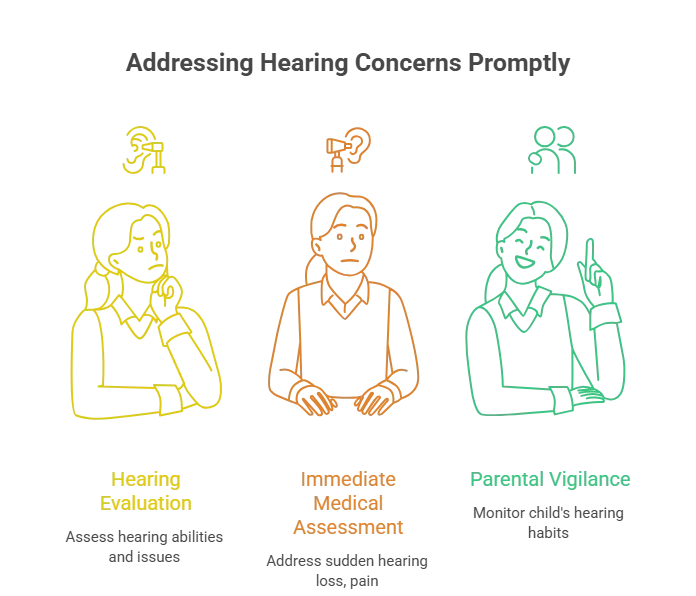
If you have any of the following symptoms, consider a hearing evaluation:
- For a long time you have had trouble hearing what people are saying;
- You often hear a ringing sound in your ears;
- You can hear a big difference between your two ears;
- You have trouble hearing after exposure to loud noise more than a few times.
Immediate medical assessment is required if there is sudden hearing loss, a great deal of ear pain, ear discharge, severe dizziness, or if there is a sudden change in tinnitus. There are other causes of sudden hearing loss, beyond noise exposure, and it may require immediate treatment.
Parents should also pay attention if a child uses headphones at high volume or seems to have difficulty hearing at school. Resonnocare provides hearing care for people of different age groups according to symptoms and clinical findings.
How Is Noise-Induced Hearing Loss Diagnosed?
The first step in diagnosis is an evaluation of your hearing and noise-exposure history. The audiologist might ask about your work, earphones, exposure to loud music or machinery, ear troubles, medications, and when you first noticed the change.
Pure tone audiometry tests the lowest sound level that you can detect at a variety of frequencies, while speech testing can help to determine if you are able to hear words clearly. Additional tests may be suggested if necessary.
A pattern of hearing loss during a hearing test may sometimes indicate noise-related damage, but there are many other factors that can impact hearing, such as age, earwax, middle ear issues, ear infections, medications, and other conditions.
For this reason, professional assessment is crucial. The goal is not just to verify that hearing has changed, but to find out why and if more medical investigation is required.
Can Noise-Induced Hearing Loss Be Treated?
Treatment depends on the degree of hearing loss, how it affects daily communication, and whether another treatable ear condition is present.
When hearing damage is permanent, management focuses on improving communication, reducing listening difficulty, and protecting remaining hearing. For some people, properly selected and programmed hearing aids can improve access to speech and everyday sounds. Hearing devices should be recommended after a hearing assessment rather than chosen only on price, appearance, or technology.
Pacesetting communication strategies may also be helpful, including facing the speaker, minimizing background noise, and captioning. If you have tinnitus, your audiologist or ENT (ear, nose, and throat) doctor might suggest additional testing.
The best treatment is based on your hearing test findings, daily listening demands, medical history, and symptoms.
How Can You Prevent Noise-Induced Hearing Loss?
The best way to do this is to minimize the amount of harmful noise that gets into your ears. Practical habits include:
- Personal listening level should be kept at a comfortable level, and listen for short periods.
- Stay away from loud music, machinery, firecrackers, or other extreme sounds as far as possible.
- Wear earplugs or earmuffs in noisy environments, concerts, workshops, and loud hobbies.
- Don’t crank up earphone volume to mask the sounds of traffic or others.
- Allow quiet time to the ears following prolonged exposure to loud noise.
- If your work requires occupational noise, please comply with the workplace hearing-protection guidelines.
- Schedule regular hearing tests if loud noises are part of your job or daily routine.
- Parents can assist by setting the volume and ensuring children and teenagers take regular breaks.
This is particularly important if your job involves noisy sounds. Individuals who work in a noisy environment, such as construction, manufacturing, transport, entertainment, aviation, and other occupations, should adhere to the hearing protection guidelines recommended for the workplace.
Can Hearing Recover After Loud Noise Exposure?
Loud sound may cause muffled hearing for a few hours, and then it gets better. This can be a temporary threshold shift, but after appearing recovered, it does not imply that repeated exposures are without effects.
If muffled hearing, tinnitus, fullness, or decreased clarity is ongoing, schedule a hearing test, particularly when hearing loss occurs in only one ear. Better to protect your ears before you notice that they can’t hear very well.
Just don’t expect it to be normal if the bell rings at the end of each concert, change, or loud event. If symptoms recur, consult with an audiologist.

Why Choose Resonnocare for Hearing and Audiology Care?
Your hearing care is clinically directed and focused on what you’re going through in your daily life at Resonnocare. Our highly trained audiologists and clinicians perform an accurate hearing assessment to gain an understanding of your hearing levels, communication challenges, noise exposure, and individual needs.
Your individual care plan might consist of hearing testing, hearing protection counseling, communication strategies, hearing aids as needed, or medical evaluation with an ENT specialist or physician when necessary due to symptoms.
For patients who find travel difficult, home visit support may be available where relevant. Depending on your needs, our team can also guide you regarding video consultation, hearing-aid fitting, follow-up adjustments, and aftercare.
We aim to help you understand your hearing and make informed decisions about the next step.
Find a Resonnocare Clinic Near You
Select your city to find the nearest Resonnocare clinic and book an appointment with our hearing care team.
Bangalore
Ear 360, Jayanagar
Ground Floor, Site No. 499, Municipal No. 499/97, East End Main Road, 9th Block, Jayanagar, Bangalore, Karnataka 560041
Timings: 10:00 AM to 7:00 PM
[Call] [Book an Appointment]
Ear 360, Spandana Sarjapura Hospital
239/205/34A, near Trinity Complex, Sompura Gate, Sarjapura Main Road, Bangalore, Karnataka 562125
Timings: 10:00 AM to 7:00 PM
[Call] [Book an Appointment]
Resonnocare, HSR Layout
150/5/72, 7th Cross, 24th Main, HSR Layout, Bangalore, Karnataka 560102
Timings: 10:00 AM to 7:00 PM
[Call] [Book an Appointment]
Resonnocare, Banashankari
272, 7th Cross Road, BSK 1st Stage, 2nd Block, Srinivasan Agra, 80 Feet Road, Bangalore, Karnataka 560050
Timings: 10:00 AM to 7:00 PM
[Call] [Book an Appointment]
Resonnocare, Indiranagar
34, Wind Tunnel Road, Murugeshpalya, Muniyappa Layout, Bangalore, Karnataka 560017
Timings: 10:00 AM to 7:00 PM
[Call] [Book an Appointment]
Resonnocare, JC’s ENT Center, Nagarbhavi
57, 3rd Main Road, 2nd Block, Govindaraja Nagar Ward, Kalyan Nagar, Nagarbhavi, Bengaluru, Karnataka 560072
Timings: 10:00 AM to 7:00 PM
[Call] [Book an Appointment]
Resonnocare, Dr Bhattacharyya ENT Clinic
No. 14, 17th Cross Road, Sector 7, HSR Layout, Bangalore, Karnataka 560102
Timings: 10:00 AM to 7:00 PM
[Call] [Book an Appointment]
Delhi
Ear 360, Dr Hans Anand Lok
46, Anand Lok Road, Anand Lok, Sadiq Nagar, New Delhi, Delhi 110049
Timings: 10:00 AM to 7:00 PM
[Call] [Book an Appointment]
Resonnocare, Dr Hans Vasant Vihar
28, Basement, Paschimi Marg, Vasant Vihar, New Delhi, Delhi 110057
Timings: 10:00 AM to 7:00 PM
[Call] [Book an Appointment]
Resonnocare, Clarity ENT Clinic
Clarity, 2-10, Hauz Khas, New Delhi, Delhi 110016
Timings: 10:00 AM to 7:00 PM
[Call] [Book an Appointment]
Resonnocare, Dr Hans Center for ENT, Punjabi Bagh
2/5, West Avenue Road, West Punjabi Bagh, Punjabi Bagh, New Delhi, Delhi 110026
Timings: 10:00 AM to 7:00 PM
[Call] [Book an Appointment]
Gurgaon
Resonnocare Head Office, M3M Urbana
Office 403, Office Block, 4th Floor, above Retail Blocks R1 and R5, M3M Urbana, Sector 67, Gurgaon, Haryana 122101
Timings: 10:00 AM to 7:00 PM
[Call] [Book an Appointment]
Resonnocare, Dr Hans Sector 28 DLF Ph-1
Metro Station, Plot No. 1SP, adjoining DLF Phase 1, Sector 28, Gurgaon, Haryana 122002
Timings: 10:00 AM to 7:00 PM
[Call] [Book an Appointment]
Ludhiana
Ear 360, BRS Nagar
963, Block B, BRS Nagar, Ludhiana, Punjab 141012
Timings: 10:00 AM to 7:00 PM
[Call] [Book an Appointment]
Resonnocare, Fawwara Chowk
565-A and 565-B, Upper Ground Floor, Cemetery Road, near Fawwara Chowk, West City, Ludhiana, Punjab 141001
Timings: 10:00 AM to 7:00 PM
[Call] [Book an Appointment]
Pune
Ear 360, Vighnaharta Healthcare Center
D-106-107, Choice Arcade, opposite Ruby Hall Hospital, Dhole Patil Road, Pune, Maharashtra 411001
Timings: 10:00 AM to 7:00 PM
[Call] [Book an Appointment]
Ear 360, Khan Parab ENT Hospital
Plot No. 102, Anand Nagar, Talegaon Dabhade, Taluka Maval, Pune, Maharashtra 410507
Timings: 10:00 AM to 7:00 PM
[Call] [Book an Appointment]
Tumkur
Resonnocare, Ashok Nagar
PID No. 3563, 8th Main, 8th Cross, Ashok Nagar, Tumkur, Karnataka 572103
Timings: 10:00 AM to 7:00 PM
[Call] [Book an Appointment]
Resonnocare, Ganadhal ENT and Dental Hospital
3rd Cross, Somashekara Puram, Coffee Board Colony, Tumkur, Karnataka 572102
Timings: 10:00 AM to 7:00 PM
[Call] [Book an Appointment]
Mangalore
Ear 360, Bunts Hostel Circle
Shop No. 6 and 7, Basement Floor, Javed Plaza, Bunts Hostel Circle, Mangalore, Karnataka 575003
Timings: 10:00 AM to 7:00 PM
[Call] [Book an Appointment]
Resonnocare, Dr G K Hebbar ENT Clinic
M-2-153/6, K.S.R.M. Building, Lighthouse Hill Road, Mangaluru, Karnataka 575001
Timings: 10:00 AM to 7:00 PM
[Call] [Book an Appointment]
Resonnocare, Dr Navisha ENT Centre
3rd Floor, Falnir Health Center, Falnir Road, Falnir, Mangaluru, Karnataka 575002
Timings: 10:00 AM to 7:00 PM
[Call] [Book an Appointment]
Mysore
Ear 360, Ramaswamy Circle
371/A, Ramaswamy Circle, Mysore, Karnataka 570024
Timings: 10:00 AM to 7:00 PM
[Call] [Book an Appointment]
Hubli
Ear 360, Vidya Nagar
Srishti Elite, Shirur Park Road, Shirur Park, Vidya Nagar, Hubballi, Karnataka 580031
Timings: 10:00 AM to 7:00 PM
[Call] [Book an Appointment]
Davangere
Ear 360, P J Extension
Shop First Floor, 2nd Main, P J Extension, Davangere, Karnataka 577002
Timings: 10:00 AM to 7:00 PM
[Call] [Book an Appointment]
Indore
Resonnocare, Dr Navnit Jain ENT Hospital
Dr Navnit Jain ENT Hospital, C/o Unique Hospital, 335, Jawahar Marg, Opp. Nafees Bakery, Indore, Madhya Pradesh 452007
Timings: 10:00 AM to 7:00 PM
[Call] [Book an Appointment]
Resonnocare, Hearing Solutions Dr Agarwal
7, Gulmarg Complex, First Floor, near Sapna Sangeeta Lumiere, Indore, Madhya Pradesh 452001
Timings: 10:00 AM to 7:00 PM
[Call] [Book an Appointment]
Conclusion
Hearing damage should not be accepted as an inevitable consequence of noise, whether it be from the workplace, travelling or entertainment, and should be avoided. A hearing assessment performed by a professional can help determine if you are experiencing noise-induced hearing loss, tinnitus, muffled hearing, or problems understanding people’s speech.
If the change is sudden, involves one ear, or if ear pain is severe, ear discharge is present, vertigo is present, or there is significant tinnitus, early evaluation is particularly critical.
FAQ’s
What can cause noise-induced hearing loss?
Noise-induced hearing loss is hearing loss caused by exposure to loud noises over a long period of time or from exposure to a single loud noise, such as a gunshot or an explosion, or loud machinery, loud music, or loud headphones. These sounds can cause damage to the hair cells in the inner ear, which can result in temporary or permanent hearing loss. Proper ear protection will help to decrease the risk substantially.
Can you fix noise-induced hearing loss?
The inner ear hair cells cannot regenerate, and in most instances, noise-induced hearing loss is permanent. But hearing aids, cochlear implants and hearing rehabilitation can help to make communication easier and improve quality of life. Prompt diagnosis and avoidance of further noise exposure are vital so as to prevent further hearing damage.
What are the treatment options for hearing loss?
Treatment will vary according to the type and cause of hearing loss. This can include medication for infections, earwax removal, hearing aids, cochlear implants, assistive listening devices, or auditory rehabilitation. A thorough hearing exam can aid in deciding on the best treatment for every person.
Can I live a normal life with moderate hearing loss?
Yes, most people with moderate hearing loss can live a normal life and be active people. Many people can keep working, communicating, and participating in everyday activities without much restriction with the appropriate treatment, such as hearing aids and communication strategies. Early intervention can positively impact hearing outcomes and quality of life.
What is stage 4 hearing loss?
The 4th level of hearing loss is considered to be severe hearing loss (HHL > 90dB HL). Individuals with profound hearing loss might not be able to hear even loud sounds and typically use hearing aids, cochlear implants, lip reading, or sign language to communicate. Early evaluations can aid in determining the optimal treatment options.