

TL; DR:
This blog is aimed at people with hearing loss, hearing aid users, seniors, caregivers, and families who are deciding between rechargeable and battery-powered hearing aids, especially those comparing long-term cost, convenience, travel needs, usability, and daily maintenance.
- Rechargeable and Battery-Powered Hearing Aids Work Differently: Rechargeable hearing aids are typically charged overnight, while battery-powered models use replaceable zinc-air batteries. However, battery type alone does not determine hearing quality; fitting, programming, receiver strength, and sound processing remain equally important.
- Rechargeable Hearing Aids May Reduce 3-Year Battery Costs: The blog compares the recurring cost of disposable batteries over three years and explains that rechargeable models can reduce ongoing battery purchases, although charger costs, servicing, device choice, and warranty should also be considered.
- Convenience Depends on Lifestyle and Dexterity: Rechargeable models may be easier for people who struggle with small batteries because of reduced finger dexterity, arthritis, tremors, or poor eyesight, while disposable batteries can be useful for people who prefer instant replacement without waiting for charging.
- The Best Choice Depends on Individual Hearing and Daily Needs: Factors such as hearing loss, amplification requirements, lifestyle, travel habits, Bluetooth usage, access to charging, budget, ear anatomy, and comfort with battery handling should guide the decision rather than choosing one power system as universally better.
The decision to upgrade to a rechargeable hearing aid versus hearing aid batteries may seem like a trivial one, but it can impact your life for years. Maybe you’re wondering about battery life, charging, travel, usability, or the possibility of not having enough battery life.
No one can be pleased with just one. The selection will depend on the type of hearing you need, your lifestyle, your hand dexterity, streaming, and charging. At Resonnocare, we want you to make the cost comparison and convenience comparison and make a decision.
What Is the Difference Between a Rechargeable Hearing Aid and a Battery-Powered Hearing Aid?
The rechargeable hearing aid will typically have a rechargeable battery. You put it in a suitable charger (usually overnight) and use it the following day. The runtime of various models varies based on usage, from a full day of typical use for many models, depending on the model, battery life, Bluetooth streaming, calls, and listening environment.
Activated by a small, disposable zinc air battery, battery-powered hearing aids are used. When the battery gets weak, it is taken out and replaced with a new one.
Neither power system determines hearing quality by itself. Sound processing, fitting accuracy, receiver strength, ear acoustics, and programming remain important. A professional hearing aid consultation should therefore come before choosing a battery type.
Know More About
- Rechargeable Hearing Aids: Benefits, Battery Life, Price & Suitability
- Hearing Aid Prices in India by Type, Features and Technology
- Hearing Aid Trial: What to Expect Before Buying Hearing Aids
Is a Rechargeable Hearing Aid Cheaper Over 3 Years?
It may save on continuous battery consumption, but this will vary based on what device you choose.
The hearing aid purchase price should be differentiated from the powering cost for a fair comparison.
If two battery-powered hearing aids are worn, each battery will last for 5-7 days per device, or 104-146 batteries per year, or approximately 312-438 over three years.
Suppose that the cost of one disposable battery is ₹40; then one such comparison is as follows:
Example | Approximate Cost |
104 batteries per year | ₹4,160 per year |
146 batteries per year | ₹5,840 per year |
The cost of the equipment after 3 years, based on lower usage. | ₹12,480 |
Rates for higher usage are based on a 3-year cost. | ₹17,520 |
These prices are examples, not market prices. Actual cost depends on the size of the battery, brand, daily use duration, streaming, and power usage of the device.
Typically, the regular replacement of batteries is not necessary with a rechargeable model. This charger can come as an add-on or be purchased separately, and in some cases battery servicing may be required later on, depending on the model and warranty.
While cost may be a factor, it is not the only one that should be used to determine the hearing aid.
Is a Rechargeable Hearing Aid More Convenient for Daily Use?
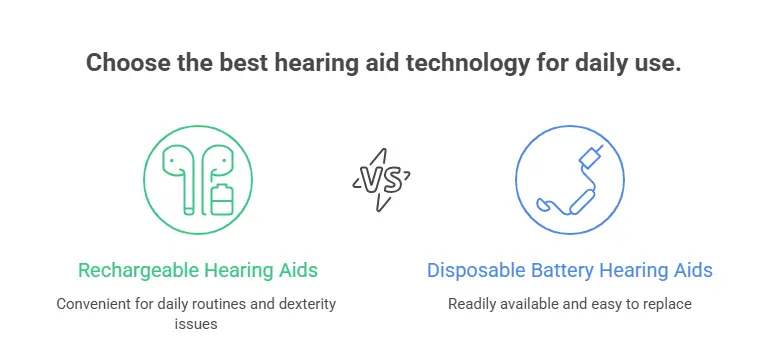
Many people could find charging simpler than repeatedly dealing with small batteries.
It may be helpful if you have decreased finger dexterity, arthritis, tremor, poor eyesight, or just like a set routine. The hearing aids are placed in the charger at night, and in the morning they are ready to wear.
There is another advantage to disposable batteries. When one is needed, you can get a new one on the spot if you have one on hand; no need to wait for charging or look for a power outlet.
The real question is, which technology is newer? This is which routine will be easier for you every day.
A free hearing aid trial can help you assess comfort, sound, device handling, and charging or battery replacement before making a final decision.
Rechargeable Hearing Aid vs Disposable Batteries: Which Is Better for Travel?
If you bring your charger and remember to take it with you, you can use a rechargeable system for travelling purposes. There are also portable charging cases available in some systems that will store energy.
When it’s not certain that you can charge, disposable batteries can be reassuring. A small pack of spares will be easy to transport and is an instant solution to get power back.
Before a long journey, ask your audiologist about expected runtime, portable charging options, and a suitable backup plan. If clinic travel is difficult because of age or mobility, a home hearing care visit may also be relevant, depending on location and need.
Which Option Is Easier for Older Adults?
There is no “best” power system for any age. Sometimes hand function, eyesight, memory, home support, and routine are more important.
Someone who has a problem with small batteries can use a rechargeable system to manage that. If an individual is familiar with battery changes, a battery-powered model might be appropriate. Do not select for a parent; let them try it out and see if it is easy to charge or replace the battery.
Does Bluetooth Streaming Affect Hearing Aid Battery Life?
Yes. Extra power is consumed by phone calls, music, videos, and wireless accessories. Streaming too heavily might reduce the charge life of a rechargeable device, or it could lead to the need for a disposable battery to be replaced sooner.
Let your audiologist know how much you stream on a daily basis. The expectations of your battery should be based on what you have actually used, not on the general brochure estimate.
What Maintenance Does Each Type Need?
Both types require regular maintenance. Clean and proper contact with the charger and proper positioning of rechargeable devices are required. Disposable battery devices require new batteries, clean contacts, and proper storage.
All hearing aids also need suitable cleaning. If sound becomes weak, charging is unreliable, batteries drain unusually fast, or the device feels uncomfortable, professional hearing aid aftercare can help identify whether cleaning, fitting, programming, parts, or servicing are needed.
How Do You Choose the Right Hearing Aid Battery System?
If you have a straightforward routine, don’t like using tiny batteries, use your hearing aids regularly, and you typically can get a place to charge, then a rechargeable hearing aid might be right for you.
For those who prefer to replace their batteries on the spot, do not always have access to a power source, or feel comfortable working with batteries, disposable batteries can be a good choice.
The type and extent of the hearing loss, type of hearing aid, required amplification, ear anatomy, listening environment, connectivity requirements, and budget are also factors your audiologist should take into account. The battery system needs to be able to accommodate the hearing solution and not limit it.
When Should You See an Audiologist or ENT Specialist?
A hearing test can determine the type and extent of hearing loss and whether hearing aids are suitable if the person has been having a gradual difficulty with hearing.
If you experience sudden deafness, sudden and severe earache, ear discharge, new or worsening vertigo, sudden or unilateral tinnitus, or persistent ear symptoms, seek an immediate medical assessment. These concerns cannot be addressed with a hearing aid alone or by simply changing the hearing aid.
This article is provided for educational purposes only and should not be used as an alternative to a physician’s diagnosis and treatment.

Why Choose Resonnocare for Hearing and Audiology Care?
Hearing care starts with an understanding of your hearing needs, not a device, at Resonnocare.
We use a clinically effective method with experienced audiologists and clinicians. By providing accurate hearing assessments, we can learn the extent and how your hearing loss manifests, and by offering personalized care plans, you will also be able to take into account your communication requirements, lifestyle, comfort, and budget.
This may include hearing tests, hearing aids, home visits, video consultation, fitting support, and aftercare as required and in the right setting. We can also assist you with battery comparison, battery handling, charging, and long-term maintenance.
Find a Resonnocare Clinic Near You
Select your city to find the nearest Resonnocare clinic and book an appointment with our hearing care team.
Bangalore
Ear 360, Jayanagar
Ground Floor, Site No. 499, Municipal No. 499/97, East End Main Road, 9th Block, Jayanagar, Bangalore, Karnataka 560041
Timings: 10:00 AM to 7:00 PM
[Call] [Book an Appointment]
Ear 360, Spandana Sarjapura Hospital
239/205/34A, near Trinity Complex, Sompura Gate, Sarjapura Main Road, Bangalore, Karnataka 562125
Timings: 10:00 AM to 7:00 PM
[Call] [Book an Appointment]
Resonnocare, HSR Layout
150/5/72, 7th Cross, 24th Main, HSR Layout, Bangalore, Karnataka 560102
Timings: 10:00 AM to 7:00 PM
[Call] [Book an Appointment]
Resonnocare, Banashankari
272, 7th Cross Road, BSK 1st Stage, 2nd Block, Srinivasan Agra, 80 Feet Road, Bangalore, Karnataka 560050
Timings: 10:00 AM to 7:00 PM
[Call] [Book an Appointment]
Resonnocare, Indiranagar
34, Wind Tunnel Road, Murugeshpalya, Muniyappa Layout, Bangalore, Karnataka 560017
Timings: 10:00 AM to 7:00 PM
[Call] [Book an Appointment]
Resonnocare, JC’s ENT Center, Nagarbhavi
57, 3rd Main Road, 2nd Block, Govindaraja Nagar Ward, Kalyan Nagar, Nagarbhavi, Bengaluru, Karnataka 560072
Timings: 10:00 AM to 7:00 PM
[Call] [Book an Appointment]
Resonnocare, Dr Bhattacharyya ENT Clinic
No. 14, 17th Cross Road, Sector 7, HSR Layout, Bangalore, Karnataka 560102
Timings: 10:00 AM to 7:00 PM
[Call] [Book an Appointment]
Delhi
Ear 360, Dr Hans Anand Lok
46, Anand Lok Road, Anand Lok, Sadiq Nagar, New Delhi, Delhi 110049
Timings: 10:00 AM to 7:00 PM
[Call] [Book an Appointment]
Resonnocare, Dr Hans Vasant Vihar
28, Basement, Paschimi Marg, Vasant Vihar, New Delhi, Delhi 110057
Timings: 10:00 AM to 7:00 PM
[Call] [Book an Appointment]
Resonnocare, Clarity ENT Clinic
Clarity, 2-10, Hauz Khas, New Delhi, Delhi 110016
Timings: 10:00 AM to 7:00 PM
[Call] [Book an Appointment]
Resonnocare, Dr Hans Center for ENT, Punjabi Bagh
2/5, West Avenue Road, West Punjabi Bagh, Punjabi Bagh, New Delhi, Delhi 110026
Timings: 10:00 AM to 7:00 PM
[Call] [Book an Appointment]
Gurgaon
Resonnocare Head Office, M3M Urbana
Office 403, Office Block, 4th Floor, above Retail Blocks R1 and R5, M3M Urbana, Sector 67, Gurgaon, Haryana 122101
Timings: 10:00 AM to 7:00 PM
[Call] [Book an Appointment]
Resonnocare, Dr Hans Sector 28 DLF Ph-1
Metro Station, Plot No. 1SP, adjoining DLF Phase 1, Sector 28, Gurgaon, Haryana 122002
Timings: 10:00 AM to 7:00 PM
[Call] [Book an Appointment]
Ludhiana
Ear 360, BRS Nagar
963, Block B, BRS Nagar, Ludhiana, Punjab 141012
Timings: 10:00 AM to 7:00 PM
[Call] [Book an Appointment]
Resonnocare, Fawwara Chowk
565-A and 565-B, Upper Ground Floor, Cemetery Road, near Fawwara Chowk, West City, Ludhiana, Punjab 141001
Timings: 10:00 AM to 7:00 PM
[Call] [Book an Appointment]
Pune
Ear 360, Vighnaharta Healthcare Center
D-106-107, Choice Arcade, opposite Ruby Hall Hospital, Dhole Patil Road, Pune, Maharashtra 411001
Timings: 10:00 AM to 7:00 PM
[Call] [Book an Appointment]
Ear 360, Khan Parab ENT Hospital
Plot No. 102, Anand Nagar, Talegaon Dabhade, Taluka Maval, Pune, Maharashtra 410507
Timings: 10:00 AM to 7:00 PM
[Call] [Book an Appointment]
Tumkur
Resonnocare, Ashok Nagar
PID No. 3563, 8th Main, 8th Cross, Ashok Nagar, Tumkur, Karnataka 572103
Timings: 10:00 AM to 7:00 PM
[Call] [Book an Appointment]
Resonnocare, Ganadhal ENT and Dental Hospital
3rd Cross, Somashekara Puram, Coffee Board Colony, Tumkur, Karnataka 572102
Timings: 10:00 AM to 7:00 PM
[Call] [Book an Appointment]
Mangalore
Ear 360, Bunts Hostel Circle
Shop No. 6 and 7, Basement Floor, Javed Plaza, Bunts Hostel Circle, Mangalore, Karnataka 575003
Timings: 10:00 AM to 7:00 PM
[Call] [Book an Appointment]
Resonnocare, Dr G K Hebbar ENT Clinic
M-2-153/6, K.S.R.M. Building, Lighthouse Hill Road, Mangaluru, Karnataka 575001
Timings: 10:00 AM to 7:00 PM
[Call] [Book an Appointment]
Resonnocare, Dr Navisha ENT Centre
3rd Floor, Falnir Health Center, Falnir Road, Falnir, Mangaluru, Karnataka 575002
Timings: 10:00 AM to 7:00 PM
[Call] [Book an Appointment]
Mysore
Ear 360, Ramaswamy Circle
371/A, Ramaswamy Circle, Mysore, Karnataka 570024
Timings: 10:00 AM to 7:00 PM
[Call] [Book an Appointment]
Hubli
Ear 360, Vidya Nagar
Srishti Elite, Shirur Park Road, Shirur Park, Vidya Nagar, Hubballi, Karnataka 580031
Timings: 10:00 AM to 7:00 PM
[Call] [Book an Appointment]
Davangere
Ear 360, P J Extension
Shop First Floor, 2nd Main, P J Extension, Davangere, Karnataka 577002
Timings: 10:00 AM to 7:00 PM
[Call] [Book an Appointment]
Indore
Resonnocare, Dr Navnit Jain ENT Hospital
Dr Navnit Jain ENT Hospital, C/o Unique Hospital, 335, Jawahar Marg, Opp. Nafees Bakery, Indore, Madhya Pradesh 452007
Timings: 10:00 AM to 7:00 PM
[Call] [Book an Appointment]
Resonnocare, Hearing Solutions Dr Agarwal
7, Gulmarg Complex, First Floor, near Sapna Sangeeta Lumiere, Indore, Madhya Pradesh 452001
Timings: 10:00 AM to 7:00 PM
[Call] [Book an Appointment]
Conclusion: Is a Rechargeable Hearing Aid the Right Choice for You?
With a rechargeable hearing aid, you can have a very simple daily routine and may save the money and time of purchasing disposable batteries for three years. For those who prefer not to rely on a charger and who want to be able to change the battery on the spot, battery-powered hearing aids are still useful.
The best one for you will be the one that suits your hearing requirements and your lifestyle.
If you don’t know which battery system, style, or technology level is right for you, please make an appointment for a hearing assessment or to consult with Resonnocare. Our audiologists can discuss the pros and cons of the options, their realistic running costs, and which one is best according to clinical need, comfort, and practicality.
FAQ’s
What is the cost of a rechargeable hearing aid?
The price of a hearing aid in India may vary depending on the brand, the technology used, the features, and the style of the hearing aid. The cost of a basic rechargeable pair could begin around ₹20,000/ear to ₹30,000/ear, with more sophisticated or high-end hearing aids, featuring Bluetooth, noise reduction, and AI sound processing, being available for purchase for ₹1 lakh or more per ear. A hearing assessment can determine the right option for your hearing needs and budget.
Which is better, a hearing aid with a battery or a rechargeable one?
They can both be effective, but rechargeable hearing aids might be much easier since you don’t have to buy replacement small batteries frequently. They are particularly helpful for seniors or those with limited hand mobility. For frequent travelers or those who do not want to charge the battery, battery-operated hearing aids may be better suited for their needs.
How many hours a day should you wear a hearing aid?
Most people are encouraged to gradually build up to wearing their hearing aids throughout their waking hours. New users can start with a few hours a day and ramp up as they get used to it. Your audiologist will be able to recommend a schedule for your hearing aids based on your comfort, lifestyle, and hearing level.
Which brand of hearing aid is best for seniors?
No one hearing aid brand is right for all seniors. Phonak, Signia, Oticon, Widex, ReSound, and Starkey are examples of brands that have models with features like rechargeability, simple controls, speech enhancement, and Bluetooth connectivity. This will be determined by the individual’s hearing loss, ear health, lifestyle, dexterity, and budget.
What are the top 3 hearing aid brands?
Popular brands of hearing aids available in India are: Phonak, Signia, and Oticon. Other well-known manufacturers, however, are Widex, ReSound, and Starkey. Instead of a brand name, it is best to choose a hearing aid that meets your audiogram, listening needs, comfort, features, aftercare, and professional fitting.