

TL: DR;
The blog targets people with hearing loss, older adults, caregivers, and family members considering rechargeable hearing aids and comparing them with disposable-battery models.
- How rechargeable hearing aids work: These hearing aids use built-in or removable rechargeable batteries and are generally charged overnight in a charging case. Most modern models use lithium-ion technology.
- Battery life and convenience: Most rechargeable hearing aids provide approximately 16–24 hours of use on a full charge. They are easier to handle, especially for seniors and people with arthritis or reduced hand dexterity.
- Benefits and limitations: Rechargeable models reduce battery waste, provide consistent power, and often include Bluetooth connectivity. However, they require regular access to electricity, may be less flexible during emergencies, and can require professional battery servicing after several years.
- Suitability and purchasing decision: Rechargeable hearing aids are best suited to users with predictable charging routines who value convenience and low maintenance. A hearing assessment, professional recommendation, and trial period can help determine whether they match the user’s hearing needs, lifestyle, and budget.
The best rechargeable hearing aid is not simply the model with the longest advertised battery life. It should be clinically suitable, comfortable to handle, correctly programmed, supported by dependable aftercare, and able to last through the user’s typical day.
Changing tiny hearing aid batteries every few days can be inconvenient, especially for older adults or anyone who finds small batteries difficult to handle.
There is also the worry of the battery running out during a conversation, while travelling, or at an important appointment.
Rechargeable hearing aids offer a simpler alternative.
Instead of replacing disposable batteries, you place the hearing aids in their charging case, usually overnight, and they are ready to use the next day.
This can make daily hearing care easier, more convenient, and less stressful.
However, rechargeable hearing aids are available in different styles, technology levels, and price ranges.
Battery life, charging time, features, charger design, quick-charging capability, portable-charging options, and suitability can vary from one device to another.
This guide explains how rechargeable hearing aids work, their benefits and limitations, how much they may cost, and what to consider before choosing one.
At Resonnocare, our audiologists can help you find an option that suits your hearing needs, lifestyle, comfort, and budget.
This article provides general educational information. Hearing aid selection should follow an appropriate hearing assessment and should not replace medical evaluation when symptoms such as sudden hearing loss, severe dizziness, ear discharge, bleeding, or significant ear pain are present.
What Are Rechargeable Hearing Aids?
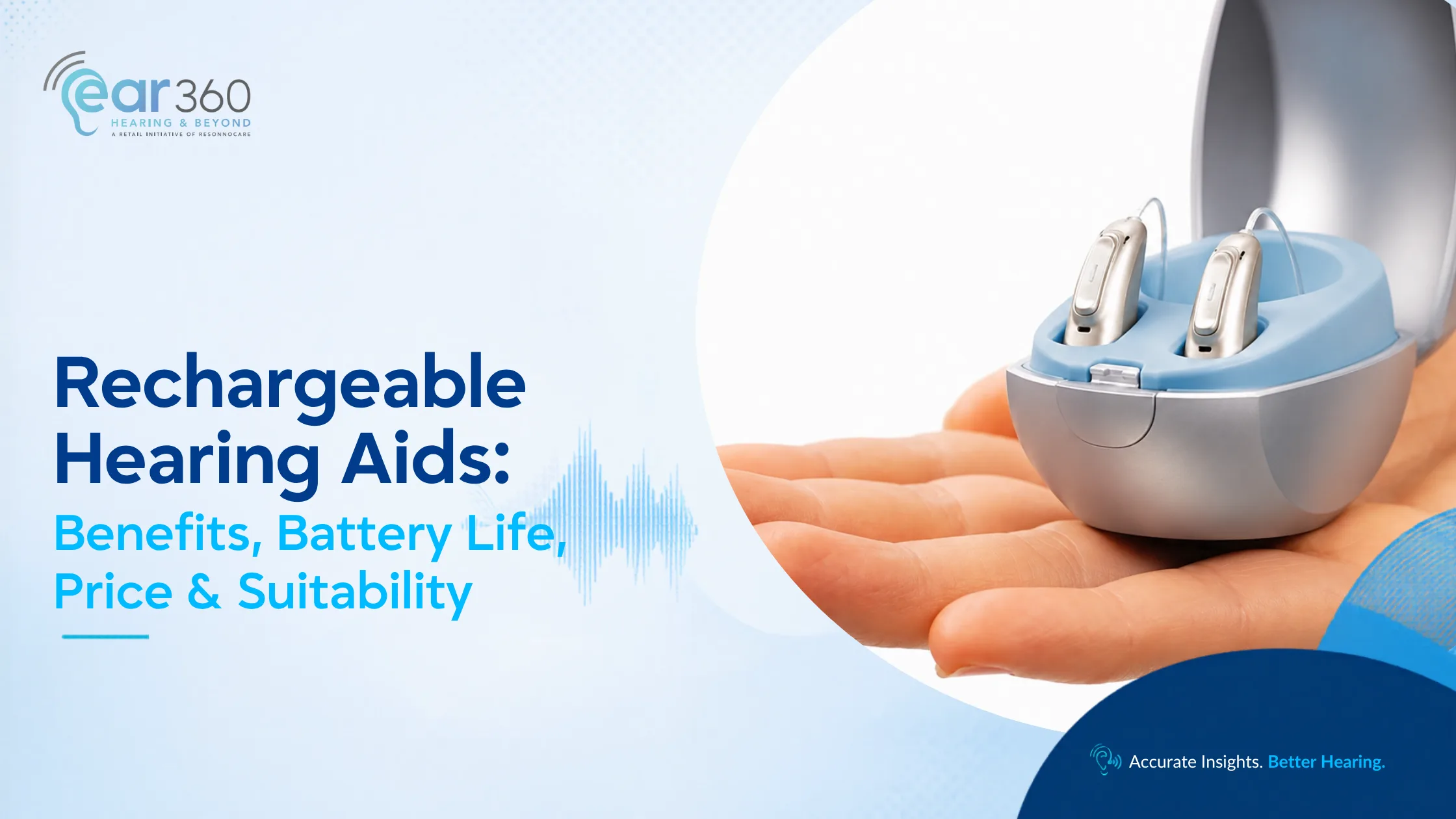
Rechargeable hearing aids have a built-in or removable rechargeable battery instead of the small disposable battery used in traditional hearing aids.
Most current rechargeable hearing aids contain a lithium-ion battery and are placed in a compatible charging case, much like a mobile phone is connected to a charger.
Charging time varies by model. Some devices take approximately two to four hours to reach a full charge, while selected chargers also provide a shorter quick-charge option for several additional hours of use.
Today’s rechargeable hearing aids commonly use lithium-ion battery technology, which is designed to deliver stable power throughout the day and support repeated charging cycles.
ASHA describes rechargeable hearing aids as devices with built-in lithium batteries that remove the need to regularly purchase and replace disposable batteries.
Some models and older rechargeable systems may use removable rechargeable batteries, although the availability of these designs varies by manufacturer and product generation.
“Rechargeable hearing aids have removed one of the biggest daily barriers to consistent hearing aid use: the frustration of managing tiny disposable batteries. For older adults especially, placing the device in a charging case each night may make daily hearing aid use simpler and more consistent.”
Resonnocare – EAR360 Audiology Clinics
How Do Rechargeable Hearing Aids Work?
Rechargeable hearing aids work in the same basic way as other digital hearing aids. Microphones collect sound, a digital processor adjusts the sound according to the programmed hearing profile, and a receiver delivers the processed sound into the ear.
The difference is the power source. Instead of opening a battery compartment and inserting a disposable zinc-air battery, the user places the hearing aids in a compatible charger. Electrical energy is stored in the rechargeable battery and powers the device when it is worn.
A typical daily routine involves:
- Removing the hearing aids before sleeping
- Cleaning visible wax or moisture
- Placing the right and left devices in the correct charging ports
- Checking that the charging indicators appear
- Leaving the devices to charge for the recommended period
- Removing them from the charger before use
- Checking the battery level through the hearing aid indicator or smartphone application where available
Some rechargeable devices turn off automatically when placed in the charger and turn on when removed. The exact operation depends on the model and charger.
Rechargeable vs Disposable-Battery Hearing Aids
Feature | Rechargeable Hearing Aids | Disposable-Battery Hearing Aids |
Power source | Built-in or selected removable rechargeable battery | Replaceable zinc-air battery |
Daily routine | Place the device in a charger | Replace the battery when depleted |
Battery handling | No frequent handling of tiny batteries | Requires opening the compartment and inserting batteries |
Power during travel | Requires charger, power bank, or available electricity | Spare batteries can be carried and replaced immediately |
Battery waste | Generates less routine disposable-battery waste | Used batteries must be replaced and disposed of regularly |
Upfront cost | May include a higher device or charger cost | May have a lower initial price in some technology levels |
Ongoing cost | May eventually require battery or charger servicing | Requires repeated battery purchases |
Bluetooth use | Commonly available, depending on model | Also available in many disposable-battery models |
Emergency flexibility | Depends on remaining charge and charger access | A depleted battery can usually be replaced immediately |
Dexterity needs | Often easier for people who struggle with small batteries | May be difficult for users with reduced hand control or vision |
Neither option is automatically better for every patient. The correct choice depends on the user’s daily routine, travel, access to electricity, handling ability, streaming use, hearing-loss level, device style, and budget.
Quick Decision Table: Rechargeable or Disposable Battery?
Decision factor | Rechargeable may be more practical when… | Disposable-battery may be more practical when… |
Dexterity and vision | You find small battery doors, stickers, and tiny cells difficult to handle. | You can comfortably replace small batteries and prefer direct control over the power source. |
Charging routine | You can reliably place the hearing aids in their charger every night. | You may forget nightly charging or prefer changing a battery only when needed. |
Travel and power reliability | You usually have dependable electricity or can carry a portable charging case or compatible backup power source. | You often spend long periods away from charging access and want to carry several spare batteries. |
Bluetooth and streaming use | You want modern wireless features and the selected model offers enough real-world battery endurance for your typical streaming pattern. | You need the flexibility to replace the battery immediately if heavy wireless use depletes power. |
Daily wearing time | The device comfortably covers your normal waking hours between charges. | You need unusually long continuous use and the selected rechargeable model may not cover that duration. |
Budget planning | You are comfortable considering the charger, future battery servicing, and aftercare as part of the total cost. | You prefer a potentially lower upfront device cost and are comfortable purchasing batteries over time. |
Emergency flexibility | A quick-charge or portable-charging option gives you enough backup for unexpected situations. | You want to restore full power immediately by inserting a fresh battery. |
A practical decision should be based on the whole routine rather than battery type alone. During counselling, compare dexterity, charging consistency, travel frequency, electricity reliability, Bluetooth use, daily wearing hours, and total budget together.
How Long Does the Battery Last on Rechargeable Hearing Aids?
One of the first questions patients consider is battery life, and it is a practical one.
Most rechargeable hearing aids are designed to provide all-day use after a full charge.
However, there is no single battery-life figure that applies to every device. Current manufacturer specifications illustrate the range: some models advertise approximately 16 to 20 hours per charge, while selected newer models advertise significantly longer operation.
The typical user may be able to wear the device throughout the day and charge it once each night.
Bluetooth streaming, television streaming, phone calls, remote microphones, powerful receivers, and advanced processing may reduce the operating time available from one charge.
Note that battery performance may change over time.
After several years of use, a lithium-ion battery may no longer hold as much charge as it did when it was new.
That is normal, and the expected service life varies by manufacturer, model, charging habits, and use.
Your audiologist can provide information about what to expect from the specific hearing aid you are considering.
Built-in rechargeable batteries are generally not intended to be replaced by the user. If operating time becomes significantly shorter or the battery develops a fault, the hearing aid may need to be sent for professional servicing.
Daily Runtime by Streaming Intensity
Battery-life claims should be interpreted in the context of how the hearing aids are actually used. Streaming does not reduce battery life by the same amount for every model, so fixed hour-by-hour estimates can be misleading. A more useful comparison is to ask how the device performs under your normal pattern of wireless use.
Typical use pattern | Examples | Expected effect on daily battery use | What to confirm during a trial |
Low streaming | Mostly face-to-face listening with occasional app checks or short calls | Usually closer to the device’s normal non-streaming operating pattern | Whether the hearing aids comfortably last through your usual day |
Moderate streaming | Regular phone calls, some television streaming, music, or online meetings | May reduce the hours available compared with mostly acoustic listening | Whether you still finish the day with a practical battery reserve |
High streaming | Frequent calls, extended TV or music streaming, remote microphone use, or long virtual meetings | Can increase power demand and shorten operating time more noticeably | Whether a full charge, quick charge, or portable charger is enough for your routine |
Ask the audiologist to demonstrate the battery estimate for the exact model and to explain whether the manufacturer’s quoted figure includes wireless streaming. Real-world trial use is more useful than comparing only the highest advertised runtime.
What Affects Rechargeable Hearing Aid Battery Life?
The number of hours available from a full charge can be affected by:
- The hearing aid model
- The age and condition of the battery
- The power required for the user’s hearing loss
- The receiver or speaker strength
- Daily wearing time
- Bluetooth phone calls
- Music and television streaming
- Remote-microphone use
- Wireless connection between two hearing aids
- Automatic environmental processing
- Tinnitus-support programs
- Temperature and environmental conditions
- The condition of the charger and charging contacts
- Whether the device reached a full charge
- Software and firmware settings
Manufacturer guidance confirms that battery operation can vary according to active features, wireless accessories, hearing-loss requirements, battery age, and the sound environment.
When comparing rechargeable hearing aids, ask for the estimated operating time under your likely usage pattern rather than relying only on the maximum advertised figure.
How Long Do Rechargeable Hearing Aids Take to Charge?
Many rechargeable hearing aids reach a full charge in approximately two to four hours, although the exact time depends on the device and charger.
Some current systems advertise:
- A full day of power after approximately one to three hours of charging
- Several hours of use after a quick charge of 15 to 30 minutes
- Portable chargers capable of recharging the hearing aids multiple times without being connected to a wall socket
For example, selected Phonak guidance states that compatible devices can require up to three hours for a full charge, while selected Oticon systems advertise a full day’s power in one to two hours. These figures are model-specific and should not be assumed for every hearing aid.
Ask the audiologist:
- How long does a full charge take?
- How much use does a quick charge provide?
- Can the charger operate as a portable power bank?
- How many extra charges can the portable case provide?
- Can the devices safely remain in the charger overnight?
- What do the charging indicator lights mean?
- What happens during a power cut?
What If You Forget to Charge Your Hearing Aids?
If you forget to charge rechargeable hearing aids, first check the remaining battery level before assuming the device will not last. If the battery is low, use the manufacturer-approved quick-charge function when available. Some models can provide additional listening time after a short charging period, but the amount varies by device.
For people who frequently forget to charge, practical backup planning may include:
- Keeping the charger in the same visible place every night
- Using a phone reminder or bedtime routine
- Carrying a compatible portable charging case where available
- Keeping the portable charger itself charged
- Checking battery level before leaving home for a long day
- Discussing whether a disposable-battery model would be more practical if missed charging happens often
Do not use an incompatible charger or improvised power accessory simply to charge the hearing aids faster.
How Can You Check the Remaining Battery Level?
Depending on the model, the battery level may be checked through:
- A smartphone application
- An audible low-battery warning
- An indicator light on the hearing aid
- An indicator on the charging case
- A notification from a connected mobile phone
- A voice announcement from the hearing aid
The low-battery warning should not be ignored, particularly when the user is travelling, attending an appointment, or relying on the hearing aids for important communication.
What Are the Benefits of Rechargeable Hearing Aids?
There are several practical benefits to choosing rechargeable hearing aids that you should understand before deciding.
Ease of Use
Rechargeable hearing aids eliminate the need to regularly handle small disposable batteries.
This can be helpful for older adults, people with arthritis, people with reduced fine-motor control, or anyone who finds battery compartments difficult to manage.
Placing the hearing aids in a charging case at night may be easier than opening a small battery door and correctly positioning a tiny battery.
Rechargeable devices may also be helpful for people with reduced vision who find it difficult to identify battery orientation or remove battery stickers.
Convenience
There is less need to store spare batteries at home or worry about replacing a disposable battery unexpectedly.
A correctly charged device may be ready for use throughout the day.
Some chargers include built-in power storage, allowing the hearing aids to be charged during travel even when a power outlet is temporarily unavailable.
Reduced Disposable-Battery Waste
Disposable hearing aid batteries must be replaced repeatedly.
Rechargeable devices may produce less routine battery waste during their usable life.
They still contain electronic components and rechargeable batteries that require appropriate servicing and disposal at the end of their life. Rechargeable does not mean waste-free.
Consistent Power
Lithium-ion batteries are designed to provide stable power throughout the normal operating period.
The hearing aid should continue delivering its programmed performance until the battery reaches a low-charge level, although the exact behaviour depends on the device.
Integration With Modern Technology
Many rechargeable hearing aids include Bluetooth connectivity, smartphone application control, and wireless accessory compatibility.
This may support phone calls, television listening, music streaming, program adjustments, and remote support.
Rechargeable batteries are commonly used in feature-rich hearing aids because wireless streaming and advanced sound processing require reliable power.
Simpler Night-Time Storage
Placing the hearing aids in the charger can create a predictable storage routine. This may reduce the likelihood of losing the devices or leaving them switched on overnight.
Benefits of Rechargeable Hearing Aids for Seniors
Rechargeable hearing aids may be especially useful for seniors who:
- Have arthritis or reduced finger movement
- Find tiny batteries difficult to hold
- Have reduced vision
- Prefer a simple night-time routine
- Regularly forget to replace disposable batteries
- Use hearing aids throughout most of the day
- Live with a caregiver who can help check the charger
- Prefer not to store small batteries at home
- Use Bluetooth phone or television features
- Want a device that turns on automatically when removed from the charger
However, age alone does not determine suitability. Memory, charging habits, power availability, caregiver support, hearing needs, and the ability to correctly position the devices in the charger should also be considered.
Are There Any Limitations to Consider?
It is just as important to inform patients about the limitations of rechargeable hearing aids as it is to emphasize their benefits.
Charging Dependency
If you do not charge the device or do not have access to power for an extended period, you may find yourself without working hearing aids.
This should be considered by travellers and people living in areas where electricity is unreliable.
A portable charger or power bank may reduce this risk, but it adds another item that must be charged and carried.
Less Flexibility in Emergencies
If a disposable battery runs out unexpectedly, it can usually be replaced with a spare battery.
Sealed rechargeable devices rely on the charging case being available and the battery having enough power.
A quick-charge function may provide several additional hours, but the hearing aid still has to remain in the charger during that period.
Professional Battery Servicing
Many rechargeable hearing aids have sealed battery compartments.
This means that battery replacement at the end of the battery’s usable life is not usually as simple as replacing a disposable battery.
The device may need to be serviced by the manufacturer or an authorized professional.
Ask whether battery replacement is covered under warranty, how long servicing usually takes, and whether a temporary replacement hearing aid is available.
Charger Dependency
The hearing aids may not be usable if the charger is lost, damaged, incompatible, or left behind during travel. A replacement charger may involve an additional cost and waiting period.
Battery Performance Can Decline
A rechargeable battery may gradually provide fewer hours of use as it ages. A noticeable decline should be discussed with the audiologist rather than managed only by repeatedly charging the device during the day.
Limited Style Availability
Rechargeable technology is widely available in Behind-the-Ear and Receiver-in-Canal devices, but it may not be available in every custom In-the-Ear or deep-canal model. Battery size, ear anatomy, and device design can limit the available options.
Higher Initial Cost
The rechargeable battery, charger, and portable-charging features may increase the initial hearing aid price compared with some disposable-battery alternatives at a similar technology level.
Each of these limitations does not make rechargeable hearing aids unsuitable.
They provide an opportunity to have an honest conversation with your audiologist before making a decision.
How Long Does a Hearing Aid Charger Last, and When Should It Be Replaced?
There is no universal lifespan for a rechargeable hearing aid charger. Its usable life depends on the charger design, cable condition, charging contacts, internal power-bank battery where present, travel handling, moisture exposure, and manufacturer support. A charger does not usually need replacement on a fixed annual schedule.
Ask for a charger assessment or replacement if:
- Charging becomes intermittent even after the contacts are cleaned correctly
- The cable, adapter, case, or charging port is physically damaged
- A portable charging case holds much less backup power than before
- One charging port repeatedly fails while the other continues to work
- The charger becomes unusually hot, swollen, cracked, or produces an unusual smell
- The manufacturer no longer supports the charger for the hearing aid model
Before purchase, confirm the replacement cost, warranty coverage, charger availability, and whether a temporary charging option is available if the original charger requires servicing.
Benefits and Limitations at a Glance
Potential Benefits | Possible Limitations |
No frequent disposable-battery changes | Requires a regular charging routine |
Easier handling for many seniors | May be inconvenient during prolonged power cuts |
Reduced routine battery waste | The built-in battery may require professional servicing |
Stable daily power | Battery capacity can decline with age |
Often supports Bluetooth and wireless features | Streaming may reduce operating time |
Simple night-time storage routine | A lost or damaged charger can interrupt use |
Portable charging may be available | Portable chargers may increase the purchase price |
No need to carry small batteries | Emergency battery replacement is not immediate |
Rechargeable Hearing Aid Safety and Charging Precautions
Rechargeable hearing aids are designed for regular daily charging, but they should be used according to the manufacturer’s instructions. The FDA has warned that rechargeable medical devices can overheat if they are charged incorrectly or used with unsuitable charging equipment.
Follow these precautions:
- Use only the charger and power supply recommended for the hearing aids
- Do not place disposable zinc-air hearing aids in a rechargeable charger
- Keep the charger away from water and excessive moisture
- Do not cover the charger with bedding, clothing, or other insulating material
- Do not use damaged charging cables or adapters
- Keep the charging contacts clean and dry
- Do not attempt to open or replace a sealed battery yourself
- Stop using a device that becomes unusually hot, swollen, damaged, or emits an unusual smell
- Contact the hearing-care professional if charging becomes inconsistent
- Keep hearing aids and charging equipment away from children and pets
- Follow air-travel and storage instructions provided by the manufacturer
- Do not expose the hearing aids or charger to extreme heat
A hearing aid may feel slightly warm immediately after charging, but a device that becomes unusually hot or causes discomfort should not be worn until it has been checked.
How Does the Price of Rechargeable Hearing Aids Compare?
Rechargeable hearing aids may cost slightly more at the time of purchase than hearing aids using disposable batteries.
This is because they include a built-in rechargeable battery and a charging unit or case.
However, disposable batteries need to be replaced regularly, and these costs can add up over time.
When you consider the expense of batteries over several years, the overall cost difference between rechargeable and disposable-battery hearing aids may become smaller.
The long-term comparison also depends on charger replacement, rechargeable-battery servicing, electricity use, warranty coverage, and how frequently disposable batteries would otherwise be replaced.
The final price also depends on the hearing aid style, technology level, brand, sound-processing features, and connectivity options such as Bluetooth.
At Resonnocare, our audiologists explain both the initial price and possible long-term costs, helping you compare suitable options clearly.
The goal is to help you choose a hearing aid that meets your hearing needs, daily routine, and budget rather than focusing only on the purchase price.
Rechargeable Hearing Aid Price in India
Rechargeable hearing aids are available across entry-level, mid-range, advanced, and premium technology categories. Resonnocare’s current hearing aid pricing information places hearing aids in India broadly between approximately ₹20,000 and more than ₹4,00,000 per device. Rechargeable models may fall anywhere within this range depending on the brand, style, processing level, and included services.
Indicative Price Category Per Device | What May Be Available | Important Consideration |
₹20,000 to ₹50,000 | Selected entry-level rechargeable devices with basic programming and features | Confirm whether the charger, fitting, and follow-up are included |
₹50,000 to ₹1,25,000 | Mid-range rechargeable devices with improved automation and connectivity | Compare battery life, Bluetooth compatibility, and aftercare |
₹1,25,000 to ₹2,50,000 | Advanced processing, rechargeable RIC or BTE styles, and wider wireless functions | Pay for features that match actual listening needs |
₹2,50,000 to ₹4,00,000 or more | Premium processing, advanced environmental management, and selected high-end models | Premium price does not guarantee the best result for every patient |
These bands are indicative, not fixed quotations. Current prices can vary by clinic, city, product generation, promotional offer, warranty, and bundled professional services.
Prices are often quoted per device. If two hearing aids are recommended, confirm whether the quotation covers one hearing aid or a pair.
What Should the Rechargeable Hearing Aid Price Include?
Before purchasing, ask whether the quotation includes:
- One hearing aid or a pair
- The charging case
- A power adapter and charging cable
- A portable charger or power bank, if offered
- The hearing assessment
- Device selection
- Fitting and programming
- Fitting verification
- Follow-up adjustments
- Cleaning and maintenance guidance
- Wax filters, domes, or earmoulds
- Bluetooth setup
- Smartphone application support
- Warranty
- Rechargeable-battery servicing
- Charger replacement conditions
- Repair coordination
- Aftercare
Request a written quotation that identifies the device model, charger type, included services, warranty duration, and possible future charges.
Long-Term Cost: Look Beyond the Purchase Price
A useful cost comparison should consider total ownership rather than only the first invoice. Rechargeable hearing aids may reduce repeated disposable-battery purchases, but long-term costs can still include charger replacement, battery servicing, repairs, wax filters, domes, earmoulds, professional adjustments, and out-of-warranty service.
Cost area | Rechargeable hearing aids | Disposable-battery hearing aids |
Initial device cost | May include rechargeable technology and charger cost | May be lower in some comparable technology levels |
Routine power cost | Electricity use is generally small, but a charger or portable case is required | Ongoing purchase of zinc-air batteries |
Battery ageing | Built-in battery performance may decline and require professional servicing | Individual batteries are simply replaced when depleted |
Charger cost | Replacement may be needed if the charger is lost, damaged, or no longer performs reliably | No proprietary charging case is required |
Maintenance | Wax filters, domes, cleaning, and professional service may still be needed | The same routine hearing aid maintenance may still be needed |
Aftercare and repairs | Depends on warranty and clinic support | Depends on warranty and clinic support |
When comparing quotations, ask for the expected warranty period, battery-service policy, charger-replacement cost, repair process, and what follow-up care is included. This makes the comparison more realistic over several years of ownership.
Who Are Rechargeable Hearing Aids Best Suited For?
Rechargeable hearing aids can be a convenient choice for many people, especially those who prefer a simple daily routine without changing small disposable batteries.
They may be particularly suitable for:
- Older adults or people who find small batteries difficult to handle
- People who can charge their hearing aids regularly, usually overnight
- Users who prefer a low-maintenance and easy-to-use option
- People who use smartphones, televisions, or other Bluetooth-enabled devices
- Those who want to reduce the waste created by disposable batteries
- People who wear their hearing aids consistently every day
- Users who have reliable access to electricity or portable charging
- People who prefer a device that turns on automatically when removed from its charger
- Caregivers who want a predictable charging and storage routine
However, rechargeable hearing aids may not be the most practical choice for everyone.
People who travel frequently, spend long periods away from a power source, or live in areas with unreliable electricity may find disposable-battery models more convenient.
At Resonnocare, our audiologists consider your hearing needs, daily routine, comfort, hand movement, and technology preferences before recommending a device.
Our hearing care is personalized for people of all ages, so the recommendation is based on what works best for you rather than a single solution for everyone.
Handling difficulties can affect hearing aid use, so battery and control accessibility should be considered as part of the fitting process rather than as an afterthought.
Who May Prefer Disposable-Battery Hearing Aids?
A disposable-battery model may be more practical for people who:
- Frequently travel to places without dependable electricity
- Spend several days away from charging facilities
- Want to replace a depleted battery immediately
- Prefer carrying spare batteries rather than a charger
- Use a hearing aid style that is not available with rechargeable technology
- Do not want to depend on a proprietary charging case
- Need extended continuous use beyond the operating time of a selected rechargeable model
- Live in an area with frequent or prolonged power cuts
- Are comfortable handling small batteries
- Prefer a lower initial purchase price in a suitable technology category
Disposable batteries may power a hearing aid for approximately three to ten days depending on the device, usage, and streaming. Bluetooth streaming can increase power consumption.
The audiologist should compare both options rather than assuming rechargeable technology is appropriate for every patient.
Which Rechargeable Hearing Aid Styles Are Available?
Rechargeable Behind-the-Ear Hearing Aids
Rechargeable BTE hearing aids sit behind the ear and connect to the ear through a tube or custom earmould. They can provide greater power and may be suitable for a wide range of hearing losses.
Rechargeable Receiver-in-Canal Hearing Aids
Rechargeable RIC or RITE hearing aids have a small body behind the ear and a receiver positioned in the ear canal. They are among the most commonly available rechargeable styles and often include Bluetooth and smartphone connectivity.
Rechargeable In-the-Ear Hearing Aids
Some manufacturers offer custom rechargeable ITE hearing aids. These may be easier to handle than smaller canal devices, although availability, size, and suitability depend on the ear anatomy and hearing loss.
Rechargeable Canal Hearing Aids
Rechargeable ITC, CIC, and IIC options are less widely available because smaller devices have limited space for batteries, charging components, and wireless features. Canal-style hearing aids may also be more difficult for some users to insert and remove.
The physical style should be chosen according to hearing loss, power needs, comfort, ear anatomy, dexterity, moisture exposure, and maintenance requirements rather than battery type alone.
Step-by-Step: How to Choose Rechargeable Hearing Aids
Step 1: Complete a Hearing Assessment
Identify the type, degree, and pattern of hearing loss before comparing rechargeable models.
Step 2: Review Your Daily Wearing Time
Estimate how many hours you need the hearing aids to operate between charges.
Step 3: Calculate Your Streaming Use
Consider how often you stream phone calls, television, music, meetings, or remote-microphone audio.
Step 4: Assess Your Charging Routine
Decide whether you can reliably place the devices in the charger every night.
Step 5: Consider Travel and Power Access
Determine whether you need a portable charger, quick-charge capability, or disposable-battery alternative.
Step 6: Review Dexterity and Vision
Check whether you can position the hearing aids correctly in the charger and identify the charging indicators.
Step 7: Compare Battery Specifications
Compare expected daily use, charging time, quick-charge performance, and battery-service policy.
Step 8: Compare the Total Price
Include the device, charger, portable case, fitting, programming, verification, follow-up, warranty, and future battery service.
Step 9: Trial the Hearing Aids
Use a trial where available to assess battery endurance, comfort, sound quality, handling, and charging convenience.
Step 10: Confirm Aftercare
Ask who will help if the charger fails, battery life declines, or the devices do not last through the day.
Can You Try Rechargeable Hearing Aids Before Buying?
Yes, and we recommend it.
Wearing a hearing aid in your daily environment, at home, at work, and in conversation, gives you a better sense of whether it suits your lifestyle than an in-clinic demonstration alone.
Resonnocare offers a free hearing aid trial that allows you to experience the device before committing to a purchase.
Our audiologists guide you through the trial period and are available to answer questions and make adjustments as needed.
Trial availability and conditions can vary by model and clinic, so ask how long the trial lasts, whether a deposit is required, and what happens if the device remains unsuitable.
What Should You Evaluate During a Rechargeable Hearing Aid Trial?
During the trial, evaluate:
- Whether the battery lasts through your typical day
- How much Bluetooth streaming affects battery life
- Whether the charging indicators are easy to understand
- Whether the devices sit securely in the charger
- How long charging takes
- Whether quick charging is sufficient during an emergency
- Whether the charger is easy to carry
- Whether you can insert and remove the hearing aids comfortably
- Speech clarity in quiet surroundings
- Speech understanding in background noise
- Telephone and television listening
- Comfort after several hours
- Whether the devices become excessively warm
- Whether the sound remains consistent towards the end of the day
- Whether the smartphone application is easy to use
Keep a short daily record of wearing time, streaming, charging, and any low-battery warnings. This can help the audiologist determine whether the model matches your routine.
Rechargeable Hearing Aid Trial Checklist
Use this checklist during the trial so the decision is based on your normal day rather than only clinic performance:
- Battery lasted from morning until your normal bedtime
- No unexpected low-battery warning during important activities
- Phone-call streaming did not reduce battery life below your daily requirement
- Television, music, or meeting streaming remained practical
- You could place both devices in the charger correctly without help
- Charging lights and battery indicators were easy to understand
- The charger was practical to carry for work or travel
- Quick charging provided a useful backup when tested
- The devices were comfortable after several hours of wear
- Speech remained clear in quiet and noisy environments
- You could manage the smartphone application if you plan to use it
- The charging case, cables, and accessories were easy to store
- You understand what happens if the battery or charger needs servicing
- The total price and included aftercare are clear
If several of these points are difficult during the trial, ask for a different rechargeable model, a different charger configuration, or a disposable-battery alternative before purchasing.
How to Charge Rechargeable Hearing Aids Correctly
Follow the instructions supplied with the specific hearing aid. A general charging routine may include:
- Clean visible wax and moisture from the hearing aids
- Confirm that the charger is connected to the correct power supply
- Place each hearing aid in the matching right or left charging port
- Check that the charging indicator appears
- Allow the hearing aids to charge for the recommended period
- Keep the charger on a firm, dry, ventilated surface
- Remove the devices when needed or leave them in the charger where manufacturer guidance permits
- Carry the charger when travelling
- Charge the portable case separately where required
- Contact the clinic if charging lights flash unexpectedly or no charge is detected
Some manufacturers recommend leaving rechargeable hearing aids in the charger when they are not being used. Follow the guidance for your model rather than applying one charging rule to every device.
Common Rechargeable Hearing Aid Problems and Solutions
Problem | Possible Cause | What to Do |
Hearing aid does not charge | Incorrect placement, dirty contacts, power issue, or damaged charger | Reseat the device, check power, clean contacts as instructed, and contact the clinic if unresolved |
Battery does not last all day | Heavy streaming, ageing battery, incomplete charge, or increased power requirement | Review usage and arrange battery or programming assessment |
Charging light does not appear | Device not positioned correctly or charger not powered | Remove and reinsert the device and verify the charger connection |
Device becomes unusually hot | Charging or battery fault | Stop using it and contact the hearing-care professional |
Only one hearing aid charges | Incorrect placement, dirty contact, or fault in one port or device | Switch ports only if permitted and seek professional support |
Hearing aid works briefly after charging | Battery deterioration or incomplete charging | Arrange professional battery and charger testing |
No sound after removing from charger | Device is off, wax filter is blocked, or software issue | Restart the device, check the wax filter, and contact the clinic if needed |
Portable charger loses power quickly | Power-bank battery ageing or incomplete charging | Recharge the case fully and request servicing if the issue continues |
Do not open a sealed rechargeable hearing aid or attempt to replace its battery at home.
How to Maintain Rechargeable Hearing Aids
To support battery and device performance:
- Clean the hearing aids daily using the recommended tools
- Replace wax filters and domes when required
- Keep the charger contacts clean and dry
- Store the devices away from heat and direct sunlight
- Avoid wearing the devices while bathing or swimming unless specifically permitted
- Use a hearing aid dryer only if it is compatible with rechargeable devices
- Do not place the charger in a humid bathroom
- Install software or firmware updates through professional guidance
- Have the hearing aids serviced periodically
- Report declining battery life early
- Keep charger cables protected during travel
- Use a protective case when the devices are not being charged
Moisture, earwax, damaged filters, and blocked receivers can affect hearing aid performance even when the battery is fully charged.

Moisture, Sweat, and Humidity: What Rechargeable Users Should Know
Rechargeable hearing aids still need protection from moisture. Sweat, humidity, condensation, wet charging contacts, and storing the charger in a damp area can interfere with charging or device performance. Water resistance varies by model and does not mean the hearing aid or charger is suitable for swimming, showering, or unrestricted water exposure.
After heavy sweating or humid conditions:
- Wipe the hearing aids with the manufacturer-recommended dry cloth
- Check that charging contacts are clean and dry before placing the devices in the charger
- Do not place a wet hearing aid into a charger
- Use only a drying system confirmed to be compatible with rechargeable devices
- Keep the charger away from bathrooms, sinks, and other damp surfaces
- Contact the clinic if moisture exposure is followed by charging problems, distorted sound, or intermittent operation
People with heavy perspiration, frequent outdoor exposure, or humid working environments should discuss moisture protection and compatible drying options during hearing aid selection.
Why Choose Resonnocare for Hearing and Audiology Care?
Making a decision between a rechargeable hearing aid and a traditional hearing aid is only one part of the broader discussion about hearing health.
At Resonnocare, our skilled audiologists and clinicians conduct thorough hearing evaluations to understand your hearing profile before making recommendations.
The assessment may consider the type and degree of hearing loss, speech-understanding ability, ear health, listening environments, dexterity, vision, charging routine, and technology preferences.
We then create a personalized care plan based on your lifestyle, communication needs, and budget.
From hearing testing and device fitting to follow-up adjustments and long-term support, we are with you throughout the hearing-care process.
For patients who cannot visit us in person, we offer home visits and video consultations to reduce barriers to appropriate care.
Some diagnostic tests, physical ear examinations, impressions, initial fittings, and fitting-verification procedures may still require an in-clinic appointment.
After your device is fitted, our aftercare services help ensure your hearing aids continue to perform appropriately over time.
Aftercare for rechargeable hearing aids may include:
- Battery-performance checks
- Charger troubleshooting
- Programming adjustments
- Cleaning and maintenance guidance
- Wax-filter and dome replacement
- Bluetooth setup
- Smartphone application support
- Warranty coordination
- Battery or charger servicing
- Reassessment if hearing changes
We are committed to clinically guided, patient-centred care at every step.
Find a Resonnocare Clinic Near You
Select your city to find the nearest Resonnocare clinic and book an appointment with our hearing care team.
Bangalore
Ear 360, Jayanagar
Ground Floor, Site No. 499, Municipal No. 499/97, East End Main Road, 9th Block, Jayanagar, Bangalore, Karnataka 560041
Timings: 10:00 AM to 7:00 PM
[Call] [Book an Appointment]
Ear 360, Spandana Sarjapura Hospital
239/205/34A, near Trinity Complex, Sompura Gate, Sarjapura Main Road, Bangalore, Karnataka 562125
Timings: 10:00 AM to 7:00 PM
[Call] [Book an Appointment]
Resonnocare, HSR Layout
150/5/72, 7th Cross, 24th Main, HSR Layout, Bangalore, Karnataka 560102
Timings: 10:00 AM to 7:00 PM
[Call] [Book an Appointment]
Resonnocare, Banashankari
272, 7th Cross Road, BSK 1st Stage, 2nd Block, Srinivasan Agra, 80 Feet Road, Bangalore, Karnataka 560050
Timings: 10:00 AM to 7:00 PM
[Call] [Book an Appointment]
Resonnocare, Indiranagar
34, Wind Tunnel Road, Murugeshpalya, Muniyappa Layout, Bangalore, Karnataka 560017
Timings: 10:00 AM to 7:00 PM
[Call] [Book an Appointment]
Delhi
Ear 360, Dr. Hans Anand Lok
46, Anand Lok Road, Anand Lok, Sadiq Nagar, New Delhi, Delhi 110049
Timings: 10:00 AM to 7:00 PM
[Call] [Book an Appointment]
Resonnocare, Dr. Hans Vasant Vihar
28, Basement, Paschimi Nagar, Vasant Vihar, New Delhi, Delhi 110057
Timings: 10:00 AM to 7:00 PM
[Call] [Book an Appointment]
Gurgaon
Resonnocare Head Office, M3M Urbana
Office 403, Office Block, 4th Floor, above Retail Blocks R1 and R5, M3M Urbana, Sector 67, Gurgaon, Haryana 122101
Timings: 10:00 AM to 7:00 PM
[Call] [Book an Appointment]
Resonnocare, Dr. Hans Sector 28
Plot No. 1SP, adjoining DLF Phase 1 Metro Station, Sector 28, Gurgaon, Haryana 122002
Timings: 10:00 AM to 7:00 PM
[Call] [Book an Appointment]
Ludhiana
Ear 360, BRS Nagar
963, Block B, BRS Nagar, Ludhiana, Punjab 141012
Timings: 10:00 AM to 7:00 PM
[Call] [Book an Appointment]
Resonnocare, Fawwara Chowk
565-A and 565-B, Upper Ground Floor, Cemetery Road, near Fawwara Chowk, West City, Ludhiana, Punjab 141001
Pune
Ear 360, Vighnaharta Healthcare Center
D-106-107, Choice Arcade, opposite Ruby Hall Hospital, Dhole Patil Road, Pune, Maharashtra 411001
Timings: 10:00 AM to 7:00 PM
[Call] [Book an Appointment]
Ear 360, Khan Parab ENT Hospital
Plot No. 102, Anand Nagar, Talegaon Dabhade, Taluka Maval, Pune, Maharashtra 410507
Timings: 10:00 AM to 7:00 PM
[Call] [Book an Appointment]
Tumkur
Resonnocare, Ashok Nagar
PID No. 3563, 8th Main, 8th Cross, Ashok Nagar, Tumkur, Karnataka 572103
Timings: 10:00 AM to 7:00 PM
[Call] [Book an Appointment]
Making the Right Choice for Your Hearing with Confidence
Choosing a hearing aid can feel like a major decision, but you do not have to make it alone.
A professional assessment and a clear discussion with an audiologist can help you move forward with greater confidence.
Rechargeable hearing aids can simplify daily device use, particularly for people who find disposable batteries difficult to handle.
However, the right decision depends on more than convenience.
Consider battery life under your actual usage pattern, charging time, access to electricity, travel habits, Bluetooth streaming, device style, battery-service policy, warranty, aftercare, and the total price.
Rechargeable hearing aids are not automatically better than disposable-battery models. The best option is the one that meets your hearing needs, lasts through your day, fits your routine, and can be supported reliably over time.
At Resonnocare, we take time to answer your questions, explain your options clearly, and support you throughout your hearing-care journey.
Book a hearing assessment with Resonnocare and take the first step towards easier conversations and more confident everyday hearing.
FAQ’s
What is the best rechargeable hearing aid to buy?
It is really a matter of charging, preference, comfort, and cost; the best is the one that suits you best. Hearing aid manufacturers Phonak, Signia, and Widex are popular choices for their clear sound, long battery life, Bluetooth connectivity, and ease of charging.
What are the disadvantages of rechargeable hearing aids?
Rechargeable hearing aids generally need to be charged daily, and the battery cannot usually be easily replaced by the hearing aid user. After a few years, the battery may cease to function, in which case, you might need to take it to a service shop. They may also be more expensive than conventional hearing aids.
Which fruit is best for hearing?
Good foods for hearing are fruits high in vitamins and antioxidants. Bananas, oranges, berries, and avocados are good for ear health due to their potassium, vitamin C, and magnesium content, which support blood circulation and nerve function.
Is Whoopi Goldberg deaf?
Whoopi Goldberg is not 100% deaf, but has been open about her hearing loss. She has stated that it might be due to the years of listening to loud music, which may have impacted her hearing.
Does Jodie Foster have hearing loss?
Yes, Jodie Foster has talked about her hearing loss in one ear. However, she has remained in a successful acting/directing career.