
TL; DR:
This blog is designed for individuals experiencing hearing difficulties, tinnitus, or age-related hearing challenges; people preparing for their first hearing test; caregivers; and anyone seeking a clear understanding of the Pure Tone Audiometry (PTA) test process and results.
- Explains the Purpose and Importance of PTA Testing: The article describes Pure Tone Audiometry as the gold-standard hearing assessment that measures the softest sounds a person can hear at different frequencies and intensities, helping to identify hearing loss accurately.
- Guides Readers Through the Entire Testing Process: We provide a step-by-step explanation of how to prepare for the test through this blog, including what happens during the procedure, such as headphone testing and bone conduction assessment, and how long the evaluation typically takes.
- Helps Readers Understand Results and Hearing Health: We will explain how audiograms are used to interpret hearing ability, the different categories of hearing loss, and why professional interpretation is important for identifying the underlying cause of hearing problems.
- Highlights Treatment Options and Ongoing Care: What are the possible next steps after testing, including medical treatment, earwax removal, hearing aids, assistive listening devices, and regular monitoring, while emphasizing Resonnocare’s comprehensive hearing care and patient support services
The uncertainty of an appointment for a hearing test can make it more stressful than it needs to be. You might ask yourself about discomfort, the length of the test, or the results.
Actually, a pure tone audiometry test is a painless and simple test to assess how well each ear hears sounds at various frequencies and intensities. After learning the process, it becomes much easier and comforting.
In this Resonnocare guide, we will outline some of the things you can do to prepare for a pure tone audiometry test, what to expect during the test, and how the results of your hearing test will be interpreted.
What Is a Pure Tone Audiometry Test?
Pure tone audiometry is a test that determines the lowest intensity (loudness) of sound that can be heard at different frequencies (pitches). It is regarded as the “gold standard” for measuring hearing sensitivity. It’s frequently the initial screening to perform after hearing issues are found, such as at a routine checkup, during pre-employment screening, or following an apparent change in hearing.
For the test, you will be required to listen to a series of tones over your headphones and respond to them as soon as you hear any tone, regardless of how soft it is. Pure-tone audiometry is different from tests of brainstem and nerve response since it requires cooperation from the person being tested.
Know More About
- Pure Tone Audiometry Test: What Your Audiogram Means
- Audiometry Test: Procedure, Cost & How to Read the Results
- Audiologist Near Me: How to Choose the Right Hearing Specialist
What Can a Pure Tone Audiometry Test Tell You?
Pure tone audiometry primarily measures hearing sensitivity. It identifies the softest tones you can respond to at different frequencies in each ear and helps the audiologist understand the degree and pattern of hearing loss.
The test can help answer:
- Is hearing reduced in the right ear, left ear, or both?
- Which frequencies are affected?
- What degree of hearing loss is present?
- Do air- and bone-conduction results suggest a conductive, sensorineural, or mixed pattern?
- Is there a meaningful difference between the two ears?
- Does another hearing or medical test need to be considered?
The result is one part of the hearing assessment. PTA does not independently explain every speech-understanding problem or identify the exact medical cause of every hearing loss.
What Causes the Need for a Pure Tone Audiometry Test?
A pure-tone audiometry test is commonly recommended because hearing loss can result from a variety of causes, including:
- Gradually worsening ability to hear, as a result of the natural aging process
- Exposure to prolonged noise, such as traffic, construction, or industrial noise.
- Regular use of earphones at high volume.
- A buildup of earwax that prevents sound from reaching the eardrum.
- Middle ear infections or fluid buildup in the middle ear.
- Some medications that have long-term effects on hearing
- A family history of hearing loss.
Since hearing changes can stem from several different causes, understanding common ear symptoms and conditions beforehand can help you describe your concerns more clearly during your appointment.
What Are the Early Signs You May Need This Test
It may be so mild that it is not noticed for months or years. These are some symptoms that you can look out for:
- Requesting the repetition of words and phrases
- Desires greater volume on TV, phone, or radio than normal
- Difficulty hearing in loud or noisy surroundings and/or in group settings.
- When you interpret the words of others as mumbling.When you think others are mumbling.
- Ringing, buzzing, or hissing noises in ears (tinnitus)
- Difficulty hearing high-pitched noises such as a door buzzer, child’s voice
If you recognize any of these, you can have answers to your questions instead of assuming answers.
Is Pure Tone Audiometry Suitable for Children and Adults?
PTA requires the patient to understand the task and give a reasonably consistent response whenever a tone is heard. Suitability therefore depends more on the ability to participate reliably than on age alone.
Patient | PTA suitability | Possible approach |
Cooperative adult | Usually suitable | Standard air- and bone-conduction testing may be performed as required |
Older child who understands the instructions | Often suitable | The response method can be adapted to the child’s age and attention |
Very young child | Standard adult-style PTA may not be reliable | Age-appropriate behavioural or objective hearing tests may be considered |
Patient unable to provide consistent responses | PTA alone may not provide reliable thresholds | Objective assessments such as OAE or BERA/ABR may be considered depending on the clinical question |
Existing hearing-aid user | Can be useful for reassessment | Results may be reviewed together with speech understanding and hearing-aid performance |
The audiologist should select the hearing test according to the patient’s ability to respond and the information that needs to be obtained.
How Should You Prepare Before the Test?
The great thing about a pure-tone audiometry test is that the amount of preparation required is very little. But a few simple measures will help make the process smoother:
- If possible, avoid exposure to loud noise for 12–16 hours before the test, as recent noise exposure may temporarily affect the results.
- Let your audiologist know if you’ve had ear pain, colds, or ear infections recently.
- Discuss any hearing aids, medication,or previous ear surgery.
- Be a few minutes early to do a brief case history discussion.
This test is not restricted by fasting, special clothes, or extensive prior arrangements, making it available to almost anyone of any age.
Air Conduction vs Bone Conduction: Why Are Both Used?
Air- and bone-conduction testing provide different information about how sound reaches the inner ear. Comparing them helps the audiologist understand whether an outer- or middle-ear problem may be contributing to the hearing loss.
Air Conduction
During air-conduction testing, tones presented through headphones or insert earphones travel through the outer ear, middle ear, and inner ear.
Bone Conduction
During bone-conduction testing, a small vibrator placed behind the ear sends vibration toward the inner ear while bypassing much of the outer and middle ear.
General test pattern | What the audiologist may consider |
Air conduction poorer than bone conduction | A conductive component may be present |
Air and bone conduction reduced by similar amounts | A sensorineural pattern may be present |
Both are reduced but air conduction is additionally poorer | A mixed hearing-loss pattern may be present |
These are general interpretation principles. The complete audiogram, masking, ear examination, tympanometry and other findings may also be needed before the type of hearing loss is determined.
What Is an Air-Bone Gap in Pure Tone Audiometry?
An air-bone gap is a difference between air-conduction and bone-conduction thresholds at the same or similar frequencies.
In simple terms, it can mean that the inner ear responds better when the outer and middle ear are largely bypassed than when sound travels through the complete hearing pathway.
The audiologist may consider conditions involving:
- Earwax or ear-canal blockage
- Middle-ear fluid
- Eardrum problems
- Middle-ear pressure
- Movement of the middle-ear bones
- Other conductive components
An air-bone gap is a test finding rather than a diagnosis by itself. It should be interpreted alongside other clinical information.
What Is Masking During a PTA Test?
When hearing differs significantly between the ears, there are situations in which a tone presented to the test ear may be detected by the other ear. Masking is a testing technique used to help obtain more ear-specific thresholds.
During masking:
- A controlled noise may be presented to the non-test ear
- The audiologist continues testing the target ear
- The responses help establish a more reliable threshold for that particular ear
Masking does not mean the test has found an additional disease. It is part of the audiologist’s method for separating the responses of the two ears when necessary.
How Is a Pure Tone Audiometry Test Performed?
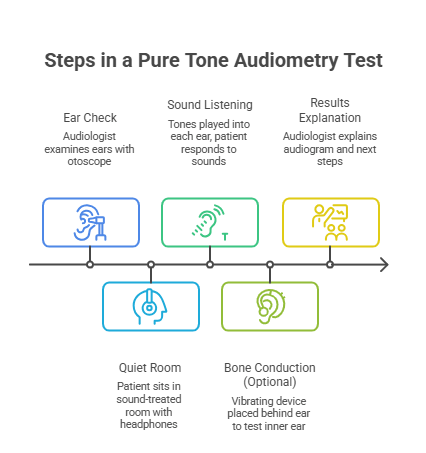
The pure tone audiometry test procedure is rapid, easy, and the time required for this test is usually 20-30 minutes. The appointment is made up of the following:
1. Your Ears Are Checked
The audiologist will use a small instrument known as an otoscope to look at your ears. This will minimize the risk of ear wax, infection, or any obvious problem that could affect the test results.
2. You Sit in a Quiet Room
The test is conducted in a quiet or sound-treated room to reduce the influence of background noise on hearing responses.
3. You Listen to Different Sounds
Earphones or headphones will be required, and you will receive a series of sounds separately into each ear. Some sounds will be loud, some will be low, and some will be quite quiet.
4. You Respond When You Hear a Sound
If you hear a tone, no matter how quiet, you will be required to push a button, raise your finger, or respond in another simple way.
There are no right answers or wrong answers. When this sound is heard, you only have to respond to the sound.
5. Bone Conduction Testing May Be Done
In some instances, the audiologist may put a tiny vibrating gadget behind your ear. This test can help to determine whether the hearing loss is caused by the outer or middle ear or the inner ear.
6. Your Results Are Explained
Once the test is completed, the audiologist will show you your hearing levels and discuss them with you in layperson’s terms. They will also communicate with you if you need extra testing, treatment, hearing protection, or hearing support.
The test is modified at Resonnocare based on the patient’s age and ability to respond. This is ideal for children, working adults, and elderly patients.
How Are Pure Tone Audiometry Test Results Read?
The results of the test are plotted on a graph called an audiogram. The graph keeps track of the lowest sounds you can hear at various frequencies.
The outcomes will include:
- Normal hearing
- Mild hearing loss
- Moderate hearing loss
- Moderately Severe hearing loss
- Severe hearing loss
- Profound hearing loss
The audiologist will also assess if the hearing loss is in one ear or both ears and if there is a problem hearing some pitches over others. This pattern can be helpful to determine the kind and likely cause of hearing loss.
It is always best to have a qualified audiologist interpret an audiogram. Even two people with similar-looking hearing results can get different advice or treatment depending on their symptoms, medical history, and overall hearing need.
PTA Normal Range and Hearing-Loss Levels
A PTA report usually categorizes hearing according to the softest sound levels detected. Exact classification systems may vary, so the audiologist should explain the system used on your report.
Hearing level | General interpretation |
Within the expected range | Softer tones can be detected within the range considered expected by the test system being used |
Mild hearing loss | Some soft sounds or speech detail may become difficult, particularly in noise |
Moderate hearing loss | Normal conversation may become more difficult to follow without support |
Moderately severe hearing loss | Speech may need to be substantially louder to be detected comfortably |
Severe hearing loss | Conversational speech may be difficult without amplification |
Profound hearing loss | Even loud speech and environmental sounds may be difficult to detect |
The degree alone does not describe the complete hearing problem. Which frequencies are affected, whether one or both ears are involved, and how well speech is understood also matter.
Hearing-Loss Degree vs Hearing-Loss Type
Degree and type describe two different parts of the hearing result.
- Degree describes how much hearing sensitivity is reduced.
- Type describes which part of the hearing pathway appears to be contributing to that reduction.
Type of hearing loss | General PTA pattern |
Conductive | Air-conduction thresholds may be poorer than bone-conduction thresholds |
Sensorineural | Air- and bone-conduction thresholds may both be reduced without a significant air-bone gap |
Mixed | Air and bone thresholds may both be reduced, with an additional conductive difference |
A person can therefore have mild conductive hearing loss, moderate sensorineural hearing loss, or another combination of type and degree.
Can Pure Tone Audiometry Detect Every Hearing Problem?
No. PTA is an important measurement of hearing sensitivity, but it does not test every part of auditory function.
PTA alone does not directly measure:
- How clearly you understand words
- How well you understand speech in background noise
- Auditory nerve and brainstem responses
- Middle-ear mechanics
- Cochlear outer-hair-cell responses
- Every cause of tinnitus
- Auditory-processing ability
- The exact medical cause of every hearing-loss pattern
Depending on the symptoms and PTA result, the audiologist may recommend speech audiometry, tympanometry, OAE, BERA/ABR, ENT assessment, or another investigation.
Why Is Speech Testing Important if PTA Already Measures Hearing?
PTA measures the detection of tones. Speech audiometry adds information about whether spoken words can be heard and understood clearly. This can be particularly important when a person says, “I can hear that someone is speaking, but I cannot understand the words.”
Speech testing may help when:
- Speech is unclear despite a relatively mild PTA result
- Background noise creates major communication difficulty
- The right and left ears perform differently
- Hearing aids are being considered
- The clinician needs a more functional picture of communication ability
Two patients with similar pure-tone thresholds may have different speech-understanding abilities, which can influence counselling and hearing-aid expectations.
Why Can Real-Life Hearing Feel Worse Than the PTA Result?
A PTA test uses simple tones in a controlled environment. Everyday listening is much more complicated. Distance, competing voices, traffic, restaurant noise, telephone quality and missing visual cues can all increase communication difficulty.
You may therefore have a relatively mild PTA result but still struggle with:
- Restaurants
- Work meetings
- Telephone conversations
- Family gatherings
- Television dialogue
- Soft-spoken people
- Speech from another room
- Listening fatigue after long conversations
Tell the audiologist about these situations rather than relying only on the degree printed on the hearing report.
When Should You See an Audiologist or Doctor?
While most people will get a pure tone audiometry exam as part of a routine check-up, some symptoms might be an early indicator that it is time to visit the audiologist sooner rather than later:
- Sudden onset (occurring over a few hours) of unusual hearing loss (one or both ears).
- Persistent tinnitus (ear ringing or buzzing).
- Earache, ear discharge, or ear pressure
- Dizziness, loss of balance, and hearing changes
- Hearing loss that lasts for more than several weeks.
Any of these symptoms should be taken seriously and looked into by a health care professional as soon as possible.
Is a PTA Test Enough Before Choosing Hearing Aids?
PTA is a key part of a hearing-aid assessment because it provides the hearing thresholds used to understand the degree and pattern of hearing loss. However, the hearing-aid decision should usually consider more than the PTA graph alone.
The audiologist may also review:
- Speech-understanding ability
- Ear health
- Whether one or both ears are affected
- Daily communication difficulties
- Work and social listening environments
- Tinnitus
- Ability to handle and maintain a device
- Previous hearing-aid experience
- Whether medical or ENT review is required
- Expected benefit from amplification
A hearing aid should therefore be selected for the complete hearing and communication profile rather than only for a PTA number.
What Treatment or Management Options Follow the Pure Tone Audiometry Test
Based on the results of the pure tone audiometry test, your audiologist may suggest:
- Treatment of infection- or fluid-related problems.
- Cleaning ear wax if it is causing hearing loss/impairment
- If you have a confirmed sensorineural hearing loss, you can get a hearing aid.
- Assistive listening devices for particular situations in the workplace or at school.
- Regular checkups for mild or early hearing loss
If hearing aids are suggested, Resonnocare’s free hearing aid trial allows you to try a device in real-life situations before deciding, which many patients find reassuring rather than overwhelming.
PTA Result to Next Step: Quick Decision Guide
PTA result or situation | Possible next discussion |
Result is within the expected range and there are no continuing concerns | Routine monitoring may be sufficient according to the audiologist’s advice |
PTA is relatively good but speech is still difficult | Speech testing or another assessment may be appropriate |
Mild hearing loss with little everyday difficulty | Monitoring, communication strategies and hearing protection may be discussed |
Hearing loss is affecting daily communication | A hearing-aid evaluation or trial may be considered |
An air-bone gap or conductive pattern is present | Ear examination, tympanometry and/or medical assessment may be appropriate |
Sensorineural hearing loss is identified | Discuss the cause, speech understanding, monitoring and hearing-aid suitability |
One ear is substantially poorer | Ask whether additional audiological or medical investigation is required |
Hearing changed suddenly | Seek urgent medical/ENT evaluation rather than treating the result as a routine hearing-aid decision |
Existing hearing aids no longer provide expected benefit | Review hearing levels, speech understanding, device function and programming |
Questions to Ask When Your PTA Results Are Reviewed
Ask your audiologist:
- Is hearing loss present in one ear or both?
- What degree of hearing loss do I have?
- Which frequencies are affected most?
- What do my air-conduction results show?
- What do my bone-conduction results show?
- Is there an air-bone gap?
- Was masking required?
- Does the result suggest conductive, sensorineural, or mixed hearing loss?
- Should I have speech audiometry?
- Do I need tympanometry or another test?
- Is any ENT or medical assessment needed?
- Do I need hearing aids now or should the hearing be monitored?
- When should I repeat the hearing test?
A useful PTA appointment should end with a clear next step rather than only a printed audiogram.
Where to Read Detailed Audiogram Symbols
This guide should focus on PTA preparation, procedure, hearing ranges and next steps. Detailed interpretation of X/O symbols, right-versus-left-ear markings, frequency/decibel axes and audiogram patterns is better handled on the dedicated Pure Tone Audiometry Test: What Your Audiogram Means page.
That creates a clearer content journey:
- PTA guide → procedure, suitability, results and next step
- Audiogram page → detailed report and symbol interpretation
How Can Resonnocare Help
Whether it’s your first hearing test or a routine follow-up, Resonnocare is committed to making every pure-tone audiometry appointment simple and comfortable. Our team explains results in an easy-to-understand way, so you leave with a clear understanding, not a report full of jargon.
For patients who prefer not to travel for every visit, Resonnocare also offers home visits and video consultations, making evaluations and follow-up discussions more convenient.
Why Choose Resonnocare for Hearing and Audiology Care
At Resonnocare, we make sure that everything is about clinically driven, patient-centric hearing care. We have a group of experienced audiologists and clinicians who place importance on an accurate hearing assessment rather than a generic or rushed evaluation, such as a pure-tone audiology test. Each result has a detailed explanation and a tailored care plan customized to your unique hearing loss and lifestyle.
Beyond testing, we support your complete hearing care journey, including hearing aid fitting, video consultations, and structured aftercare to ensure any recommended solution continues to serve you well over time.

Find a Resonnocare Clinic Near You
Select your city to find the nearest Resonnocare clinic and book an appointment with our hearing care team.
Bangalore
Ear 360, Jayanagar
Ground Floor, Site No. 499, Municipal No. 499/97, East End Main Road, 9th Block, Jayanagar, Bangalore, Karnataka 560041
Timings: 10:00 AM to 7:00 PM
[Call] [Book an Appointment]
Ear 360, Spandana Sarjapura Hospital
239/205/34A, near Trinity Complex, Sompura Gate, Sarjapura Main Road, Bangalore, Karnataka 562125
Timings: 10:00 AM to 7:00 PM
[Call] [Book an Appointment]
Resonnocare, HSR Layout
150/5/72, 7th Cross, 24th Main, HSR Layout, Bangalore, Karnataka 560102
Timings: 10:00 AM to 7:00 PM
[Call] [Book an Appointment]
Resonnocare, Banashankari
272, 7th Cross Road, BSK 1st Stage, 2nd Block, Srinivasan Agra, 80 Feet Road, Bangalore, Karnataka 560050
Timings: 10:00 AM to 7:00 PM
[Call] [Book an Appointment]
Resonnocare, Indiranagar
34, Wind Tunnel Road, Murugeshpalya, Muniyappa Layout, Bangalore, Karnataka 560017
Timings: 10:00 AM to 7:00 PM
[Call] [Book an Appointment]
Delhi
Ear 360, Dr. Hans Anand Lok
46, Anand Lok Road, Anand Lok, Sadiq Nagar, New Delhi, Delhi 110049
Timings: 10:00 AM to 7:00 PM
[Call] [Book an Appointment]
Resonnocare, Dr. Hans Vasant Vihar
28, Basement, Paschimi Nagar, Vasant Vihar, New Delhi, Delhi 110057
Timings: 10:00 AM to 7:00 PM
[Call] [Book an Appointment]
Gurgaon
Resonnocare Head Office, M3M Urbana
Office 403, Office Block, 4th Floor, above Retail Blocks R1 and R5, M3M Urbana, Sector 67, Gurgaon, Haryana 122101
Timings: 10:00 AM to 7:00 PM
[Call] [Book an Appointment]
Resonnocare, Dr. Hans Sector 28
Plot No. 1SP, adjoining DLF Phase 1 Metro Station, Sector 28, Gurgaon, Haryana 122002
Timings: 10:00 AM to 7:00 PM
[Call] [Book an Appointment]
Ludhiana
Ear 360, BRS Nagar
963, Block B, BRS Nagar, Ludhiana, Punjab 141012
Timings: 10:00 AM to 7:00 PM
[Call] [Book an Appointment]
Resonnocare, Fawwara Chowk
565-A and 565-B, Upper Ground Floor, Cemetery Road, near Fawwara Chowk, West City, Ludhiana, Punjab 141001
Pune
Ear 360, Vighnaharta Healthcare Center
D-106-107, Choice Arcade, opposite Ruby Hall Hospital, Dhole Patil Road, Pune, Maharashtra 411001
Timings: 10:00 AM to 7:00 PM
[Call] [Book an Appointment]
Ear 360, Khan Parab ENT Hospital
Plot No. 102, Anand Nagar, Talegaon Dabhade, Taluka Maval, Pune, Maharashtra 410507
Timings: 10:00 AM to 7:00 PM
[Call] [Book an Appointment]
Tumkur
Resonnocare, Ashok Nagar
PID No. 3563, 8th Main, 8th Cross, Ashok Nagar, Tumkur, Karnataka 572103
Timings: 10:00 AM to 7:00 PM
[Call] [Book an Appointment]
Conclusion
A pure-tone audiometry test is one of the most accurate and trusted ways to assess your hearing health. Knowing what to expect can help ensure that an uncertain experience is a simple and informative one for you and your family, from preparation to results. If you are having your first hearing test or a routine hearing test, knowing the procedure for the pure-tone audiometry test will make you feel more confident than apprehensive about it.
Our clinical staff is available to help you if you have noticed changes in your hearing or if you just want a baseline. Schedule a pure-tone audiometry test and consultation with Resonnocare today and take another step towards sound health.
FAQ’s
What is the normal range for a hearing test?
For a normal hearing test result, the range of frequencies tested will be between 0 Decibels (dB HL) and 25 Decibels (dB HL). Those in this range can typically hear soft sounds and comprehend conversation without a problem. If the results exceed 25 dB, the person might have mild, moderate, severe, or profound hearing loss, depending on the hearing threshold measured during the evaluation.
Can audiometry diagnose tinnitus?
Audiometry is not used directly to diagnose tinnitus, but it can help determine hearing loss or other ear or hearing problems that could be related to tinnitus. The test assesses your hearing ability and can help determine the acoustic nature of your ringing, buzzing, or other phantom sounds. Further evaluations may be needed for a thorough assessment of tinnitus.
What is the normal PTA of the ear?
A normal Pure Tone Average (PTA) is normally between 0 and 25 dB HL. Hearing thresholds at important speech frequencies are used to calculate PTA, which helps assess overall hearing ability. If your PTA is within normal limits, your hearing is normal; if it is above normal, this may be an early sign of hearing loss or a sign that further testing or treatment is needed.
What should I expect during a PTA test?
At a PTA test, you will be in a quiet room with headphones and hear tones of various pitches and volumes. There will be sounds played, and you will be required to respond. The test is harmless, non-invasive, and typically takes 15 to 30 minutes. Results enable specialists to assess hearing function and determine whether there is hearing loss.
What should you not do before a hearing test?
Avoid exposure to loud noise for at least 12 to 24 hours before the hearing test, because high noise levels can temporarily affect the results. Avoid inserting anything into your ears, including cotton swabs, and tell your health care provider if you have had an ear infection in the past, have been prescribed ear drops, or have had any recent ear problems. These measures are taken to make the most accurate hearing screening possible.