
TL; DR:
This blog is intended for individuals experiencing hearing difficulties, parents seeking hearing assessments for their children, caregivers of older adults, and anyone searching for a reliable audiometry test centre near them and wanting guidance on choosing the right provider.
- This explains why choosing the Right Centre Matters: The article highlights that an audiometry test is only as valuable as the quality of the testing environment, equipment, and professional expertise behind it, making centre selection a critical part of hearing care.
- Provides Practical Criteria for Evaluating Centres: What to look for in a hearing test provider, including qualified audiologists, sound-treated testing rooms, clear result explanations, age-appropriate care, follow-up support, and access to hearing aid services.
- Describes the Audiometry Testing Process: What happens during an audiometry test, including ear examination, sound booth testing, tone and speech recognition assessments, and audiogram interpretation, helping patients feel more prepared and confident.
- Emphasizes Comprehensive Hearing Care Beyond Testing: The article discusses the importance of ongoing support after diagnosis, including treatment recommendations, hearing aid trials, monitoring, home visits, video consultations, and long-term hearing care services.
When it comes to selecting a hearing test centre, it is not just the distance from the clinic that matters. It is also important that you have confidence that the test will be conducted properly, the results will be clearly communicated, and that your concerns will be listened to.
There are a lot of audiometry clinics, hospitals, and diagnostic centres that are offering audiometry tests, and it may be confusing to know which one to trust. Qualified audiologists, appropriate testing equipment, a quiet testing room, and a patient-friendly approach are all hallmarks of the right centre.
This guide can help you know what to check in any audiology testing facility that you consider and select the best one that will provide you with accurate testing, instructions, and proper hearing care.
Quick Answer: How Should You Choose an Audiometry Test Centre Near You?
Choose an audiometry test centre based on the quality of the assessment not distance alone. Look for a qualified audiologist, an appropriate sound-treated testing environment, suitable hearing-test equipment, clear explanation of your results, age-appropriate testing, and a defined next step after the assessment.
Before booking, confirm five things:
- Who will conduct and interpret the hearing test?
- Where will the hearing test be performed?
- Which tests are available if PTA alone is not enough?
- Will the results be explained rather than only handed to you as a report?
- What happens if the test identifies hearing loss or another ear problem?
A centre that is slightly farther away may be a better choice if it provides a more appropriate clinical assessment and clearer follow-up.
Who Is This Guide For?
This guide can help if you are comparing nearby hearing-test providers and are unsure whether convenience alone is enough to make the decision. It is particularly relevant for:
- Adults noticing gradual hearing difficulty
- People struggling to understand speech in background noise
- Someone referred for an audiometry test by a doctor or ENT
- Parents arranging a hearing assessment for a child
- Families helping an older adult arrange hearing care
- People who need a hearing report for work, school, or documentation
- Patients with mobility or travel constraints
- People comparing a clinic, hospital, diagnostic centre, or dedicated audiology provider
- Anyone who wants to understand what should happen after the hearing test
Your age, symptoms, mobility, type of test required, and expected next step can all change which centre is most suitable.
What Is an Audiometry Test?
An audiometry test is a hearing test used to assess your hearing ability for sounds at different frequencies and intensities. It may assist in diagnosing whether hearing loss exists, suggest the possible cause of the hearing loss, inform about the severity of the hearing loss, and prepare for any subsequent hearing care decisions. Pure tone, speech, and middle ear function test (tympanometry) may be measured during audiometry.
The selection of a testing centre is as significant as the actual test, since audiometry is key to diagnosis.
Know More About
- Audiometry Test: Procedure, Cost & How to Read the Results
- Audiologist Near Me: How to Choose the Right Hearing Specialist
- Age-Related Hearing Loss: Signs, Causes & Best Treatment Options
Why Do People Look for an Audiometry Test Near Them?
There are numerous reasons why individuals might look for an audiometry test in their local area. Some experience changes in their hearing; others are referred to the test by a doctor.
Common reasons include:
- Having trouble hearing conversations clearly.
- Recommendation from a general check-up by a doctor.
- A family history of hearing loss
- Auditory test requirements for school, work, or official documentation.
- Worry that an older family member or parent has a hearing change.
- It’s easy to reach a clinic, and that is what is important. (to be removed)
- Limited mobility due to age, illness, or disability that hinders travel.
If follow-up visits are required, it can be easier to choose a centre that has a convenient location. This ease of testing, however, should not be made at the expense of accurate testing. Choosing a centre that has a qualified audiologist conducting the test and a clear explanation provided of the results is vital.
Near Me vs Right for Me: Which Matters More?
Distance matters when repeated appointments are likely, but the nearest centre is not necessarily the most appropriate centre for every patient.
Decision factor | Why it matters |
Distance from home | Important when mobility is limited or repeat appointments are expected |
Qualified audiologist | Important for selecting the right test and interpreting the result |
Testing environment | Background noise can affect hearing-test reliability |
Tests available | Symptoms may require more than one type of hearing assessment |
Age-appropriate testing | Children and adults may require different approaches |
Result explanation | The report should lead to a clear understanding of what happens next |
Follow-up availability | Useful when monitoring, additional testing, medical referral, or hearing support is needed |
A practical approach is to first shortlist centres that meet the clinical requirements and then compare distance, convenience, appointment availability, and cost among those suitable options.
What Are the Early Signs You May Need an Audiometry Test?
Hearing loss may be progressive, and it is sometimes difficult to detect subtle changes in hearing. If you have any of the following symptoms, an audiometry test might be beneficial:
- Frequently asking people to repeat themselves
- Loudening the sound of the TV, phone, or radio before
- Finding it difficult to follow conversations in crowded or noisy places
- When people are talking too softly or softly, you may think they are talking through their hats.
- Audiological symptoms such as tinnitus, buzzing or ringing in the ears.
- Failure to hear higher-pitched noises, like a doorbell, alarm, or birdsong.
- Issues with hearing on the telephone.
- Having a feeling that one ear is better than the other
All of these signs are not necessarily evidence of permanent hearing loss. Hearing loss may also be caused by ear wax buildup, infection, or other treatable causes. If this doesn’t occur, an audiometry test may help determine the cause and direct you to the appropriate step.
If these signs sound familiar, it may also help to review common ear symptoms and conditions so you can describe your experience clearly during your appointment.
Match the Centre to the Hearing Problem
Not every patient needs exactly the same hearing test. Before choosing a provider, check whether the centre can assess the problem you are actually experiencing.
Your situation | What to confirm before booking |
Gradual hearing difficulty | Whether appropriate pure-tone hearing assessment and result interpretation are available |
You hear speech but words remain unclear | Whether speech testing can be considered when clinically appropriate |
Blocked ear, pressure, or recurrent infections | Whether middle-ear assessment such as tympanometry is available when required |
Child needing assessment | Whether the centre provides age-appropriate hearing evaluation |
One ear seems significantly poorer | Whether right- and left-ear results will be individually assessed and explained |
Older adult with limited mobility | Whether access, caregiver support, home-visit options, and necessary in-clinic testing can be coordinated |
Sudden hearing loss | Do not choose only on routine audiometry convenience; urgent medical or ENT evaluation may be required |
The right centre is the one that can answer your clinical question, not simply the one advertising a generic hearing test.
What Should You Look for When Choosing an Audiometry Test Centre Near You
Audiometry testing clinics vary in the services they provide. When selecting options, there are a few points to keep in mind:
- Qualified audiologists: The test should be conducted and interpreted by a qualified audiologist. Not just a person who operates the equipment without interpreting the test results.
- An accurately sound-treated testing room: Precise sound testing is required in a sound-treated testing room. It is possible that background noises could impact results.
- In good centres, the centre will report back not only with the audiogram but also will explain what the results mean and discuss what is going to happen next.
- Other hearing care services: Centres that offer aftercare services, hearing aid trials and fittings are more likely to offer continuity of care than centres that only test for hearing loss.
- Home visit and video consultation without compromising on clinical accuracy: Some centres like Resonnocare provide home visit and video consultation services that can be very useful for elderly patients and those with mobility issues, without requiring any compromise in clinical accuracy.
- Age-appropriate care: Test requirements vary greatly with age, with infants, adults, and older people requiring very different test types and amounts, which depends on the capacity of a centre to be flexible. Resonnocare’s hearing rehabilitation is flexible, fitting the needs of every age.
Audiometry Test Centre Decision Scorecard
Use this checklist while comparing two or more centres. A provider does not need the most elaborate facility; it needs the right clinical setup for your hearing concern.
What to check | Question to ask the centre | Why it can change your decision |
Audiologist involvement | Who will conduct and interpret my test? | The result needs professional interpretation, not only equipment operation |
Testing environment | Where will the audiometry test be performed? | A suitable quiet or sound-treated environment supports reliable testing |
Test availability | Which tests can be added if the initial result does not explain my symptoms? | Some problems require PTA plus speech or middle-ear assessment |
Child suitability | Do you routinely assess patients of my child’s age? | Testing method depends on the child’s ability to participate |
Report | Will I receive my audiogram or hearing report? | Useful for follow-up, monitoring, or second opinions |
Result explanation | Will an audiologist explain what the findings mean? | A report alone does not tell you what action is appropriate |
Follow-up | What happens if hearing loss or another problem is identified? | The centre should have a defined pathway rather than ending at the report |
Medical referral | Can you tell me when ENT review is needed? | Some hearing findings require medical rather than device-led management |
Accessibility | Can my mobility or caregiver requirements be accommodated? | Practical access affects whether assessment and follow-up can be completed |
Cost clarity | What exactly is included in the quoted fee? | Different centres may quote for different combinations of tests and consultation |
What Proof of Quality Should You Look For?
Trust should come from how the centre explains and conducts care, not from a claim that it offers a “hearing test.”
Before booking, look for evidence that:
- A trained audiologist is involved in the assessment and interpretation
- The test is performed in an appropriate testing environment
- The centre can explain which hearing test you actually need
- Results are discussed in understandable language
- The centre can distinguish between monitoring, medical referral, and hearing rehabilitation
- Children are tested using an approach suited to their age and ability
- You can receive or review the hearing report
- Follow-up is available when another assessment is necessary
You should be able to understand who is testing you, what is being tested, and what will happen after the result before committing to the appointment.
Warning Signs of a Poor Hearing-Test Experience
Consider asking more questions before proceeding if:
- Nobody can tell you who will interpret the test
- The provider cannot explain what is included in the appointment
- The same test is presented as suitable for every patient regardless of age or symptoms
- The focus moves immediately to purchasing a hearing aid before your hearing problem is properly assessed
- You are given only a graph without an explanation
- There is no clear pathway for medical referral when required
- The centre cannot explain what happens if the initial test is inconclusive
- The environment appears unsuitable for accurate threshold testing
The purpose of choosing a centre is to obtain a reliable clinical answer, not simply to complete a test.
How Is an Audiometry Test Performed?
The following are the general steps taken during the most common form of audiometry test, but will differ based on the audiometry clinic you visit:
- Ear canal examination: An otoscope exam will exclude the ear being obstructed by earwax or an ear condition that can be seen.
- Sound booth testing: The testing is done in a sound-treated room equipped with headphones.
- Tone response: Raise a hand or press a button at any time the tone is sounded – even if it is faint.
- Speech testing (if necessary): Words can be spoken at various levels of intensity to determine word recognition.
Review of results: Your audiologist discusses results of the test and what to do next (if anything).
The test is non-invasive, takes about 20-40 minutes, and does not require any preparation or special equipment on the part of the patient (except that it is suggested that the patient avoid any exposure to loud noises prior to the test).
What Should the Complete Appointment Journey Look Like?
A good hearing-test experience should have a clear beginning, assessment, explanation, and next step.
Step 1: Before Booking
Describe your main hearing problem, age, which ear seems affected, and whether there are symptoms such as tinnitus, pressure, pain, discharge, or dizziness. Ask which test is likely to be required and what the fee includes.
Step 2: Case History and Ear Check
The clinician reviews your symptoms and relevant history and checks for visible ear problems that could affect the test.
Step 3: Appropriate Hearing Testing
The audiologist performs the assessment required for your clinical question rather than relying on a generic one-test approach.
Step 4: Result Explanation
You should be told what the hearing result means, whether one or both ears are affected, and whether anything needs further investigation.
Step 5: Next-Step Plan
The outcome may be reassurance, monitoring, additional testing, ENT referral, wax or middle-ear management, or hearing rehabilitation depending on the findings.
The appointment should end with a decision, not simply an audiogram.
What Should You Ask About Cost Before Booking?
Price is relevant, but it should be compared only after you know what each centre is actually providing. A low quoted amount may represent a different assessment from a broader audiology appointment.
Ask:
- Is the fee for pure-tone audiometry only or a broader hearing evaluation?
- Is speech testing included if required?
- Is tympanometry separately charged?
- Is the audiologist consultation included?
- Will both ears be assessed?
- Will I receive a written report?
- Is result interpretation included?
- Would another test require a separate charge?
- Is follow-up included or billed separately?
Compare equivalent services rather than choosing solely from the lowest headline price.
Clinic Visit, Home Visit, or Video Consultation: Which Is Suitable?
Convenience can influence your choice of provider, especially for older adults or people with mobility limitations, but the format should match what needs to be done.
Option | Where it may help | What to confirm |
Clinic assessment | When dedicated testing equipment and a controlled testing environment are required | Which tests are available and who interprets them |
Home visit | When travel is difficult and an appropriate assessment can be provided at home | Which hearing tests can actually be completed during the visit and under what conditions |
Video consultation | History-taking, report discussion, counselling, or appropriate follow-up conversations | Whether an in-person hearing test or ear examination is still required |
Do not assume a video consultation can replace a test that requires physical examination or audiology equipment. Ask the provider which parts of your care can be completed remotely and which require an in-person assessment.
When Should You See an Audiologist or Doctor?
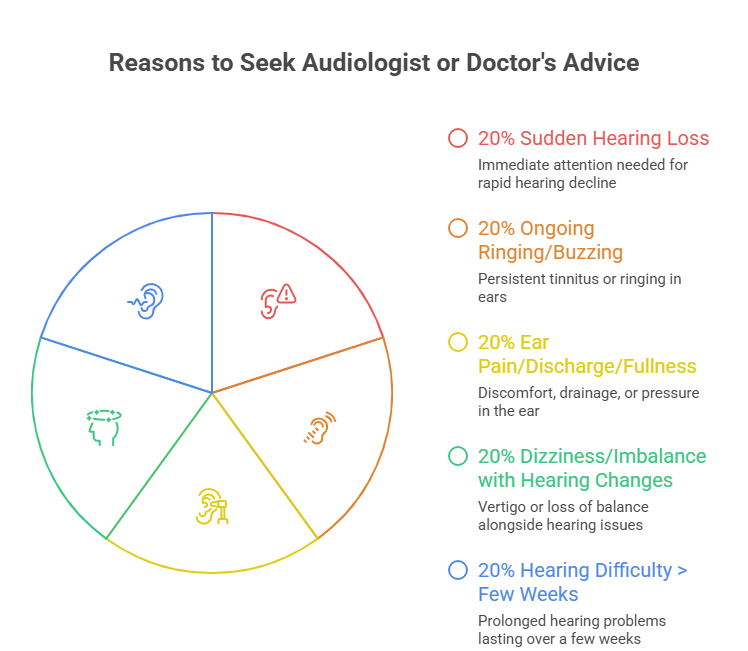
Some even schedule an audiometry test as part of a regular hearing exam. Some symptoms, however, should be evaluated by an audiologist or doctor immediately.
If you have any of the following symptoms, please consult your GP or ENT Specialist
- Acute (im sudden) loss of hearing in one or both ears
- Persistent tinnitus or ‘ringing in the ears’.
- Discomfort of the ear, discharging or a plugged or stuffy ear
- Dizziness, imbalance, and hearing changes together.
- Persistent hearing loss (that is, lasting longer than several weeks)
- Significant inter-aural difference in hearing ability
Sudden hearing loss is a problem that requires emergency treatment. Don’t wait to find out if it will get better. A qualified health care professional will be able to determine the cause and what more testing or treatment is needed.
When “Near Me” Should Not Delay More Urgent Care
A routine centre-comparison process is appropriate for most planned hearing assessments, but urgent symptoms should change the decision.
If hearing suddenly drops, especially in one ear, or hearing changes occur with significant dizziness, discharge, pain, or another concerning symptom, the priority is appropriate medical or ENT assessment rather than spending several days comparing routine audiometry providers.
In these situations, choose the pathway that gets the hearing problem appropriately evaluated not simply the centre with the most convenient location or lowest testing price.
What Happens After the Audiometry Test?
After the test, your audiologist will review the results with you and discuss what to do next. These will vary depending on the type and severity of the hearing loss discovered.
The audiologist can suggest:
- If your hearing is normal, then no further treatment.
- Regular follow-up tests to check on your hearing.
- Wax removal from the ears (if it is blocking your hearing)
- Medical treatment or ENT consultation if infection, fluid, or other ear condition suspected
- Further detailed hearing tests to gain more insight into the issue.
- Hearing aids/other hearing support when permanent hearing loss is detected
The test isn’t just to help determine if someone has a hearing loss, but also to help you understand the cause of the loss and what steps you can take next.
If hearing aids are suggested, look for a centre that offers a free hearing aid trial, since trying a device in real-world situations often makes the decision far less overwhelming.
What Should a Good Centre Explain After the Test?
Before you leave, you should understand:
- Whether hearing loss was found
- Whether one or both ears are affected
- Whether additional testing is required
- Whether an ear or middle-ear problem may need medical review
- Whether the result should simply be monitored
- When another hearing test should be considered
- Whether hearing aids or another form of support is relevant
- What the immediate next step is
A centre that performs the test but cannot explain what the result means for you is not providing the complete decision support this stage of the hearing journey requires.
Final Centre Selection Table
If you are comparing two or three nearby options, use this final decision sequence:
Question | Choose the centre if… |
Can it perform the assessment I actually need? | Yes—the testing approach matches your symptoms and age |
Who interprets the test? | A suitable audiology professional is involved |
Is the testing environment appropriate? | The centre can explain where and how threshold testing is performed |
Will my result be explained? | You will receive interpretation and next-step counselling, not just a graph |
Can it handle the next step? | It has a pathway for further testing, monitoring, or medical referral where needed |
Is it practical for me? | Distance, mobility, caregiver needs, and follow-up requirements are manageable |
Is the price clear? | You understand what is included and what may cost extra |
If a provider performs strongly on clinical suitability, interpretation, and follow-up, use location and price to make the final choice between otherwise appropriate centres.
Before You Book: 10 Questions to Ask an Audiometry Test Centre
- Who will conduct and interpret my hearing test?
- Which audiometry test do I need for my symptoms?
- Is the test performed in a sound-treated environment?
- Is speech testing available if my main problem is understanding words?
- Is tympanometry available if I have pressure, blockage, or middle-ear symptoms?
- Do you provide age-appropriate testing for children or older adults?
- What exactly is included in the quoted fee?
- Will I receive and have my hearing report explained?
- What happens if the result suggests that I need an ENT or another test?
- What follow-up is available after the assessment?
If the centre can answer these questions clearly, you are in a much better position to judge whether it is suitable before travelling to the appointment.
Your Next Step: Book an Audiologist Consultation
If you have already noticed a hearing problem but are unsure which test you need, the most appropriate next step is to book an audiologist consultation or hearing assessment rather than selecting a test only from its name or price.
Take details of:
- What you are struggling to hear
- When the problem started
- Whether one or both ears are affected
- Your most difficult listening situations
- Any tinnitus, pressure, pain, discharge, or dizziness
- Previous hearing reports
- Current hearing aids, if you use them
This allows the audiologist to select the appropriate assessment and move you to the correct next stage of care.
How Can Resonnocare Help
You don’t need to sacrifice quality for convenience when you’re searching for an audiometry test provider with Resonnocare. All testing is performed in our acoustic room by our Well-qualified audiologists, and all results are reported in non-technical terms.
For patients who prefer added convenience, we also provide video consultation options, allowing certain discussions and follow-ups to happen without an in-person visit, particularly useful for busy schedules or patients located slightly further away.
Why Choose Resonnocare for Hearing and Audiology Care
Here at Resonnocare, we ensure that it’s all about clinically driven hearing care followed by patient-first care. Our highly trained audiology team and clinicians specialize in the proper hearing test, not one that’s rushed or generic. Each hearing loss appointment has an in-depth/follow-up care plan that explains the results and provides information on monitoring, treatment, and hearing aids.
Beyond testing, we support the complete hearing care journey, including hearing aid fitting, home visits, video consultations, and structured aftercare, so care continues well after the initial appointment rather than ending with a single report.
Find a Resonnocare Clinic Near You
Select your city to find the nearest Resonnocare clinic and book an appointment with our hearing care team.
Bangalore
Ear 360, Jayanagar
Ground Floor, Site No. 499, Municipal No. 499/97, East End Main Road, 9th Block, Jayanagar, Bangalore, Karnataka 560041
Timings: 10:00 AM to 7:00 PM
[Call] [Book an Appointment]
Ear 360, Spandana Sarjapura Hospital
239/205/34A, near Trinity Complex, Sompura Gate, Sarjapura Main Road, Bangalore, Karnataka 562125
Timings: 10:00 AM to 7:00 PM
[Call] [Book an Appointment]
Resonnocare, HSR Layout
150/5/72, 7th Cross, 24th Main, HSR Layout, Bangalore, Karnataka 560102
Timings: 10:00 AM to 7:00 PM
[Call] [Book an Appointment]
Resonnocare, Banashankari
272, 7th Cross Road, BSK 1st Stage, 2nd Block, Srinivasan Agra, 80 Feet Road, Bangalore, Karnataka 560050
Timings: 10:00 AM to 7:00 PM
[Call] [Book an Appointment]
Resonnocare, Indiranagar
34, Wind Tunnel Road, Murugeshpalya, Muniyappa Layout, Bangalore, Karnataka 560017
Timings: 10:00 AM to 7:00 PM
[Call] [Book an Appointment]
Delhi
Ear 360, Dr. Hans Anand Lok
46, Anand Lok Road, Anand Lok, Sadiq Nagar, New Delhi, Delhi 110049
Timings: 10:00 AM to 7:00 PM
[Call] [Book an Appointment]
Resonnocare, Dr. Hans Vasant Vihar
28, Basement, Paschimi Nagar, Vasant Vihar, New Delhi, Delhi 110057
Timings: 10:00 AM to 7:00 PM
[Call] [Book an Appointment]
Gurgaon
Resonnocare Head Office, M3M Urbana
Office 403, Office Block, 4th Floor, above Retail Blocks R1 and R5, M3M Urbana, Sector 67, Gurgaon, Haryana 122101
Timings: 10:00 AM to 7:00 PM
[Call] [Book an Appointment]
Resonnocare, Dr. Hans Sector 28
Plot No. 1SP, adjoining DLF Phase 1 Metro Station, Sector 28, Gurgaon, Haryana 122002
Timings: 10:00 AM to 7:00 PM
[Call] [Book an Appointment]
Ludhiana
Ear 360, BRS Nagar
963, Block B, BRS Nagar, Ludhiana, Punjab 141012
Timings: 10:00 AM to 7:00 PM
[Call] [Book an Appointment]
Resonnocare, Fawwara Chowk
565-A and 565-B, Upper Ground Floor, Cemetery Road, near Fawwara Chowk, West City, Ludhiana, Punjab 141001
Pune
Ear 360, Vighnaharta Healthcare Center
D-106-107, Choice Arcade, opposite Ruby Hall Hospital, Dhole Patil Road, Pune, Maharashtra 411001
Timings: 10:00 AM to 7:00 PM
[Call] [Book an Appointment]
Ear 360, Khan Parab ENT Hospital
Plot No. 102, Anand Nagar, Talegaon Dabhade, Taluka Maval, Pune, Maharashtra 410507
Timings: 10:00 AM to 7:00 PM
[Call] [Book an Appointment]
Tumkur
Resonnocare, Ashok Nagar
PID No. 3563, 8th Main, 8th Cross, Ashok Nagar, Tumkur, Karnataka 572103
Timings: 10:00 AM to 7:00 PM
[Call] [Book an Appointment]
Conclusion
While it is a good step to look for an audiometry test near you, the right centre is just as important as the actual test. Interpretation of the results, appropriate testing, and a qualified audiologist make the difference between a routine check-up and clinically significant information. If you’re preparing for your first hearing test or a subsequent one, it pays to spend a bit of time selecting the right center, as this will benefit you in the long run.
Looking for a proven audiometry test provider near you? Resonnocare’s clinical staff is ready to help you with in-clinic testing, at-home testing, and video consultations. Make your appointment with Resonnocare today to step into the future of clear, informed hearing care with an audiometry test.
FAQ’s
How much does an audiometry test cost?
The price of an audiometry test in India will vary from clinic to clinic and from city to city, and you may have to pay anywhere between Rs.300 and Rs.2500, depending on various other factors. Extensive or comprehensive hearing evaluations might be more expensive. Audiometry is a cost-effective assessment of the hearing to diagnose hearing issues, to track hearing health, and to identify the need for more treatment, including hearing aids.
Can I do an audiogram at home?
Yes, there are online hearing tests or mobile apps available that can be used at home for a basic hearing screening. These tests are not as accurate as one done by an audiologist, however. If you have a suspected hearing loss or symptoms like tinnitus, a clinical audiogram is recommended, which will give a detailed picture of your hearing thresholds. Does Medicare cover audiometry?
Coverage for Medicare audiometry is dependent on the country and healthcare plan. In a few instances, hearing tests may be included if ordered by a doctor when medically required. Typical hearing test costs for hearing aids may be undercovered. Please consult your health care provider or insurance plan for coverage information.
Can audiometry detect tinnitus?
Tinnitus is not measurable; it is a symptom, so there is no way that audiology can be used to directly measure tinnitus. Audiometry, however, can detect hearing loss and other typical hearing problems that can be associated with tinnitus. The results are used to understand your hearing status better and whether further tinnitus assessment or treatment is warranted. For the further Tinnitus Retraining therapy Audiometry can be used as a primary testing to understand the acoustic nature of tinnitus better. (To be added)
What is the red flag of tinnitus?
Sudden hearing loss, tinnitus in one ear, severe dizziness, problems with balance, facial weakness, or sound that is pulsating and coincides with your heartbeat are all red flags for tinnitus. These symptoms can be a sign of an underlying health risk and should be checked promptly. If you have any of these symptoms, go to an ENT specialist or neurologist for medical help at once.