
TL;DR:
The short answer: Pure Tone Audiometry (PTA) is an essential part of a hearing
evaluation, but it does not measure every aspect of everyday communication. A person
may detect sounds in a quiet booth and still struggle to understand speech in noise, in
groups, on the phone, or when speakers are distant.
Why this matters
A parent or grandparent may say, “I can hear you,” while repeatedly asking people to repeat themselves.
They may turn up the television, avoid phone calls, or become quieter during family conversations. These
experiences can be real even when the hearing thresholds do not seem to explain the full difficulty.
A comprehensive hearing assessment looks beyond a single number or graph. Depending on the person’s
symptoms and clinical findings, it may include PTA, speech testing, speech-in-noise assessment,
middle-ear testing and a detailed discussion of communication needs.
A simple way to think about it
PTA asks: “What is the softest sound this person can detect at different pitches?”
Real life asks: “Can this person understand and communicate when the environment
becomes challenging?”
In this guide, we explain what PTA tells us, what it may not tell us, which additional assessments may be useful, warning signs families should notice, and how the results can guide personalised management.
This blog is aimed for Seniors, older adults, and family members or caregivers who have noticed difficulty with conversations, especially in noisy environments, and want to understand why a complete hearing assessment may require more than a standard PTA test.
- PTA is an important starting point but may not reflect real-world hearing difficulties: Pure Tone Audiometry measures the softest sounds a person can hear in a quiet setting, but it may not fully explain why an older adult struggles to understand speech in everyday situations.
PTA tells us | Real life asks |
Can you hear a tone? | Can you understand words? |
In quiet | In noise |
One sound at a time | Multiple people talking |
Controlled environment | Restaurants, family gatherings |
Detection | Understanding |
Ear-focused measurement | Communication-focused outcome |
- Additional tests can reveal problems PTA may miss: Speech Audiometry, tympanometry, and a detailed assessment of everyday listening challenges can help identify difficulties with speech understanding, middle-ear function, and age-related auditory processing changes.
- Age-related hearing loss can affect speech clarity before overall hearing seems severely reduced: Seniors may hear that someone is speaking but struggle to understand certain words, consonants, phone conversations, or speech in crowded environments, making a broader evaluation important.
- A comprehensive hearing assessment helps guide more personalised care: The blog explains the warning signs families should watch for, when to consult an audiologist, how hearing loss is assessed in seniors, and how options such as communication strategies, hearing aids, home visits, and long-term aftercare may be recommended based on individual needs.
It can begin with simple alterations. A parent/grandparent starts to ask people to repeat themselves, turns up the TV, or has difficulty listening to others during family events, particularly when multiple people speak simultaneously.
Once families make the decision to have a hearing test, often one of the first recommended tests is Pure Tone Audiometry (PTA). PTA is helpful because it reveals the loudest quiet tones an individual can hear at various pitches. For the elderly, the ability to hear well in the real world means more than hearing beeps and buzzes in a quiet room.
A student may be able to follow reasonably well on PTA and may still have problems hearing people, understanding speech, following conversations in noisy areas, or more than one person talking.
For this reason, a comprehensive hearing exam for older adults could involve extra tests beyond PTA. In this guide, we will discuss why PTA alone may not be a complete picture, other hearing tests that might be suggested, and the purpose of these tests to help the audiologist understand how an older adult is hearing in the real world.
What Is a Hearing Test for Elderly Patients?
A hearing test for an older adult often begins with Pure Tone Audiometry, or PTA. During this test, you wear headphones and listen for a series of soft beeps at different pitches. You simply respond whenever you hear a sound.
PTA helps the audiologist understand:
- The softest sounds you can hear
- Which pitches are easier or harder for you to hear
- Whether one ear hears better than the other
- The overall degree and pattern of any hearing loss
For younger adults, PTA may sometimes provide much of the information needed, especially when the concern is straightforward, and speech understanding is otherwise good. In older adults, however, hearing difficulties can be more complex.
A senior may be able to hear a sound during PTA but still struggle to understand words clearly, particularly when:
- Several people are speaking at once
- There is background noise
- Someone is speaking from a distance
- Conversations happen over the phone
- Speech is fast or unclear
PTA vs. Real-World Listening
PTA Everyday communication
Quiet, controlled environment Noise and competing sounds
One tone at a time1 Continuous, complex speech
Measures detection Requires speech understanding
Produces hearing thresholds Involves communication, attention and listening effort
This is because age-related hearing changes can affect not only how softly a person can hear sounds, but also how clearly the brain processes speech.
For this reason, a hearing test for seniors may include additional assessments beyond PTA, such as speech testing, middle-ear testing, or other tests recommended by the audiologist.
The aim is to understand not just whether an older person can hear a sound in a quiet room, but how well they can understand and communicate in real-life situations.
Know More About Hearing Tests
- Hearing Test: Types, Procedure, Results & Cost
- Hearing Aid Trial: What to Expect Before Buying Hearing Aids
- Hearing Aid Price: What Affects the Cost of Hearing Aids?
Why Might PTA Test Alone Not Tell the Full Story for an Elder Patient?
Sometimes, an older adult may do reasonably well on a PTA test but still say, “I can hear people speaking, but I cannot always understand what they are saying.” This can be confusing for both the person and their family.
The reason is that PTA mainly measures the softest sounds a person can hear in a quiet setting. Everyday listening is much more complicated. Older adults may find it difficult to separate speech from background noise, follow fast conversations, or understand someone when several people are talking at once.
For example, a person may be able to hear a tone during PTA but still struggle to follow:
- Conversations at family gatherings
- Speech in restaurants or other noisy places
- Someone speaking from another room
- Phone conversations
- Fast or softly spoken speech
These difficulties may happen because ageing can affect not only the ear, but also the way sound and speech are processed.
This is why the audiologist may recommend additional assessments, depending on the person’s symptoms and PTA results. These may include:
- Speech testing to check how clearly words are understood
- Speech-in-noise testing to see how well conversation is understood with background noise
- Tympanometry to check the function of the eardrum and middle ear
- A detailed discussion about the listening situations that are most difficult in everyday life
Looking at these results together can provide a more realistic picture of how well an older person is actually hearing and communicating.
“I Can Hear You, But I Can’t Understand You.”
This is one of the most useful clues a family can report. It may indicate that the main problem is not simply sound detection. The person may have difficulty extracting speech from background noise or
understanding speech when listening conditions become demanding.
Real-life situations that may reveal the problem
- family gatherings where several people speak at once;
- restaurants, functions or other noisy environments;
- conversation from another room or at a distance;
- telephone conversations where visual cues are absent; and
- fast, softly spoken or unclear speech.
A useful clinical question
“Where do you hear well, and where do you struggle?”
That question shifts the conversation from the audiogram alone to the person’s actual communication experience.
What Additional Assessments May Add
Assessment What it helps answer
Pure Tone Audiometry How softly can the person detect sounds at different frequencies?
Speech testing How well can the person recognise or understand speech
Speech-in-noise testing How well can the person understand speech when background noise
competes with it?
Tympanometry How are the eardrum and middle-ear system functioning?
Case history / listening needs Which everyday situations are difficult, and how is hearing affecting
communication?
Not every person needs every test. The audiologist selects additional assessments according to symptoms, history and initial findings.
What Causes Hearing Difficulty in Older Adults?
The most common cause of hearing difficulty in older adults is age-related hearing loss, also known as presbycusis. It usually develops gradually, which means the person may not notice the change straight away.
One of the first changes may involve difficulty hearing higher-pitched sounds. As a result, certain parts of speech, particularly consonants such as “s,” “f,” and “th,” may become less clear. This is why someone may say that they can hear a person talking but cannot always make out the words.
Other factors can also contribute to hearing difficulties, including:
- Age related changes in inner ear
- Long-term exposure to loud noise
- Earwax buildup
- Certain medications that may affect hearing
- Conditions such as diabetes or cardiovascular disease
- Previous ear problems or infections
- Family history and genetic factors
Sometimes, more than one factor is involved at the same time. For example, an older adult may have age-related inner-ear changes along with earwax or a middle-ear problem.
This is another reason why a complete hearing assessment can be more useful than relying on PTA alone. It helps the audiologist understand not just how much hearing has changed, but also what may be contributing to the difficulty and what type of support may be most appropriate.
A key point for families
Do not assume that every hearing difficulty is simply “normal ageing.” A proper assessment helps distinguish hearing loss from potentially treatable ear problems and identifies the type of communication difficulty that needs attention.
What Are the Early Signs Families Should Watch For?
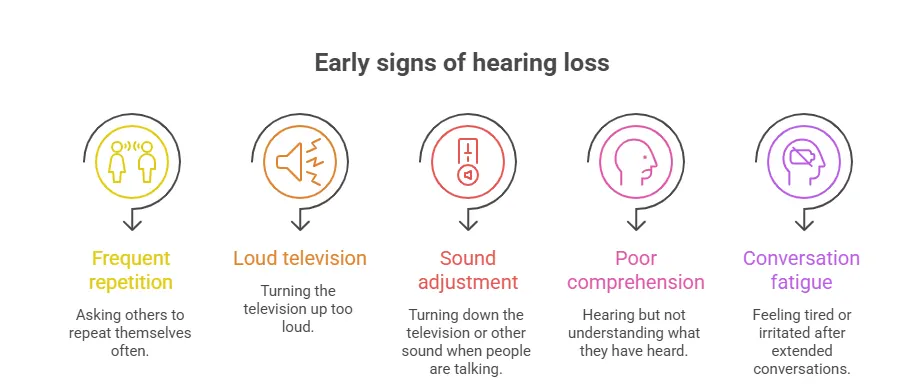
It is common for family members to pick up on changes before the person who is experiencing the changes. Noticeable changes can include asking others to repeat themselves often, turning the television up too loud, turning down the television or other sound when people are talking, hearing but not understanding what they have heard, or feeling tired or irritated after extended conversations. These signs are all good indicators that it’s time to have a proper hearing test for elderly family members. See our ear symptoms and conditions page for more information about related symptoms.
When Should You See an Audiologist?
Hearing changes in older adults can happen gradually, so they are sometimes mistaken for a normal part of ageing. However, difficulty hearing should not simply be ignored, especially when it begins to affect everyday communication and social life.
It may be time to arrange a hearing assessment if you notice that a parent, grandparent, or older family member is:
- Avoiding phone calls because conversations are difficult to follow
- Taking part in fewer social activities
- Asking people to repeat themselves more often
- Increasing the television or phone volume
- Becoming quieter or less involved in family conversations
- Finding it difficult to understand speech, especially in groups or noisy places
A hearing test for elderly patients can help identify whether hearing has changed and what type of support may be appropriate.
Some symptoms should be assessed more promptly, including:
- Sudden hearing loss
- Ear pain
- Fluid or discharge from the ear
- Persistent or sudden tinnitus
- Dizziness or balance problems
- A noticeable difference in hearing between the two ears
These symptoms may sometimes be related to an ear or health condition that needs medical evaluation.
For seniors who find it difficult to travel to a clinic, hearing assessments can also be arranged at home. This can make it easier for older adults to have their hearing checked in a familiar and comfortable environment.
How Is Hearing Loss Diagnosed in Seniors?
Hearing loss in older adults is usually assessed using more than one test. This is important because a person may be able to hear certain sounds during a hearing test but still struggle to understand conversations in everyday situations.
A hearing evaluation for seniors may include:
- Tympanometry: This checks how well the eardrum and middle ear are working and can help identify problems such as fluid, pressure changes, or other middle ear conditions.
- Pure Tone Audiometry (PTA): This measures the softest sounds a person can hear at different frequencies and helps determine the degree and pattern of hearing loss.
- Speech testing: This may be used to understand how clearly a person can recognise and understand spoken words.
- Speech-in-noise testing: If someone says, “I can hear people, but I cannot understand them in a group or noisy place,” this test can provide useful information that may not be fully reflected in a standard PTA result.
The audiologist will also consider the person’s symptoms, medical history, communication difficulties, and how hearing problems are affecting everyday activities.
This broader assessment helps build a clearer picture of how the person is actually hearing in daily life, rather than relying on a single test result. It also reflects the comprehensive evaluation followed in our clinical excellence approach.
One patient’s journey
Mr. R, 72: “I hear the TV perfectly, but I can’t follow my grandchildren at dinner.”His PTA provides the hearing-threshold profile. Because his main complaint occurs in groups, speech understanding and speech-in-noise performance become particularly relevant. The management discussion can then focus on the situations that matter most to him—not just the audiogram.
What Treatment or Management Options Are Available?
Once the hearing assessment is complete, the next step depends on the type and degree of hearing loss, as well as how much it is affecting everyday communication.
For some seniors, management may include:
- Regular hearing checks: Mild changes may simply need to be monitored over time.
- Communication strategies: Sitting closer to the speaker, reducing background noise, and speaking face-to-face can make conversations easier.
- Hearing aids: If hearing loss is making it difficult to follow conversations, use the phone, watch television, or participate socially, an audiologist may recommend hearing aids based on the person’s hearing test and lifestyle.
- Hearing aid adjustments and follow-up: Hearing aids may need fine-tuning after fitting to keep speech clear and the device comfortable.
- Ongoing support: Regular cleaning, maintenance, and hearing reviews can help the hearing aids continue to work well as hearing needs change.
Modern hearing aids can also include features designed to make everyday listening easier, such as reducing background noise and improving speech clarity in busy environments.
If hearing aids are recommended, trying them before making a decision can be helpful. A free hearing aid trial allows the senior and their family to experience how the devices perform during daily activities before deciding what feels most suitable.
Continued follow-up is equally important, especially for older adults. Good hearing care is not only about fitting a hearing aid once, but also about making sure it remains comfortable, useful, and appropriate as hearing needs change over time.
What Happens After the Assessment?
Management depends on the type and degree of hearing loss, the person’s communication needs, medical findings and preferences. There is no single solution for every older adult.
- Communication strategies: face the speaker, improve lighting, reduce background noise and move closer when appropriate.
- Hearing aids: may be recommended when hearing loss is affecting communication and the person is likely to benefit.
- Trial and verification: where appropriate, a hearing-aid trial can help the person experience benefit in everyday situations before making a decision.
- Fine-tuning and follow-up: settings, comfort and communication goals may need adjustment after fitting.
- Ongoing care: cleaning, maintenance, periodic hearing review and support help maintain benefit over time.
A hearing aid is not the end of the process. Successful hearing care includes fitting,adaptation, counselling and follow-up.
Myth vs Reality
Myth Reality
“My PTA is okay, so my hearing is okay.” PTA is important, but communication difficulty can require additional assessment.
“Hearing loss is just part of getting older.” Age-related loss is common, but hearing difficulty should still be assessed.
“If I can hear loud sounds, I don’t need help.” Loudness and speech understanding are not the same thing.
“A hearing aid alone fixes everything.” Good outcomes also depend on appropriate fitting, counselling,communication strategies and follow-up.
(Please align this maam, i wasnt able to)

Why Choose Resonnocare for Hearing and Audiology Care?
Resonnocare understands that a hearing test for elderly patients needs patience, clinical depth, and genuine attentiveness, not a rushed, one-size-fits-all process. Our experienced audiologists and clinicians go beyond standard PTA to build an accurate, complete picture of each senior’s hearing health, followed by personalised care plans suited to their specific lifestyle and challenges. Depending on individual needs, this may include detailed hearing assessments, hearing aids, home visits for added comfort, video consultations for family discussions, and structured aftercare to support long-term hearing health. Explore our full range of services on our hearing care for all ages page.
Find a Resonnocare Clinic Near You
Select your city to find the nearest Resonnocare clinic and book an appointment with our hearing care team.
Bangalore
Ear 360, Jayanagar
Ground Floor, Site No. 499, Municipal No. 499/97, East End Main Road, 9th Block, Jayanagar, Bangalore, Karnataka 560041
Timings: 10:00 AM to 7:00 PM
[Call] [Book an Appointment]
Ear 360, Spandana Sarjapura Hospital
239/205/34A, near Trinity Complex, Sompura Gate, Sarjapura Main Road, Bangalore, Karnataka 562125
Timings: 10:00 AM to 7:00 PM
[Call] [Book an Appointment]
Resonnocare, HSR Layout
150/5/72, 7th Cross, 24th Main, HSR Layout, Bangalore, Karnataka 560102
Timings: 10:00 AM to 7:00 PM
[Call] [Book an Appointment]
Resonnocare, Banashankari
272, 7th Cross Road, BSK 1st Stage, 2nd Block, Srinivasan Agra, 80 Feet Road, Bangalore, Karnataka 560050
Timings: 10:00 AM to 7:00 PM
[Call] [Book an Appointment]
Resonnocare, Indiranagar
34, Wind Tunnel Road, Murugeshpalya, Muniyappa Layout, Bangalore, Karnataka 560017
Timings: 10:00 AM to 7:00 PM
[Call] [Book an Appointment]
Resonnocare, JC’s ENT Center Nagarbhavi
57, 3rd Main Road, 2nd Block, Govindaraja Nagar Ward, Kalyan Nagar, Nagarbhavi, Bengaluru, Karnataka 560072
Timings: 10:00 AM to 7:00 PM
[Call] [Book an Appointment]
Resonnocare, Dr Bhattacharyya ENT Clinic
No. 14, 17th Cross Road, Sector 7, HSR Layout, Bangalore, Karnataka 560102
Timings: 10:00 AM to 7:00 PM
[Call] [Book an Appointment]
Delhi
Ear 360, Dr Hans Anand Lok
46, Anand Lok Road, Anand Lok, Sadiq Nagar, New Delhi, Delhi 110049
Timings: 10:00 AM to 7:00 PM
[Call] [Book an Appointment]
Resonnocare, Dr Hans Vasant Vihar
28, Basement, Paschimi Marg, Vasant Vihar, New Delhi, Delhi 110057
Timings: 10:00 AM to 7:00 PM
[Call] [Book an Appointment]
Resonnocare, Clarity ENT Clinic
Clarity, 2-10, Hauz Khas, New Delhi, Delhi 110016
Timings: 10:00 AM to 7:00 PM
[Call] [Book an Appointment]
Resonnocare, Dr Hans Center for ENT Punjabi Bagh
2/5, West Avenue Road, West Punjabi Bagh, Punjabi Bagh, New Delhi, Delhi 110026
Timings: 10:00 AM to 7:00 PM
[Call] [Book an Appointment]
Gurgaon
Resonnocare Head Office, M3M Urbana
Office 403, Office Block, 4th Floor, above Retail Blocks R1 and R5, M3M Urbana, Sector 67, Gurgaon, Haryana 122101
Timings: 10:00 AM to 7:00 PM
[Call] [Book an Appointment]
Resonnocare, Dr Hans Sector 28 DLF Ph-1
Metro Station, Plot No. 1SP, adjoining DLF Phase 1, Sector 28, Gurgaon, Haryana 122002
Timings: 10:00 AM to 7:00 PM
[Call] [Book an Appointment]
Ludhiana
Ear 360, BRS Nagar
963, Block B, BRS Nagar, Ludhiana, Punjab 141012
Timings: 10:00 AM to 7:00 PM
[Call] [Book an Appointment]
Resonnocare, Fawwara Chowk
565-A and 565-B, Upper Ground Floor, Cemetery Road, near Fawwara Chowk, West City, Ludhiana, Punjab 141001
Timings: 10:00 AM to 7:00 PM
[Call] [Book an Appointment]
Pune
Ear 360, Vighnaharta Healthcare Center
D-106-107, Choice Arcade, opposite Ruby Hall Hospital, Dhole Patil Road, Pune, Maharashtra 411001
Timings: 10:00 AM to 7:00 PM
[Call] [Book an Appointment]
Ear 360, Khan Parab ENT Hospital
Plot No. 102, Anand Nagar, Talegaon Dabhade, Taluka Maval, Pune, Maharashtra 410507
Timings: 10:00 AM to 7:00 PM
[Call] [Book an Appointment]
Tumkur
Resonnocare, Ashok Nagar
PID No. 3563, 8th Main, 8th Cross, Ashok Nagar, Tumkur, Karnataka 572103
Timings: 10:00 AM to 7:00 PM
[Call] [Book an Appointment]
Resonnocare, Ganadhal ENT and Dental Hospital
3rd Cross, Somashekara Puram, Coffee Board Colony, Tumkur, Karnataka 572102
Timings: 10:00 AM to 7:00 PM
[Call] [Book an Appointment]
Mangalore
Ear 360, Bunts Hostel Circle
Shop No. 6 and 7, Basement Floor, Javed Plaza, Bunts Hostel Circle, Mangalore, Karnataka 575003
Timings: 10:00 AM to 7:00 PM
[Call] [Book an Appointment]
Resonnocare, Dr G K Hebbar ENT Clinic
M-2-153/6, K.S.R.M. Building, Lighthouse Hill Road, Mangaluru, Karnataka 575001
Timings: 10:00 AM to 7:00 PM
[Call] [Book an Appointment]
Resonnocare, Dr Navisha ENT Centre
3rd Floor, Falnir Health Center, Falnir Road, Falnir, Mangaluru, Karnataka 575002
Timings: 10:00 AM to 7:00 PM
[Call] [Book an Appointment]
Mysore
Ear 360, Ramaswamy Circle
371/A, Ramaswamy Circle, Mysore, Karnataka 570024
Timings: 10:00 AM to 7:00 PM
[Call] [Book an Appointment]
Hubli
Ear 360, Vidya Nagar
Srishti Elite, Shirur Park Road, Shirur Park, Vidya Nagar, Hubballi, Karnataka 580031
Timings: 10:00 AM to 7:00 PM
[Call] [Book an Appointment]
Davangere
Ear 360, P J Extension
Shop First Floor, 2nd Main, P J Extension, Davangere, Karnataka 577002
Timings: 10:00 AM to 7:00 PM
[Call] [Book an Appointment]
Indore
Resonnocare, Dr Navnit Jain ENT Hospital
Dr Navnit Jain ENT Hospital, C/o Unique Hospital, 335, Jawahar Marg, Opp. Nafees Bakery, Indore, Madhya Pradesh 452007
Timings: 10:00 AM to 7:00 PM
[Call] [Book an Appointment]
Resonnocare, Hearing Solutions Dr Agarwal
7, Gulmarg Complex, First Floor, near Sapna Sangeeta Lumiere, Indore, Madhya Pradesh 452001
Timings: 10:00 AM to 7:00 PM
[Call] [Book an Appointment]
Conclusion
While a hearing test is a key initial assessment, PTA is not always a comprehensive explanation of why everyday conversations are more difficult than is reflected in the test. A comprehensive, unbiased assessment, one that considers listening beyond the thresholds to actual listening capacity, provides much more insight into what the older person is actually hearing. Don’t wait for things to get harder if the parent or grandparent has been confused by conversations. Contact Resonnocare to arrange a comprehensive audiological evaluation of elderly relatives and get advice from a competent audiologist who will listen to the whole situation.
FAQ’s
How to improve hearing naturally?
Although most hearing loss is non-reversible, you can do five things to help protect and support your hearing: Avoid exposure to loud noise; use hearing protection; eat a healthy diet; exercise regularly; control medical problems like diabetes and high blood pressure; avoid smoking. Regular hearing check-ups can also identify problems in the early stages and prevent the loss of hearing.
What medications are used to treat hearing loss?
Treatment is based upon the cause of the hearing loss. Treatment of SNHL might include corticosteroids, antibiotics, or other medication in cases of infection. However, there are a number of types of permanent hearing loss that can’t be cured with medicine alone and may require hearing aids, cochlear implants, or auditory rehabilitation.
What are the signs and symptoms of hearing loss?
Some of the most frequent symptoms of hearing loss are that people say people mumble, they have difficulty understanding what people are saying, they often have to ask people to repeat themselves, they hear very loud sounds or noises from other people when they are noisy, they hear noise in their ears (tinnitus), and they have to turn the volume up on electronic devices. Symptoms may be slow to develop and may become more severe over time.
What is normal hearing for a 70-year-old?
While it is normal for people to experience some hearing loss as they get older, if someone is 70 years old, they should be able to hear and understand what others are saying without difficulty. Aging increases the risk of having a mild hearing loss, especially for high frequencies. Periodic testing may be used to check if there are changes in hearing that are normal or if they indicate a need for treatment.
At what age do older adults start losing hearing?
Presbycusis is a hearing loss that typically occurs gradually from the 50s or 60s and gets worse as you get older. This risk is higher in those over the age of 65, and many older people have trouble hearing high-pitched sounds or speech in noisy places. Early hearing assessment allows you to manage hearing loss effectively.