

TL; DR:
This blog is aimed at people with moderate to severe hearing loss, existing hearing aid users, seniors, caregivers, and family members who are comparing RIC and BTE hearing aids and want to understand which style may better suit their hearing level, comfort, handling needs, and lifestyle.
- RIC and BTE Hearing Aids Differ in Design and Fit: A RIC hearing aid places the receiver inside the ear canal and connects it to the behind-the-ear unit with a thin wire, while a BTE keeps the receiver inside the hearing aid body and delivers sound through tubing to an earmould or earpiece.
- Both Styles Can Work for Moderate to Severe Hearing Loss: RIC devices can be suitable for many people with moderate and some severe hearing loss, depending on receiver strength and fitting, while power BTE models may be preferred when greater amplification, a secure earmould, or additional fitting reserve is needed.
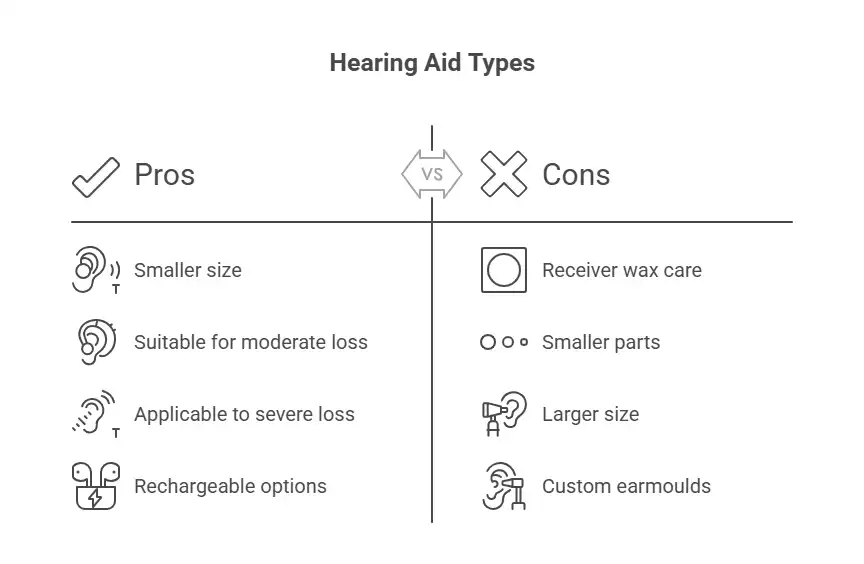
- Comfort, Handling and Maintenance Matter: RIC devices are generally smaller but involve components such as receivers, domes, and wax filters that require regular care. BTE devices may be easier for some users to handle and clean, especially when dexterity or managing small components is a concern.
- The Right Choice Should Be Based on an Audiological Assessment: An audiologist considers factors such as audiogram results, speech understanding, ear condition, hand-eye coordination, daily listening environments, and future hearing needs before recommending RIC or BTE. The blog emphasizes that there is no single best style for everyone.
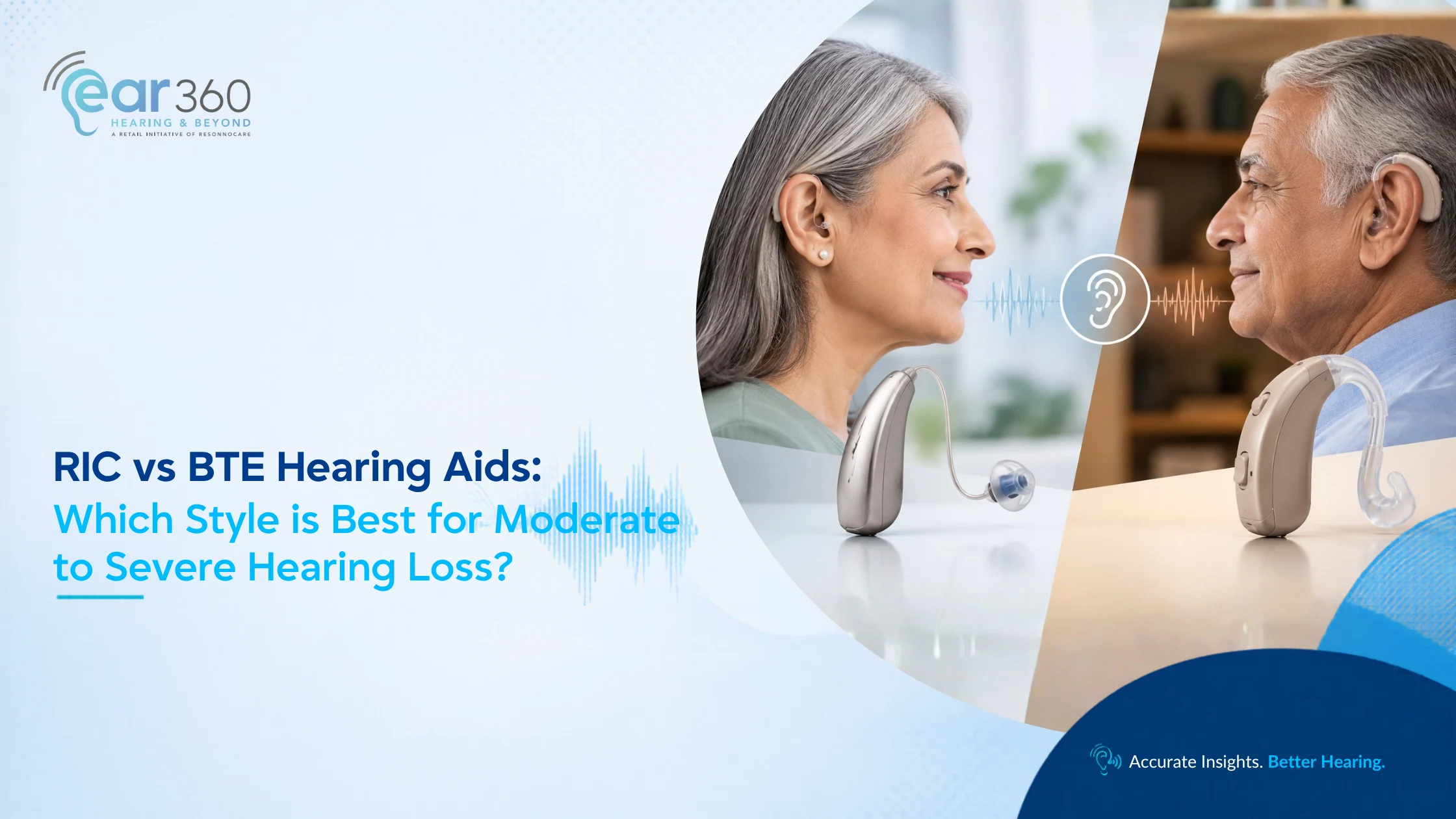
The initial choice when considering hearing aids for moderate to severe hearing loss may be whether to opt for a BTE or a RIC hearing aid. They are both worn behind the ear, but have different playback qualities and are appropriate for different types of audio and handling requirements.
The selection of an appropriate hearing aid at Resonnocare will depend on an audiogram, speech understanding, ear health, and the hearing aid’s ability to be used in the environment and managed by the listener – not appearance. The best is the one that fits the individual hearing profile.
What Is a RIC Hearing Aid and How Is It Different From a BTE?
Also referred to as a RIC (receiver in the canal) hearing aid, this type is compact and small and has a thin wire that extends to a receiver, or speaker, which is placed into the ear canal. For many RIC models, this design keeps the size of the RIC relatively small.
With a BTE or ‘behind the ear’ device, the receiver is located inside the hearing aid body. The sound is conducted through the tubes to the earmoulds or earpiece.
That difference has an impact on size, power available, fit, and maintenance.
Know More About
- Hearing Aid Prices in India by Type, Features and Technology
- Hearing Aid Machine Price: What Determines the Cost?
- Hearing Aids Near Me: How to Choose the Right Hearing Aid Center
When Is a RIC Hearing Aid Suitable for Moderate to Severe Hearing Loss?
Great hearing loss is not a contraindication for receiver-in-canal devices. A RIC hearing aid can fit well with many moderate and some severe hearing loss, depending on the hearing aid model, receiver strength, and earpiece type.
It may be used if you want a smaller device behind your ear, you have a hearing profile that allows it, and you can comfortably handle the receiver, dome, and wax filter.
If the hearing loss is greater, a stronger receiver and a closed dome or custom earmould might be required for adequate amplification and feedback control.
Resonnocare’s hearing aid service focuses on selecting devices around hearing levels, listening needs, comfort, and practical use.
When Might a BTE Hearing Aid Be Better?
If more amplification or handling of the hearing aid is required, BTE hearing aids are important.
A BTE might be recommended if a higher output/extra room for spares is required, a secure custom earmould is suitable, or a larger device is easier for you to manage and clean.
For larger hearing losses, power BTEs are often used, as they will have a more powerful sound delivery and can be fitted with custom earmoulds.
Not everyone with profound hearing loss will require a BTE. Also, some high-power RIC fittings may be suitable depending on the severity and form of the hearing loss, speech understanding, and the range of fitting of the device.
RIC Hearing Aid vs BTE: Which Is More Comfortable?
Comfort is personal. Smaller does not necessarily mean more comfortable.
RIC devices are generally based on a thin wire and a small dome or earpiece. If it is deemed safe to have an open fitting, some individuals opt for the less obstructed feel. However, a tighter dome or earmould might be required with a higher level of hearing loss.
Typically, BTE devices are attached to an earmould via a tube. This fitting is preferred by some patients because they feel that it provides more stability, particularly if small receivers are hard to position.
If the pain or pressure continues to be persistent, the audiologist should be consulted instead of being ignored.
RIC Hearing Aid vs BTE: Which Provides More Power?
When hearing loss is moderate, both RIC and BTE models can offer sufficient amplification if they are appropriately chosen and programmed.
The fitting range becomes more important for severe hearing loss. Some patients will benefit from high-power RIC receivers, and high-power BTE receivers might be beneficial for specific hearing profiles.
The more powerful the device, the better it is, not always. Audiograms, or measurements of hearing levels, need to be used to program the hearing aids. If it is too loud and too amplified, this does not necessarily aid in understanding speech.
Which Style Is Easier to Clean and Maintain?
RIC devices have a receiver placed within the ear canal and are therefore subject to earwax and moisture. It is recommended to check domes and wax filters regularly.
The receiver is still kept in the case, which is behind the ear, and the earmould and tubing do require cleaning and periodic adjustment.
Sometimes, a BTE can be easier to deal with if you have trouble replacing the small wax guards.
Neither style is maintenance-free. Resonnocare’s hearing aid aftercare can support fitting checks, programming adjustments, cleaning guidance, and device care when needed.
How Does an Audiologist Decide Between RIC and BTE?
Your hearing assessment should not begin with a product catalogue.
Generally, an audiologist will take into account:
- Your audiogram: The amount and level of hearing loss will indicate what level of amplification is needed.
- Speech understanding: Speech testing can be a guide to setting realistic expectations.
- Ear condition: Size of the ear canal, ear wax, ear irritation and other ear issues could impact the selection of the dome, receiver or earmould.
- Hand-eye co-ordination: Some people find it hard to use small devices, so a larger device would be easier to use.
- Different demands for daily listening: Work, family conversations, noisy environments.
- Future needs: The audiologist may want to know how extendable the device is should your hearing change.
Seek immediate medical attention if hearing loss is sudden, especially in one ear. If the ear pain is severe, or the ear is discharging, if ear symptoms have persisted or are new, if the vertigo is severe, or if the tinnitus is new or persistent, then these symptoms should also be assessed medically or audiologically before purchasing a hearing aid.
Can You Try RIC and BTE Hearing Aids Before Choosing?
Trying an appropriate device in everyday situations lets you assess comfort, speech at home, and ease of handling.
Resonnocare offers a free hearing aid trial for eligible patients using selected devices after an appropriate hearing assessment. A trial cannot promise perfect hearing, but it can help you and your audiologist evaluate comfort, usability, and real-life benefit before purchase.
RIC Hearing Aid or BTE: Quick Comparison
What matters | RIC | BTE |
Size behind the ear | Usually smaller | Usually larger |
Moderate hearing loss | Often suitable | Often suitable |
Severe hearing loss | Applicable to chosen fittings | Often appropriate, such as power models |
Receiver position | Inside ear canal | Inside behind-ear case |
Custom earmould | Available when needed | Commonly used |
Wax exposure | Receiver needs closer wax care | Receiver is less directly exposed |
Handling | Smaller parts | Splitting into smaller pieces could be easier for some users |
Rechargeable options | Commonly available | There are lots of ranges available |
This comparison is a reference and not a prescription.
Why Choose Resonnocare for Hearing and Audiology Care?
Selection of a hearing aid is not a standalone transaction, but an integral part of clinically guided hearing care at Resonnocare.
Accurate hearing assessments are performed by our experienced audiologists and clinicians to gain a better understanding of your hearing levels and communication challenges. Comfort, lifestyle, handling needs, and listening needs in the real world are all taken into account when providing personalized care plans.
Where relevant, care may include hearing tests, hearing aids, home visits, video consultation, and ongoing aftercare. Our clinical hearing care approach also emphasizes assessment, patient education, rehabilitation and continued monitoring.

Find a Resonnocare Clinic Near You
Select your city to find the nearest Resonnocare clinic and book an appointment with our hearing care team.
Bangalore
Ear 360, Jayanagar
Ground Floor, Site No. 499, Municipal No. 499/97, East End Main Road, 9th Block, Jayanagar, Bangalore, Karnataka 560041
Timings: 10:00 AM to 7:00 PM
[Call] [Book an Appointment]
Ear 360, Spandana Sarjapura Hospital
239/205/34A, near Trinity Complex, Sompura Gate, Sarjapura Main Road, Bangalore, Karnataka 562125
Timings: 10:00 AM to 7:00 PM
[Call] [Book an Appointment]
Resonnocare, HSR Layout
150/5/72, 7th Cross, 24th Main, HSR Layout, Bangalore, Karnataka 560102
Timings: 10:00 AM to 7:00 PM
[Call] [Book an Appointment]
Resonnocare, Banashankari
272, 7th Cross Road, BSK 1st Stage, 2nd Block, Srinivasan Agra, 80 Feet Road, Bangalore, Karnataka 560050
Timings: 10:00 AM to 7:00 PM
[Call] [Book an Appointment]
Resonnocare, Indiranagar
34, Wind Tunnel Road, Murugeshpalya, Muniyappa Layout, Bangalore, Karnataka 560017
Timings: 10:00 AM to 7:00 PM
[Call] [Book an Appointment]
Resonnocare, JC’s ENT Center, Nagarbhavi
57, 3rd Main Road, 2nd Block, Govindaraja Nagar Ward, Kalyan Nagar, Nagarbhavi, Bengaluru, Karnataka 560072
Timings: 10:00 AM to 7:00 PM
[Call] [Book an Appointment]
Resonnocare, Dr Bhattacharyya ENT Clinic
No. 14, 17th Cross Road, Sector 7, HSR Layout, Bangalore, Karnataka 560102
Timings: 10:00 AM to 7:00 PM
[Call] [Book an Appointment]
Delhi
Ear 360, Dr Hans Anand Lok
46, Anand Lok Road, Anand Lok, Sadiq Nagar, New Delhi, Delhi 110049
Timings: 10:00 AM to 7:00 PM
[Call] [Book an Appointment]
Resonnocare, Dr Hans Vasant Vihar
28, Basement, Paschimi Marg, Vasant Vihar, New Delhi, Delhi 110057
Timings: 10:00 AM to 7:00 PM
[Call] [Book an Appointment]
Resonnocare, Clarity ENT Clinic
Clarity, 2-10, Hauz Khas, New Delhi, Delhi 110016
Timings: 10:00 AM to 7:00 PM
[Call] [Book an Appointment]
Resonnocare, Dr Hans Center for ENT, Punjabi Bagh
2/5, West Avenue Road, West Punjabi Bagh, Punjabi Bagh, New Delhi, Delhi 110026
Timings: 10:00 AM to 7:00 PM
[Call] [Book an Appointment]
Gurgaon
Resonnocare Head Office, M3M Urbana
Office 403, Office Block, 4th Floor, above Retail Blocks R1 and R5, M3M Urbana, Sector 67, Gurgaon, Haryana 122101
Timings: 10:00 AM to 7:00 PM
[Call] [Book an Appointment]
Resonnocare, Dr Hans Sector 28 DLF Ph-1
Metro Station, Plot No. 1SP, adjoining DLF Phase 1, Sector 28, Gurgaon, Haryana 122002
Timings: 10:00 AM to 7:00 PM
[Call] [Book an Appointment]
Ludhiana
Ear 360, BRS Nagar
963, Block B, BRS Nagar, Ludhiana, Punjab 141012
Timings: 10:00 AM to 7:00 PM
[Call] [Book an Appointment]
Resonnocare, Fawwara Chowk
565-A and 565-B, Upper Ground Floor, Cemetery Road, near Fawwara Chowk, West City, Ludhiana, Punjab 141001
Timings: 10:00 AM to 7:00 PM
[Call] [Book an Appointment]
Pune
Ear 360, Vighnaharta Healthcare Center
D-106-107, Choice Arcade, opposite Ruby Hall Hospital, Dhole Patil Road, Pune, Maharashtra 411001
Timings: 10:00 AM to 7:00 PM
[Call] [Book an Appointment]
Ear 360, Khan Parab ENT Hospital
Plot No. 102, Anand Nagar, Talegaon Dabhade, Taluka Maval, Pune, Maharashtra 410507
Timings: 10:00 AM to 7:00 PM
[Call] [Book an Appointment]
Tumkur
Resonnocare, Ashok Nagar
PID No. 3563, 8th Main, 8th Cross, Ashok Nagar, Tumkur, Karnataka 572103
Timings: 10:00 AM to 7:00 PM
[Call] [Book an Appointment]
Resonnocare, Ganadhal ENT and Dental Hospital
3rd Cross, Somashekara Puram, Coffee Board Colony, Tumkur, Karnataka 572102
Timings: 10:00 AM to 7:00 PM
[Call] [Book an Appointment]
Mangalore
Ear 360, Bunts Hostel Circle
Shop No. 6 and 7, Basement Floor, Javed Plaza, Bunts Hostel Circle, Mangalore, Karnataka 575003
Timings: 10:00 AM to 7:00 PM
[Call] [Book an Appointment]
Resonnocare, Dr G K Hebbar ENT Clinic
M-2-153/6, K.S.R.M. Building, Lighthouse Hill Road, Mangaluru, Karnataka 575001
Timings: 10:00 AM to 7:00 PM
[Call] [Book an Appointment]
Resonnocare, Dr Navisha ENT Centre
3rd Floor, Falnir Health Center, Falnir Road, Falnir, Mangaluru, Karnataka 575002
Timings: 10:00 AM to 7:00 PM
[Call] [Book an Appointment]
Mysore
Ear 360, Ramaswamy Circle
371/A, Ramaswamy Circle, Mysore, Karnataka 570024
Timings: 10:00 AM to 7:00 PM
[Call] [Book an Appointment]
Hubli
Ear 360, Vidya Nagar
Srishti Elite, Shirur Park Road, Shirur Park, Vidya Nagar, Hubballi, Karnataka 580031
Timings: 10:00 AM to 7:00 PM
[Call] [Book an Appointment]
Davangere
Ear 360, P J Extension
Shop First Floor, 2nd Main, P J Extension, Davangere, Karnataka 577002
Timings: 10:00 AM to 7:00 PM
[Call] [Book an Appointment]
Indore
Resonnocare, Dr Navnit Jain ENT Hospital
Dr Navnit Jain ENT Hospital, C/o Unique Hospital, 335, Jawahar Marg, Opp. Nafees Bakery, Indore, Madhya Pradesh 452007
Timings: 10:00 AM to 7:00 PM
[Call] [Book an Appointment]
Resonnocare, Hearing Solutions Dr Agarwal
7, Gulmarg Complex, First Floor, near Sapna Sangeeta Lumiere, Indore, Madhya Pradesh 452001
Timings: 10:00 AM to 7:00 PM
[Call] [Book an Appointment]
Conclusion: Is a RIC Hearing Aid or BTE Better for You?
The ideal style of hearing device for moderate to severe hearing loss is not one size fits all. A RIC hearing aid can be considered for use if its fitting range will give you the amplification you need, and you would prefer a smaller hearing aid. If additional power, a secure earmould, easier handling, or additional fitting reserve is needed, then a BTE may be more appropriate.
The most conservative option is the option based on an audiological evaluation and providing comparison for devices that match the real hearing profile.
When it becomes more difficult to hear or if you already have a hearing aid but still need help, schedule a hearing evaluation or hearing aid consultation with Resonnocare. The team can listen to your hearing, discuss the options, and help you decide on the best course of action.
SEO Title: RIC Hearing Aid vs BTE: Best Choice for Moderate to Severe Hearing Loss
Meta Description: RIC hearing aid vs BTE: compare comfort, power, fit and suitability for moderate to severe hearing loss, with audiologist-guided advice.
FAQ’s
What is RIC in a hearing aid?
RIC is an acronym for Receiver-in-Canal. The basic hearing aid is placed behind the ear, and a small receiver, also called a speaker, is placed in the ear canal. The two parts are connected by a thin wire. Due to their discreet size, weight, and being commonly used for mild to severe hearing loss, depending on receiver power and fitting, RIC hearing aids are a popular choice.
Which is better, BTE or RIC?
There isn’t a clear winner. RIC Hearing Aids are typically smaller and more discreet, and offer a more realistic open-ear experience. BTE hearing aids can often be more durable and have more power, and can be used for severe to profound hearing loss, or when you want something easier to handle. An audiologist can suggest which one is more appropriate for you based on your hearing test, ear condition, and lifestyle.
What is the best RIC hearing aid?
This is because the best RIC hearing aid will vary depending on the extent of your hearing loss, speech-understanding requirements, lifestyle, budget, and desired features. Many of the top brands like Phonak, Signia, Oticon, Widex, ReSound and Starkey have rechargeable RIC models that have Bluetooth capabilities, directional microphones and advanced noise reduction. Professional fitting is crucial, more than merely picking up a device by means of brand name.
What is the lifespan of a RIC hearing aid?
A standard lifespan for a RIC hearing aid is 4-7 years, but this can vary depending on usage, maintenance, moisture, earwax, and proper maintenance of the device. The receiver is also placed in the ear canal and can become damaged sooner due to earwax and moisture.
Which hearing aid brand is better?
No hearing aid brand is “the best” for all people. Phonak, Signia, Oticon, Widex, ReSound, and Starkey are all known hearing aid brands. The ideal choice for you will be based on the type of hearing impairment, comfort, desired features, cost, service availability, and the ability to have the hearing aid professionally programmed for your hearing loss.