
TL;DR
This blog is designed for parents of newborns and young children with hearing concerns, adults experiencing sudden or unexplained hearing changes, people exposed to loud noise, and anyone advised by a doctor or audiologist to undergo an OAE hearing test.
- What an OAE hearing test is: An OAE (Otoacoustic Emissions) hearing test checks how well the tiny outer hair cells inside the inner ear respond to sound. It’s a quick, painless, and non-invasive screening test commonly used for early hearing detection.
- Who may need the test: OAE testing is especially useful for newborns, children with speech delays or recurrent ear infections, adults with sudden hearing loss or tinnitus, and individuals exposed to loud noise or unable to complete traditional hearing tests.
- How the procedure works and what the results mean: During the test, a small, soft probe is placed in the ear to deliver sounds and record inner-ear responses. Results are usually marked as “pass” or “refer,” and a “refer” result does not always mean permanent hearing loss; further evaluation may simply be needed.
- How Resonnocare supports hearing care: The blog highlights Resonnocare’s patient-focused hearing services, including expert audiologists, calibrated diagnostic equipment, personalized treatment plans, hearing aid support, home visits, video consultations, and long-term aftercare for patients of all ages.
A normal OAE result is reassuring but does not rule out every hearing condition. Similarly, a “refer” result is not a final diagnosis and should be followed by the testing recommended by an audiologist.
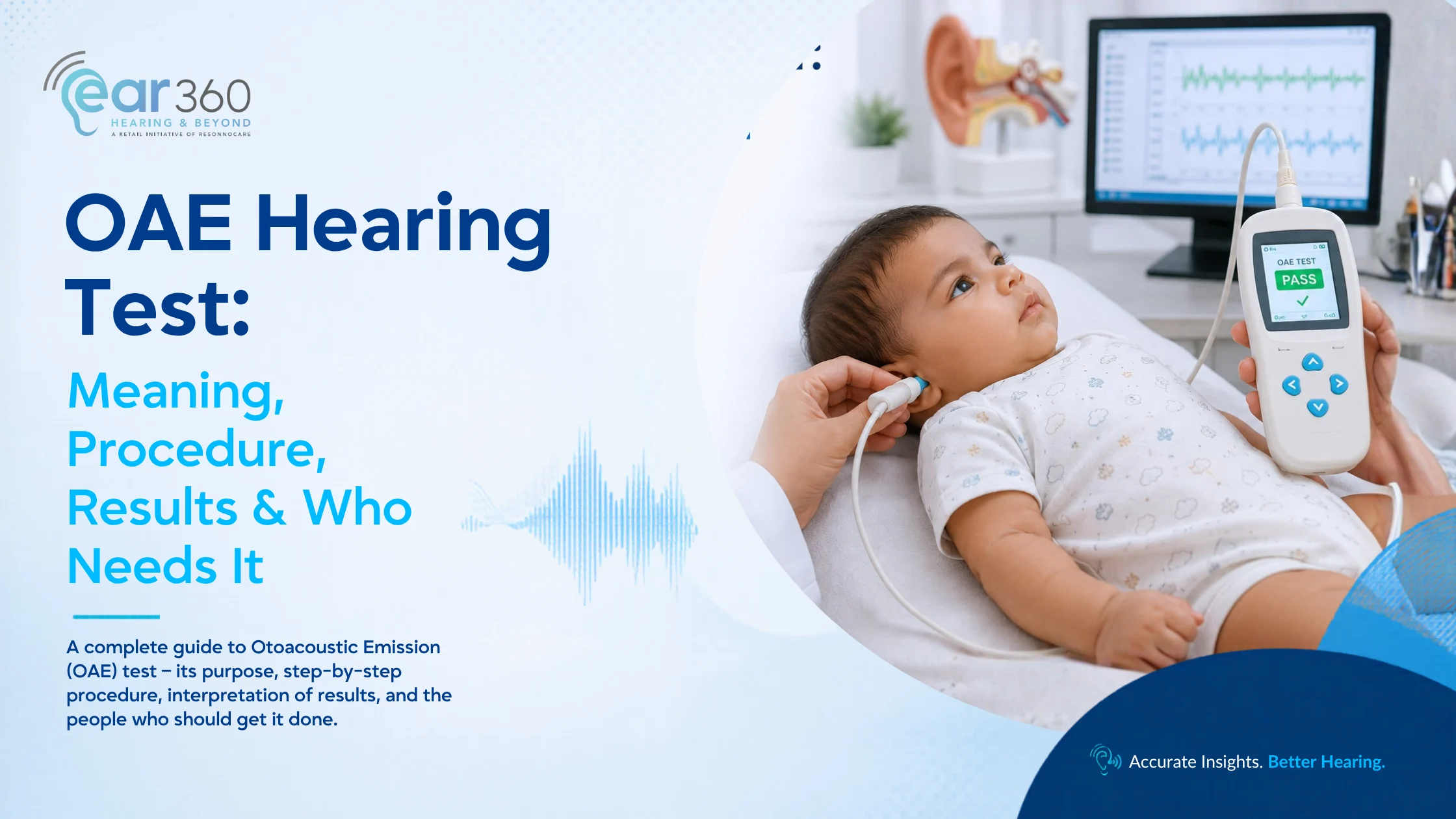
An OAE (Otoacoustic Emissions) hearing test records the inner ear’s response to sound and is commonly used for newborn hearing screening and selected hearing assessments. During the test, a small probe is placed in the ear canal to play sounds and record responses. The result is often reported as pass or refer, and an audiologist can explain whether further hearing assessment is needed.
This article provides general educational information and should not replace an individual hearing assessment, medical diagnosis, or advice from an audiologist, pediatrician, or ENT specialist.
What Is an OAE Hearing Test?
OAE stands for Otoacoustic Emissions.
There are thousands of small sensory cells in the inner ear known as outer hair cells. These cells help the cochlea respond to sound and produce a very soft sound of their own, similar to an echo. These sounds are called otoacoustic emissions.
An OAE hearing test can be used to determine whether these outer hair cells are functioning as expected.
If the outer hair cells are functioning, the testing equipment may record a measurable response. Damage, middle-ear interference, or hearing loss associated with outer hair-cell dysfunction may result in an absent or reduced response.
This makes the OAE hearing test a useful, non-invasive first-line screening tool, particularly for newborns and young children who cannot yet respond reliably during a conventional hearing test.
During the test, a small probe placed in the ear canal presents sounds and measures the faint echo generated by the inner ear. The procedure does not depend on a behavioural response, so a baby can be asleep during the screening.
“OAE testing can identify whether the outer hair cells of the inner ear are responding to sound, making it a widely used first-line screening tool for newborns and young children who cannot actively participate in standard audiometry. A ‘refer’ result does not confirm permanent hearing loss. It means the ear requires further assessment.”
Resonnocare – EAR360 Audiology Clinics
What Does an OAE Test Measure?
An OAE test measures sounds produced by the cochlea after it receives an auditory stimulus. These emissions are generated mainly through the activity of the outer hair cells in the inner ear.
The test can provide information about:
- Whether measurable cochlear responses are present
- Whether outer hair-cell function appears to be working within the tested frequency region
- Whether further hearing assessment may be required
- Whether cochlear function has changed after noise exposure or potentially ototoxic treatment
- Whether an infant or difficult-to-test patient should be referred for diagnostic evaluation
The test is objective because the patient does not have to indicate whether a sound was heard. However, the quality of the result can still be affected by movement, probe position, earwax, middle-ear fluid, and background noise.
What an OAE Test Cannot Tell You
An OAE test does not provide a complete diagnosis of hearing ability on its own. It does not directly measure how clearly a person understands speech or establish a complete behavioural audiogram.
An OAE test may not independently determine:
- The exact degree of hearing loss
- How well speech is understood
- Whether the auditory nerve and brainstem are functioning normally
- Whether a person has an auditory processing disorder
- The exact cause of an absent response
- Whether a hearing aid is required
- How a person functions in everyday listening situations
A patient can have present OAEs and still have a hearing disorder involving the auditory nerve or another part of the hearing pathway. This is why OAE results should be interpreted together with the medical history, ear examination, tympanometry, ABR or BERA, and behavioural hearing tests where appropriate.
Does a “Pass” OAE Result Mean Hearing Is Completely Normal?
No. A pass result means that a measurable otoacoustic emission was recorded in the tested frequency region under the conditions of the test. It is reassuring about cochlear outer hair-cell function, but it does not test every part of hearing.
A child or adult may still need further assessment when:
- There are continuing concerns about hearing or speech understanding
- A child is not responding consistently to sound
- Speech or language development remains delayed
- There is a significant difference between the two ears
- There is persistent tinnitus or another hearing symptom
- There is concern about the auditory nerve or brainstem
- The medical or developmental history suggests additional risk
OAE does not directly measure speech understanding, exact behavioural hearing thresholds, or the complete auditory pathway. A pass should therefore be interpreted together with the reason the test was requested.
What Are the Types of OAE Tests Used in Clinical Practice?
Two main types are used in clinical practice.
Transient Evoked Otoacoustic Emissions
Transient Evoked Otoacoustic Emissions, or TEOAEs, involve using short clicks or tone bursts to produce responses in the inner ear.
This type is commonly used for screening across multiple frequencies in a short period and is often used in newborn hearing-screening programs.
TEOAEs provide a broad assessment of cochlear outer hair-cell responses across a clinically useful frequency range.
Distortion Product Otoacoustic Emissions
During a Distortion Product Otoacoustic Emissions, or DPOAE, test, two tones are presented together and the inner ear produces a measurable distortion-product response.
Specific frequency regions can be assessed using DPOAEs. They are often used with older children and adults, including in clinical monitoring and occupational hearing evaluations.
DPOAEs may also be used to monitor cochlear function in people exposed to loud noise or medicines that may affect hearing.
The most suitable type is chosen by our staff at Resonnocare based on your age, medical history, and the purpose of your referral.
TEOAE vs DPOAE: What Is the Difference?
Feature | TEOAE | DPOAE |
Sound used | Clicks or brief tone bursts | Two continuous tones presented together |
Common use | Newborn and general hearing screening | Frequency-specific cochlear assessment and monitoring |
Frequency information | Broad response across a frequency range | Responses can be examined at selected frequencies |
Test duration | Usually brief | May take longer when several frequencies are assessed |
Patient response needed | No | No |
Result format | Often pass or refer during screening | May show responses across individual frequencies |
Neither test is automatically better in every situation. The audiologist selects the test according to the patient’s age, symptoms, risk factors, and the clinical question that needs to be answered.
OAE vs BERA, Pure-Tone Audiometry, and Tympanometry
Test | What It Primarily Assesses | Does the Patient Need to Respond? | Common Use |
OAE | Outer hair-cell and cochlear response | No | Newborn screening and assessment of cochlear function |
BERA or ABR | Auditory nerve and brainstem response to sound | No | Infants, difficult-to-test patients, and auditory-pathway assessment |
Pure-tone audiometry | Softest sounds heard at different frequencies | Yes | Cooperative older children and adults |
Tympanometry | Eardrum movement and middle-ear function | No behavioural response | Middle-ear fluid, pressure, perforation, and related conditions |
Speech audiometry | Speech detection and word understanding | Yes | Understanding the functional effect of hearing loss |
These tests are complementary rather than interchangeable. For example, an absent OAE may be associated with cochlear hearing loss, earwax, or middle-ear fluid, while an ABR or BERA provides information about the auditory nerve and brainstem.
Who Needs an OAE Hearing Test?
The OAE hearing test can be used with patients of all ages.
It is particularly useful when the individual being assessed cannot perform a standard hearing test requiring a voluntary response.
Newborns and Infants
Many hospitals offer OAE testing as part of their standard newborn hearing-screening practices.
If a baby has hearing loss, it can be identified early, and suitable support can be planned through further assessment, hearing technology, cochlear implant evaluation, and speech and language intervention where required.
Newborn hearing screening is an initial check rather than a complete diagnostic evaluation. Babies who do not pass should receive the recommended follow-up assessment rather than waiting to see whether hearing concerns become noticeable.
Current early-hearing benchmarks recommend screening babies before one month of age, completing diagnostic assessment before three months when a baby does not pass, and beginning intervention as early as possible and no later than six months when hearing loss is confirmed.
Children With Speech or Language Delay
A hearing evaluation is an important initial step for young children with speech or language delays.
An OAE hearing test may be useful for children who are not meeting expected speech milestones, particularly when they cannot reliably complete behavioural hearing testing.
A present OAE response does not rule out every cause of speech delay or every hearing disorder. Additional behavioural, developmental, speech-language, or auditory-pathway assessment may still be required.
Children With Ear Infections or Glue Ear
Repeated middle-ear infections or fluid behind the eardrum can affect how sound travels towards the inner ear.
An OAE test may help assess whether a measurable inner-ear response can be recorded.
However, middle-ear fluid can prevent an OAE response from being recorded even when the cochlear outer hair cells are functioning. Tympanometry is therefore often important when ear infections or glue ear are suspected.
Adults With Sudden or Unexplained Hearing Loss
Any sudden hearing loss should be evaluated promptly.
The OAE hearing test may contribute information about cochlear outer hair-cell function, but it should not be used alone to determine the cause of sudden hearing loss.
Sudden hearing loss, particularly in one ear, is a medical emergency and requires urgent ENT or emergency medical assessment. Do not delay care while arranging only an OAE screening.
People Exposed to Loud Noise
Noise-induced hearing loss can begin with damage to sensory structures in the cochlea.
An OAE hearing test may detect changes in outer hair-cell responses and may be used as one part of monitoring for people who experience repeated occupational or recreational noise exposure.
A normal OAE result does not mean that unlimited noise exposure is safe. Hearing protection, safe listening levels, and periodic hearing assessments remain important.
People With Tinnitus or Ear Pressure
Tinnitus or ear pressure may occur alongside inner-ear or middle-ear conditions.
An OAE test may be included as one part of a broader assessment.
The test does not independently identify the cause of tinnitus, and persistent one-sided tinnitus, pulsatile tinnitus, sudden hearing change, dizziness, pain, or discharge may require ENT evaluation.
People Who Cannot Complete Conventional Testing
OAE testing may also be useful for:
- People with developmental or cognitive conditions
- Patients who cannot follow conventional test instructions
- Patients whose behavioural hearing-test responses are inconsistent
- People who are medically unwell or unable to provide a reliable response
- Patients requiring objective monitoring of cochlear function
- People taking certain medicines that may affect hearing
If you are unsure whether you or your child needs a hearing assessment, our hearing care for all ages service can guide you.
Newborn vs Adult OAE Testing: How Is the Purpose Different?
The same OAE technology can be used at different ages, but the clinical question is not always the same.
Patient | Why OAE may be used | What usually matters next |
Newborn | Early hearing screening when the baby cannot provide a behavioural response | Pass, repeat screening, or diagnostic follow-up according to the result and risk factors |
Infant or young child | Objective information when behavioural testing is difficult or when speech/hearing concerns are present | Interpret with age-appropriate behavioural testing, tympanometry, BERA/ABR, developmental history, or other assessments where required |
Older child | Additional information about cochlear function or monitoring when standard test results need support | Combine with behavioural audiometry and speech-related assessment where appropriate |
Adult | Cochlear assessment, selected monitoring after noise exposure or potentially ototoxic treatment, or part of a broader hearing evaluation | Interpret with symptoms, audiometry, speech testing, tympanometry, and medical assessment when needed |
For adults who can reliably complete pure-tone and speech testing, OAE is usually one part of the assessment rather than a replacement for those tests. For newborns, its ability to work without a behavioural response makes it particularly valuable for screening.
Newborn hearing screening supports early identification of permanent hearing loss. CDC data have reported hearing loss in approximately 1.8 per 1,000 screened infants, although prevalence can vary by population and reporting method.
Who May Not Need an OAE Test as the Only or First Test?
An OAE test may not be the only or most appropriate first assessment for every patient.
A cooperative older child or adult with suspected hearing loss may initially need:
- Pure-tone audiometry
- Speech audiometry
- Tympanometry
- Ear examination
- A complete case history
A patient with visible earwax blockage, active ear discharge, severe pain, bleeding, or a foreign object may first require an ear examination and medical management.
A person with sudden hearing loss, severe dizziness, facial weakness, or neurological symptoms requires urgent medical assessment rather than only an OAE test.
The audiologist should select OAE testing when it addresses a specific clinical question or forms part of an appropriate hearing-test battery.
How Is an OAE Hearing Test Done? Understanding the Procedure
The OAE hearing test is painless, fast, and requires no active patient participation.
It is this characteristic that makes it useful when screening newborns and young children.
Position
The patient is seated or lying still.
For babies, the test is usually performed while they are asleep, settled, or feeding.
Movement, crying, talking, or sucking can create noise that interferes with the recording, so a calm and quiet patient generally produces a more reliable result.
Ear Check
Before placing the probe, the professional may examine the ear canal for earwax, discharge, narrowing, or another obstruction.
Tympanometry may also be recommended when a middle-ear condition is suspected.
Probe Placement
A small, soft probe is gently inserted into the ear canal.
The probe does not penetrate deeply into the ear.
The probe contains a small speaker that presents the test sounds and a sensitive microphone that records the cochlear response.
Sound Delivery
Quiet clicks or tones are sent into the ear.
The sounds are controlled and the patient does not need to respond.
Measurement
The outer hair cells produce a faint response when stimulated by sound, and this response is recorded by the microphone within the probe.
Results
The equipment analyzes the recorded response.
During a screening, the result may be displayed as “pass” or “refer” within a few minutes.
A diagnostic OAE assessment may provide more detailed information about responses at individual frequencies rather than only a pass-or-refer result.
The test is carried out in a quiet clinical setting to support accurate results.
The entire process often takes about 5 to 10 minutes.
It may take longer if both ears need to be retested, the child is unsettled, the probe fit changes, or earwax and background noise affect the recording.
How to Prepare for an OAE Hearing Test
OAE testing usually requires very little preparation. However, the following steps may help produce a clear recording:
- Bring previous hearing-test and newborn-screening reports
- Inform the audiologist about ear infections, discharge, pain, or recent congestion
- Tell the clinician about noise exposure and medicines that may affect hearing
- Avoid inserting cotton buds, oil, or other substances into the ear
- Bring the baby when they are likely to be calm, asleep, or ready to feed
- Carry milk, a bottle, comfort items, diapers, and a change of clothes for an infant
- Keep older children calm and explain that the test will not hurt
- Follow any additional instructions provided by the clinic
Sedation is not normally required for an OAE test because the procedure is brief and can often be completed while a baby is naturally asleep.
Step-by-Step OAE Test Procedure
Step 1: Review of Hearing and Medical History
The audiologist asks about hearing concerns, newborn screening, speech development, ear infections, noise exposure, tinnitus, medicines, and previous hearing-test results.
Step 2: Examination of the Ear Canal
The ear canal may be checked for wax, discharge, or another condition that could affect the probe or the result.
Step 3: Probe Placement
A soft probe is positioned in the ear canal. A suitable seal is required so that sounds and responses can be recorded accurately.
Step 4: Presentation of Test Sounds
Clicks or tones are played through the probe at controlled levels.
Step 5: Recording of the Cochlear Response
A sensitive microphone records the faint otoacoustic emission produced by the inner ear.
Step 6: Testing of the Other Ear
The same procedure is usually repeated for the second ear.
Step 7: Result Review
The equipment analyzes the response, and the audiologist reviews whether the result is reliable and whether further testing is needed.
Step 8: Explanation of the Next Step
The patient or parent is told whether the result is reassuring, needs to be repeated, or requires diagnostic audiological or medical evaluation.
What Do OAE Hearing Test Results Mean?
OAE results are generally presented in two ways during screening.
Pass
An OAE response was recorded.
This indicates that the outer hair cells responded within the tested frequency range and under the conditions of the test.
A “pass” result is reassuring during newborn screening.
However, a pass does not prove that hearing is completely normal at every frequency and does not rule out auditory neuropathy, neural hearing disorders, delayed-onset hearing loss, or difficulties with speech understanding and auditory processing.
Refer
A definite response was not recorded.
The important thing to note is that a “refer” result does not necessarily indicate permanent hearing loss.
It may be influenced by factors such as fluid in the middle ear, background noise, earwax, temporary congestion, movement, or poor probe placement.
A “refer” result means that further evaluation is required.
The word “refer” is preferred to “fail” because the result is not a final diagnosis. It indicates that the patient should be referred for repeat screening or diagnostic assessment.
It should be noted that the OAE hearing test specifically assesses outer hair-cell and cochlear function rather than the entire auditory pathway.
In conditions such as Auditory Neuropathy Spectrum Disorder, OAE results may be present even though the transmission of sound through the auditory nerve is abnormal.
That is why a thorough audiological evaluation may include Auditory Brainstem Response or BERA testing and detailed clinical evaluation.
Pass, Refer, and Absent OAE Results Compared
Result | What It Usually Means | What Happens Next? |
Pass | A measurable cochlear response was recorded in the tested frequency range | Routine monitoring or other testing if concerns continue |
Refer | A reliable response was not recorded during screening | Repeat screening or diagnostic assessment |
Absent response during diagnostic testing | The response may be affected by cochlear dysfunction, middle-ear problems, earwax, or test conditions | Interpret with tympanometry, audiometry, ABR or BERA, and clinical findings |
Present OAEs with abnormal ABR | May suggest a neural hearing disorder such as auditory neuropathy | Detailed pediatric, neurological, ENT, and audiological assessment |
The audiologist should explain the result in the context of the patient’s age, symptoms, medical history, and other test findings.
What Does a “Refer” OAE Result Mean in Practical Terms?
A refer result means that a reliable otoacoustic emission was not recorded during that screening. It does not by itself tell you why the response was absent and does not confirm permanent hearing loss.
The next step depends on the situation:
- The OAE may need to be repeated
- The ear may need to be checked for wax or another obstruction
- Tympanometry may be used when middle-ear fluid or pressure is suspected
- A newborn or difficult-to-test child may require diagnostic BERA/ABR or another age-appropriate hearing assessment
- A cooperative older child or adult may require behavioural audiometry and speech testing
- Medical or ENT evaluation may be required when symptoms or findings are concerning
The key point is to complete the recommended follow-up rather than treating “refer” as either a confirmed diagnosis or something that can safely be ignored.
What Can Affect OAE Test Results?
Several factors can reduce or prevent the recording of an otoacoustic emission even when permanent cochlear hearing loss has not been confirmed.
These include:
- Earwax blocking the probe or ear canal
- Fluid behind the eardrum
- An outer- or middle-ear infection
- Temporary congestion after birth
- A poor probe seal
- Probe movement
- Crying, talking, chewing, or sucking
- Background noise
- Electrical or equipment interference
- A very small or unusually shaped ear canal
- Recent loud-noise exposure
- Outer hair-cell damage
- The frequencies and test criteria selected
An absent response should therefore be interpreted alongside ear examination and middle-ear testing. Middle-ear dysfunction can prevent emissions from being measured because the test sound and the returning cochlear response must pass through the middle ear.
Why Can Earwax or Middle-Ear Fluid Change an OAE Result?
The OAE test sound must travel through the outer and middle ear to reach the cochlea, and the faint response produced by the cochlea must travel back through the same pathway to the probe. A blockage or middle-ear problem can therefore interfere with the recording.
Possible issue | How it may affect the test | Possible next step |
Earwax blocking the canal or probe | The stimulus or returning response may not be recorded reliably | Ear examination and appropriate wax management before repeat testing when needed |
Middle-ear fluid | Sound transmission through the middle ear may be reduced | Tympanometry and clinical review may help assess middle-ear status |
Congestion after birth | Temporary conditions may contribute to a refer result in a newborn | Repeat screening or diagnostic follow-up according to the screening pathway |
Poor probe seal or movement | The equipment may not obtain a reliable response | Reposition the probe and repeat the measurement |
Background noise or crying | Noise can interfere with detection of the faint emission | Retest when the patient and environment are quieter |
This is why an absent OAE should not automatically be interpreted as inner-ear damage. Ear examination, middle-ear assessment, repeat testing, and other hearing tests may be required to understand the result.
What Happens If a Newborn Does Not Pass the OAE Test?
A baby who does not pass the first OAE screening may be screened again or referred for diagnostic assessment, depending on the hospital protocol and the baby’s medical risk factors.
Parents should:
- Book the recommended follow-up appointment promptly
- Take the newborn screening record to the appointment
- Inform the audiologist about premature birth, jaundice, NICU stay, family history, infections, or other risk factors
- Complete diagnostic testing within the advised timeline
- Avoid assuming that the baby cannot hear or that the result is only due to fluid
- Continue monitoring responses to sound and communication development
- Begin intervention promptly if permanent hearing loss is confirmed
The recommended early-hearing timeline is screening by one month, diagnostic evaluation by three months after a non-pass result, and intervention by six months when hearing loss is diagnosed.
A non-pass result is not a diagnosis, but missing follow-up can delay the identification of hearing loss during an important period for speech and language development.
What Test Comes Next After an OAE?
There is no single automatic “next test.” The next assessment depends on the OAE result, the patient’s age, symptoms, ear findings, and the reason for testing.
Situation after OAE | Possible next assessment | Why it may be used |
Newborn receives a refer result | Repeat OAE and/or diagnostic BERA/ABR according to the screening pathway | To determine whether the non-pass persists and assess the auditory pathway more fully |
Wax, pressure, recurrent infection, or suspected middle-ear fluid | Ear examination and tympanometry | To determine whether an outer- or middle-ear problem is affecting the OAE |
Older child or adult can respond reliably | Pure-tone audiometry and speech audiometry | To measure hearing thresholds and functional speech understanding |
OAE is present but a neural hearing disorder is suspected | BERA/ABR and specialist assessment | Because OAE does not assess the auditory nerve and brainstem completely |
OAE is normal but hearing concerns remain | Broader audiological assessment based on the symptoms | A pass does not rule out every hearing disorder |
Sudden hearing loss, severe dizziness, neurological symptoms, bleeding, or severe pain | Urgent medical/ENT assessment | Medical evaluation should not be delayed for routine screening tests |
The most useful question after receiving an OAE result is not simply “Did I pass?” but “Based on this result and my symptoms, what should be tested next?”
Benefits of the OAE Hearing Test
The benefits of OAE testing include:
- It is non-invasive
- It is generally painless
- It can be completed quickly
- No verbal or behavioural response is required
- It can be used while a baby is asleep
- It provides objective information about cochlear outer hair-cell function
- It can be used in newborn hearing screening
- It may help assess difficult-to-test children and adults
- It may support noise- and medicine-related cochlear monitoring
- It can be repeated when clinically required
These benefits make OAE testing useful as part of a wider hearing-assessment pathway, but the test should not be interpreted in isolation.
Limitations and Risks of the OAE Test
The OAE procedure itself has no known serious routine risks. The soft probe may cause brief pressure or mild discomfort if the ear canal is sensitive, but the test does not involve injections, radiation, or electrical stimulation.
Its main limitations are diagnostic rather than physical:
- It does not measure the entire auditory pathway
- It may miss auditory neuropathy
- It does not directly measure speech understanding
- It may not provide exact hearing thresholds
- A result may be affected by earwax or middle-ear fluid
- Noise and movement may cause a false refer result
- A pass may provide false reassurance if other symptoms are ignored
- Further testing may still be needed
Patients should not delay a full hearing assessment because an OAE result was normal when noticeable communication difficulties, one-sided symptoms, or medical warning signs remain.
OAE Result Next-Step Selector
Use the OAE result as one part of the decision rather than the final diagnosis.
What happened | What to do next |
Newborn passes and there are no continuing concerns | Continue routine hearing and developmental monitoring as advised. |
Newborn receives a refer result | Complete the recommended repeat screening or diagnostic assessment promptly. |
Child passes OAE but speech or hearing concerns continue | Do not stop at the pass result; discuss age-appropriate behavioural, developmental, speech-language, or auditory-pathway assessment. |
Adult has an absent OAE with wax or middle-ear symptoms | Discuss ear examination and middle-ear testing before assuming permanent cochlear hearing loss. |
Adult has a normal OAE but still struggles to hear or understand speech | A broader hearing assessment may be needed because OAE does not measure full hearing ability or speech understanding. |
OAE result is unclear because of movement, noise, or poor probe fit | Repeat testing under more reliable conditions may be appropriate. |
Sudden hearing loss or another urgent warning sign is present | Seek urgent medical/ENT evaluation; do not rely on OAE alone. |
If you are unsure which pathway applies, book an appropriate paediatric or hearing assessment and take the OAE report with you so the audiologist can interpret it alongside the clinical history and other findings.
When Should You See an Audiologist About Your Hearing?
Some hearing changes are not immediately noticeable.
If any of the following symptoms are present, it is important to seek a professional hearing evaluation:
- Acute hearing loss, including sudden total or partial hearing loss in one or both ears
- By 12 months, a baby does not startle at loud sounds or respond to their name
- A child has speech delay or unclear pronunciation that is not developmentally appropriate
- Persistent ringing, buzzing, or hissing in the ears
- A sense of obstruction, fullness, or pressure in the ear
- Frequent ear infections, ear discharge, or unexplained ear pain
- Vertigo or dizziness occurring with a change in hearing
- A child stops using words they previously used
- A child responds inconsistently to sound
- A child frequently turns one ear towards the speaker
- Difficulty understanding speech in background noise
- Regular exposure to loud workplace or recreational sound
- A noticeable difference between the two ears
- Reduced hearing after starting a potentially ototoxic medicine
The symptoms should not be self-managed or ignored.
Contact an experienced audiologist or ENT specialist for a comprehensive assessment.
Sudden hearing loss, especially in one ear, requires urgent same-day or next-day medical evaluation. An OAE test may form part of the assessment, but it should not delay ENT care.

Why Choose Resonnocare for Hearing and Audiology Care?
We know how it feels to have a hearing concern for ourselves or a loved one and how worrying it can be.
We strive to make the diagnostic process as smooth, accurate, and supportive as possible.
Clinically Guided Care
All assessments at Resonnocare are conducted by experienced audiologists and clinicians who follow evidence-based procedures.
The audiologist reviews the OAE findings together with the patient’s symptoms, age, ear health, medical history, and results from other hearing tests where required.
Calibrated Diagnostic Equipment
We use calibrated diagnostic equipment to ensure that each OAE hearing test and evaluation is performed under appropriate testing conditions.
Reliable probe placement, a quiet environment, suitable test settings, and professional interpretation are all important for obtaining a meaningful result.
Personalized Care Plans
There is no one-size-fits-all approach to hearing care.
Following your evaluation, our team designs a care strategy tailored to your results, lifestyle, and hearing goals.
The next step may include monitoring, repeat OAE testing, tympanometry, BERA or ABR, behavioural audiometry, ENT referral, hearing aid evaluation, or speech and language support.
Hearing Aids and Devices
Following diagnosis, patients who need amplification can be guided towards modern, clinically appropriate hearing aids that meet different needs and budgets.
A hearing aid is not recommended from an OAE result alone. The recommendation is based on a wider hearing assessment and the patient’s communication requirements.
Flexible Consultation Options
We can provide selected home-visit services when a patient is unable to attend the clinic, and video consultations are available for follow-up support.
Whether an OAE test can be completed during a home visit depends on the availability of suitable equipment, environmental noise, and the patient’s individual needs.
Structured Aftercare
Our services do not end at the clinic door.
We provide structured aftercare and long-term support to assist with ongoing monitoring and management of hearing health.
For patients using hearing aids, aftercare may include fitting reviews, programming adjustments, cleaning guidance, device servicing, and reassessment if hearing changes.
You can explore our full range of hearing and audiology services or learn about our commitment to clinical excellence on our website.
Find a Resonnocare Clinic Near You
Select your city to find the nearest Resonnocare clinic and book an appointment with our hearing care team.
Bangalore
Ear 360, Jayanagar
Ground Floor, Site No. 499, Municipal No. 499/97, East End Main Road, 9th Block, Jayanagar, Bangalore, Karnataka 560041
Timings: 10:00 AM to 7:00 PM
[Call] [Book an Appointment]
Ear 360, Spandana Sarjapura Hospital
239/205/34A, near Trinity Complex, Sompura Gate, Sarjapura Main Road, Bangalore, Karnataka 562125
Timings: 10:00 AM to 7:00 PM
[Call] [Book an Appointment]
Resonnocare, HSR Layout
150/5/72, 7th Cross, 24th Main, HSR Layout, Bangalore, Karnataka 560102
Timings: 10:00 AM to 7:00 PM
[Call] [Book an Appointment]
Resonnocare, Banashankari
272, 7th Cross Road, BSK 1st Stage, 2nd Block, Srinivasan Agra, 80 Feet Road, Bangalore, Karnataka 560050
Timings: 10:00 AM to 7:00 PM
[Call] [Book an Appointment]
Resonnocare, Indiranagar
34, Wind Tunnel Road, Murugeshpalya, Muniyappa Layout, Bangalore, Karnataka 560017
Timings: 10:00 AM to 7:00 PM
[Call] [Book an Appointment]
Delhi
Ear 360, Dr. Hans Anand Lok
46, Anand Lok Road, Anand Lok, Sadiq Nagar, New Delhi, Delhi 110049
Timings: 10:00 AM to 7:00 PM
[Call] [Book an Appointment]
Resonnocare, Dr. Hans Vasant Vihar
28, Basement, Paschimi Nagar, Vasant Vihar, New Delhi, Delhi 110057
Timings: 10:00 AM to 7:00 PM
[Call] [Book an Appointment]
Gurgaon
Resonnocare Head Office, M3M Urbana
Office 403, Office Block, 4th Floor, above Retail Blocks R1 and R5, M3M Urbana, Sector 67, Gurgaon, Haryana 122101
Timings: 10:00 AM to 7:00 PM
[Call] [Book an Appointment]
Resonnocare, Dr. Hans Sector 28
Plot No. 1SP, adjoining DLF Phase 1 Metro Station, Sector 28, Gurgaon, Haryana 122002
Timings: 10:00 AM to 7:00 PM
[Call] [Book an Appointment]
Ludhiana
Ear 360, BRS Nagar
963, Block B, BRS Nagar, Ludhiana, Punjab 141012
Timings: 10:00 AM to 7:00 PM
[Call] [Book an Appointment]
Resonnocare, Fawwara Chowk
565-A and 565-B, Upper Ground Floor, Cemetery Road, near Fawwara Chowk, West City, Ludhiana, Punjab 141001
Pune
Ear 360, Vighnaharta Healthcare Center
D-106-107, Choice Arcade, opposite Ruby Hall Hospital, Dhole Patil Road, Pune, Maharashtra 411001
Timings: 10:00 AM to 7:00 PM
[Call] [Book an Appointment]
Ear 360, Khan Parab ENT Hospital
Plot No. 102, Anand Nagar, Talegaon Dabhade, Taluka Maval, Pune, Maharashtra 410507
Timings: 10:00 AM to 7:00 PM
[Call] [Book an Appointment]
Tumkur
Resonnocare, Ashok Nagar
PID No. 3563, 8th Main, 8th Cross, Ashok Nagar, Tumkur, Karnataka 572103
Timings: 10:00 AM to 7:00 PM
[Call] [Book an Appointment]
Conclusion: The OAE Hearing Test Is a Small Step With a Big Impact
The OAE hearing test is one of today’s most useful hearing tests because it is easy, fast, and non-invasive, yet provides important information about the health of the inner ear.
The OAE hearing test is a valuable tool for supporting long-term hearing health, whether it is used to screen a newborn in the first days of life or to investigate an unexplained hearing change in an adult.
However, OAE is a screening or cochlear-assessment tool rather than a complete measure of the entire hearing system. Results should be interpreted by an audiologist and combined with other tests whenever required.
The earlier hearing issues are detected and addressed, the better the opportunity to provide suitable communication and developmental support.
Do not delay if you have been advised to undergo an OAE hearing test or if you have concerns about your hearing or your child’s hearing and communication development.
A “refer” result should be followed up promptly, while a “pass” result should not prevent further assessment when hearing concerns continue.
Schedule an appropriate hearing assessment to understand the findings clearly and identify the right next step.
FAQ’s
What is a normal OAE level?
Normal Otoacoustic Emissions Test results indicate that the tiny hair cells in the cochlea are responding to sound in the normal manner. The test does not measure a single “normal number” but rather assesses whether there is clear sound output, which typically indicates normal inner ear function and hearing at a healthy level.
How long does OAE take?
An Otoacoustic Emissions Test is a short test (usually only a few minutes per ear). The entire hearing screening can often be completed in 5-15 minutes, depending on the patient’s cooperation and background noise.
What does a failed OAE test mean?
Failure of an Otoacoustic Emissions Test can be due to hearing loss, fluid in the ear, earwax plugging, middle ear problems, or excessive movement/noise during testing. Unfortunately, a bad test doesn’t mean that the hearing loss is permanent, and another hearing check is typically recommended.
Is an OAE test painful?
No, the Otoacoustic Emissions Test is not painful or invasive. A small, soft probe is inserted into the ear canal to play sounds and record the ear’s response, and most babies and adults are comfortable with it.
How much time does an OAE test take?
Most Otoacoustic Emissions Test procedures are performed in approximately 5 – 15 minutes. This may take slightly longer depending on the patient’s age, co-operation, and whether both ears are measured more than once.
Who needs an OAE hearing test?
An OAE, or Otoacoustic Emissions test, may be used for newborns, babies, children, and adults. It is especially useful when a person cannot reliably respond during a conventional hearing test or when the audiologist wants to assess how well the outer hair cells of the inner ear are functioning.
Is OAE used for newborn hearing screening?
Yes. OAE is commonly used as part of newborn hearing screening because it is quick, objective, and does not require the baby to respond to sounds. A small probe is placed gently in the ear canal to measure the inner ear’s response to sound.
What does “pass” mean on an OAE test?
A “pass” generally means that measurable otoacoustic emissions were detected in the tested frequencies, suggesting that the outer hair cells of the cochlea are functioning as expected. However, OAE alone does not assess every part of the hearing pathway.
What does “refer” mean?
A “refer” result means that a clear response was not recorded and further assessment may be needed. It does not automatically mean that hearing loss is present. Temporary factors such as fluid, earwax, movement, background noise, or debris in a newborn’s ear canal can affect the result.
Does a failed OAE mean my baby has hearing loss?
No. A baby who receives a “refer” or does not pass the OAE screening does not necessarily have hearing loss. The test usually needs to be repeated or followed by another hearing assessment before any diagnosis is made.
What test may be needed after an abnormal OAE result?
Depending on the situation, the audiologist may repeat the OAE or recommend tests such as BERA/ABR, tympanometry, or age-appropriate behavioural hearing testing. BERA is particularly useful when more information is needed about how sound travels through the auditory nerve and brainstem.
What is the difference between OAE and BERA?
OAE primarily measures the response of the outer hair cells in the cochlea, while BERA measures electrical responses along the auditory nerve and brainstem. Both are objective tests that do not require the patient to respond, but they examine different parts of the hearing system. In some cases, they are used together to provide a more complete assessment.