Month: June 2026

Hearing Aid Center Near Me Checklist Before Booking an Appointment
July 19, 2026 Comments (0)

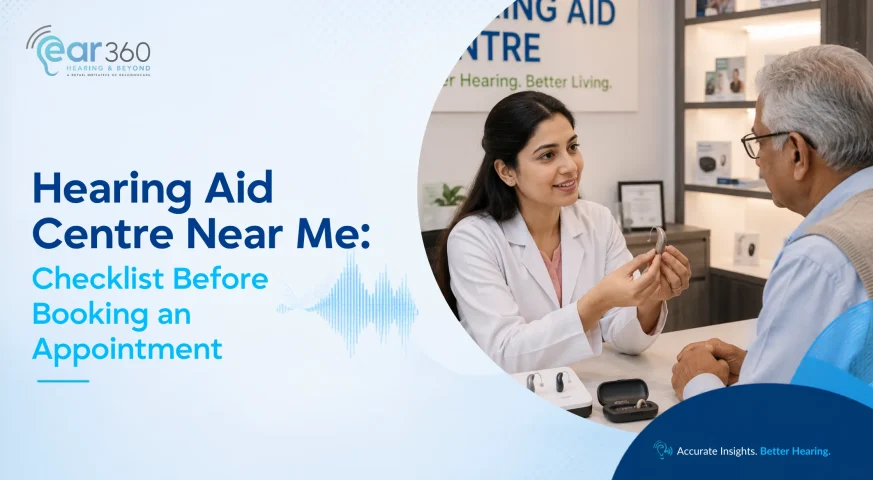
Hearing Aid Center Near Me: Checklist Before Booking an Appointment

TL: DR; This blog is written for people searching for a “hearing aid center near me,” especially patients, elderly individuals, caregivers, and families who want to choose a trustworthy hearing aid clinic before booking an appointment. Choose a center with qualified audiologists: “An Audiologist is a formally trained professional who specializes in the evaluation, diagnosis, and management of hearing and balance problems”.The blog advises the readers that Hearing aids are medical devices, so patients should ensure that their hearing tests, diagnoses, fittings, and follow-up care are handled by trained audiologists, not just sales staff or hearing aid dispensers. A proper hearing assessment is essential before buying a hearing aid: The blog advises readers that a reliable hearing aid center should conduct a complete Audiological evaluation, including tests such as pure-tone audiometry, speech audiometry, and tympanometry where needed, before recommending any device. Why Can’t I Just Buy a Hearing Aid Online: The blog suggests that not all hearing loss is the same. Two people may have hearing loss. One may struggle with soft sounds, and another may struggle only in noisy environments. Both require different hearing aid settings. A professionally fitted hearing aid is customized to your hearing test results, making it more comfortable and effective. Patients should check for trial options, transparent pricing, and device variety: The blog advises readers to look for centers that offer hearing aid trials, multiple brands and price ranges, clear cost breakdowns, warranties, and explanations for why a specific device suits their hearing needs. Aftercare and accessibility matter as much as the device itself: The blog highlights the importance of follow-up visits, device adjustments, servicing, cleaning, home visits, video consultations, and care for patients of all ages, positioning Resonnocare as a patient-focused hearing care provider. What Is a Hearing Aid Center? A hearing aid center is a clinic or hearing-care facility where hearing difficulties are assessed and suitable hearing solutions are recommended. A comprehensive center may provide hearing tests, audiologist consultations, hearing aid trials, device fitting, programming, counseling, repairs, and long-term aftercare. A hearing aid center should not function only as a retail shop. Its role is to understand the type and degree of hearing loss, identify situations that may require an ENT referral, and help the patient choose an appropriate next step. When looking for a “hearing aid center near me,” it can be easy to get confused about which center to select, since it is the first step towards improving your hearing. People may receive hearing care through hospital audiology departments, stand-alone audiology clinics, retail stores, or online providers, but the quality of care varies. Choosing the wrong center could lead to rushed consultations, incomplete hearing evaluations, unsuitable recommendations, and wasted money. In some centers, a hearing aid may be promoted before the patient’s hearing level and communication difficulties have been properly assessed. A quality hearing aid clinic begins with a comprehensive hearing test, asks about your lifestyle and communication needs, and presents you with a personalized care plan. It shouldn’t be only about a device being sold. This checklist will help you compare your options, ask the right questions, and choose a hearing aid center you can trust. This article is intended for general education and should not replace an individual hearing assessment, ENT consultation, or medical diagnosis. Who Should Book an Appointment at a Hearing Aid Clinic Near Me? Consider booking a hearing assessment if you or a family member: Frequently asks people to repeat themselves Turns the television or phone volume higher than others prefer Finds conversation difficult in restaurants, meetings, or crowded places Feels that people are mumbling Has trouble hearing telephone calls, doorbells, or announcements Experiences listening fatigue after conversations Has tinnitus or ringing or buzzing in the ears Already uses hearing aids but finds the sound unclear or uncomfortable Needs a hearing aid trial, fitting, repair, or programming adjustment Has been advised by an ENT or another healthcare professional to undergo a hearing test Children should receive age-appropriate assessment rather than being fitted through a general retail process. Adults with sudden, rapidly worsening, one-sided, or medically concerning symptoms should seek urgent clinical evaluation rather than waiting for a routine hearing aid appointment. Common Signs That a Hearing Assessment May Be Needed Hearing loss is not always experienced as a complete inability to hear. Many people hear sounds but struggle to understand speech clearly, particularly when background noise is present. Common signs include: Difficulty following group conversations Missing parts of words or sentences Trouble hearing higher-pitched voices Needing subtitles even when the television is audible Avoiding social situations because listening feels tiring Responding incorrectly because part of a question was missed Feeling that one ear hears better than the other Depending on lip-reading or facial cues Difficulty hearing while driving or speaking on the telephone Family members noticing the difficulty before the individual does These signs do not confirm that a hearing aid is required. They indicate that an appropriate hearing assessment may help determine the cause, type, and degree of the difficulty. Good Hearing Center vs Poor Hearing Center Good Hearing Center Poor Hearing Center Performs detailed hearing tests Recommends devices immediately Qualified audiologists Sales-focused staff Offers hearing aid trials No trial option Transparent pricing Hidden charges Provides follow-up care Limited support after a purchase Multiple device options Pushes one product Explains the hearing test results Uses technical terms without clear explanation Checks comfort and sound quality after fitting Ends support once the device is sold Refers medically concerning symptoms to an ENT Ignores warning signs and proceeds with a sale Provides written warranty and aftercare information Makes verbal promises without clear documentation Can I Buy a Hearing Aid Online Without Visiting a Clinic? Buying a hearing aid online may appear convenient, but it does not replace a diagnostic hearing assessment. An online device may not account for the type of hearing loss, differences between the ears, speech-understanding ability, ear-health concerns, physical fit, or the listening environments in which the patient needs support. Online or self-selected

Read More
Blog image 3
July 19, 2026 Comments (0)

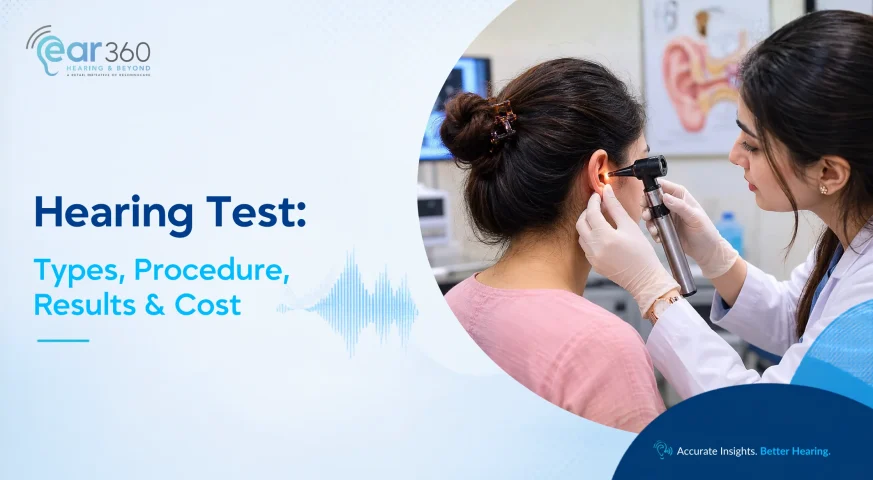
Hearing Test: Types, Procedure, Results, and Cost

TL: DR; Hearing tests: They check how well you hear different sounds, pitches, and volumes. Different tests check different needs: PTA, speech audiometry, tympanometry, OAE, and ABR assess different parts of hearing. The procedure is simple: Most hearing tests are painless, non-invasive, and guided by an audiologist. Results are clearly shown: Audiograms help classify hearing loss as normal, mild, moderate, severe, or profound. Costs vary by test type: Hearing test cost in India depends on the assessment needed and the clinic location. Get checked at Ear360 clinics: Visit Ear360 clinics for guided testing, clear results, and personalized hearing care. In most cases, people only call in for a hearing test when hearing issues have become a problem. But most often, hearing loss is a gradual process. It may become difficult to hear people when they are talking; you may find yourself repeating what you hear, turning the TV up to a higher volume, or becoming more fatigued after longer listening sessions. These signs may occur gradually, and some individuals adapt without noticing any changes in their hearing. A hearing test can eliminate the uncertainty. It is a non-invasive, easy-to-use method to determine the degree of hearing loss and its type, if any, and determine if any further intervention is required. We at ResonnoCare offer correct and clinically relevant hearing testing for all ages. Whether it’s a routine checkup or your child’s hearing problem, age-related or new symptoms, this guide will help you prepare for your initial appointment. What Is a Hearing Test? A hearing test measures the ability to hear various sounds, including loudness and pitch. It is performed by a trained audiologist and typically lasts about 30 to 60 minutes, depending on the tests required. This is not simply to determine if there is a hearing loss. An appropriate hearing test can also indicate if you have a hearing loss, the nature of the hearing loss, the affected ear(s), and what may be causing it. Your audiologist uses this information as a guide to the next steps. This can be hearing monitoring, additional medical testing, hearing aids, or other hearing support, depending on your results. Hearing tests are appropriate for everyone, from newborns to older adults. Our hearing care for all ages service at Resonnocare is built around exactly this understanding. What Are the Different Types of Hearing Tests? There is no one test that fits all. An effective audiological assessment is a sequence of assessments, each addressing a different aspect. The most common hearing test performed in clinics is known as Pure Tone Audiometry (PTA). Sounds can be heard at different pitch and volume levels through headphones, and the event of the sound can be perceived. These will be reported on an audiogram, which will show your speech range and hearing thresholds. Speech Audiometry: This test assesses not only tones but also speech. Words or phrases repeated are uttered at varying volumes. This is particularly beneficial for appreciating the effects of hearing loss on communication in everyday life. Tympanometry: This test determines the health and mobility of your eardrum and middle ear. The air pressure is slowly changed as a small probe is inserted into the ear canal. It is not a hearing test but a method of detecting underlying conditions such as fluid behind the eardrum, a perforated eardrum, or Eustachian tube problems. Otoacoustic Emissions (OAE): OAE tests measure the sounds produced by the inner ear (cochlea) when a sound is played in the ear. It lends itself especially well to newborn hearing screening and can be applied to persons who are unable to communicate verbally. Auditory Brainstem Response (ABR): A test used to evaluate the response of the auditory nerve and brainstem to sound. Electrodes are put on the scalp, and reactions are measured. May be done if an additional auditory pathway assessment is required or if standard tests are not possible. How Is a Hearing Test Performed? A Step-by-Step Overview Patients will feel more comfortable and know what to expect before their appointment. The following is a typical hearing test routine for an adult performed in a clinic such as Resonnocare: Step 1: Case History. Your audiologist will begin by discussing your symptoms, medical history, noise exposure history, and family history of hearing problems. This context should help to guide the testing approach. Step 2: Otoscopy. Your audiologist will use an otoscope to examine your ears prior to any electronic testing. This eliminates earwax plugging, infections, or structural problems that could impact the results. Step 3: Pure Tone Testing, you will be seated in a soundproof booth or quiet room with headphones. Various tones will be sounded, each rising or falling in pitch and volume, one ear at a time. On each occurrence of sound, whether weak or strong, you press a button or raise your hand. Bone Conduction Testing (Step 4). A bone conduction vibrator behind the ear and mastoid bone vibrates directly into the inner ear, bypassing the outer and middle ears. This helps differentiate between sensorineural and conductive hearing loss. Step 5: Speech Testing. Your audiologist will then have you say words at various levels to assess speech recognition. Step 6: Tympanometry. A probe is inserted into your ear canal. This only takes a minute and assesses the function of the middle ear. Step 7: Results and Counseling. After your tests, your audiologist will review your results and discuss the findings with you, including any further steps (if any) that are advisable. How Do You Read Hearing Test Results? The results are displayed on an audiogram, which is a chart that shows how well you hear sounds at various frequencies. On the X-axis, from left to right, are different frequencies (pitch), from low (250 Hz) to high (8000 Hz). Loudness is on the vertical axis from very soft at the top to very loud at the bottom. Normal hearing is defined as 0-15 dB. If the numbers are lower, it means that you need sounds to be louder to hear them,

Read More
Hearing Aid Trial What to Expect Before Buying Hearing Aids
July 19, 2026 Comments (0)

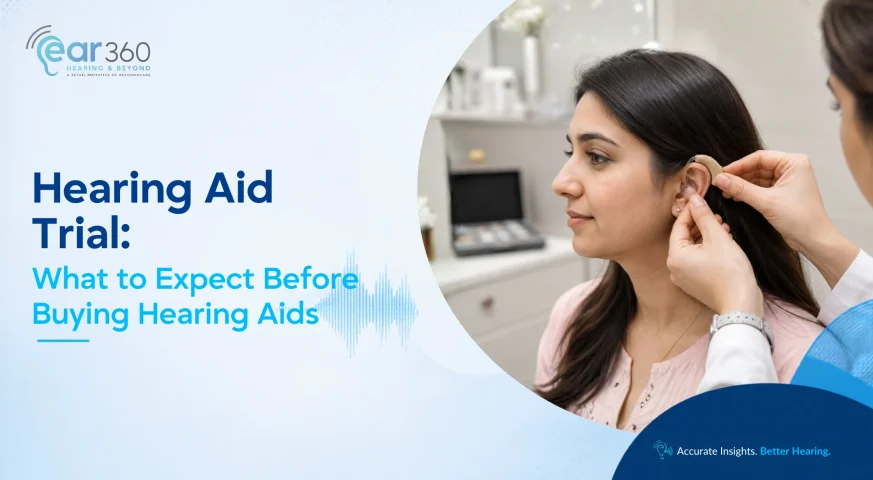
Hearing Aid Trial: What to Expect Before Buying Hearing Aids

TL: DR; A hearing aid trial reduces doubt: It helps you try hearing aids before making a purchase decision. You test them in real life: Use them at home, work, outdoors, and in conversations to judge performance. The process is audiologist-guided: It includes hearing assessment, device selection, fitting, usage support, and adjustments. Comfort and clarity matter: Notice speech clarity, background noise handling, ease of use, and overall comfort. Feedback helps fine-tune fit: Share issues like whistling, unclear sound, or unnatural voice quality with your audiologist. Get a free trial at Ear360 clinics: Visit Ear360 clinics for hearing aid trials, expert guidance, and personalized hearing care. The decision of which hearing aid to select can be daunting. Not only is it a medical choice, it is also a personal and financial choice. This is often a point people arrive at after months or years of having to ask others to repeat themselves, or of avoiding large crowds and places with a lot of noise, or of feeling left out of conversations that once came easily. When there are many hearing aid manufacturers and models available, it’s natural to ask yourself which hearing aid will work best for your lifestyle, hearing needs, comfort, and budget. No one wants to buy a hearing aid and discover that it doesn’t fit within their daily routine. You can make that decision with confidence after undergoing a hearing aid trial. Don’t just read about or be told what the device does, test it out in the real world: at home, at work, during discussions, and in the places where you need to hear it the most. At ResonnoCare, we offer a free hearing aid trial so you can experience the difference before committing. This guide explains how the trial works, what to expect, and how it can help you choose the right hearing aid for your hearing health. What Is a Hearing Aid Trial? A hearing aid trial is a structured period during which patients can try a hearing aid selected for their individual hearing profile before making a purchase. It is not just a quick demonstration or a listen-in. A well-designed trial, which typically runs for 3-5 days, takes place in real-world environments that matter to you, such as your home, workplace, family gatherings, and noisy public places. The goal of a hearing aid trial is to ask a practical question: Will this hearing aid make a difference in my life, in my hearing, and in my communication? That is something that can’t be recreated in a showroom. It’s only through experience with a hearing aid in various listening contexts that you’ll get the proof you need. A trial also gives your audiologist time to fine-tune device settings based on your feedback, and the experience you have during the trial accurately reflects what the device can do once it’s fitted to you. Who Should Consider a Hearing Aid Trial? If a hearing assessment has confirmed mild-to-profound hearing loss and an audiologist has recommended amplification, a hearing aid trial is the next logical step before purchasing a device. A trial might be helpful if you: You’ve been diagnosed with hearing loss and are not sure if you are ready for a hearing aid. You have used hearing aids before but want to try a newer model or a different style. You want an elderly parent or family member to experience the benefits of hearing aids firsthand. You are unsure about the cost and want to understand the value before making an investment. You have previously used a hearing aid for a short time but found it uncomfortable or unhelpful. A trial eliminates the uncertainty. Instead of thinking, “It might help,” you can confidently say, “Yes, this works for me,” or “Let’s try something different.” Our hearing care for all ages service means that whether you are arranging a trial for a young adult with hearing loss or an elderly parent who has been resisting hearing aids for years, we have the experience to guide the process thoughtfully. What Happens During a Hearing Aid Trial?  Knowing what to expect allows you to get the most out of the adventure. Step 1: Hearing Assessment: A complete hearing test is performed before a particular hearing device is chosen. The frequencies and volume levels that need amplification will depend on your audiogram. Choosing a hearing aid without this test would be like prescribing glasses without checking vision. At Resonnocare, each hearing aid trial starts with a clinically accurate assessment. Step 2: Device Selection and Fitting: Your audiologist will choose the appropriate hearing aid model(s) for you based on your audiogram, hearing needs, lifestyle, and preferences. This device can then be tailored to your hearing levels. It is important to check the fit carefully because even a technically good hearing aid may not feel comfortable or perform well if it does not fit properly. Step 3: Orientation and Education: Before you leave with the device, your audiologist will show you how to insert and remove it, use the controls, clean and care for it, and replace the batteries or charge it, if applicable. Before the trial, you should feel comfortable using the device. Step 4: “Living With It”: This is the most crucial step. Use the hearing aid in different environments: at home, during family conversations, in busy markets, while watching TV, on phone calls, and outdoors. Pay attention to which is easier and which is still difficult. Numerous audiologists offer a basic feedback diary for making observations. Step 5: Follow-Up Adjustment: After about the middle or end of the trial, you go back to the clinic to give feedback about your experience. This feedback allows your audiologist to make adjustments to the device’s programming. Some people need only minor adjustments, while others may feel comfortable with the first fitting itself. In either case, it is critical to know what needs to be done in the follow-up. Step 6: Decision & Next Steps: You and your audiologist review your hearing

Read More

Resonnocare Health-Tech Private Limited Provides hearing and audiology services through a structured, clinically guided approach.

Popular Clinic Locations:

Delhi | Bangalore | Pune | Ludhiana

contact info

RESONNOCARE HEALTH-TECH PVT. LTD

Head Office 403, Office Block ‘C’

4th Floor – Above Retail Block R1 & R5,

M3M URBANA, Sector 67, Gurgaon 122101 Haryana

2026, All rights reserved by Resonnocare  health-tech private limited